
四环医药

Search documents
四环医药(00460) - 截至二零二五年十一月三十日止之股份发行人的证券变动月报表
2025-12-01 08:02
股份發行人及根據《上市規則》第十九B章上市的香港預託證券發行人的證券變動月報表 截至月份: 2025年11月30日 狀態: 新提交 I. 法定/註冊股本變動 | 1. 股份分類 | 普通股 | 股份類別 | 不適用 | | | 於香港聯交所上市 (註1) | | 是 | | | --- | --- | --- | --- | --- | --- | --- | --- | --- | --- | | 證券代號 (如上市) | 00460 | 說明 | 普通股 | | | | | | | | | | 法定/註冊股份數目 | | | 面值 | | | 法定/註冊股本 | | | 上月底結存 | | | 100,000,000,000 | HKD | | 0.01 | HKD | | 1,000,000,000 | | 增加 / 減少 (-) | | | | | | | HKD | | | | 本月底結存 | | | 100,000,000,000 | HKD | | 0.01 | HKD | | 1,000,000,000 | 本月底法定/註冊股本總額: HKD 1,000,000,000 FF301 第 1 頁 ...
耐用消费产业行业研究:消费品供需适配性方案提供消费板块切换与成长方向
SINOLINK SECURITIES· 2025-11-30 11:32
Consumer Macro Strategy - The overall performance of the discretionary consumption sector is flat as the year-end approaches, but high-end consumption, including duty-free shopping in islands, is expected to gradually stabilize overall consumption [2][10] - The implementation plan released on November 26 aims to enhance the adaptability of supply and demand for consumer goods, with a goal to optimize the supply structure by 2027, creating three trillion-yuan consumption fields and ten hundred-billion-yuan consumption hotspots [2][10] - By 2030, a high-quality development pattern of mutual promotion between supply and consumption is expected to be established, with consumption steadily contributing to economic growth [2][10] New Consumption Manufacturing - The pet economy continues to thrive, with companies like Guobao Pet investing in high-end pet food factories in New Zealand, enhancing competitiveness in international markets [23][24] - The AI and 3D printing sector is rapidly evolving, with significant advancements expected in consumer-grade 3D printing by 2026, driven by companies like Huina Technology and Snapmaker [25][26] - The integration of AI with 3D printing is being promoted in educational settings, expanding the supply space for the industry [25] Light Industry Manufacturing - The home appliance sector is facing weak domestic demand, but there are opportunities for companies with overseas production capabilities and brand advantages as demand recovers [26][27] - The new tobacco sector is experiencing growth, particularly in e-cigarette exports to the U.S., which saw a significant increase in October [27][28] - The packaging industry is showing signs of profitability improvement despite a slight decline in revenue, driven by leading companies capturing market share from smaller firms [28] Textile and Apparel - The apparel sector is experiencing fluctuations in consumer demand, with a focus on companies that can demonstrate unique advantages in the market [30][31] - The export market remains under pressure due to trade tensions, but leading textile manufacturers are expected to present investment opportunities as they maintain strong positions in the industry [31] Beauty and Personal Care - The beauty sector shows positive fundamentals, with a 9.6% year-on-year increase in retail sales for cosmetics in October, although valuations have been affected by the new consumption sector [32][33] - The medical beauty segment is expanding, with new products gaining regulatory approval, indicating growth potential in the market [33] Home Appliances - Focus on two directions: resilient white goods leaders with strong cash flow and black goods leaders benefiting from optimized domestic sales and stable costs [34][35] - The white goods sector is facing pressure in domestic sales, while black goods are seeing improvements in average prices and export recovery [36][37]
万元童颜针价格被打至4999元,医美巨头遭上游厂商拉黑
2 1 Shi Ji Jing Ji Bao Dao· 2025-11-28 06:31
Core Viewpoint - The ongoing conflict between upstream manufacturers and downstream medical beauty institutions highlights issues of product authorization and market competition in the rapidly expanding medical beauty industry in China [2][5][12]. Group 1: Conflict Overview - Puli Yan accused several medical institutions, including Anhui Hefei Hanmei Plastic Surgery Hospital and Xinyang Youth Clinic, of being "unauthorized cooperation institutions," warning of potential health risks for consumers due to unverified product sourcing [1][2]. - Xinyang responded by asserting that all Puli Yan products used are sourced from legally qualified suppliers and emphasized compliance with ISO 37301 management standards [1][2]. Group 2: Market Dynamics - The medical beauty market, particularly the "童颜针" (youthful needle) segment, has seen rapid growth, with market size increasing from over 1 billion yuan in 2021 to an estimated 30 billion yuan last year, projected to reach 100 billion yuan in five years [5][6]. - Xinyang's introduction of lower-priced products, such as the "奇迹童颜" series, has disrupted the pricing structure established by upstream manufacturers, leading to tensions and demands for product removal from the market [5][6]. Group 3: Compliance and Regulation - Concerns have been raised regarding Xinyang's compliance with regulations, as some manufacturers claim that Xinyang has used products without proper authorization, potentially jeopardizing consumer safety [8][9]. - Legal experts emphasize that medical institutions must procure products from authorized sources to ensure traceability and compliance with regulations, highlighting the risks associated with unauthorized procurement [9][12]. Group 4: Industry Challenges - The medical beauty industry faces significant challenges, including the prevalence of unauthorized sales and counterfeit products, which threaten consumer safety and complicate regulatory enforcement [12][13]. - The need for a collaborative approach among manufacturers, medical institutions, and regulatory bodies is critical to establish a sustainable and compliant industry ecosystem [14].


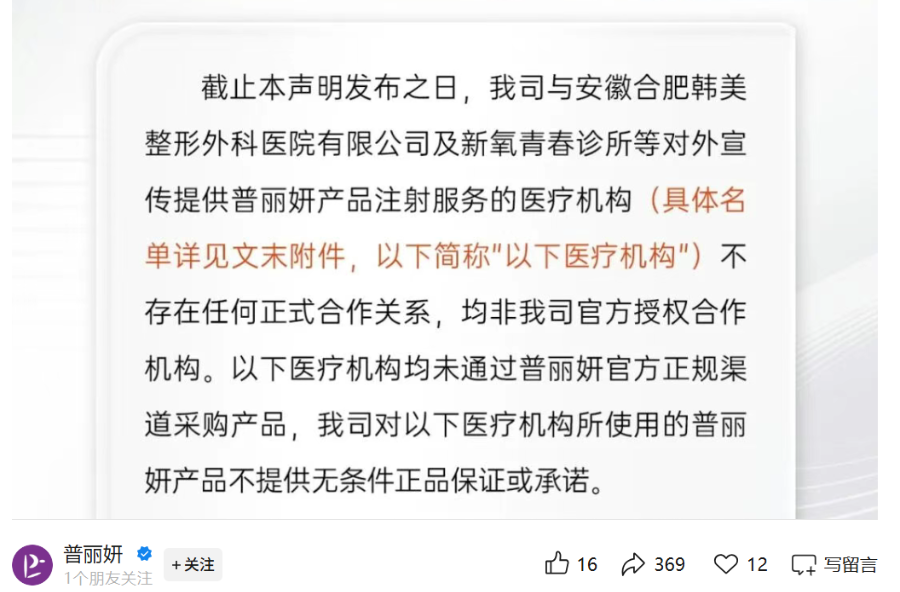
普丽妍“拉黑”新氧 新氧反告“造谣”:谁在破坏医美规则?
2 1 Shi Ji Jing Ji Bao Dao· 2025-11-28 06:22
Core Viewpoint - The medical beauty industry is experiencing a tug-of-war between upstream manufacturers and terminal institutions regarding product authorization and pricing, highlighting the need for regulatory compliance and market order [1][2]. Group 1: Industry Dynamics - The conflict centers around product authorization and compliance channels, reflecting a struggle for pricing power between upstream manufacturers and terminal medical beauty institutions [2]. - The medical beauty market in China is expanding, with unauthorized sales of related products becoming increasingly common, indicating a shift from "wild growth" to "regulated development" in the industry [2]. Group 2: Pricing Strategies - The market for "童颜针" (youthful beauty injections) has seen rapid growth, with its market size exceeding 30 billion yuan last year and projected to reach 100 billion yuan in five years [4]. - New Oxygen's introduction of low-priced "童颜针" projects has disrupted the pricing structure of upstream manufacturers, with prices significantly lower than official guidance [5]. - New Oxygen's pricing strategy aims to make medical beauty services more affordable, addressing the issue of consumers turning to unregulated "black medical beauty" services due to high prices [6]. Group 3: Compliance and Regulation - Concerns have been raised regarding New Oxygen's compliance, as it has been accused of using products without proper authorization, which could jeopardize consumer safety [7][8]. - Legal experts emphasize that medical institutions must procure medical devices from authorized sources to ensure traceability and compliance with regulations [8]. - The ongoing issues of counterfeit products and unauthorized sales highlight the urgent need for effective governance in the medical beauty industry [10][11]. Group 4: Consumer Protection - Consumers are advised to verify product authenticity through official channels and request proper documentation from medical institutions to safeguard their rights [12]. - The responsibility for ensuring compliance should not solely rest on consumers; a collaborative effort among manufacturers, institutions, and regulatory bodies is essential for sustainable development in the medical beauty sector [13].
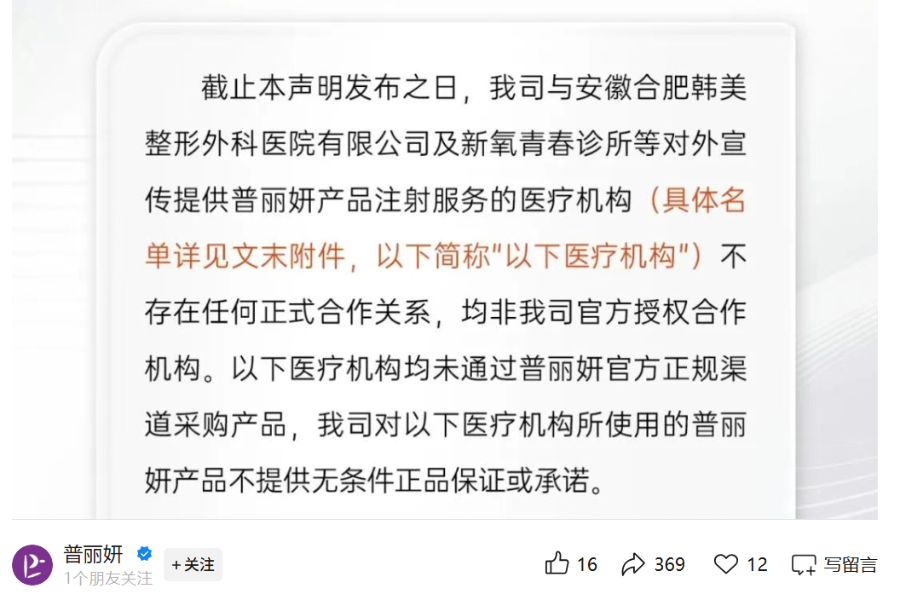
万元童颜针价格被打至4999元,医美巨头遭上游厂商拉黑
21世纪经济报道· 2025-11-28 06:18
Core Viewpoint - The ongoing conflict between upstream manufacturers and downstream medical beauty institutions highlights the challenges in product authorization and market pricing within the medical aesthetics industry, indicating a shift from "wild growth" to "regulated development" in China’s medical beauty market [4][5]. Group 1: Industry Dynamics - The medical beauty industry is experiencing a tug-of-war over product pricing and authorization, with companies like Purity and New Oxygen at the forefront of this conflict [4][5]. - New Oxygen's low pricing strategies for products like "Miracle Youth 3.0" have disrupted traditional pricing structures, leading to tensions with upstream manufacturers [8][9]. - The market for youth-enhancing products, such as the "童颜针" (youth needle), has seen rapid growth, with estimates suggesting it will reach a scale of 100 billion in five years, up from over 30 billion last year [7]. Group 2: Compliance and Regulation - There are significant compliance concerns regarding the sourcing of medical products, with allegations that New Oxygen has used products without proper authorization, raising questions about product safety and traceability [11][12]. - Legal experts emphasize the importance of purchasing medical devices from authorized sources to ensure compliance with regulations, highlighting the potential penalties for non-compliance [12]. - The medical beauty industry faces challenges with counterfeit products and unauthorized sales, necessitating stronger regulatory measures and consumer awareness [15][16]. Group 3: Consumer Safety and Market Integrity - The prevalence of unauthorized medical beauty institutions and counterfeit products poses a significant risk to consumer safety, with only 35% of products in circulation being genuine [9][15]. - Industry leaders argue that lowering prices for legitimate medical beauty services is essential to combat the prevalence of "black medical beauty" practices, which thrive on high prices in the legitimate market [9][10]. - There is a call for a collaborative approach among manufacturers, medical institutions, and regulatory bodies to ensure consumer rights and product quality are prioritized in the evolving medical beauty landscape [17].

拟分拆上市 德镁医药面临三大挑战
Xin Lang Cai Jing· 2025-11-25 20:05
Core Viewpoint - 康哲药业's subsidiary, 德镁医药, has submitted a listing application to the Hong Kong Stock Exchange, aiming for a spin-off listing without financing, reflecting a trend of pharmaceutical companies pursuing independent growth [1][6] Company Overview - 德镁医药, established in 2020, has been operating as an independent unit since 2021, focusing on skin health and ranking first among Chinese innovative pharmaceutical companies in skin prescription drug revenue in 2024 [2] - The skin disease treatment and care market in China is projected to reach a scale of 899 billion yuan in 2024, with a compound annual growth rate of 10.4% from 2024 to 2035 [2] Financial Performance - 德镁医药's revenue from 2022 to the first half of 2025 is reported as follows: 384 million yuan, 473 million yuan, 618 million yuan, and 498 million yuan, respectively, while the company has not yet achieved profitability, with net losses of 55.17 million yuan, 4.70 million yuan, 106 million yuan, and 31.08 million yuan during the same period [2][5] - The revenue structure is primarily composed of skin prescription drugs and dermatological skincare products, with prescription drugs accounting for nearly 90% of total revenue [2] Product Portfolio - The main products include益路取 (替瑞奇珠单抗注射液), 喜辽妥 (多磺酸粘多糖乳膏), and 安束喜 (聚多卡醇注射液), along with four candidates in clinical stages, targeting diseases like psoriasis and vitiligo [3] - The candidate product, 芦可替尼乳膏, is expected to be a new growth point, with its new drug application accepted by the National Medical Products Administration in September 2024 [3] Challenges Ahead - 德镁医药 faces challenges in original research capabilities, as its main products are primarily licensed or acquired, necessitating upfront licensing fees [4] - The company has incurred high sales and marketing expenses, attributing its losses to costs associated with promoting newly acquired or launched products [4][5] - The transition to an independent entity requires enhancing operational capabilities, as evidenced by the significant reduction in procurement from 康哲药业 over the years [5] Industry Context - The trend of pharmaceutical companies pursuing spin-off listings is gaining momentum, with several companies, including 三生制药 and 复星医药, also planning similar moves [6] - The rationale for these spin-offs includes expanding financing channels, accelerating internationalization, and enabling strategic transformation [6]
智通港股通资金流向统计(T+2)|11月25日
智通财经网· 2025-11-24 23:32
Core Insights - The article highlights the net inflow and outflow of funds in the Hong Kong stock market, with specific focus on the top performers and laggards in terms of capital movement [1][2][3] Fund Inflows - The top three stocks with the highest net inflow are: - 盈富基金 (02800) with a net inflow of 74.33 billion, representing a 24.09% increase in capital [2] - 恒生中国企业 (02828) with a net inflow of 19.17 billion, showing a 29.84% increase [2] - 南方恒生科技 (03033) with a net inflow of 14.88 billion, reflecting a 14.32% increase [2] Fund Outflows - The top three stocks with the highest net outflow are: - 小米集团-W (01810) with a net outflow of -6.11 billion, indicating a -4.66% decrease [2] - 泡泡玛特 (09992) with a net outflow of -2.74 billion, showing an -8.07% decrease [2] - 兖矿能源 (01171) with a net outflow of -1.84 billion, reflecting a -43.34% decrease [2] Net Inflow Ratios - The stocks with the highest net inflow ratios are: - 南方港美科技 (03442) at 75.22% with a net inflow of 711.95 million [2] - 工银南方中国 (03167) at 75.00% with a net inflow of 10.4 million [2] - 保诚 (02378) at 64.37% with a net inflow of 539.33 million [2] Net Outflow Ratios - The stocks with the highest net outflow ratios are: - 中国春来 (01969) at -67.51% with a net outflow of -146.76 million [3] - 丘钛科技 (01478) at -58.59% with a net outflow of -969.83 million [3] - 中国东方教育 (00667) at -56.10% with a net outflow of -1830.56 million [3]


开源晨会-20251124
KAIYUAN SECURITIES· 2025-11-24 14:41
Group 1: Overall Strategy and Market Trends - The report highlights a dual-driven strategy where technology and cyclical sectors are rebalancing, with opportunities in the chemical industry emerging under the "anti-involution" trend [7][8] - The A-share market is experiencing accelerated capacity clearance, indicating a turning point for cyclical industries, particularly in chemicals, which show significant advantages over traditional sectors like steel and coal [8][9] - The chemical industry is expected to enter a new prosperity cycle driven by supply-demand recovery and anti-involution policies, with a notable decrease in capital expenditure and a resilient export market [9][10] Group 2: Industry-Specific Insights - The military industry is currently facing high valuations, with a PE-TTM of 67.34, indicating a slight decrease from previous weeks, while geopolitical uncertainties are expected to accelerate military orders [13][14] - The real estate sector shows signs of stabilization, with new home transaction areas increasing month-on-month, supported by government policies aimed at boosting investment and consumption [17][21] - The consumer services sector, particularly in tourism and dining, is witnessing a recovery, with companies like Ctrip and Haidilao reporting strong performance and expansion plans [24][25] Group 3: Company-Specific Developments - Lenovo Group is benefiting from the Windows 11 upgrade cycle, with a projected non-GAAP net profit growth of 21.8% for FY2026, reflecting strong supply chain resilience [29][30] - NetEase is expected to see growth driven by overseas gaming expansion and new game launches, with a projected net profit increase of 31.8% in Q3 2025 [34][35] - Dawi Technology is focusing on AI data centers, with plans to enhance its competitive edge through strategic partnerships and infrastructure development [38][39]
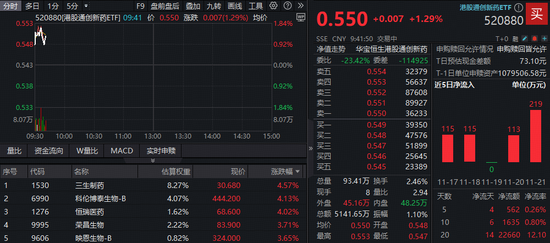
创新药突破不断,港股通创新药ETF(520880)盘初上探1.66%!三生制药等龙头股领衔修复行情
Xin Lang Ji Jin· 2025-11-24 01:55
Core Insights - The Hong Kong innovative drug sector is experiencing a rebound, with the Hong Kong Stock Connect innovative drug ETF (520880) rising by 1.66% at one point [1] - Major stocks such as Sanofi, Kelun-Biotech, and Hengrui Medicine saw increases of over 4%, while stocks like China Resources Pharmaceutical and Fuxing Pharmaceutical faced adjustments [1] Industry Trends - The innovative drug industry is shifting from a quantity-driven approach to a quality-driven one, entering a phase where product efficacy is paramount [3] - There is a growing focus on differentiated and internationalized pipelines, with an emphasis on products that can generate profits [3] - Oral peptide drugs, such as PCSK9 inhibitors and IL-23 antagonists, are showing promising clinical data and have the potential to reshape treatment paradigms [3] Market Dynamics - Chinese innovative pharmaceutical companies are deeply involved in global drug development, with the number of clinical trials ranking first worldwide, particularly in cell therapy, ADCs, and bispecific antibodies [3] - By 2024, it is expected that 38% of globally approved new drugs will have their first launch in China, highlighting the country's growing importance in the pharmaceutical landscape [3] - The upcoming expiration of patents for multinational corporations (MNCs) is creating opportunities for Chinese assets, which are becoming significant sources for important projects [3] ETF Performance - The Hong Kong Stock Connect innovative drug ETF (520880) and its linked funds are passively tracking the Hang Seng Hong Kong Stock Connect Innovative Drug Select Index, which includes top-weighted stocks like BeiGene, China Biologic Products, and Innovent Biologics [3]
康哲药业分拆德镁医药赴港IPO,烧钱续命能否扛起百亿目标?
Xin Lang Cai Jing· 2025-11-23 10:10
Core Viewpoint - In 2024, Kangzhe Pharmaceutical's core cardiovascular business faced revenue and profit declines due to unsuccessful bidding in centralized procurement, prompting its subsidiary Dermavon to apply for an IPO on the Hong Kong Stock Exchange despite ongoing losses in its skin care segment [3][4]. Group 1: Company Overview - Dermavon, established in 2020 and spun off from Kangzhe in 2021, focuses on skin prescription drugs and skin care products, holding three marketed drugs and a developing skin care brand [4][6]. - Kangzhe Pharmaceutical's revenue in 2024 was 7.469 billion yuan, a decrease of 6.8% year-on-year, with net profit dropping by 32.3% to 1.613 billion yuan [4]. Group 2: Financial Performance - Dermavon reported revenue growth from 384 million yuan in 2022 to 618 million yuan in 2024, but net losses increased from 55.17 million yuan to 106 million yuan during the same period [8][9]. - Sales expenses for Dermavon rose from 246 million yuan in 2022 to 388 million yuan in 2024, consistently accounting for around 60% of revenue [9][10]. Group 3: Market Position and Challenges - Dermavon's core product, Yilvqu (for psoriasis), lacks price competitiveness compared to established competitors, which impacts market penetration and necessitates high marketing expenditures [11][12]. - The skin care segment, particularly the He Ling series targeting sensitive skin, faces intense competition from established brands like Winona, which reported revenue of 4.91 billion yuan in 2024, significantly overshadowing Dermavon's performance [13][14]. Group 4: Future Outlook and Strategic Goals - Dermavon aims for a compound annual growth rate of over 50% over the next five years, targeting sales exceeding 10 billion yuan by 2029, although achieving this goal poses significant challenges given the current market dynamics [14][18]. - The company's reliance on Kangzhe for resources and sales channels raises concerns about its independence and long-term viability, as it struggles to establish a self-sustaining business model [16][17].
