
迈瑞医疗

Search documents
秦朔:中国新质企业家时代的来临
Xin Lang Cai Jing· 2026-02-02 00:21
Core Viewpoint - The event "For China's Economy, Cheers to Entrepreneurs" highlighted the emergence of a new generation of entrepreneurs in China, focusing on advanced technologies such as brain-machine interfaces, autonomous driving, and low-altitude economy, showcasing their impact on society and the economy [1][3][29]. Group 1: Technological Innovations - Strong Brain Technology's smart bionic hand has assisted over 10,000 individuals with upper or lower limb disabilities, allowing them to live and work normally [29]. - The L4 autonomous vehicle from Pony.ai operates without a driver, demonstrating advancements in autonomous driving technology [29]. - The flying car developed by Huitian has received 7,000 global orders and plans to start deliveries by the end of 2026, with a next-generation model capable of carrying six people for 500 kilometers [29]. Group 2: New Quality Entrepreneurs - The 2025 "Top Ten Economic Figures" includes four entrepreneurs associated with cutting-edge technologies: Liu Debing from Zhipu, Peng Jun from Pony.ai, Han Bicheng from Strong Brain Technology, and Zhao Deli from Huitian [31]. - The evaluation committee also recognized groups involved in "China's Chip Infrastructure," highlighting the shift towards new quality productivity driven by technological breakthroughs and innovative resource allocation [31][32]. Group 3: Economic Strategy and Consumer Focus - The "14th Five-Year Plan" emphasizes enhancing the competitiveness of traditional industries while promoting new demand to drive supply [32]. - Three representatives from the consumer and lifestyle sector were recognized: Leng Youbin from China Feihe, Ma Yin from Anaya, and Wu Xiangdong from Zhenjiu Lidu Group [32]. Group 4: Historical Context of Entrepreneurs - The evolution of Chinese entrepreneurs has gone through 15 stages since the reform and opening up, from the emergence of individual private economies to the current focus on high-quality development and innovation [35][36][37]. - The current entrepreneurial landscape is characterized by a significant shift towards new quality productivity, with a focus on advanced manufacturing and technology-driven solutions [51]. Group 5: Future Outlook - The future of China's economy is expected to continue along the path of high-quality development, leveraging new technologies and innovative business models [52]. - The "single person + AI as a company" model represents a new entrepreneurial path empowered by technology, indicating a shift in how businesses operate and innovate [52].


医药生物周报(25年第4周):精锋医疗招股书梳理,关注手术机器人赛道
Guoxin Securities· 2026-02-01 10:50
本周医药板块表现弱于整体市场,医药商业降幅居前。本周全部 A 股下 跌 0.98%(总市值加权平均),沪深 300 上涨 0.08%,中小板指下跌 3.78%,创业板指下跌 0.09%,生物医药板块整体下跌 3.31%,生物医 药板块表现弱于整体市场。分子板块来看,化学制药下跌 3.20%,生物 制品下跌 2.50%,医疗服务下跌 4.15%,医疗器械下跌 3.86%,医药商 业下跌 4.49%,中药下跌 1.94%。医药生物市盈率(TTM)37.27x,处 于近 5 年历史估值的 80.47%分位数。 精锋医疗为领先的手术机器人公司。精锋医疗成立于 2017 年,是中国 首家、全球第二家同时取得多孔腔镜、单孔腔镜及自然腔道三类手术机 器人注册审批的领先企业,2024 年斩获国内手术机器人制造商销量第 一,2026 年 1 月于香港联交所挂牌上市。公司核心管理层具备深厚的 行业经验与国际背景,全球专利布局超 734 项,技术实力雄厚。 精锋医疗构建了覆盖多科室的丰富管线。多孔系列 MP1000 及升级款 已获批多专科应用并实现商业化放量,单孔系列 SP1000 为国内首个 覆盖三大外科的国产单孔机器人,支气管 ...
首富再入凡尘
创业家· 2026-02-01 10:42
Core Viewpoint - The article discusses the return of Zhang Yong as CEO of Haidilao, highlighting the challenges and strategies the company faces in a changing market environment, as well as the new leadership dynamics within the organization [10][25]. Group 1: Zhang Yong's Leadership Transition - Zhang Yong announced a ten-year succession plan in April 2020, expressing concerns about his ability to keep up with the company's growth and the need for a new leader [11][12]. - In March 2022, Zhang officially stepped down as CEO, with Yang Lijuan taking over, but the company faced significant financial losses, including a nearly 90% drop in net profit in 2020 and a loss of 4.136 billion yuan in 2021 [12][13]. - By early 2022, Haidilao's market value plummeted from 430 billion HKD to below 100 billion HKD, prompting Zhang to take responsibility for the company's direction [13][12]. Group 2: Financial Performance and Strategic Plans - The "Red Pomegranate Plan" aims to diversify Haidilao from a single hotpot brand into a multi-category restaurant group, leveraging its supply chain and management experience [15][20]. - Despite efforts to stabilize the company, recent financial reports indicate a decline in revenue, with a 3.66% drop in H1 2025 revenue compared to H1 2024, and a 9% decrease in core restaurant income [20][22]. - The company is facing challenges in maintaining profitability, with net profits decreasing for two consecutive years, indicating that previous cost-cutting measures may have reached their limits [20][22]. Group 3: Market Challenges and Brand Identity - The restaurant market has shifted, and the once-celebrated "Haidilao experience" is now seen as a product of a bygone era, struggling to adapt to a more competitive landscape [23][24]. - The company's service model, which relies heavily on high levels of customer service, is becoming less sustainable in a market that is increasingly saturated with competitors [23][24]. - Zhang Yong's return to the CEO position is seen as a move to regain control and address the operational challenges that have emerged during his absence [15][19]. Group 4: New Leadership Dynamics - Alongside Zhang Yong's return, four new female board members have been appointed, indicating a strategic shift towards a more diverse leadership team [25][26]. - These new leaders have extensive experience within Haidilao and are expected to help implement Zhang's vision while addressing operational challenges directly [25][27]. - The new leadership structure aims to enhance communication and execution of strategies across the company's extensive network of restaurants [27].

2月金股组合
Bank of China Securities· 2026-02-01 08:53
Strategy Overview - The core strategy indicates that Trump's nomination of Kevin Warsh as the next Federal Reserve Chairman suggests a hawkish policy stance, advocating for balance sheet reduction and cautious interest rate cuts, which may reverse market expectations for continued liquidity easing and strengthen the dollar, leading to a global tightening of dollar liquidity expectations and asset price reassessment [4][2] - In the short term, after a strong spring rally, the market may enter a rhythm adjustment period due to proactive policy guidance and increased overseas disturbances, presenting rotation opportunities for previously stagnant sectors [4][2] Real Estate Sector: Poly Real Estate Group - The company experienced a 48.1% year-on-year revenue growth in the first half of 2025, driven by increased project completions, with a settlement area of 814,000 square meters, up 20.8% year-on-year, and a settlement amount of 17.37 billion yuan, up 52.5% year-on-year [8] - Despite revenue growth, the net profit attributable to shareholders decreased by 44.3%, primarily due to a negative investment income of 950 million yuan and an increase in minority shareholder losses [8] - The company’s gross margin improved to 17.5%, up 3.2 percentage points year-on-year, while the net profit margin decreased to 1.3%, down 0.7 percentage points year-on-year [8][9] - The company’s debt structure improved, with interest-bearing debt down 8.6% year-on-year to 68.2 billion yuan, and the average financing cost decreased by 48 basis points to 2.90% [9] - The company’s sales ranking improved to 15th in the industry, with a sales amount of 29.5 billion yuan in the first seven months of 2025, despite a 13.5% year-on-year decline [10] Transportation Sector: CITIC Offshore Helicopter - CITIC Offshore Helicopter is a leading player in China's general aviation sector, operating the largest civil helicopter fleet in Asia with 84 advanced model helicopters [13] - The company has a strong revenue stream from offshore oil services, with nearly 70% of its revenue derived from this segment, and maintains a market share of over 60% in the offshore helicopter service market [14] - The general aviation market in China is expected to grow steadily, supported by policy guidance, with the number of general airports reaching 475 and the number of general aviation enterprises reaching 760 by 2024 [14] Transportation Sector: Air China - Air China is the only flag carrier in China, with passenger transport services accounting for nearly 91% of total revenue in 2024 [16] - The company reported a revenue of 166.7 billion yuan in 2024, up 18.14% year-on-year, with a sales gross margin of 5.11% [16] - The domestic passenger transport volume reached 730 million in 2024, a 17.86% increase year-on-year, marking a historical high [17] Chemical Sector: Zhejiang Longsheng - The company reported a 6.47% year-on-year decline in revenue to 6.505 billion yuan in the first half of 2025, with a gross margin of 29.80%, up 1.87 percentage points year-on-year [19][20] - The dye business saw a slight revenue decline of 3.17% to 3.632 billion yuan, but the gross margin improved by 4.40 percentage points to 34.17% [19] - The company is focusing on cost reduction and efficiency improvements to maintain stable development amid industry challenges [19] Chemical Sector: Yake Technology - The company achieved a revenue growth of 15.37% in the electronic materials segment, with a total revenue of 2.573 billion yuan in the first half of 2025 [24] - The company is actively developing new technologies and products in the LNG and electronic materials sectors, with a focus on semiconductor chemical materials [23] New Energy Sector: Foster - Foster is a leading player in the photovoltaic encapsulation materials market, maintaining a market share of around 50% [27] - The company is exploring new solutions for space environment applications, leveraging its existing technology in photovoltaic materials [28] Medical Sector: Mindray Medical - The company faced revenue pressure in the first half of 2025, with a 23.77% year-on-year decline in Q2 revenue to 8.506 billion yuan [29] - International business revenue increased by 5.39%, accounting for about 50% of total revenue, indicating a growing presence in the global market [30] - The company is focusing on building a digital healthcare ecosystem through the integration of devices, IT, and AI technologies [31] Food and Beverage Sector: Kweichow Moutai - The company is navigating a challenging environment in the liquor industry, focusing on quality and long-term value rather than short-term performance metrics [33] - In Q3 2025, the company reported a revenue of 39.06 billion yuan, a slight increase of 0.6% year-on-year, with a gross margin of 91.3% [34] Social Services Sector: Lingnan Holdings - The company achieved a revenue of 2.09 billion yuan in the first half of 2025, up 8.52% year-on-year, with a net profit of 50 million yuan, up 24.39% [36] - The company is expanding its travel agency and hotel management services, with a focus on enhancing its operational capabilities [38] Electronics Sector: Zhaoyi Innovation - The company expects a revenue of approximately 9.203 billion yuan in 2025, a 25% year-on-year increase, driven by demand from AI computing and the storage industry [39]





医药生物周报(25年第4周):精锋医疗招股书梳理,关注手术机器人赛道-20260201
Guoxin Securities· 2026-02-01 07:44
Investment Rating - The report maintains an "Outperform" rating for the pharmaceutical and biotechnology sector [4] Core Insights - The surgical robot market is expected to grow significantly, driven by technological innovation, clinical demand, and policy benefits, particularly in China where the penetration rate is projected to increase from 0.7% in 2024 to 3.0% by 2033 [20][29] - Jingfeng Medical is a leading surgical robot company in China, having achieved significant milestones including the first domestic sales ranking in 2024 and a successful listing on the Hong Kong Stock Exchange in January 2026 [1][10] - The company has a robust pipeline of products across multiple specialties, with its multi-port and single-port surgical robots already commercialized and showing strong sales growth [2][34] Summary by Sections Market Performance - The overall pharmaceutical sector underperformed the market, with a decline of 3.31% in the biopharmaceutical sector, while the A-share market saw an average decline of 0.98% [1] - The TTM price-to-earnings ratio for the biopharmaceutical sector stands at 37.27x, which is at the 80.47th percentile of the past five years [1] Company Overview - Jingfeng Medical was established in 2017 and is the first in China and the second globally to obtain regulatory approval for multi-port, single-port, and natural orifice surgical robots [10] - The company has over 734 global patents, showcasing its strong technological capabilities and commitment to innovation [35] Product Pipeline - The company has developed a diverse product line, including the MP1000 multi-port robot and the SP1000 single-port robot, which are approved for various surgical applications [2][10] - The CP1000 bronchoscopic robot is an innovative product aimed at non-invasive diagnosis and treatment of lung diseases, with significant clinical advantages [31][34] Financial Projections - Jingfeng Medical's revenue for the first half of 2025 reached 149 million RMB, a year-on-year increase of 394%, with surgical robot sales accounting for 92.9% of total revenue [34] - The company is expected to continue its growth trajectory with increasing overseas orders and expanding market presence [35] Competitive Landscape - The multi-port surgical robot market is currently dominated by Intuitive Surgical, which holds an 83% market share, while domestic competitors are rapidly emerging [26] - The single-port robot market is still in its early stages, with Jingfeng Medical holding a first-mover advantage in China [28]
中国手术机器人行业近况更新:华创医药投资观点&研究专题周周谈·第161期
Huachuang Securities· 2026-02-01 00:25
Investment Rating - The report does not explicitly state an investment rating for the surgical robot industry, but it indicates a positive outlook for growth and development in the sector. Core Insights - The surgical robot industry in China is entering a rapid development phase, supported by national policies and capital investment, with significant advancements in technology and market demand [13]. - The report highlights the transition from a capital-driven to a value-driven model in the surgical robot sector, emphasizing the importance of clinical applications and technological integration [13]. - The approval process for surgical robots by the NMPA has accelerated, particularly for orthopedic surgical robots, which dominate the market in terms of the number of products approved [30][28]. Summary by Sections Market Overview - The surgical robot market in China is characterized by a growth in sales volume, with a total of 332 units sold in the first 11 months of 2025, reflecting a year-on-year increase of 3.75% [34]. - The sales revenue for surgical robots reached 2.973 billion yuan, showing a slight decline of 0.87% year-on-year, indicating a structural transition rather than a market downturn [34]. Technological Advancements - Innovations in remote operation, miniaturization, and AI assistance are driving the development of surgical robots, with products like the TUMAI® remote surgical robot achieving significant milestones in cross-border surgeries [16][19]. - The introduction of AI-assisted surgical robots is enhancing precision in surgeries, with products capable of 3D reconstruction and personalized surgical planning [16]. Regulatory Developments - The National Healthcare Security Administration has established a pricing framework for surgical robots, which is expected to facilitate market growth by clarifying reimbursement policies and pricing structures [27][26]. - The pricing guidelines categorize surgical robot services into navigation, participation in execution, and precision execution, linking them to main surgical procedures [27]. Market Segmentation - The orthopedic surgical robot segment holds the largest market share, accounting for 50% of the total NMPA-approved surgical robots from 2014 to 2024, followed by neurosurgical robots [30]. - The report indicates a significant potential for growth in emerging fields such as vascular surgery robots, with increasing demand and technological advancements [34]. Competitive Landscape - The report identifies key players in the surgical robot market, including domestic manufacturers that are rapidly gaining market share as regulatory barriers for imports increase [45]. - The competitive landscape is shifting as domestic products receive NMPA approval, challenging the previously dominant imported products [45].
中国手术机器人行业近况更新:华创医药投资观点&研究专题周周谈·第161期-20260131
Huachuang Securities· 2026-01-31 15:16
Investment Rating - The report does not explicitly state an investment rating for the surgical robot industry, but it highlights a positive outlook for growth and innovation in the sector. Core Insights - The surgical robot industry in China is entering a rapid development phase, supported by national policies and capital investment, with significant advancements in technology and market demand [13]. - The report emphasizes the transition from a capital-driven to a value-driven model in the surgical robot sector, indicating a shift towards more sustainable growth and clinical applications [13]. - The approval process for surgical robots by the NMPA has accelerated, particularly for domestic products, with orthopedic surgical robots leading in the number of approvals [30]. Summary by Sections Market Overview - The surgical robot market in China is characterized by a growth in sales volume, with a total of 332 units sold in the first 11 months of 2025, reflecting a year-on-year increase of 3.75% [34]. - The sales revenue for surgical robots reached 2.973 billion yuan, showing a slight decline of 0.87% year-on-year, indicating a structural transition rather than a market downturn [34]. Technological Advancements - Innovations in remote operation, miniaturization, and AI assistance are driving the development of surgical robots, with notable products like the first remote surgical robot approved in China [16][19]. - The report highlights the introduction of AI-assisted surgical robots that enhance precision and efficiency in surgeries, marking a significant technological leap in the industry [16]. Regulatory Developments - The National Healthcare Security Administration has established a pricing framework for surgical robots, which is expected to facilitate market growth by clarifying reimbursement policies and pricing structures [27][26]. - The report notes that the establishment of a clear payment system is crucial for the adoption of surgical robots in hospitals, as high costs and long return periods can deter procurement [27]. Market Segmentation - The orthopedic surgical robot segment dominates the market, accounting for 50% of the NMPA approvals from 2014 to 2024, with a strong growth trajectory expected in this area [30]. - The report identifies the laparoscopic surgical robot and orthopedic surgical robot as the two largest segments in the market, with significant potential for expansion in emerging fields [41]. Future Outlook - The report projects substantial growth in the surgical robot market, with expectations for increased penetration rates and market size driven by technological advancements and policy support [44]. - The anticipated CAGR for the laparoscopic surgical robot market from 2024 to 2033 is estimated at 30.4%, indicating robust future demand [44].
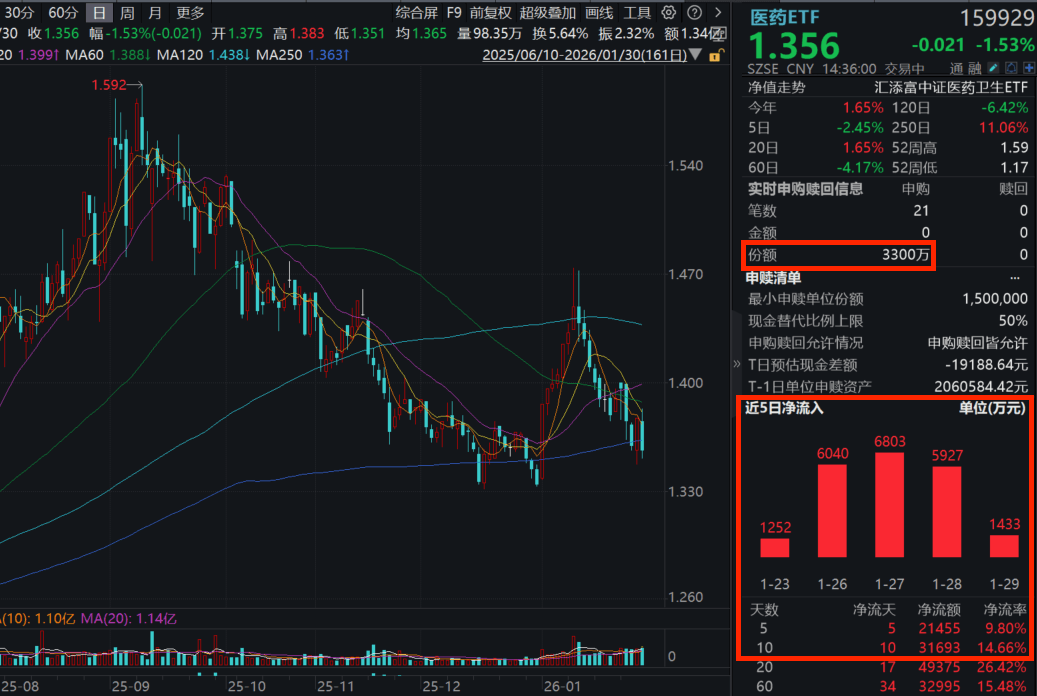
医药再度回调!医药ETF(159929)跌超1.5%,资金连续11天持续涌入!JPM 2026传递出哪四大医药创新风向标?
Sou Hu Cai Jing· 2026-01-30 07:00
Group 1 - The pharmaceutical sector experienced a pullback, with the pharmaceutical ETF (159929) declining by 1.53% and a trading volume exceeding 1.3 billion yuan, indicating a net inflow of over 45 million yuan during the day, marking 11 consecutive days of capital inflow totaling over 360 million yuan [1][3] - Major stocks within the pharmaceutical ETF saw most decline, including Meien Health and Pianzaihuang dropping over 3%, WuXi AppTec and Aier Eye Hospital falling over 2%, while Tigermed rose over 7% [3][4] - Tigermed is projected to see a net profit growth of 105% to 204% by 2025, indicating strong future performance [3] Group 2 - The JPM 2026 conference highlighted a shift in the global pharmaceutical industry's focus towards the effective allocation and long-term value realization of innovations amidst rising uncertainties [5] - Chinese innovation is gaining global recognition, with increased participation from Chinese companies at the JPM 2026, reflecting a growing acknowledgment from international capital and multinational pharmaceutical companies [5][6] - The evaluation logic of multinational pharmaceutical companies regarding Chinese innovative assets is evolving, focusing on their efficacy, differentiation, and competitive positioning for inclusion in global product portfolios [6][10] Group 3 - Multinational pharmaceutical companies are entering a critical patent cliff period, necessitating diversification in their pipelines to mitigate risks associated with single products and treatment areas [10][12] - The integration of AI into core strategies is becoming mainstream, with AI being utilized to enhance R&D efficiency and optimize operational systems, thus addressing challenges posed by the patent cliff [12][13] - The oncology sector remains a core area for pharmaceutical innovation, with a focus on antibody-drug conjugates (ADCs) and cell therapies, indicating a robust pipeline and commercial potential [13][15]



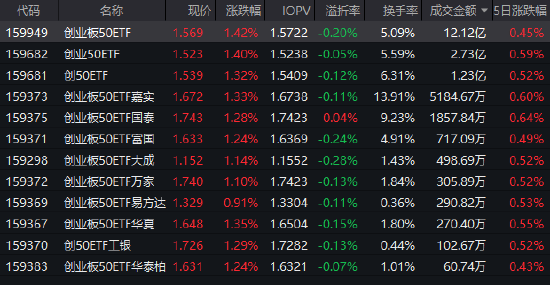
固态电池材料新突破!创业板50ETF(159949)领涨同类,成交额突破12亿元居首
Xin Lang Cai Jing· 2026-01-30 04:31
Core Viewpoint - The A-share market shows signs of recovery, with the ChiNext index rebounding and the ChiNext 50 ETF (159949) leading in performance among similar ETFs, indicating potential investment opportunities in the technology sector [1][5]. Market Performance - On January 30, the Shanghai Composite Index regained the 4100-point mark, while the ChiNext index rose by 0.80% [1][5]. - The ChiNext 50 ETF (159949) increased by 1.42%, closing at 1.569 yuan, with a turnover rate of 5.09% and a trading volume of 12.12 billion yuan, making it the top performer among similar ETFs [1][5]. Top Holdings Performance - The latest quarterly report shows that most of the top ten holdings of the ChiNext 50 ETF (159949) experienced price increases, including: - Ningde Times up 2.93% - Zhongji Xuchuang up 4.07% - Xinyi Sheng up 4.40% - Sunshine Power up 3.30% - Tianfu Communication up 11.92% [2][6][7]. Investment Outlook - Institutions like Guotai Junan Securities and Haitong Securities believe that there is still significant room for growth in China's "transformation bull" market, with reform and transformation being the long-term themes [4][8]. - The ChiNext 50 ETF (159949) is viewed as a convenient tool for investors optimistic about China's technology growth sector, having achieved a return of 35.71% over the past three years, outperforming its benchmark [4][8].

脑机接口技术迈向产业拐点,医疗创新ETF(516820)连续10天净流入
Xin Lang Cai Jing· 2026-01-30 02:37
消息面上,民政部印发《关于进一步推进民政科技创新的指导意见》,其中提到,广泛应用人形机器 人、脑机接口、人工智能等前沿技术,开展失能失智预防和抗衰老、生活照料和康复护理、精神慰藉和 社会参与促进、安全风险监测和紧急救援、老年宜居环境建设和适老化改造等方面关键技术装备研发。 截至2026年1月30日 10:05,中证医药及医疗器械创新指数(931484)成分股方面涨跌互现,海思科领涨 2.62%,新产业上涨1.67%,华润三九上涨0.96%;片仔癀领跌。医疗创新ETF(516820)最新报价0.36元。 规模方面,医疗创新ETF最新规模达18.67亿元,创近1年新高。从资金净流入方面来看,医疗创新ETF 近10天获得连续资金净流入,最高单日获得4182.65万元净流入,合计"吸金"1.86亿元,日均净流入达 1857.56万元。(数据来源:Wind) 招商证券指出,脑机接口技术已从长期学术探索阶段进入产业拐点,在政策与需求双重驱动下,医疗成 为其核心主战场,占全球应用场景的56%;中国脑机接口产业在系统集成与应用落地方面进展显著, 2025年被正式纳入"十五五"规划中的"六大未来产业",顶层设计与地方支持同步加 ...