
长安汽车

Search documents
中国电车攻占泰国70%市场
21世纪经济报道· 2025-12-25 06:14
记者丨赖镇桃 编辑丨和佳 李艳霞 黎奥从未想过,一次他觉得很寻常的对话,会让一位泰国员工怕得想离职。"当时和一位员工 说话声音大了点,对方就觉得我们是在凶他,第二天不敢来上班了。"作为一家中国车企的海 外业务人士,这是他踏上"微笑之国"一年多后,才逐渐参透的文化差异。 在泰国,游客们常会听闻一种"三不叫"的说法:车不叫——即便曼谷的交通堵得水泄不通, 也少见烦躁的喇叭声;狗不叫——街头的流浪犬慵懒地趴着,它们知道静候常能换来一口施 舍;人不叫——细声慢语是这里表达尊敬的默认规则。 然而,这片浸润在独特"宁静"之中的土地,在全球汽车工业的版图上,却从不沉寂。 泰国是全球第十大、东南亚第一大汽车生产国,享有"东方底特律"的盛名。 同时,它又是牢 不可破的"日系车后花园"。自上世纪60年代踏足于此, 日系车 凭借先发优势与成熟的本地产 业链, 巅峰时期市占率常年高达90%,2024年其占有率依然稳固在70%左右。 当泰国政府拉开新能源转型的大幕,蓄力已久的中国车企开始了密集抢滩。 电动化狂奔 在泰国Citywalk时,只要走出曼谷的核心区,尤其是来到曼谷以外的城镇,常会看到道路两旁 散落着许多两三层高的独栋小房。 ...


至信股份今起招股 1月6日申购
Xin Lang Cai Jing· 2025-12-25 05:27
Core Viewpoint - Chongqing Zhixin Industrial Co., Ltd. (referred to as "Zhixin Co." or "the company") has disclosed its prospectus and is set to launch its public offering on January 6, with plans to list on the Shanghai Stock Exchange [1][2]. Group 1: IPO Details - Zhixin Co. plans to publicly issue 56,666,667 shares, all of which are new shares, resulting in a total share capital of 226,666,667 shares post-issuance [1][3]. - The initial strategic placement will consist of 11,333,333 shares, accounting for 20.00% of the total issuance [1][3]. - Before the strategic placement adjustment, the offline initial issuance will be 27,200,334 shares, representing 60.00% of the remaining shares, while the online initial issuance will be 18,133,000 shares, making up 40.00% of the remaining shares [1][3]. - The preliminary inquiry period for the issuance is set for December 30 from 9:30 to 15:00, with an online roadshow scheduled for January 5 [1][3]. Group 2: Company Overview - Zhixin Co. specializes in the development, processing, production, and sales of automotive stamping and welding parts, as well as related molds [2][4]. - The company has maintained a consistent focus on the research and production of automotive body stamping parts for over thirty years, expanding into upstream mold development and automation production solutions [2][4]. - Through years of development, Zhixin Co. has established a product advantage in the market and gained wide recognition from its customers [2][4]. - The company has enhanced its intelligent manufacturing capabilities through automated production solutions, utilizing proprietary algorithms and software integration to achieve comprehensive control over product development, process flow, and quality control [2][4]. - Major clients include well-known automotive manufacturers such as Changan Automobile, Geely, Changan Ford, NIO, Li Auto, BYD, Great Wall Motors, and Leap Motor, as well as notable parts manufacturers like CATL, Inafa, and Webasto [2][4].
年末车市未见翘尾行情:部分消费者开始观望,业内期待补贴接续
Xin Lang Cai Jing· 2025-12-25 05:27
Core Insights - The automotive market is experiencing a quiet end to the year, with consumers showing a strong wait-and-see attitude, contrasting sharply with the usual year-end rush [1][9] - The decline in consumer activity is attributed to changes in policy, particularly the phasing out of various subsidies and the upcoming adjustment of the new energy vehicle purchase tax [2][12] - Industry experts predict a significant drop in December retail sales, with an expected year-on-year decrease of 12.7% [2][12] Consumer Behavior - Consumers are hesitant to make purchases, anticipating the continuation of national subsidies in the coming year and expecting new models with enhanced features at lower prices [2][12] - The automotive market saw its first year-on-year decline in sales in November, with approximately 2.701 million vehicles sold, a 4.4% decrease compared to the previous year [2][12] - Many consumers are waiting for the release of popular new models expected in 2026, contributing to the current market stagnation [2][12][13] Market Dynamics - The pace of new product iterations is accelerating, leading to increased consumer indecision as many wait for better deals [3][13] - The automotive price war has cooled, with many dealerships adopting a more subdued approach to sales, lacking the usual festive promotions [6][14] - The National Market Supervision Administration has issued guidelines to prevent irrational price competition, which has further impacted sales strategies [7][15] Future Outlook - The automotive industry is expected to face growth challenges in 2026, with many analysts predicting a mere 2% increase in sales, totaling around 28.2 million vehicles [8][16] - There is a consensus that consumer-side policies will need to be supported to stimulate demand, with expectations for new subsidy policies to be introduced [8][16][17] - The "two new" policies have shown significant effects, with over 2.5 trillion yuan in sales driven by trade-in programs, benefiting over 360 million people [8][16]
长安汽车回应“数千万国有资产流失”传言
Guan Cha Zhe Wang· 2025-12-25 05:09
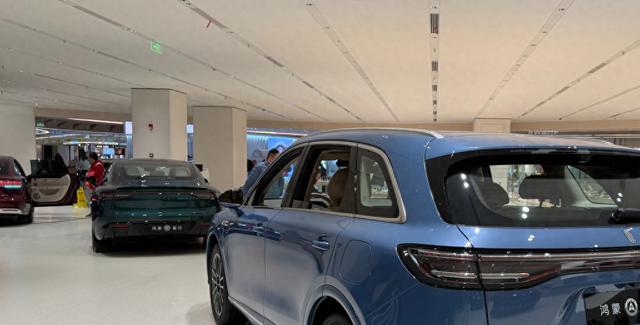
长安汽车回应"数千万国有资产流失"传言 长安汽车不实信息举报中心 【文/观察者网 潘昱辰 编辑/高莘】12月24日晚,微信公众号"长安汽车不实信息举报中心"发布声明,称 近期关注到网络上有"重庆长安汽车废轻铁拍卖,疑致数千万国有资产流失"等信息。长安汽车称,经调 查核实,该内容为不实信息,上述发布行为已对长安汽车的品牌声誉和正常经营秩序造成了严重的负面 影响。 长安汽车强调,网络并非法外之地,针对造谣、传谣、抹黑和诋毁行为,将通过法律手段维护公司的合 法权益,维护清朗的网络环境与公平的市场竞争秩序。 本文系观察者网独家稿件,未经授权,不得转载。 ...

我国自动驾驶向商业化应用迈出关键一步
Zhong Guo Zhi Liang Xin Wen Wang· 2025-12-25 05:08
Core Viewpoint - The approval of the first batch of L3-level conditional autonomous driving vehicles in China marks a significant step towards the commercialization of autonomous driving, transitioning from "technical validation" to "mass production application" [1] Group 1: Regulatory Developments - The Ministry of Industry and Information Technology has granted approval for two L3-level autonomous driving models from Changan and Arcfox to conduct road trials in designated areas of Beijing and Chongqing [1] - This approval signifies a shift in responsibility, where automakers and system providers will be held accountable for accidents occurring while the vehicle is in autonomous mode [1][2] - The L3-level vehicles must have "front-mounted mass production" sensing equipment, ensuring technical stability from the outset [1] Group 2: Industry Standards and Safety - The global autonomous driving industry is transitioning from technical validation to large-scale commercialization, with standardization becoming crucial for technological discourse [2] - The establishment of standards such as the "Intelligent Driving Pyramid Grading Evaluation System" and the national standard for "Safety Requirements for Intelligent Connected Vehicle Combination Driving Assistance Systems" aims to provide clear technical evaluations and safety guidelines [2] - The differentiation between L2 and L3 levels lies in the "human-machine responsibility transition" and "safety redundancy mechanisms," with L3 allowing for autonomous driving in specific scenarios [3] Group 3: Pilot Vehicle Specifications - The Changan SC7000AAARBEV can operate autonomously at speeds up to 50 km/h in specific urban and highway conditions, while the Arcfox BJ7001A61NBEV can reach speeds of 80 km/h under similar conditions [4][5] - The two models represent different technological approaches, with Changan using a combination of cameras and radar, while Arcfox employs multiple sensors including LiDAR [5] - The pilot program is limited to specific routes in Chongqing and Beijing to ensure safety and effective monitoring [5] Group 4: Collaborative Efforts and Future Directions - The advancement of autonomous driving relies not only on technological innovation but also on precise policy adaptation, clear responsibility delineation, and public trust [6] - Companies are encouraged to focus on safety redundancy in their designs and to enhance user experience through intuitive interfaces [6] - To achieve sustainable development, companies should deepen their algorithm and data research, build comprehensive service capabilities, and foster cross-industry collaborations [6][7] Group 5: Challenges Ahead - The commercialization of L3-level autonomous driving faces challenges related to technology, policy, and societal acceptance [7] - Companies are advised to participate in the formulation of local and industry standards and to establish necessary infrastructure in key areas to support testing and future scalability [7]
车企年末掀起“百亿融资战”
Sou Hu Cai Jing· 2025-12-25 03:52
Core Viewpoint - The Chinese automotive industry is experiencing a significant "billion financing battle" as companies prepare for future market competition, with over 10 billion yuan raised in just two months [2][8]. Group 1: Financing Activities - In November and December, four major financing events occurred, including Deep Blue Auto's third round of financing expected to raise approximately 6.122 billion yuan, JAC Motors' 3.5 billion yuan private placement approved by the CSRC, and BAIC Blue Valley's 6 billion yuan refinancing project also approved [2]. - Polestar secured a total of approximately 1.2 billion USD in financing, including 300 million USD in equity and 600 million USD in loans, addressing its cash flow and debt pressures [7]. Group 2: Market Trends and Projections - The latest data from the China Association of Automobile Manufacturers indicates that in November, sales of new energy vehicles reached 1.823 million units, with a penetration rate of 53.2% [8]. - Predictions suggest that by 2026, domestic automobile sales may exceed 28 million units, with new energy vehicles potentially surpassing 20 million units next year [8]. Group 3: Strategic Financing Objectives - Traditional automakers like Deep Blue, BAIC Blue Valley, and JAC Motors are focusing on financing for new platform development, next-generation vehicle development, smart driving technology, and brand building [10]. - JAC Motors plans to invest over 4.2 billion yuan in its new energy passenger vehicle project and related body parts project, aiming for an annual production capacity of 200,000 new energy vehicles [12]. Group 4: Competitive Landscape - The current financing wave reflects a strategic move by established players to secure their positions in the market, while smaller brands may struggle to keep up due to limited financing options [8][10]. - Polestar, despite its previous ambitions, is facing challenges with a net loss of 1.558 billion USD and a significant decline in gross margin, highlighting the need for a sustainable business model and core technology [14]. Group 5: Future Implications - The recent financing activities signal the end of the initial chaotic phase in the automotive industry, marking the beginning of a new era focused on technological depth, capital strength, and operational efficiency [14].



深蓝汽车61.22亿元增资落地,渝富集团、招银投资参与
Ju Chao Zi Xun· 2025-12-25 03:32
Core Viewpoint - Changan Automobile announced a capital increase for its subsidiary Deep Blue Automobile, raising a total of 6.122 billion yuan, with new investors including Chongqing Yufu Holding Group and China Merchants Bank Financial Asset Investment [2][3] Group 1: Capital Increase Details - The capital increase consists of public and private placements, with the public announcement period from November 26 to December 23, 2025 [2] - The total capital increase of 6.122 billion yuan will raise the registered capital of Deep Blue Automobile from 328.108278 million yuan to 466.157065 million yuan [3] - Changan Automobile will contribute 3.122 billion yuan, including 2.079 billion yuan in cash and 1.043 billion yuan in intangible assets [3] Group 2: Shareholding Structure Post-Investment - After the capital increase, Changan Automobile will maintain a 50.9959% stake, while Chongqing Yufu Group will hold 12.0934% and China Merchants Bank Financial Asset Investment will hold 2.4187% [4] - Existing shareholders of Deep Blue Automobile did not participate in this capital increase [3] Group 3: Investor Background - Chongqing Yufu Group is a state-owned enterprise with a registered capital of 16.8 billion yuan, focusing on investment and asset management [4] - China Merchants Bank Financial Asset Investment is a wholly-owned subsidiary of China Merchants Bank, with a registered capital of 15 billion yuan, specializing in non-banking financial services [4] Group 4: Valuation and Future Prospects - The pricing for the capital increase is based on a valuation of Deep Blue Automobile at 14.55 billion yuan as of March 31, 2025 [4] - The capital injection is expected to provide sufficient funds for Deep Blue Automobile's business expansion and technological upgrades [4]
占比超一半,海外快成中国车企的主战场了
3 6 Ke· 2025-12-25 02:56
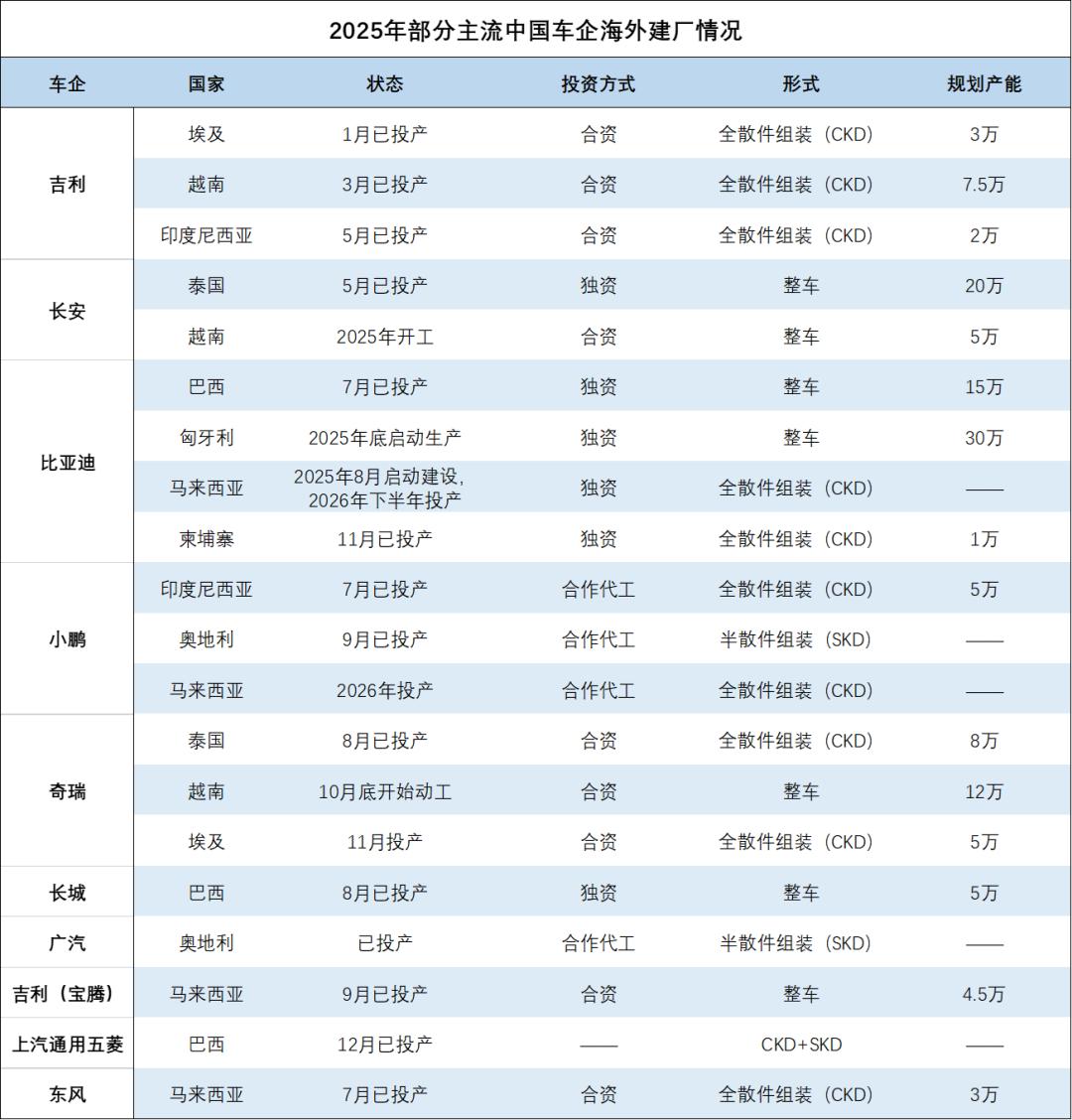
Core Insights - China's goods trade surplus reached a milestone of $1.08 trillion in the first 11 months of this year, marking a significant achievement in both Chinese foreign trade history and globally [1] - The automotive export sector is one of the fastest-growing segments, with predictions indicating that China's oil vehicle exports will surpass Japan's, solidifying its position as the world's largest automotive exporter [2][3] Automotive Export Growth - In the first 11 months of this year, the overall sales of China's passenger car market grew by 6.1%, while exports surged by 17.2%, significantly outpacing the domestic market [2] - Companies like BYD and Great Wall Motors reported record overseas sales, with BYD's overseas monthly sales exceeding 130,000 units in November, a 297% year-on-year increase, and accounting for nearly 30% of its total sales [3] Overseas Market Strategy - Chinese automakers are increasingly focusing on overseas markets as their primary battleground, with many companies planning to establish local production facilities abroad [4][5] - By 2025, the planned production capacity of overseas factories established by major Chinese automakers is expected to exceed 1.2 million units, contrasting sharply with the overcapacity situation in the domestic market [4] Production Capacity and Investment - A detailed overview of various Chinese automakers' overseas production plans reveals significant investments in local manufacturing, with companies like Geely, BYD, and Changan actively expanding their global footprint [5][6][7] - The shift from exporting complete vehicles to establishing full-process production bases abroad allows companies to better utilize local resources and mitigate tariff impacts [6] Profitability in Overseas Markets - Chinese automakers are experiencing higher profit margins in overseas markets compared to domestic sales, with BYD's overseas gross margin at 27.3%, significantly higher than its domestic margin of 17.7% [12][13] - The trend of higher pricing and lower competition in international markets is driving the profitability of Chinese brands, making overseas expansion a lucrative opportunity [12][13] Market Penetration and Competition - Chinese brands are increasingly gaining market share in traditional automotive strongholds like Europe, with their presence doubling in the first ten months of this year despite tariff challenges [14] - The recent announcement of increased tariffs on Chinese vehicles by Mexico poses a significant challenge, as Mexico has become the largest destination for Chinese automotive exports [15][16]

企业竞争或进入技术、盈利、商业落地等全面比拼新阶段
Xin Hua Wang· 2025-12-25 02:33
Core Insights - The intelligent driving industry is entering a "survival of the fittest" phase, where competition will focus on technology, profitability, and commercial viability [1][5][6] Market Restructuring - The intelligent driving company Haomo Zhixing has reportedly come to a complete halt, with many employees not receiving salaries for months. The company, backed by Great Wall Motors, once had a valuation exceeding 10 billion yuan but is now facing layoffs and executive departures [2] - Other companies like Zongmu Technology and Qingyan Weishi have also faced bankruptcy or deep restructuring despite previous funding rounds [2] Resource Concentration - The Ministry of Industry and Information Technology has conditionally approved two L3 autonomous driving models for trial operations in specific areas, marking a shift from "practice allowed" to "official road use" [3] - Companies like Yuanrong Qihang and Zhuoyue Technology have secured significant investments, indicating a trend of resource concentration towards leading firms [3] International Competition - Global giants like General Motors are seeking expertise from former employees of failed ventures to enhance their autonomous vehicle initiatives, reflecting a diverse technological approach in the industry [4] - The investment landscape has cooled significantly since its peak in 2021, with a notable shift towards funding established players rather than startups [4][5] Industry Challenges - Companies face significant challenges in establishing sustainable business models, with only a few profitable among the major listed intelligent driving firms [6][7] - The focus has shifted from merely technological capabilities to include cost control, compliance, and mass production capabilities as essential criteria for success [7] Future Outlook - The industry is expected to consolidate further, with independent autonomous driving companies facing increased pressure and potential mergers or acquisitions [5][6] - Predictions indicate a shift towards fully autonomous driving solutions in the next 5 to 10 years, driven by advancements in data and AI technologies [7][8]


财联社汽车早报12月25日
Xin Lang Cai Jing· 2025-12-25 02:15
Group 1: Transportation Industry Developments - The Ministry of Transport aims to accelerate the development of smart logistics, low-carbon economy, and digital transportation industries, initiating the construction of zero-carbon highway transport corridors [1] - The focus will be on integrating advanced technologies such as artificial intelligence, big data, and new-generation information technology into the transportation sector [1] - The promotion of clean and low-carbon transportation tools, including new energy vehicles and vessels, is a priority [1] Group 2: Automotive Market Performance - From December 1 to 21, the national retail sales of passenger cars reached 1.3 million units, a year-on-year decrease of 19%, but a month-on-month increase of 5% [3] - Cumulatively, retail sales for the year reached 22.783 million units, showing a year-on-year growth of 4% [3] - The retail sales of new energy vehicles in the passenger car market reached 788,000 units, with a year-on-year increase of 1% and a penetration rate of 60.6% [3] Group 3: Corporate Actions and Financial Developments - Changan Automobile announced that two investors have paid deposits for the capital increase and share expansion project of its subsidiary, Deep Blue Automobile [5] - The company will maintain a 50.9959% stake post-expansion, while the new investors will hold 12.0934% and 2.4187% respectively [5] - Zotye Automobile has reached a settlement with two banks regarding financial loan disputes, avoiding forced execution and asset seizure [10] Group 4: Company-Specific News - Avita responded to controversy regarding its "Antarctic journey," stating that its vehicle will remain in Antarctica for over 16 months for adaptive testing [6] - The departure of Li Auto's product line manager is reported to be voluntary and unrelated to the company's business, with plans for merging product lines [7][8] - Waymo is upgrading its autonomous vehicle fleet to enhance navigation capabilities during power outages [11]