
零跑汽车

Search documents
汽车企业,压力来了!年终行情悬而未决,淘汰赛鸣笛!|人民智行
Zheng Quan Shi Bao Wang· 2025-12-05 03:01
Core Viewpoint - The Chinese automotive market faces significant uncertainty as it transitions into the "post-subsidy era," with many companies expressing concerns about market conditions and competition intensifying [1][2][5]. Group 1: Market Conditions - By the end of 2025, the anticipated "tail effect" in the automotive market remains uncertain, with many companies unprepared for year-end sales targets [2][5]. - The withdrawal of local replacement subsidies and the adjustment of the new energy vehicle purchase tax from full exemption to a 50% reduction are expected to increase purchase costs for consumers [2][5]. - The overall automotive sales in China from January to October reached 27.687 million units, reflecting a year-on-year growth of 12.4% [5]. Group 2: Competitive Landscape - Companies are increasingly adopting "bottom-line" subsidy strategies to boost year-end sales, which may raise sales costs and challenge smaller brands with limited profit margins [3][4]. - The competition is expected to become more transparent and brutal, focusing on product strength, cost control, and user experience as the market moves away from policy-driven growth [5][9]. - The market is predicted to see a significant divide, with leading companies leveraging scale advantages and brand influence, while smaller brands may struggle with cash flow and product iteration [8][10]. Group 3: Future Outlook - The automotive industry is entering a phase where only a few strong brands are likely to survive, with predictions suggesting that in the future, only five dominant brands will remain in the market [10][11]. - The shift away from policy reliance is expected to allow companies to focus on technological innovation and service upgrades, fostering healthier industry development [10][11].


比亚迪赚走6成利润,6家新势力亏掉107亿,14大车企前三季度业绩锐评
3 6 Ke· 2025-12-05 02:56
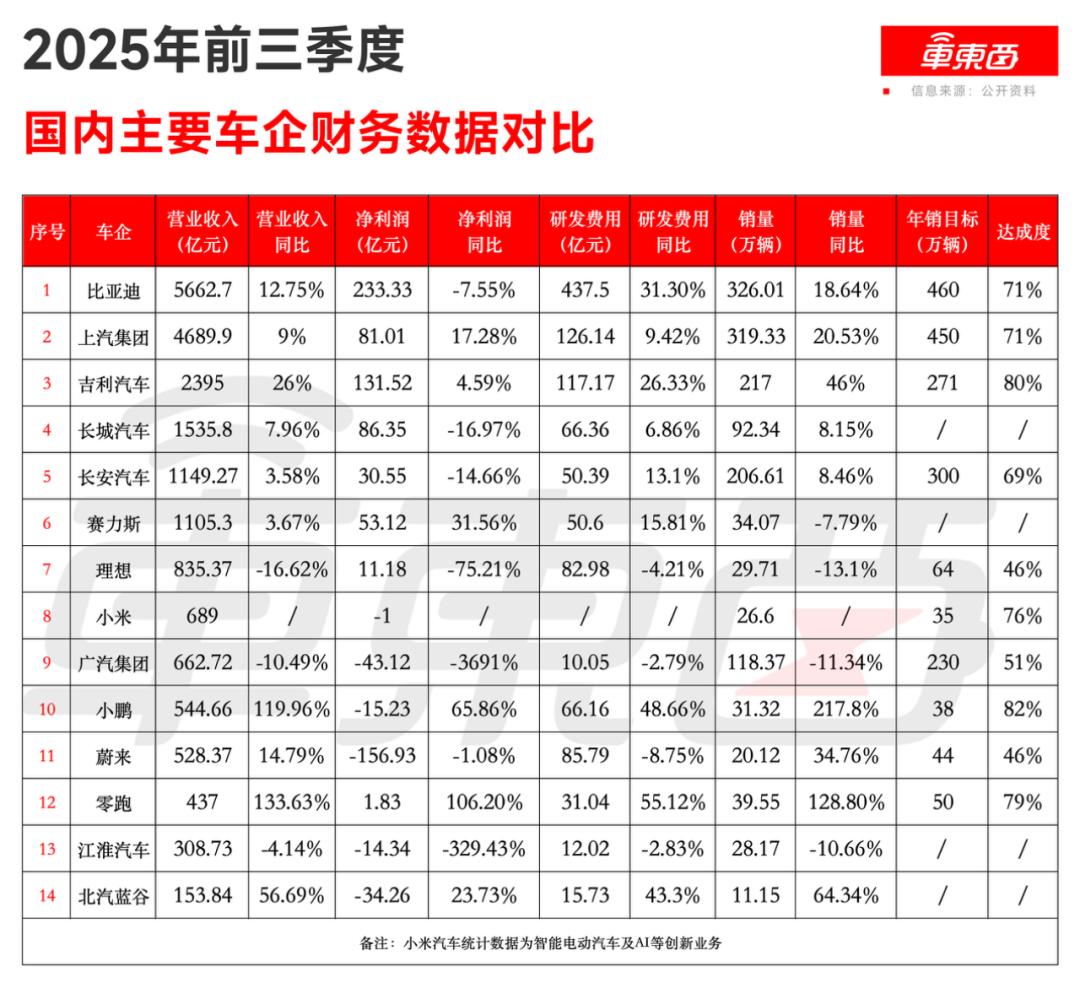
Core Insights - The financial reports of 14 major domestic car manufacturers for the first three quarters of 2025 show a total revenue of 2.07 trillion yuan and a net profit of 364 billion yuan, resulting in a net profit margin of only 1.76% [2][6][22]. Group 1: Financial Performance - Among the traditional car manufacturers, eight companies reported a combined net profit exceeding 471 billion yuan, with BYD leading with a net profit of 233 billion yuan, accounting for 64% of the total net profit of the 14 companies [4][8]. - Geely's revenue reached 239.5 billion yuan, a 26% increase year-on-year, with a net profit of 131.52 billion yuan, benefiting from its accelerated transition to new energy vehicles [8][22]. - The new energy vehicle sector is experiencing significant losses, with six new entrants collectively losing 107 billion yuan, while only Seres, Li Auto, and Leap Motor reported profits [4][6][22]. Group 2: Revenue and Profit Comparison - BYD's revenue was 566.27 billion yuan, a 12.75% increase, while its net profit decreased by 7.55% [5][7]. - SAIC Group reported a revenue of 468.99 billion yuan and a net profit of 81.01 billion yuan, both showing growth [11][22]. - NIO's revenue was 528.37 billion yuan, with a significant net loss of 156.93 billion yuan, highlighting the challenges faced by the company [22][24]. Group 3: R&D Investment - BYD led in R&D investment with 437.5 billion yuan, a 31.3% increase, indicating a commitment to technological expansion despite a slight decline in net profit [25][29]. - Geely's R&D expenditure was 117 billion yuan, up 26%, reflecting its focus on innovation [29][32]. - NIO, despite its losses, invested 85.79 billion yuan in R&D, maintaining a strong commitment to technology development [32][36]. Group 4: Sales Performance - The total sales volume for the 14 companies reached 15 million units, with BYD, SAIC, Geely, and others achieving significant growth [37][41]. - BYD sold 3.26 million vehicles, a year-on-year increase of 18.64%, while SAIC's sales reached 3.19 million units, growing by 20.53% [38][45]. - New entrants like Leap Motor and Xpeng saw substantial sales increases, with Leap Motor's sales up 128.8% and Xpeng's up 217.8% [49][50]. Group 5: Market Dynamics - The competitive landscape in the automotive industry is intensifying, with companies facing pressures from supply chain costs, rapid technological changes, and the need for substantial R&D investments [52]. - The performance of these 14 companies reflects a growing divide in profitability, with only a few achieving a balance between revenue growth and profit margins [22][52].




年终行情悬而未决,“后补贴时代”车市淘汰赛鸣笛
Zheng Quan Shi Bao· 2025-12-05 02:32
Core Viewpoint - The Chinese automotive market faces uncertainty as it transitions into the "post-subsidy era," with increased competition and policy changes impacting sales expectations for the end of 2025 [1][2][5]. Group 1: Market Conditions - Many car manufacturers are uncertain about their sales expectations for December, with some executives stating they are unprepared for the challenges ahead [2]. - The withdrawal of local trade-in subsidies and the upcoming reduction in purchase tax for electric vehicles are significant factors contributing to the market's unpredictability [2][6]. - The cumulative sales of automobiles in China from January to October reached 27.687 million units, reflecting a year-on-year growth of 12.4% [6]. Group 2: Competitive Landscape - The automotive industry is entering a new phase where competition will focus on product quality, cost control, and user experience, marking a shift away from reliance on subsidies [1][4][10]. - The introduction of "bottom-line" subsidy schemes by companies like Xiaomi and NIO indicates a strategic response to pressure from declining sales and inventory management [3][4]. - The market is expected to see a significant differentiation among brands, with larger companies better positioned to absorb profit pressures compared to smaller firms [8][9]. Group 3: Future Outlook - Analysts predict that the automotive market will experience a decline in sales pressure due to macroeconomic factors and policy changes, leading to a more stable and mature phase for the electric vehicle sector [8][10]. - The competition will intensify, with companies needing to innovate and improve efficiency to survive, as traditional factors like technology and cost control become critical in consumer decision-making [9][10]. - The industry is anticipated to undergo a significant reshaping, with only a few strong brands likely to survive in the long term, as indicated by industry leaders [11].
港股消费ETF(159735)年初至今涨超21%,零跑汽车涨超1%,机构:消费有望延续温和增长的新常态
2 1 Shi Ji Jing Ji Bao Dao· 2025-12-05 02:15
Group 1 - The Hong Kong stock market opened lower and continued to decline, with the Hong Kong Consumer ETF (159735) dropping by 0.48% as of the report date, although it has risen over 21% year-to-date as of December 4 [1] - Notable stocks within the ETF include Li Auto and Techtronic Industries, which both increased by over 1%, while Chow Tai Fook, Li Ning, Hengan International, and Midea Group also showed positive performance [1] - The Hong Kong Consumer ETF tracks the CSI Hong Kong Stock Connect Consumer Theme Index, which consists of 50 large-cap, liquid consumer-related stocks within the Stock Connect framework, weighted by free float market capitalization to reflect the overall performance of consumer stocks [1] Group 2 - According to CMB International, consumer spending is expected to see a slight recovery in 2025, with a moderate growth trend continuing into 2026 characterized by slower overall demand growth [2] - The new normal in consumption will be driven by rational consumer behavior and an upward shift in demand levels, leading to structural differentiation that becomes a significant growth driver in niche markets [2] - The market is anticipated to gradually establish a new balance focused on uncovering consumer demand, emphasizing operational efficiency; companies need to accurately perceive consumption trends through product, channel, technology innovation, and supply chain optimization to seize structural opportunities in the new normal [2]


浙江最大贸易伙伴易主凸显区域合作新动能
Sou Hu Cai Jing· 2025-12-05 01:27
Core Viewpoint - A historic shift is occurring in Zhejiang, where ASEAN has surpassed the EU to become the province's largest trading partner for the first time in history, reflecting significant changes in trade dynamics and economic relationships [1][4][13]. Trade Dynamics - From January to October this year, Zhejiang's total import and export value with ASEAN reached 710.61 billion yuan, a year-on-year increase of 16.2%, while trade with the EU totaled 702.94 billion yuan, with a growth rate of only 7.5% [4][6]. - The overall import and export value of Zhejiang for the same period was 4.60 trillion yuan, growing by 5.3%, which is 1.7 percentage points higher than the national average [4][12]. Factors Driving Change - The shift in trade partnerships is attributed to multiple factors, including the accelerated restructuring of global supply chains and the ongoing benefits from the Regional Comprehensive Economic Partnership (RCEP) [4][8]. - ASEAN's role as a significant manufacturing base and consumer market complements Zhejiang's industries, particularly in emerging sectors like digital economy and green energy [4][12]. Export Growth Areas - Exports of electric passenger vehicles from Zhejiang to ASEAN surged by 195%, and lithium-ion batteries increased by 67.2% from January to October [6][10]. - The trade has evolved from primarily labor-intensive products to include high-tech products such as machinery and electric vehicles, indicating a shift towards more sophisticated exports [10][12]. Import Trends - Zhejiang's imports from ASEAN are diversifying beyond raw materials to include high-quality agricultural products and industrial goods [11][12]. Role of Private Enterprises - The transition to ASEAN as the largest trading partner is significantly driven by Zhejiang's robust private enterprise sector, which comprises 112,000 foreign trade companies, with private enterprises accounting for 82% of the province's total import and export value [12][13]. - Private enterprises in Zhejiang have shown a 9.4% growth rate in exports, contributing 96.6% to the overall export growth [12].
零跑C10:03年小姐姐凭眼缘秒定,80后大哥因为颜色玄学买单
车fans· 2025-12-05 00:30
Core Viewpoint - The article discusses the sales performance and customer demographics of the Leap C10 electric vehicle, highlighting its competitive pricing and features in the current market environment [1]. Sales Performance - In October, the store received 39 orders, with 13 units of the C10 sold, indicating a steady demand despite the recent pause in national subsidies [2]. - The store currently has 10 units in stock, with the most popular configuration being the 650悦享版, which has 7 units available, predominantly in black and gray [2][15]. Customer Demographics - The primary customers for the C10 are divided into two groups: middle-aged male customers, typically business owners or private sector employees, who prioritize practicality and cost-effectiveness [3]. - The second group consists of younger female customers, often students or recent graduates, who are more influenced by aesthetics and brand perception [4]. Competitive Analysis - Customers frequently compare the C10 with competitors such as BYD Song PLUS and Deep Blue S07, with battery quality and brand reputation being significant factors in their decision-making process [8][9]. - Older customers express concerns about the Leap brand compared to more established brands like BYD, particularly regarding battery reliability [9]. Pricing and Discounts - The C10 was initially priced firmly upon launch, but by August, discounts of around ¥5,000 became available, with potential total savings reaching nearly ¥20,000 when including government subsidies [15]. - The most popular configuration, the 650悦享版, is priced at ¥125,800 after discounts, with financing options available [16]. Customer Feedback - Common complaints from customers include concerns about battery performance and the vehicle's range, with some attributing these issues to the choice of battery supplier [19]. - Maintenance costs for the C10 are approximately ¥150 for electric models and ¥300-400 for range-extended versions, with service intervals set at 10,000 kilometers or annually [21]. Purchase Incentives - The company offers a trade-in subsidy of ¥4,000 and has recently introduced promotional activities, including a lottery for purchase credits during the National Day period [22].

年终行情悬而未决 “后补贴时代”车市淘汰赛鸣笛
Zheng Quan Shi Bao· 2025-12-04 22:21
Core Viewpoint - The Chinese automotive market faces uncertainty as it transitions into the "post-subsidy era," with increased competition and policy changes impacting sales expectations for the end of 2025 [1][2]. Group 1: Market Dynamics - Many car manufacturers are uncertain about their sales expectations for December, with some indicating a lack of preparedness for the end-of-year sales push [2]. - The withdrawal of local trade-in subsidies and the adjustment of the new energy vehicle purchase tax from full exemption to a 50% reduction are significant factors affecting consumer purchasing decisions [2][3]. - The market is moving away from reliance on policy support, entering a phase where product quality and user experience will be the primary competitive factors [1][6]. Group 2: Competitive Landscape - The competition among car manufacturers is expected to intensify, with a focus on product strength, cost control, and user experience as key differentiators [1][9]. - Smaller brands may struggle to absorb increased sales costs associated with "bottom-line" subsidy schemes, leading to potential operational challenges [4][9]. - The market is predicted to undergo significant differentiation, with leading companies leveraging scale and brand influence to maintain competitiveness [8][10]. Group 3: Industry Trends - The automotive industry is witnessing a shift towards a more transparent and direct competition environment, with a potential "淘汰赛" (elimination race) for less competitive players [10][11]. - Companies that can innovate and maintain service quality are likely to thrive, while those lacking core technology and cost control may face difficulties [10][11]. - The overall sentiment indicates that the automotive market will see a consolidation of strong brands, with predictions that only a few dominant players will remain in the long term [11].
零跑汽车(09863.HK):11月销量连续超7万辆再创历史新高 零跑LAFA5正式上市
Ge Long Hui· 2025-12-04 20:14
Group 1 - The core viewpoint is that Leap Motor has achieved record sales in November, delivering 70,327 vehicles, marking a year-on-year increase of 75.1% and a month-on-month increase of 0.1% [1] - Leap Motor's cumulative sales from January to November reached 536,000 vehicles, representing a year-on-year growth of 113.4%, successfully meeting the annual delivery target of 500,000 vehicles ahead of schedule [1] - The launch of the new model Lafa5 on November 27, priced between 97,800 to 121,800 yuan, is expected to enhance the company's product lineup and drive future sales growth [1] Group 2 - The company is in a strong new vehicle cycle, with plans to launch multiple products globally over the next three years, including the recently launched B10, B01, and Lafa5 [2] - Leap Motor has established a robust domestic sales network with 866 sales outlets as of September 30, 2025, and has expanded its international presence with over 700 sales and service points across approximately 30 markets [2] - The company is increasing its investment in intelligent driving, with a nearly 100% increase in team size and computational resources planned for the first half of 2025 [2] Group 3 - The domestic market is expected to see continued sales growth driven by strong new vehicle cycles and competitive pricing strategies [3] - The partnership with Stellantis, the fourth largest automotive group globally, allows Leap Motor to leverage existing sales and production networks for efficient international expansion [3] - Forecasted net profits for Leap Motor are projected to be 630 million, 5.01 billion, and 8.37 billion yuan for the years 2025 to 2027, with corresponding price-to-earnings ratios of 108.7X, 13.8X, and 8.2X [3]
年终行情悬而未决“后补贴时代”车市淘汰赛鸣笛
Zheng Quan Shi Bao· 2025-12-04 17:50
Core Viewpoint - The Chinese automotive market faces uncertainty as it transitions into the "post-subsidy era," with many companies expressing concerns about market volatility and competition intensifying [1][2]. Group 1: Market Conditions - By the end of 2025, the anticipated "tail effect" in the automotive market remains uncertain, with many companies unprepared for the challenges ahead, particularly those without existing orders [2]. - The withdrawal of local vehicle replacement subsidies and the adjustment of the new energy vehicle purchase tax from full exemption to a 50% reduction are significant factors affecting consumer purchasing decisions [2][3]. - The overall automotive sales in China from January to October reached 27.687 million units, reflecting a year-on-year growth of 12.4% [6]. Group 2: Competitive Landscape - The competition among automotive companies is expected to become more transparent and brutal, focusing on product strength, cost control, and user experience as the market moves away from policy-driven sales [1][6]. - Companies are increasingly adopting "bottom-line" subsidy strategies to boost year-end sales, which may raise sales costs and challenge smaller brands with limited profit margins [4][7]. - The market is predicted to experience significant differentiation, with leading companies leveraging scale advantages and brand influence to withstand price competition, while smaller brands may struggle with cash flow and product iteration [8][9]. Group 3: Future Outlook - The automotive industry is entering a phase where only a few strong brands are expected to survive, with predictions suggesting that in the future, only five dominant brands will remain in the market [11]. - As the market shifts away from reliance on policies, companies lacking core technology and cost control will find it increasingly difficult to maintain stability [10]. - The transition to a more mature and stable new energy vehicle market is anticipated, but not all companies will be able to remain competitive [8][10].
联手华为 小鹏补课增程
Bei Jing Shang Bao· 2025-12-04 16:13
Core Viewpoint - Xiaopeng Motors collaborates with Huawei to launch the Xiaopeng X9 Super Extended Range vehicle, utilizing Huawei's DriveONE integrated high-pressure oil-cooled generator technology to enhance competitiveness in the rapidly growing new energy vehicle market [1][2][4]. Group 1: Collaboration and Technology - The partnership between Xiaopeng Motors and Huawei marks a shift from traditional supplier relationships to a joint R&D model, aimed at improving range extension technology and market competitiveness [1][2]. - The Xiaopeng X9 features the DriveONE generator, which has a power density of 1.88 kW/kg and a peak power output of 85 kW, supporting a cruising range of 150 km without battery depletion [2][3]. - The new generator addresses existing pain points in the industry, such as limited refueling efficiency and insufficient electric range, which traditional systems could not meet [2][3]. Group 2: Market Dynamics - The hybrid and extended range vehicle market is expected to grow rapidly, with projections indicating that by 2025, these vehicles could account for nearly 50% of the new energy vehicle market [4][5]. - Sales of hybrid vehicles in China have increased tenfold from 2020 to 2023, with plug-in hybrid vehicle sales reaching 480,000 units in October 2023, a 13% month-over-month increase [4][5]. - The entry of various brands into the high-end MPV market reflects rising demand, with traditional automakers like Buick and Volkswagen also beginning to focus on hybrid strategies [5][6]. Group 3: Financial Performance and Future Plans - Xiaopeng Motors reported a revenue of 20.38 billion yuan in Q3 2023, a year-on-year increase of 101.8%, with a gross margin of 20.1% [7]. - The company aims to achieve breakeven in Q4 2023, with plans to launch three super extended range products in Q1 2024 to enhance market share [7][8]. - The success of extended range models has been demonstrated by other companies, such as Li Auto and Seres, which have achieved profitability through similar strategies [8].