
蔚来

Search documents
今夜!跳水了!
中国基金报· 2025-12-31 16:18
Group 1 - Chinese concept stocks experienced a significant drop, with the index falling by 1.4% on December 31, 2023, while major U.S. indices also saw slight declines [2][4][5] - NIO, Xpeng Motors, and Li Auto were among the hardest hit, with NIO's stock price dropping nearly 10% [5][6] - The anticipated year-end rally in U.S. stocks, often referred to as the "Santa Rally," has not materialized, attributed to traders delaying major decisions during the holiday season [8] Group 2 - Analysts expect the S&P 500 index to achieve double-digit growth in 2026, but there are concerns about prolonged market fluctuations until corporate earnings catch up with high valuations [9] - The AI sector has been a significant driver of market performance over the past three years, with the S&P 500 rising by 24% in 2023 and 23% in 2024, although performance among major tech companies has started to diverge [9] - Precious metals, including gold and silver, have seen price declines as investors take profits after a historically strong year, compounded by increased margin requirements from CME Group [10][11]


美股全线转跌,中概股下挫,贵金属再跳水,巴菲特正式退休
2 1 Shi Ji Jing Ji Bao Dao· 2025-12-31 15:59
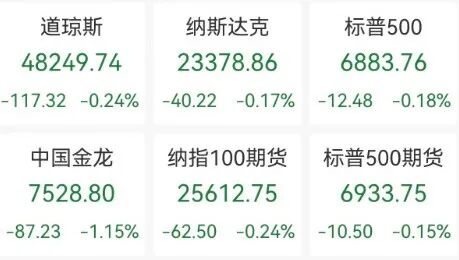
北京时间12月31日晚,美股三大指数小幅高开后全线转跌。 科技股表现不佳,截至22:50,美国科技七巨头多数下跌,英伟达高开后涨幅缩小。 多只热门中概股下跌,纳斯达克中国金龙指数目前跌幅扩大至1%。蔚小理跌幅居前 ,分别跌8.2%、 5.9%和4.9%,百度、网易、新东方、阿里巴巴均跌超1%。上涨方面,联掌门户大涨超25%,灿谷涨超 4%。 反弹仅一天,贵金属再度跳水,目前跌幅有所收窄。截至23:00左右: 美国联邦储备委员会当地时间12月30日公布的12月货币政策会议纪要显示,美联储官员对此次会议降息 决定并未达成一致,对未来货币政策预期也存在明显分歧。 现货黄金一度跌约1.5%,目前涨0.03%。 此外,原油期货小幅上涨,美国天然气期货日内大跌6%。 2025年收官:巴菲特正式退休,全球顶级富豪财富暴增2.2万亿美元 执掌美国投资公司伯克希尔·哈撒韦多年的著名投资家沃伦·巴菲特(95岁)将于12月31日卸任CEO一 职。"投资之神"巴菲特的卸任给市场留下了不安,其继任者副董事长格雷格·阿贝尔的能力备受关注。 巴菲特在2025年5月的年度股东大会上宣布将卸任CEO,但仍将担任董事长。 据智通财经报道,随着股 ...
美股全线转跌,中概股下挫,蔚来跌超8%,贵金属再跳水,巴菲特正式退休
2 1 Shi Ji Jing Ji Bao Dao· 2025-12-31 15:44
北京时间12月31日晚,美股三大指数小幅高开后全线转跌。 多只热门中概股下跌,纳斯达克中国金龙指数目前跌幅扩大至1%。蔚小理跌幅居前,分别跌8.2%、 5.9%和4.9%,百度、网易、新东方、阿里巴巴均跌超1%。上涨方面,联掌门户大涨超25%,灿谷涨超 4%。 | 名称 | 现价 | 涨跌幅 | | --- | --- | --- | | 蔚来 | 5.047 | -8.24% | | 小鹏汽车 | 20.020 | -5.92% | | 理想汽车 | 16.425 | -4.89% | | 博美 | 3.720 | -3.38% | | 水滴公司 | 1.827 | -3.32% | | EPSIUM ENTERPRISE | 2.080 | -2.80% | | ટેટ | 1.510 | -2.49% | | 小牛电动 | 3.090 | -2.22% | | 嘉银科技 | 5.830 | -2.18% | | 小赢科技 | 5.660 | -2.07% | 反弹仅一天,贵金属再度跳水,目前跌幅有所收窄。截至23:00左右: | 道琼斯 | 纳斯达克 | 标普500 | | --- | --- | -- ...

延续弱势,中概股高开低走,黄金冲高回落
Ge Long Hui· 2025-12-31 14:04
维持弱势,全天围绕中轴窄幅盘整,截至收盘稍等再上均小幅收跌,其中道指下跌0.2%,纳指下跌 0.24%,标指下跌0.14%。盘面上,银行股集体收跌,科技股弱势分化,中概股高开低走,黄金冲高回 落。 银行股延续弱势,但整体跌幅不大。美国银行、花旗集团、高盛、摩根士丹利、摩根大通、齐昂银行等 股均小幅收跌。 科技股持续分化,其中英特尔上涨1.69%,高通、谷歌、微软、亚马逊等股均小幅收涨;特斯拉逆势下 跌1.13%,英伟达、苹果、超威公司等股均小幅收跌。 中概股高开低走,截至收盘中国金龙小跌0.27%,其中百度大涨4.39%,小鹏汽车上涨3.8%,蔚来上涨 3%,理想汽车、网易、爱奇艺等股均小幅收涨;京东逆势下跌1.91%。 COMEX黄金冲高回落,截至收盘微涨0.05%报4352.3美元/盎司,盘中最低报4338.8美元/盎司,最高报 4420.5美元/盎司。 理财就是一场修行,有人修有人度,结果就是看谁踩准了点,把握住了机会。 ...
车市告别顺风时代
21世纪经济报道· 2025-12-31 13:52
Core Viewpoint - The Chinese automotive market is at a historic crossroads, transitioning from a growth phase to a competitive landscape characterized by technology, ecology, and globalization, as evidenced by the rising penetration of new energy vehicles (NEVs) and intensified competition among manufacturers [1][2]. Market Dynamics - The retail volume of fuel vehicles decreased by 22% year-on-year, while pure electric vehicles saw a 9.2% increase, pushing the NEV retail penetration rate to 59.3% in November 2025, further rising to 62.3% by mid-December [2]. - The market has shifted from a phase of broad growth to one of intense competition, where companies must focus on technological advancement, ecosystem development, and operational efficiency [4]. Competitive Landscape - BYD, once a dominant player, experienced a 26.81% decline in domestic sales in November 2025, highlighting the pressures from increased competition and the need for continuous technological innovation [4]. - Chery achieved significant growth, with a 54% year-on-year increase in NEV wholesale sales in November 2025, marking its entry into the top three NEV manufacturers [5]. - Traditional automakers like SAIC are rapidly transforming, narrowing the sales gap with BYD, indicating a shift in competitive dynamics [5]. Global Expansion - Chinese automotive exports reached 634.3 million units from January to November 2025, a year-on-year increase of 18.7%, with NEVs becoming a core driver of this growth [9]. - The export strategy has evolved from a trade-focused approach to a more integrated model involving localized production and ecosystem collaboration [9][10]. Policy Changes and Market Outlook - Key policy adjustments, including changes to the new energy vehicle purchase tax, are expected to drive companies to enhance cost control and supply chain optimization [15]. - The market is anticipated to see modest growth in 2026, with a focus on high-quality transitions rather than mere volume expansion, as companies adapt to new competitive realities [16]. Strategic Focus - Companies are expected to concentrate on product iteration, technological implementation, and cost optimization in the domestic market, while also enhancing localization and ecosystem output in overseas markets [17][18]. - The ability to establish a technological and ecological moat domestically, along with a sustainable operational framework internationally, will be crucial for companies navigating the upcoming competitive landscape [18].

新能源汽车售后,谁是一条龙,谁是一条虫
3 6 Ke· 2025-12-31 12:09
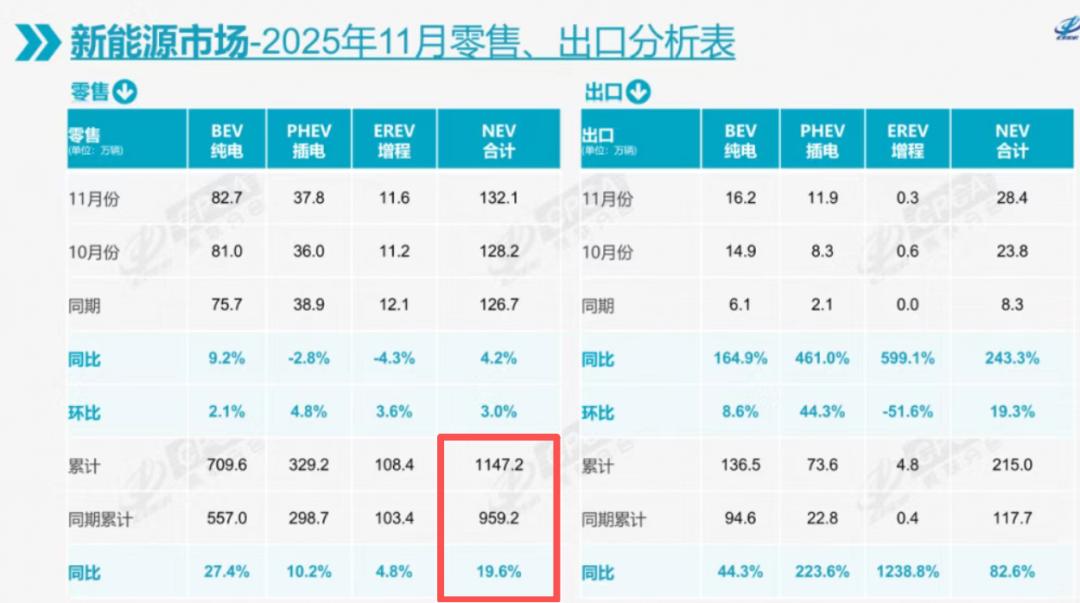
Core Insights - The retail sales of new energy passenger vehicles reached 11.472 million units in the first 11 months, a year-on-year increase of 19.6%, surpassing traditional fuel vehicles by 1.462 million units [1] - In November, the domestic retail penetration rate of new energy vehicles surged to 59.3%, an increase of seven percentage points year-on-year [1] Sales Data Summary - In November, the retail sales of new energy vehicles included 827,000 BEVs, 378,000 PHEVs, and 116,000 EREVs, totaling 1.321 million units [2] - Compared to October, November saw a 2.1% increase in BEV sales, a 4.8% increase in PHEV sales, and a 3.6% increase in EREV sales [2] - Cumulatively, from January to November, BEV sales reached 7.096 million units, PHEV sales reached 3.292 million units, and EREV sales reached 1.084 million units, totaling 11.472 million units [2] Customer Experience Challenges - Many new energy vehicle owners report dissatisfaction with post-purchase experiences, particularly regarding after-sales service [3] - Common complaints include delays in service response, issues with vehicle systems, and inadequate support for charging infrastructure [4][6] - The gap between sales promises and actual service delivery is becoming a significant concern for consumers [3][7] After-Sales Service Issues - Customers have expressed frustration over the reliability of charging stations and the responsiveness of customer service when issues arise [4][6] - Repair experiences can be lengthy and complicated, especially in areas lacking official service centers [8][19] - The high technical complexity of electric vehicles creates challenges for maintenance and repair, leading to longer wait times for parts and service [16][19] Industry Response and Strategies - Different companies are adopting varied strategies to address after-sales service challenges [21] - NIO has focused on building a high-quality service ecosystem, including extensive battery swap networks and dedicated service centers [25] - Tesla integrates sales and service through a direct sales model, ensuring transparency and efficiency in service delivery [27] - Other companies, like Hongmeng Zhixing, leverage existing networks to enhance service offerings, creating a more customer-centric experience [30] Conclusion - The new energy vehicle market is experiencing rapid growth, but the disparity between sales and service quality poses risks to customer satisfaction and brand loyalty [31] - Companies must prioritize after-sales service as part of their long-term strategy to remain competitive in the evolving market landscape [31]

蔚来吹哨,日本动手:电车要称重计税?
3 6 Ke· 2025-12-31 11:22
(原标题:蔚来吹哨,日本动手:电车要称重计税?) 作者 | 丁卯 编辑 | 张帆 蔚来李斌的一句"吐槽",竟成了全球新能源车税制改革的先声。 今年5月,李斌曾公开表达过"新能源车越重,道路损耗越大"的观点,当时被不少人解读为其对自家换 电模式的"站台",甚至登上热搜,引发了舆论争议。 然而,仅半年后,日本财务省便印证了这一"物理直觉"。近日,日本财务省在《令和8年度税制改正要 望事项》中提出,计划将电动汽车重量关联税负纳入"车体课税绿色化"改革。自2028年5月起,日本将 对私人购买的电动车(含纯电及插混)征收新税,采用"车重越重、税额越高"的阶梯机制。 事实上,这种税制转型已成全球趋势。此前,英国曾计划自2028年起征收里程税(3便士/英里),新西 兰及美国部分州也已推行注册附加费。这背后反映出随着全球新能源汽车渗透率的提升,传统的燃油税 收入急剧萎缩,已难以支撑庞大的基建养护开支。 作为全球最大的新能源车市场,2025年中国新能源车透率已经跨越50%大关,标志着市场已正式步入成 熟期。 那么,面对日本的"重量税"样板,未来中国是否也会效仿建立本土化的"新能源课税体系"? 日本针对新能源车祭出重量税 日本此 ...
纳斯达克中国金龙指数上涨1%
Xin Lang Cai Jing· 2025-12-31 10:51
Group 1 - The Nasdaq China Golden Dragon Index has increased by 1% [1] - Baidu Group has seen a rise of nearly 6% [1] - NIO has surged over 5% [1] - XPeng Motors and WeRide have both increased by over 3% [1]


头部做大、腰部塌陷,但中国车市仍难迎寡头时代
Xin Lang Cai Jing· 2025-12-31 10:11
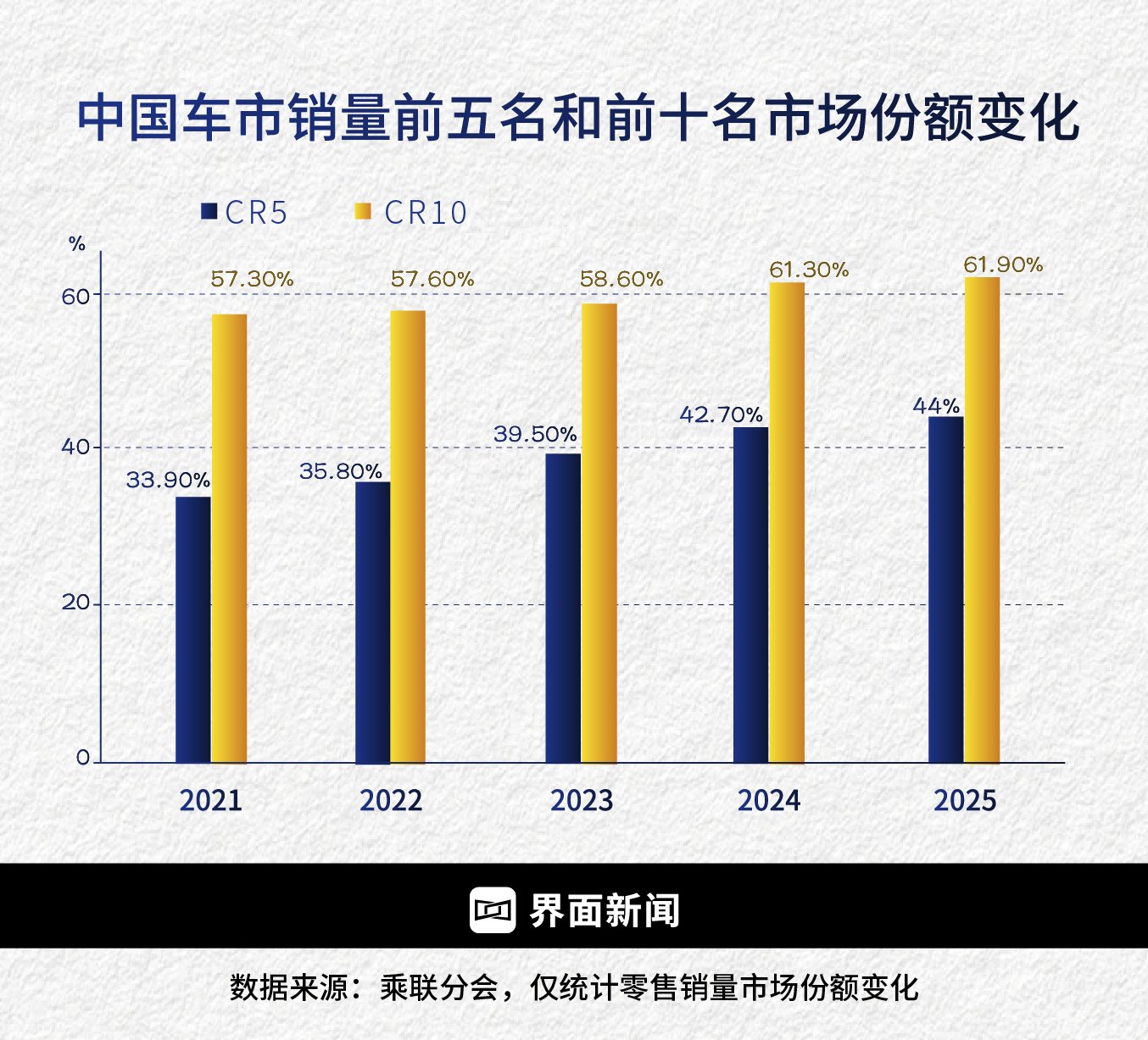
Group 1 - The Chinese passenger car market is undergoing a significant structural transformation, with overall growth slowing and market concentration increasing, leading to a clear advantage for leading companies in terms of sales and resources, while traditional mid-tier brands face severe survival pressures [1] - The market share of the top five automotive companies increased from 33.9% in 2021 to 44% by 2025, while the top ten's market share rose from 57.3% to 61.9%, indicating a shift from multi-brand competition to dominance by a few enterprises [1] - Geely Auto Group has shown the most significant market share growth among leading companies, increasing by approximately 3.5 percentage points compared to 2024, driven by the sales growth of new energy vehicles supported by government subsidies [3] Group 2 - BYD's market share has slightly declined this year but remains close to 15%, attributed to its vertically integrated supply chain that maintains product price advantages and a strong product offensive that ensures the launch of popular models across different market segments [4] - The strategy of using a shared platform for multiple models allows companies to reduce trial and error costs while maximizing market returns, enhancing the marginal returns on R&D investments [4] - Leading automotive companies are strengthening their scale advantages and cost efficiency through internal integration, as the focus shifts from technological leadership to cost competition in a market characterized by product homogeneity and slow technological iteration [7] Group 3 - The rapid collapse of mid-tier companies is evident, particularly in the second-tier joint venture brands, with significant sales declines reported for Dongfeng Nissan and GAC Honda from 2022 to 2024 [8] - New car-making forces like Li Auto, NIO, XPeng, and others are filling the gap left by traditional mid-tier brands, with their sales surpassing those of GAC Honda and Dongfeng Honda, entering the top 20 in annual sales rankings [8] - For mid-tier enterprises to survive, joint venture brands must develop products tailored to the Chinese market rather than simply importing overseas models, while new car-making forces need to achieve profitability and build operational capabilities to support large-scale production [9] Group 4 - The ongoing consolidation efforts among major automotive companies, such as the proposed merger between Changan and Dongfeng, highlight the complexities and challenges of achieving clear leadership in the market due to administrative disparities and high integration difficulties [10] - The current market dynamics suggest that while some foreign brands may exit, the overall number of participants may not significantly decrease, and the competition remains complex and ongoing [10] - The impressive sales figures of leading companies may be viewed as short-term responses to capital market pressures rather than indicators of long-term stability and profitability [10] Group 5 - The absolute dominance of leading companies, the elimination of mid-tier players, and the clearing out of lower-tier brands indicate that the market structure is still maturing, with the final outcome of the competitive landscape in the Chinese automotive market still unfolding [14]
调研速递|万安科技接待山西证券等7家机构 无线充电效能超92% EMB产品2026年将量产
Xin Lang Cai Jing· 2025-12-31 08:20
Core Insights - The company, Wan'an Technology, and its parent company, Wan'an Group, engaged in a specific investor survey to discuss key topics such as aluminum-magnesium alloy product layout, wireless charging project progress, convertible bond issuance plans, performance growth points, and cost control measures [1] Group 1: Business Layout and Project Progress - The aluminum-magnesium alloy business is focused on lightweight chassis components, primarily aluminum alloy products, which are crucial for the new energy vehicle (NEV) sector, with key products like aluminum alloy subframes and fixed calipers already integrated into the supply chains of leading NEV manufacturers such as Leap Motor, NIO, and Xiaomi [2] - The wireless charging project by the subsidiary Yichuang Zhilian has achieved multi-scenario deployment, including passenger vehicles and low-speed unmanned vehicles, with a commercial progress in the low-speed unmanned vehicle sector and partnerships established with companies like Huzhou Columbus and Yingfeng Environment. The wireless charging efficiency in passenger vehicles reaches 92%-93%, leading the industry [3] - The company’s subsidiary Hengchuang Zhixing is set to start small-scale production of electronic mechanical brake systems (EMB) for passenger vehicles in 2026, following the implementation of new regulations. This product is expected to enhance safety and reduce weight, becoming a significant growth driver for the company [4] Group 2: Financial Planning and Cost Control - The company has successfully issued the first phase of convertible bonds and plans to initiate the second phase after the first phase's completion to optimize its capital structure and support business expansion [5] - To mitigate the impact of rising raw material costs, the company is implementing various cost control measures, including procurement cost reduction, product structure optimization, and price linkage mechanisms to ensure stable profitability [6] Group 3: Future Strategy - The company aims to focus on automotive electronic control systems as its core development direction, continuing to advance the marketization of aluminum alloy lightweight components and intelligent driving projects, leveraging existing customer resources and technological accumulation for steady growth [7]

