
万科

Search documents
下周重磅日程:美非农、欧英央行决议、日本大选、伊朗局势、谷歌亚马逊AMD财报
Hua Er Jie Jian Wen· 2026-02-01 03:53
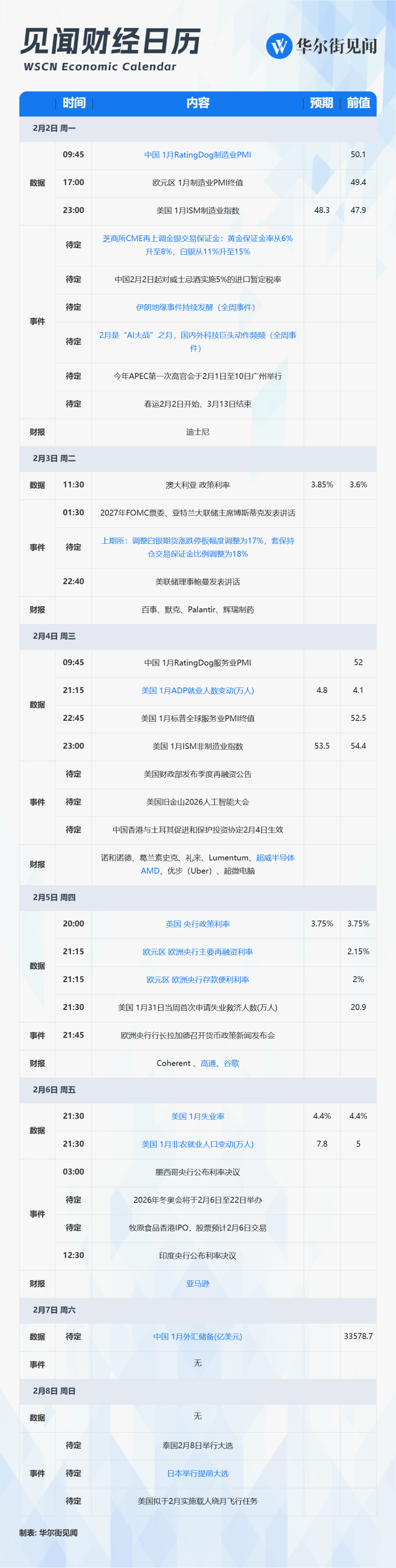
Economic Data - China's January Manufacturing PMI is expected to be 50.1, indicating a slight recovery in manufacturing activity [3] - Eurozone's January Manufacturing PMI final value is reported at 49.4, showing continued contraction [3] - The US ISM Manufacturing Index for January is anticipated to rise to 48.3 from 47.9, suggesting a potential stabilization in manufacturing [3] Central Bank Decisions - The Reserve Bank of Australia is expected to raise its policy rate to 3.85% from 3.6% [4] - The European Central Bank and the Bank of England are both expected to maintain their current interest rates during their upcoming meetings [9] Major Corporate Earnings - Key earnings reports are expected from major companies including Disney, Pepsi, Merck, and Pfizer, with a focus on their performance in the current economic climate [4][26] - Tech giants like Google and Amazon will report on their cloud business growth, which is critical for assessing AI monetization capabilities [6][26] Geopolitical Events - Ongoing tensions in Iran are highlighted, with the US increasing military presence in the region, which may impact global markets [12] - Japan and Thailand are set to hold significant elections on February 8, which could influence regional political stability [15][17] IPOs and Market Movements - Muyuan Foods is set to launch its IPO in Hong Kong, potentially raising up to 14 billion HKD (approximately 1.8 billion USD) [28] - The Shanghai Futures Exchange has adjusted the trading limits and margin requirements for silver futures, reflecting a tightening in trading conditions [11] Commodity Market Changes - CME has raised the margin requirements for gold from 6% to 8% and for silver from 11% to 15%, indicating a move to reduce leverage in the precious metals market [10] - The Chinese government has implemented a temporary 5% import tax on whiskey starting February 2 [19]



房企座次再洗牌,万科下滑、中旅投资成“黑马”
Di Yi Cai Jing· 2026-01-31 15:00
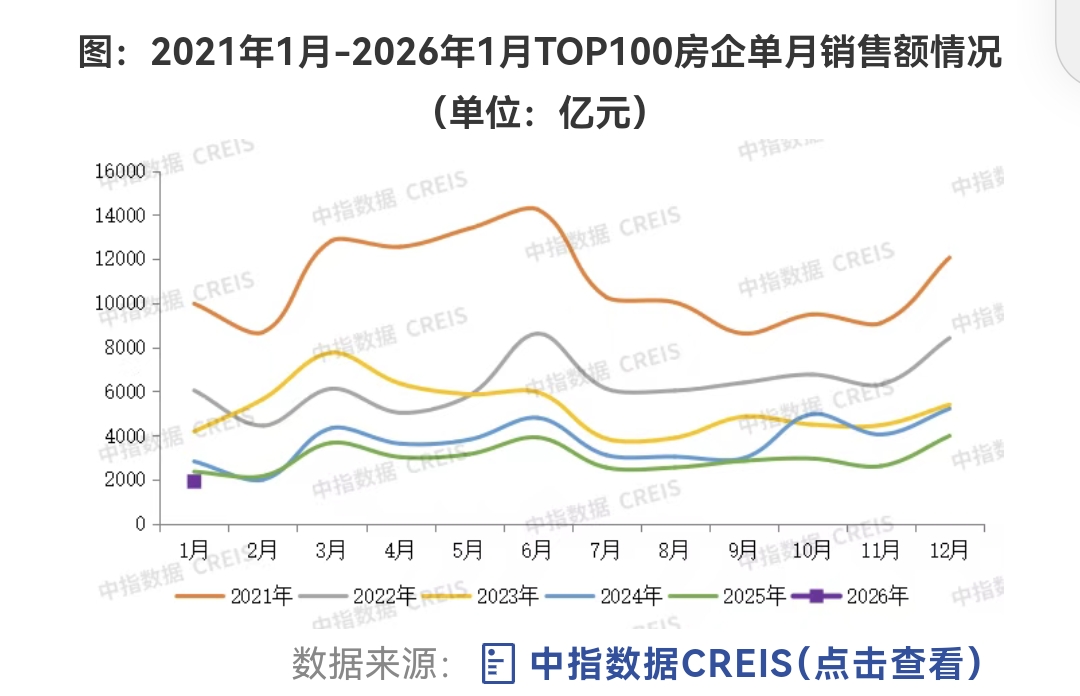
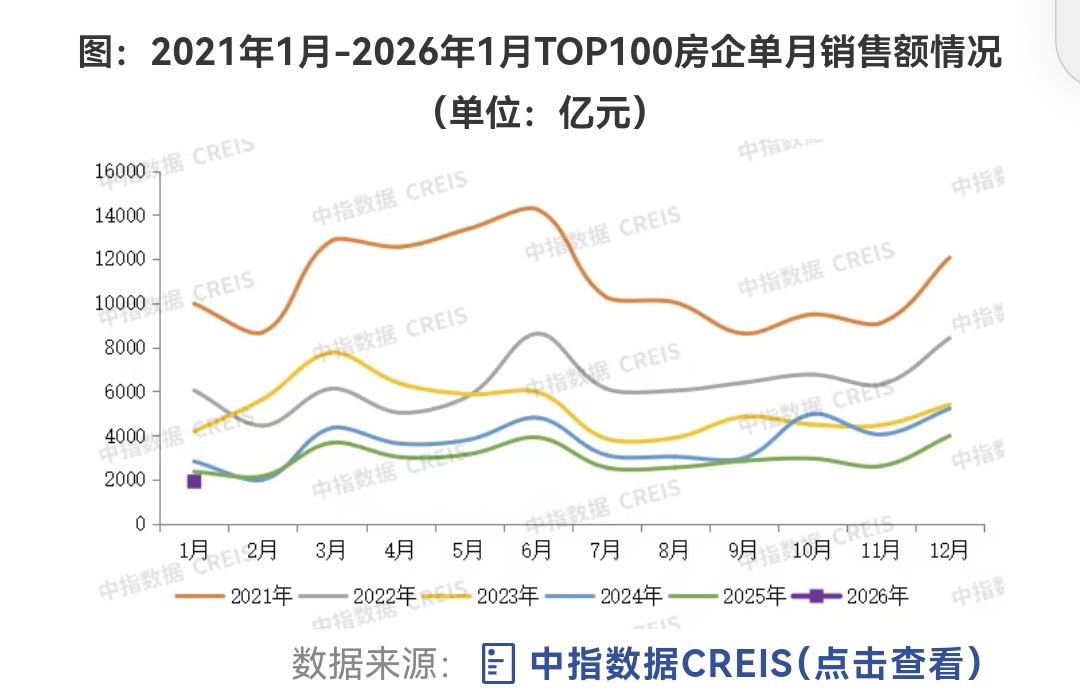
Core Insights - In January 2026, the top 100 real estate companies in China reported a total sales revenue of 190.52 billion yuan, a year-on-year decrease of 18.9% [1] - The equity sales amount for the same group was 132.14 billion yuan [1] - The top ten companies by sales included Poly Developments, China Overseas Land, and China Resources Land, with only Poly, China Overseas, and China Resources exceeding 10 billion yuan in sales for the month [1] Sales Performance - The average sales revenue for the top 10 companies was 9.33 billion yuan, down 11.6% year-on-year [2] - Companies ranked 11-30 had an average sales revenue of 2.6 billion yuan, a decline of 25.6% [2] - Companies ranked 31-50 reported an average sales revenue of 1.03 billion yuan, down 21.0% [2] Market Dynamics - The decline in sales is attributed to the high base from January of the previous year when the market was more active due to policy changes [5] - The real estate industry is undergoing an adjustment, with a shift from "scale competition" to "quality competition," leading to resource concentration among stronger companies [5] - In January 2026, 32 companies among the top 100 reported year-on-year sales growth, with 10 companies experiencing growth exceeding 100% [5] Market Trends - The new housing market showed weak performance in January, while the second-hand housing market demonstrated notable growth, with transaction volumes increasing by 33% year-on-year [6] - The central government has been signaling stability in market expectations, emphasizing the importance of managing expectations to stabilize the real estate market [6] - Recent policy measures include lowering the down payment ratio for commercial property loans and adjusting monetary policy tools [6] Future Outlook - As the Chinese New Year approaches, real estate companies are expected to increase marketing efforts, which may sustain some activity in core city markets [7] - There are ongoing challenges for companies to convert financial restructuring into sustainable operational capabilities [7]



房企座次再洗牌,万科下滑中旅投资成“黑马”
Di Yi Cai Jing· 2026-01-31 14:52
百强房企1月卖房"成绩单"出炉。 2026年开年,百强房企1月卖房"成绩单"出炉。 1月31日,中指研究院发布数据显示,2026年1月,TOP100房企销售总额为1905.2亿元,同比下降18.9%;同期,TOP100房企权益销售额为1321.4亿元。 房企销售金额前十依次为:保利发展、中海地产、华润置地、绿城中国、中旅投资、招商蛇口、中国金茂、建发房产、万科、滨江集团,其中仅保利、中 海、华润单月销售过百亿。 对比上年同期,房企销售位次已经发生了较大变化。头部房企中,保利、中海、华润、绿城的顺序未变,但万科从上年1月的第5位,下滑至今年1月的第9 位。中旅投资短期内成为"黑马",闯到今年1月房企全口径销售榜第5位。 TOP10随后的房企中,招商蛇口、建发房产、滨江集团变化不大、依然位列其中,但是华发股份从去年1月的第6位降至今年1月的第18位,同期中国铁建 从第10位降至第13位,中国金茂则从去年1月的第13位升至今年1月的第7位。 克而瑞数据显示,1月全国重点50城市新建商品住宅成交面积约810万平方米,表现较为清淡,新房市场整体进入淡季;同期,重点13城市二手房成交面积 约810万平方米,环比上升16% ...
信用利差周度跟踪 20260130:利率震荡信用利差略有回落二永债表现偏弱-20260131
Huafu Securities· 2026-01-31 14:48
1. Report Industry Investment Rating No information provided in the content. 2. Core Viewpoints of the Report - Interest rates are fluctuating narrowly, credit bond yields have slightly declined, and most credit spreads are still narrowing. [3][9] - Most urban investment bond spreads have decreased by 1 - 2BP. [14] - Real - estate bond spreads are still widening, while most other industrial bond spreads are converging. [25] - This week, Tier 2 and perpetual bonds (Two - and - Perpetual bonds, "Two - and - Perpetual" bonds refer to bank Tier 2 capital bonds and perpetual bonds) have shown weak performance. Except for the 5Y variety, most yields have increased. [4][33] - The excess spread of 3Y industrial perpetual bonds has narrowed, while the excess spread of urban investment bonds has shown differentiation. [4][36] 3. Summary According to Relevant Catalogs 3.1 Interest rates are fluctuating narrowly, credit bond yields have slightly declined, and most credit spreads are still narrowing - Interest - rate bond yields fluctuated narrowly. The yields of 1Y and 10Y China Development Bank bonds increased by 1BP, the yield of 3Y decreased by 1BP, and the yields of 5Y and 7Y remained flat. [3][9] - Credit bond yields generally declined slightly. The yields of 1Y AA + and above - grade credit bonds increased by 1BP, while the other grades remained flat; the yield of 3Y AAA remained flat, and the other grades decreased by 2 - 4BP; the yields of 5Y AA + and above - grade remained flat, and the other grades increased by 1BP; the yields of 7Y all grades decreased by 1 - 3BP; the yields of 10Y all grades increased by 1BP. [3][9] - Most credit spreads slightly converged. The credit spreads of 1Y AA + and above - grade remained flat, and the other grades narrowed by 1BP; the spread of 3Y AAA increased by 1BP, the spread of AA - decreased by 1BP, and the other grades compressed by 3BP; the spreads of 5Y AA + and above - grade remained flat, and the other grades widened by 1BP; the spreads of 7Y all grades narrowed by 1 - 3BP; the spreads of 10Y all grades narrowed by 1BP. [3][9] 3.2 Most urban investment bond spreads have decreased by 1 - 2BP - In terms of external ratings, the credit spreads of external - rated AAA platforms generally decreased by 1BP compared with last week, and the credit spreads of AA + and AA platforms generally decreased by 2BP. [14] - By administrative level, the credit spreads of provincial - level platforms generally decreased by 1BP compared with last week, and the credit spreads of prefecture - level and district - county - level platforms generally decreased by 2BP. [19] 3.3 Real - estate bond spreads are still widening, while most other industrial bond spreads are converging - Most industrial bond spreads converged. The spread of Vanke continued to compress significantly, but the spreads of central and state - owned enterprise real - estate bonds and other private - enterprise real - estate bonds still widened overall. [25] - The spreads of central and state - owned enterprise real - estate bonds widened by 1 - 3BP, the spread of mixed - ownership real - estate bonds converged by 188BP, and the spread of private - enterprise real - estate bonds increased by 15BP. [25] - The spread of Longfor decreased by 2BP, that of CIFI increased by 49BP, that of Vanke decreased by 1802BP, that of Midea Real Estate decreased by 1BP, that of Huafa increased by 13BP, and that of Poly increased by 3BP. [25] - The spread of AA - grade coal bonds increased by 1BP, and the other grades decreased by 1BP; the spread of AAA - grade steel bonds remained flat, and that of AA + decreased by 2BP; the spread of AAA - grade chemical bonds remained flat, and that of AA + decreased by 1BP. [25] 3.4 This week, Tier 2 and perpetual bonds have shown weak performance. Except for the 5Y variety, most yields have increased - The yields of 1Y all - grade Tier 2 capital bonds remained flat, and the spreads decreased by 0 - 1BP; the yields of all - grade perpetual bonds increased by 1 - 2BP, and the spreads increased by 0 - 1BP. [33] - The yields of 3Y all - grade Tier 2 capital bonds increased by 2 - 3BP, and the spreads widened by 3 - 4BP; the yields of all - grade perpetual bonds remained flat, and the spreads widened by 1BP. [33] - The yields of 5Y all - grade Tier 2 capital bonds decreased by 0 - 2BP, the yields of perpetual bonds remained flat, and the spreads changed by the same margin. [33] - The yields of 10Y all - grade Tier 2 capital bonds increased by 2 - 5BP, and the spreads widened by 1 - 3BP; the yields of perpetual bonds increased by 5BP, and the spreads increased by 3BP. [33] 3.5 The excess spread of 3Y industrial perpetual bonds has narrowed, while the excess spread of urban investment bonds has shown differentiation - The excess spread of industrial AAA - grade 3Y perpetual bonds converged by 0.76BP compared with last week to 13.91BP, at the 36.17% percentile since 2015. The excess spread of industrial 5Y perpetual bonds remained the same as last week at 13.21BP, at the 33.60% percentile since 2015. [36] - The excess spread of urban - investment AAA - grade 3Y perpetual bonds increased by 0.83BP to 4.86BP, at the 5.43% percentile. The excess spread of urban - investment 5Y perpetual bonds decreased by 3.72BP to 9.62BP, at the 11.15% percentile. [36] 3.6 Credit Spread Database Compilation Instructions - The overall market credit spreads, commercial bank Tier 2 and perpetual spreads, and urban - investment/industrial perpetual bond credit spreads are calculated based on ChinaBond Medium - and Short - Term Notes and ChinaBond Perpetual Bonds data. The historical percentiles are since the beginning of 2015. [38] - The credit spreads related to urban - investment and industrial bonds are compiled and statistically analyzed by the Huafu Securities Research Institute, and the historical percentiles are since the beginning of 2015. [38] - The credit spreads of industrial and urban - investment individual bonds = the ChinaBond valuation (exercise) of individual bonds - the yield to maturity of the same - term China Development Bank bonds (calculated by the linear interpolation method), and finally the arithmetic average method is used to calculate the credit spreads of the industry or regional urban - investment bonds. [40] - The excess spread of bank Tier 2 capital bonds/perpetual bonds = the credit spread of bank Tier 2 capital bonds/perpetual bonds - the credit spread of bank ordinary bonds of the same grade and term. The excess spread of industrial/urban - investment perpetual bonds = the credit spread of industrial/urban - investment perpetual bonds - the credit spread of medium - term notes of the same grade and term. [40] - Sample screening criteria and other information: Both industrial and urban - investment bonds select medium - term notes and public - offering corporate bond samples, and exclude guaranteed bonds and perpetual bonds. If the remaining term of an individual bond is less than 0.5 years or more than 5 years, it will be excluded from the statistical samples. Industrial and urban - investment bonds are all external entity ratings, while commercial banks use ChinaBond implicit debt ratings. [40]
信用周报 20260131:债市延续修复,中长普信债表现偏强-20260131
Huachuang Securities· 2026-01-31 13:47
证 券 研 究 报 告 【债券周报】 债市延续修复,中长普信债表现偏强 ——信用周报 20260131 本周信用债收益率、信用利差走势分化。本周权益高位震荡,年初配置行情 延续叠加央行创新货币政策工具催化,收益率延续修复。全周来看,信用债表 现强于利率债。3y 及以上中长端普信债、2-4y 券商次级债收益率有所下行, 利差有所收窄,其中 3-4y 普信债、5y 城投、4y 券商次级债表现相对占优;其 余品种收益率多数上行,除 1y 品种外利差以走阔为主。近期仍处于摊余债基 开放高峰,3-5y 品种普信债利差进一步压缩。 热点重点政策及热点事件 1、央行副行长表示将增加离岸人民币国债供给规模。这一举措有利于满足境 外投资者对优质人民币资产配置的需要,活跃市场交易、提升人民币定价能力。 2、吉林省成功退出地方债务重点省份。吉林省债务体量相对较小,率先退出 重点省份基本符合市场预期,可重点关注退重点省份后区域发展机会及发债主 体新增融资空间。 3、万科公布与深铁 23.6 亿借款方案。借款方案背靠深铁将为债券部分兑付提 供资金保障,万科债务风险的缓释有助于阶段性稳定市场预期。 4、多家房地产企业已不再被监管部门要求 ...
A股52家上市房企:5家预亏超百亿,12家预计盈利!
Sou Hu Cai Jing· 2026-01-31 13:15
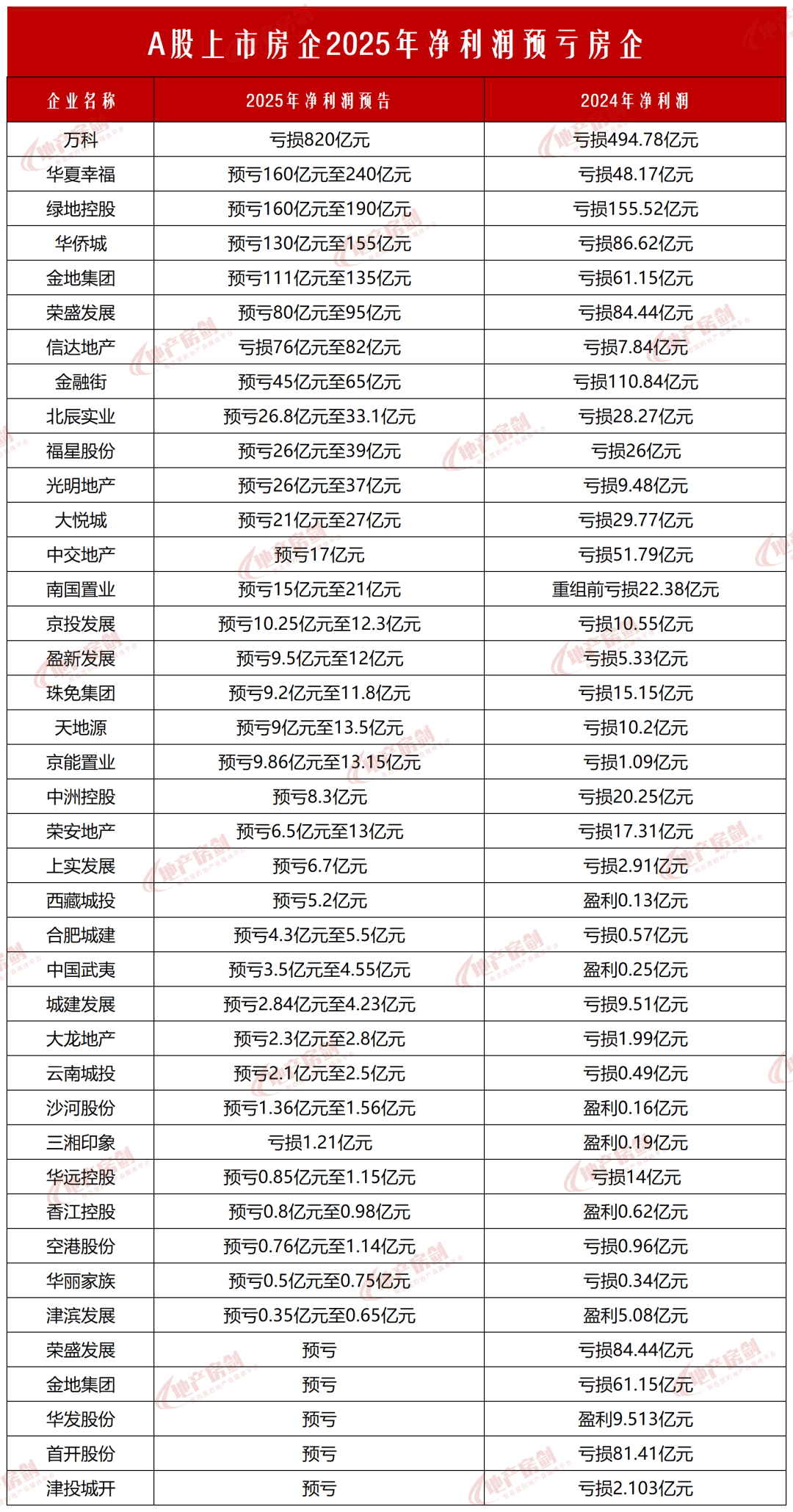
Core Viewpoint - The majority of A-share listed real estate companies are expected to report significant losses for the year 2025, indicating a challenging market environment for the industry [1][2]. Group 1: Loss Predictions - Out of 52 listed real estate companies, 40 are expected to report losses for 2025, which means over 80% of these companies are projected to be in the red [1]. - Five companies are expected to report losses exceeding 10 billion yuan, with Vanke leading at a projected loss of 820 billion yuan, followed by China Fortune Land Development, Greenland Holdings, Overseas Chinese Town, and Gemdale [2][3]. - Vanke's cumulative losses for 2024 and 2025 are projected to be nearly 1,315 billion yuan, surpassing the total profits from 2019 to 2023 [3]. Group 2: Reasons for Losses - The losses are attributed to declining property prices and significant impairment provisions that companies have had to make over the past two years [9][10]. - Many companies had previously anticipated a market recovery and began to recognize inventory impairments, but the continued market downturn has forced them to increase these provisions [10]. Group 3: Companies Reporting Profits - Twelve companies are expected to report profits, with Jinke Real Estate projected to achieve a net profit of 300 billion to 350 billion yuan, primarily due to successful restructuring [12][13]. - Poly Developments and China Merchants Shekou are also expected to report profits, albeit with significant declines compared to 2024, primarily due to impairment provisions [16][17]. Group 4: Market Dynamics - The list of loss-making companies includes a mix of private, state-owned, and central enterprises, indicating that the nature of the company does not correlate with the likelihood of losses [7]. - State-owned platform companies, which previously supported land acquisitions, are now facing increased pressure due to the ongoing market decline [8]. Group 5: Future Outlook - The upcoming annual report season in March and April 2025 will provide more detailed insights into the operational conditions of these companies [25].


首批商业不动产 REITs 申报:商业不动产 REITs,资产出表再添工具
GUOTAI HAITONG SECURITIES· 2026-01-31 12:53
Investment Rating - The report assigns an "Overweight" rating for the commercial real estate REITs sector [6]. Core Insights - The launch of commercial real estate REITs in China is expected to significantly improve corporate cash flow and performance, optimizing financial statements and guiding the industry towards a new model of development [2][6]. - The first batch of commercial real estate REITs has entered the application stage, accelerating the development process [6]. - The report highlights several recommended companies across different categories, including development, residential-commercial, property management, and cultural tourism [6]. Summary by Relevant Sections Investment Highlights - The first batch of commercial real estate REITs covers diverse asset types such as hotels, offices, and commercial complexes, enhancing the range of underlying assets [2]. - Specific REITs mentioned include: 1. Huazhong Jinjiang Closed-end Commercial Real Estate Securities Investment Fund, with a projected fundraising scale of 1.703 billion yuan and an annualized cash distribution rate forecast of 3.44% for 2025 [6]. 2. Huitianfu Shanghai Real Estate Closed-end Commercial Real Estate Securities Investment Fund, with a projected fundraising scale of 4.002 billion yuan and an annualized cash distribution rate forecast of 4.50% for 2026 [6]. 3. CICC Vipshop Closed-end Commercial Real Estate Securities Investment Fund, with a projected fundraising scale of 7.47 billion yuan and an annualized cash distribution rate forecast of 4.57% for 2026 [6]. Company Profitability Forecast - The report provides profitability forecasts for key companies, indicating expected earnings per share (EPS) and price-to-earnings (PE) ratios for 2024 to 2026, with all listed companies receiving an "Overweight" rating [8]. - Notable companies include: - Vanke A, with a projected EPS of -4.17 yuan for 2024 and a market cap of 54.22 [8]. - China Overseas Development, with a projected EPS of 1.43 yuan for 2024 and a market cap of 8.93 [8]. - Longfor Group, with a projected EPS of 1.58 yuan for 2024 and a market cap of 5.93 [8].



万科发布2025年度业绩预告 称将全力以赴推进经营改善
Nan Fang Du Shi Bao· 2026-01-31 02:47
Core Viewpoint - Vanke is expected to report a net loss of 82 billion yuan for 2025, a significant increase from the previous year's loss of 49.478 billion yuan, primarily due to declining project settlement scale and high land acquisition costs [1] Group 1: Financial Performance - The expected net loss for 2025 is attributed to a significant decrease in the scale of real estate project settlements and low gross margins [1] - The company has increased provisions for credit impairment and asset impairment due to heightened business risk exposure [1] - Losses in operational business after deducting depreciation and amortization, along with losses from non-core financial investments, have contributed to the overall financial downturn [1] Group 2: Support from Major Shareholder - Shenzhen Metro Group has provided over 30 billion yuan in shareholder loans to Vanke, with terms more favorable than market conditions, aiding in liquidity pressure relief [2] - The major shareholder has strengthened business collaboration with Vanke, including a leasing operation framework agreement for long-term rental apartments [2] - A pilot cooperation project involving autonomous delivery by robots in the subway has been initiated, with plans for gradual rollout in Q4 2025 [2] Group 3: Operational Highlights - Vanke successfully delivered 117,000 housing units in 2025, with 16,000 units delivered 30 days ahead of schedule and approximately 5,000 units delivered across the year-end [2] - The company's operating service business reported revenue of 43.57 billion yuan by Q3 2025, maintaining stability, with the long-term rental business leading the industry in scale and efficiency [2] - The property management segment oversees over 4,400 residential projects and more than 2,500 commercial projects, showcasing industry-leading scale and service capabilities [2] Group 4: Logistics and Commercial Business - Vanke's logistics business has over 10 million square meters of rentable warehouse space, ranking among the top tier in the industry, with a cold chain business also leading in scale [3] - The high-standard warehouse rental rate stands at 86%, maintaining a competitive level in the industry [3] - The commercial business has seen steady growth in foot traffic and sales, with an overall rental rate of 92% [3] Group 5: Future Outlook - The company acknowledges ongoing severe challenges and anticipates continued pressure on operational performance [3] - Vanke plans to focus on operational improvements through strategic focus, standardized operations, and technological empowerment to optimize business layout and structure [3] - The company aims to collectively address risks and work towards overcoming current difficulties to emerge from the downturn [3]
万科发布2025年度业绩预告,称将全力以赴推进经营改善
Nan Fang Du Shi Bao· 2026-01-31 02:45
Group 1 - The core point of the article is that Vanke is forecasting a significant net loss of 82 billion yuan for the year 2025, compared to a loss of 49.478 billion yuan in the previous year [2] - The decline in profitability is attributed to a significant decrease in the scale of real estate project settlements and low gross margins, with high land acquisition costs impacting the profit margins of projects settled in 2025 [2] - Additional factors contributing to the losses include increased business risk exposure leading to credit and asset impairment provisions, operational losses after depreciation, and losses from non-core financial investments [2] Group 2 - Vanke's major shareholder, Shenzhen Metro Group, has provided over 30 billion yuan in loans to support the company's liquidity, with favorable borrowing conditions compared to market rates [3] - The collaboration between Shenzhen Metro and Vanke has strengthened, including a leasing operation framework agreement for long-term rental apartments and a pilot project for autonomous delivery using robots [3] - Vanke successfully delivered 117,000 housing units in 2025, with 16,000 units delivered 30 days early and approximately 5,000 units delivered across the year-end [3] Group 3 - Vanke's property management business reported stable revenue of 43.57 billion yuan by Q3 2025, maintaining its leading position in the long-term rental market with a management scale exceeding 200,000 units and a stable occupancy rate of 94% [4] - The logistics business has over 10 million square meters of rentable warehouse space, ranking among the top in the industry, with a cold chain business also leading in scale [4] - Despite the challenges faced, Vanke aims to improve operations through strategic focus, standardized operations, and technological empowerment to optimize business layout and structure [4][5]

万科预告2025年度业绩 将全力以赴推进经营改善
Zhong Guo Jing Ying Bao· 2026-01-31 02:33
Core Viewpoint - Vanke (000002.SZ) is expected to report a net loss of approximately 82 billion yuan and a non-recurring net loss of about 80 billion yuan for the year 2025, primarily due to a significant decline in the scale of real estate project settlements and low gross margins [1] Group 1: Financial Performance - The main reasons for Vanke's expected losses include a notable decrease in the settlement profits from real estate development projects, which are linked to sales from 2023 and 2024, as well as the consumption of existing and near-existing inventory in 2025 [1] - The high land acquisition costs for these projects have led to a substantial reduction in total gross profit during the reporting period [1] - Additional provisions for credit impairment and asset impairment have been made due to increased business risk exposure, alongside losses from some operational activities after depreciation and amortization [1] Group 2: Support from Major Shareholder - Shenzhen Metro Group, Vanke's major shareholder, has provided over 30 billion yuan in shareholder loans under favorable conditions to help alleviate Vanke's liquidity pressure [2] - The collaboration between Shenzhen Metro Group and Vanke has been strengthened, including a leasing operation framework agreement for Vanke's long-term rental apartment brand, "Boyu," enhancing cooperation in the housing rental sector [2] - A pilot project for "robotic autonomous delivery via subway for businesses" has been launched in partnership with Shenzhen Metro Group, set to gradually go live in the fourth quarter of 2025 [2] Group 3: Operational Strategies - Vanke has focused on maintaining company operations and fulfilling housing delivery commitments, completing the delivery of 117,000 homes in 2025, with 16,000 of these delivered 30 days ahead of schedule [3] - The company has implemented various measures to enhance delivery work, including improving project management quality and utilizing smart technologies like 360° cameras and drones for site monitoring [3] - Vanke aims to optimize its business layout and structure through strategic focus, standardized operations, and technological empowerment, with the goal of overcoming challenges and emerging from its current difficulties [3]