燕京啤酒

Search documents
食品饮料行业:月聚焦:如何布局零食“春季躁动”?
GF SECURITIES· 2026-01-20 06:14
Group 1 - The report highlights the "Spring Excitement" in the snack sector, indicating a historical high relative win rate of 70% for the food and beverage sector in the 40 days leading up to the Spring Festival [7][16] - The report emphasizes that the "Spring Excitement" is not solely dependent on the annual beta of the food and beverage sector, as structural opportunities still exist despite a long-term adjustment period since 2021 [7][16] - Key catalysts for the upcoming Spring Festival include concentrated demand for gifts and gatherings, which leads to more planned channel stocking, creating a positive feedback loop of expectations and validations [7][16][28] Group 2 - In December, the food and beverage sector underperformed the market by 7.5 percentage points, with a decline of 5.2%, ranking last among 31 primary industries [7][61] - The report notes a divergence in performance among sub-sectors, with snacks and soft drinks showing gains while liquor and beer experienced declines [7][61][64] - The absolute and relative valuations of the food and beverage sector are at their lowest since 2010, indicating potential investment opportunities [7][61][64] Group 3 - The report tracks the recovery of consumer confidence, with a 0.9% year-on-year increase in retail sales in December, showing improvement from the previous month [7][63] - It highlights that the liquor sector is facing weak demand and declining prices, with the price adjustments for premium liquor nearing levels seen between 2011 and 2015 [7][63][64] - The report identifies structural differentiation in costs, with some packaging materials and agricultural products experiencing price increases [7][63][64] Group 4 - Investment recommendations include a focus on liquor stocks that have undergone a four-year adjustment period, with potential for a "valuation + performance" double bottom [7][64] - For consumer goods, the report anticipates a moderate increase in industry prices in 2026, with specific recommendations for companies like Anjuke Foods, Qianhe Flavor, and Eastroc Beverage [7][64] - The report suggests that the upcoming Spring Festival will provide a favorable environment for growth narratives, particularly in the restaurant supply chain and certain chain formats [7][64]






扩大内需政策“暖”风频吹!大消费尝试修复
Mei Ri Jing Ji Xin Wen· 2026-01-20 06:13
Group 1 - The National Development and Reform Commission (NDRC) is formulating a strategy for expanding domestic demand from 2026 to 2030, focusing on improving supply structure and enhancing consumer capacity [1] - The consumer sector is experiencing negative performance, exemplified by Shui Jing Fang's (600779) forecast of a 42% year-on-year decline in revenue for 2025, indicating that the industry's pessimism is already reflected in prior adjustments [1] - Leading companies like Kweichow Moutai (600519) are adapting by launching market-oriented initiatives, such as online direct sales, to increase accessibility for consumers [1] Group 2 - The consumer ETF from Huaxia (510630.SH) has seen net inflows for three consecutive days, covering various consumer sub-sectors including liquor and dairy [2] - The food ETF from Huaxia (159151.SZ) focuses on daily consumer goods without including liquor or beer, emphasizing strong demand resilience [2] - The optional consumption ETF (562580.SH) covers sectors like automotive and retail, excluding food and beverage categories [2]
海量财经丨利润两年增长24倍,上市前突击分红:金星啤酒IPO是“逆袭”还是“虚火”?
Sou Hu Cai Jing· 2026-01-20 05:52
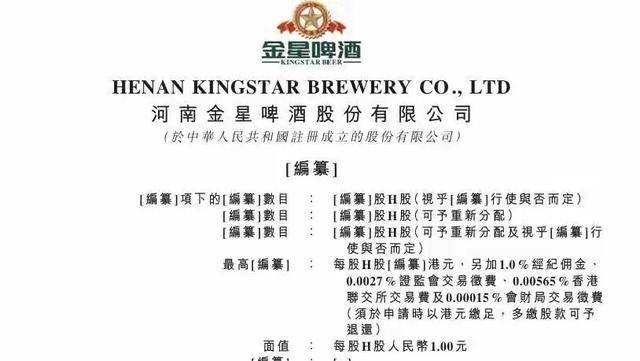
Core Viewpoint - The rapid growth of Jin Xing Beer, driven by its innovative product "Jin Xing Mao Jian" tea beer, has led to significant financial improvements, but the company's aggressive dividend policy and family-controlled ownership structure raise concerns about sustainability and governance risks [1][3][6]. Financial Performance - Jin Xing Beer reported a net profit increase from 12.2 million yuan in 2023 to 125 million yuan in 2024, representing a growth of approximately 925%. By the first nine months of 2025, net profit surged to 305 million yuan, marking a 24-fold increase compared to the entire year of 2023 [1]. - Revenue skyrocketed from 356 million yuan in 2023 to 1.11 billion yuan in the first three quarters of 2025, reflecting a growth rate of 191.34%. The gross margin improved from 27.3% to 47.0%, and net margin increased from 3.4% to 27.5% [3][10]. Product Innovation - The core driver of Jin Xing Beer's growth is the launch of its tea beer product "Jin Xing Mao Jian" in August 2024, which combines Xinyang Maojian tea with beer brewing techniques. The product achieved sales of 6 tons on its first day and surpassed 100 million cans within 10 months, contributing nearly 80% of the company's revenue [3][10]. - In the first three quarters of 2025, this product generated 867 million yuan in revenue, accounting for 78.1% of total sales, significantly altering the company's revenue structure [3]. Market Context - Jin Xing Beer's growth is notable against the backdrop of a declining traditional beer market in China, where major players like China Resources and Qingdao are experiencing sales drops. The overall beer industry saw a 5.7% revenue decline [10]. - The craft beer market in China has grown significantly, with a market size exceeding 80 billion yuan in 2024 and a year-on-year growth rate of over 30%. Products incorporating Chinese elements, such as tea beer, have seen a substantial increase in market share [11]. Governance and Risks - The ownership structure of Jin Xing Beer is characterized by a "family fortress," with the Zhang family controlling 100% of the company. This raises concerns about governance and potential conflicts of interest [6][8]. - The company has engaged in aggressive dividend payouts, distributing 2.29 billion yuan before its IPO, which is 182.6% of the projected net profit for 2024. Such practices are rare and may indicate a focus on maximizing family interests [7][8]. - There are compliance issues regarding social insurance and housing fund contributions, with significant amounts owed in these areas, which could lead to legal risks [8]. Competitive Landscape - Despite its current leading position in the niche market of Chinese craft beer, Jin Xing Beer faces increasing competition from established brands like Qingdao and Budweiser, which are also entering the tea beer segment [11]. - The company holds only a 0.3% market share in the overall beer market, while its market share in the craft beer segment is 14.6%, highlighting a disparity in its competitive positioning [11].

东海证券晨会纪要-20260120
Donghai Securities· 2026-01-20 05:41
Group 1: Key Recommendations - The Spring Festival stocking has started, with a resonance in the meat and dairy cycle, which is expected to boost the performance of food companies in Q1 due to delayed stocking caused by the festival's timing this year [5][6] - Frozen products are entering a peak sales season, with leading companies experiencing reduced competition, and income growth in Q1 is anticipated to increase due to extended stocking time and weather factors [5][6] - E-commerce activities for the Spring Festival have been extended, benefiting the demand for snacks and other stocking needs [5] Group 2: Industry Dynamics - The average price of fresh milk as of January 8 is 3.02 yuan/kg, showing a week-on-week decrease of 0.3%, marking a continuous decline for over four years [6] - The price of culling cows is 19.88 yuan/kg, up 2.2% from the beginning of the year, indicating a gradual shift in supply and demand dynamics in the industry [6] - Companies like Yuanji Food and Jinxing Beer have submitted listing applications, with projected revenues for Yuanji Food of 2.026 billion yuan in 2023 and 2.561 billion yuan in 2024, and Jinxing Beer expecting revenues of 356 million yuan in 2023 and 730 million yuan in 2024 [7] Group 3: Market Performance - The food and beverage sector saw a decline of 2.10%, underperforming the CSI 300 index by 1.53 percentage points, ranking 25th among 31 first-level sectors [6] - The overall market performance showed mixed results, with the Shanghai Composite Index closing at 4114 points, up 0.29%, while the Shenzhen Component Index and ChiNext Index displayed varied performances [20][21] - The average daily trading volume was 34.283 billion yuan, indicating increased market activity compared to the previous value of 28.287 billion yuan [12]
再添双奖!慧博科技斩获多行业权威认可,数智实力赋能全域增长
Jin Tou Wang· 2026-01-20 04:32
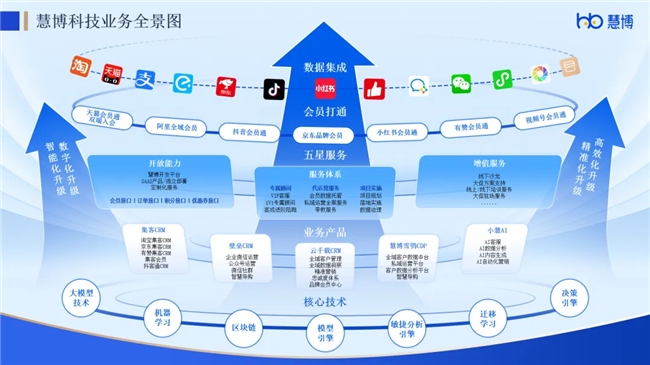
Core Insights - The article highlights the recognition of Huibo Technology as a leading digital service provider in the fashion and consumer sectors, winning two prestigious awards for its innovative solutions and service excellence [1][5]. Group 1: Awards and Recognition - Huibo Technology won the "2025 Outstanding Digital Service Provider" award at the 10th Fashion Industry CIO Co-Creation Conference, acknowledging its contributions to digital transformation in the fashion sector [2]. - The company also received the "Top Ten Outstanding Service Providers" award at the 5th Business Innovation Conference, reflecting its strong performance in driving commercial value through digital innovation [5]. Group 2: Service Capabilities and Achievements - Huibo Technology has developed tailored solutions for major brands like Anta, Fila, and New Balance, addressing key challenges in omnichannel collaboration, private domain operations, and inventory optimization [2]. - The company has successfully enhanced customer engagement and sales metrics for clients, such as increasing daily interactions by over 100% and repurchase rates by over 10% for Ordos [3]. Group 3: Product Matrix and AI Integration - Huibo Technology offers a comprehensive suite of digital solutions powered by AI, covering data management, content creation, private domain operations, and intelligent decision-making [8][10]. - The company has introduced "Xiao Hui AI," which integrates large model capabilities into membership operations and data analysis, helping brands gain a competitive edge in digital transformation [12][13]. Group 4: Future Directions - Moving forward, Huibo Technology aims to deepen the integration of AI technology with industry scenarios, focusing on enhancing its product matrix and cross-industry service capabilities [14].
80后最爱喝的啤酒,要破产了?
首席商业评论· 2026-01-20 04:15
Core Viewpoint - Shandong Taishan Brewery has entered bankruptcy reorganization due to historical debt burdens, marking a critical phase in its efforts to revive and transform its business model amidst industry challenges [4][5][6]. Group 1: Bankruptcy Reorganization - The court has accepted the bankruptcy reorganization application of Shandong Taishan Brewery, with total assets of approximately 622 million and total liabilities of about 663 million, resulting in a debt-to-asset ratio of 106.63% [5][6]. - The management emphasizes that the company's difficulties stem from historical debt rather than product or market issues, and the reorganization will allow a focus on production and consumer service [5][6]. - The reorganization process provides a "protection period" where the company can avoid asset seizures and maintain basic operations while developing a debt repayment and business restructuring plan [7]. Group 2: Historical Context and Market Position - Founded in 1952, Taishan Brewery has evolved from a local state-owned brewery to a national leader in the fresh beer segment, leveraging local resources and traditional brewing techniques [9][10]. - The introduction of the "7-day short shelf life" fresh beer in 2013 marked a significant shift, allowing the company to capture a niche market and achieve substantial growth, even during challenging times like the pandemic [10][11]. - The brand's deep integration with local culture and consistent quality has helped it build a loyal customer base, with a repurchase rate of over 60% [11][12]. Group 3: Transformation Strategies - The reorganization is seen as a proactive step for traditional breweries facing pressures from market saturation and changing consumer preferences, aiming for a systematic overhaul [15][16]. - High-end product innovation and channel restructuring are critical for breaking away from low-margin, high-inventory models, with Taishan Brewery successfully transitioning to a fresh beer market that aligns with health and personalization trends [15][16]. - The establishment of a direct-to-consumer model and a robust supply chain has enabled the brewery to enhance customer engagement and operational efficiency, setting a precedent for other traditional breweries [16][17]. Group 4: Future Prospects - The reorganization is viewed as a new starting point for Taishan Brewery, with potential to expand into new consumption scenarios and partnerships, leveraging its established product strength and regional connections [18].

食品饮料行业周报:春节备货启动,肉奶周期共振
Donghai Securities· 2026-01-19 12:24
Investment Rating - The industry investment rating is "Overweight" indicating a positive outlook for the sector in the next six months [1]. Core Insights - The food and beverage industry is expected to benefit from the extended Chinese New Year stocking period, which may lead to improved performance in Q1 2026 [5]. - The raw milk price has been stabilizing at a low level, with the average price at 3.02 CNY/kg as of January 8, 2026, indicating a potential turning point in supply and demand dynamics [5]. - The secondary market performance showed a decline of 2.10% in the food and beverage sector, underperforming the CSI 300 index by 1.53 percentage points [10]. Summary by Sections 1. Secondary Market Performance - The food and beverage sector ranked 25th among 31 sectors, with all sub-sectors under pressure, particularly health products which saw a smaller decline of 0.72% [10]. - The top five performing stocks included CITIC Nia, Good Idea, and others, with gains ranging from 5.05% to 8.85% [10]. 2. Major Consumer Goods and Raw Material Prices - As of January 9, 2026, the retail price of fresh milk was 12.18 CNY/liter, and yogurt was 15.88 CNY/kg, showing slight weekly increases [26]. - The price of live pigs was 12.78 CNY/kg, with a weekly increase of 1.19% but a year-on-year decrease of 18.91% [26]. 3. Industry Dynamics - Yuanji Food Group and Jinxing Beer have submitted applications for listing on the Hong Kong Stock Exchange, with projected revenues of 2.026 billion CNY and 3.56 billion CNY respectively for 2023 [53]. - The dairy farming sector in Shandong is experiencing a recovery in raw milk prices, with a reported average cost of 3.34 CNY/kg for dairy farming [54].
食品饮料行业周报:春节备货启动,肉奶周期共振-20260119
Donghai Securities· 2026-01-19 11:53
Investment Rating - The industry investment rating is "Overweight" indicating a positive outlook for the sector relative to the market index [1]. Core Insights - The food and beverage industry is expected to benefit from the extended Chinese New Year stocking period, which may lead to improved performance in Q1 2026 [5]. - The raw milk price has been stabilizing at a low level, with the average price at 3.02 CNY/kg as of January 8, 2026, indicating a potential turning point in supply and demand dynamics [5]. - The secondary market performance showed a decline of 2.10% in the food and beverage sector, underperforming the CSI 300 index by 1.53 percentage points [10]. - Key companies such as Yuanji Food and Jinxing Beer have submitted applications for listing on the Hong Kong Stock Exchange, indicating growth and expansion in the sector [53]. Summary by Sections 1. Secondary Market Performance - The food and beverage sector experienced a decline of 2.10%, ranking 25th among 31 sectors [10]. - The top five gainers included CITIC Nia, Good Idea, and others, with gains ranging from 5.05% to 8.85% [10]. 2. Major Consumer Goods and Raw Material Prices - As of January 9, 2026, the retail price of fresh milk was 12.18 CNY/liter, and yogurt was 15.88 CNY/kg, showing slight increases [26]. - The price of live pigs was 12.78 CNY/kg, with a week-on-week increase of 1.19% [26]. 3. Industry Dynamics - Yuanji Food reported revenues of 2.026 billion CNY and 2.561 billion CNY for 2023 and 2024, respectively, with a net profit increase of 31% in the first nine months of 2025 [53]. - Jinxing Beer achieved revenues of 3.56 billion CNY and 7.30 billion CNY for 2023 and 2024, respectively, with a significant increase in net profit [53].
非白酒板块1月19日涨1.82%,*ST兰黄领涨,主力资金净流入1912.61万元
Zheng Xing Xing Ye Ri Bao· 2026-01-19 08:52
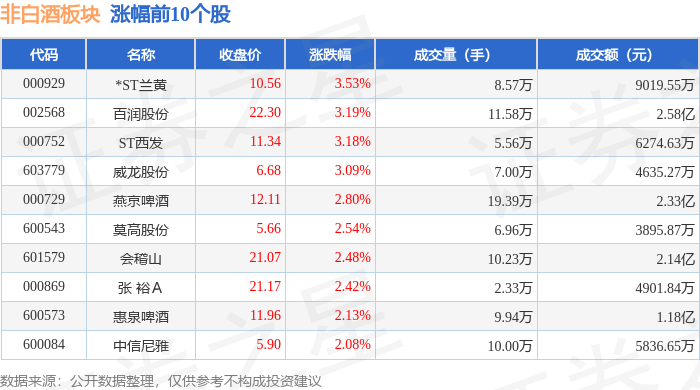
Market Performance - The non-liquor sector increased by 1.82% compared to the previous trading day, with *ST Lanhua leading the gains [1] - The Shanghai Composite Index closed at 4114.0, up 0.29%, while the Shenzhen Component Index closed at 14294.05, up 0.09% [1] Stock Highlights - The top-performing stocks in the non-liquor sector included: - *ST Lanhua: Closed at 10.56, up 3.53% with a trading volume of 85,700 shares and a turnover of 90.20 million yuan [1] - Zhirun Co.: Closed at 22.30, up 3.19% with a trading volume of 115,800 shares and a turnover of 258 million yuan [1] - ST Xifa: Closed at 11.34, up 3.18% with a trading volume of 55,600 shares and a turnover of 62.75 million yuan [1] Capital Flow - The non-liquor sector saw a net inflow of 19.12 million yuan from institutional investors, while retail investors contributed a net inflow of 25.07 million yuan [1] - Retail investors experienced a net outflow of 44.20 million yuan from speculative funds [1] Individual Stock Capital Flow - Key stocks with significant capital flow included: - Huaiqi Mountain: Net inflow of 13.72 million yuan from institutional investors, with a net outflow of 15.01 million yuan from speculative funds [2] - Xianjing Beer: Net inflow of 13.16 million yuan from institutional investors, with a net outflow of 29.92 million yuan from speculative funds [2] - ST Xifa: Net inflow of 12.87 million yuan from institutional investors, with a net outflow of 5.68 million yuan from speculative funds [2]


一字观年景 | 聚势而旺
Guang Xi Ri Bao· 2026-01-19 04:36
Group 1 - The core viewpoint of the article highlights the revitalization of the consumer market in Guangxi, driven by both infrastructure upgrades and supportive government policies [2][6][7] - The reopening of the renovated Water Street and Zhongshan Road in Nanning is expected to enhance the consumer experience and contribute to the festive atmosphere during the New Year [1] - The launch of the "old for new" consumption policy on January 1 has already seen significant uptake, with over 130,000 subsidies issued and a direct boost to sales in home appliances and digital products amounting to 520 million yuan [2][3] Group 2 - The government and businesses are collaborating effectively to implement policies that directly benefit consumers, with a focus on creating a three-tiered discount system involving national subsidies, manufacturer reductions, and retailer promotions [2][4] - The "2025 Guangxi Warm Winter Consumption Month" campaign has successfully driven new car sales exceeding 137,000 units, generating over 19.3 billion yuan in consumption [4][5] - Infrastructure improvements, such as the establishment of pedestrian streets and community service areas, have significantly enhanced the shopping experience, attracting more consumers and increasing sales for local businesses [5][6] Group 3 - The continuous deepening of openness in Guangxi has opened new growth avenues for the consumer market, with inbound tourism increasing by 15% year-on-year [6] - Measures to attract international tourists include multilingual tax refund guides, enhanced border crossing facilities, and the establishment of international shopping districts [6] - Retail sales in the region have shown a year-on-year growth of 8.4% from January to November 2025, indicating a positive trend in consumer confidence and economic vitality [6][7]