泸州老窖

Search documents
A股酿酒板块走高,舍得酒业、会稽山涨停
Cai Jing Wang· 2025-11-10 20:37
Group 1 - The A-share liquor sector experienced a significant rise on November 10, with multiple companies reaching their daily limit up [1] - Shede Liquor and Kweichow Moutai both hit the daily limit, indicating strong investor interest [1] - Other notable performers included Gujing Gongjiu and Shanxi Fenjiu, both rising over 5%, while Yanjing Beer and Huichuan Beer saw increases of over 2% [1]


消费赛道复苏预期升温多只消费股估值具备优势
Zheng Quan Shi Bao· 2025-11-10 18:20
Core Viewpoint - The consumer sector is experiencing a collective rebound, driven by government policies aimed at boosting consumption and supporting key industries [1][3]. Group 1: Market Performance - As of November 10, 2023, various consumer indices, including food and beverage, beauty care, and retail, have shown less than 10% growth year-to-date, underperforming the Shanghai Composite Index [2]. - The food and beverage sector has been the weakest performer, with its index in a downward trend for the year [2]. Group 2: Institutional Optimism - Institutions are gradually becoming optimistic about the future performance of the consumer sector, with several brokerages identifying potential investment opportunities [3]. - Open Source Securities notes that the food and beverage sector is nearing a bottom, with recovery expectations rising as negative factors have largely been released and policy impacts are slowing [3]. - Huachuang Securities highlights that service consumption is in a transformative phase, supported by strong policy guidance, making it a promising investment focus [3]. - Galaxy Securities emphasizes the importance of enhancing consumer power and expanding quality supply during the 14th Five-Year Plan period, with new consumption trends emerging as key growth points [3]. Group 3: Valuation Advantages - Many consumer stocks currently exhibit valuation advantages, with 123 stocks having a rolling P/E ratio below 30 and underperforming the Shanghai Composite Index year-to-date [4]. - Notable large-cap stocks include Kweichow Moutai, Midea Group, and Wuliangye, among others [4]. - 23 stocks have seen a cumulative decline of over 10% this year, with Ganyuan Food experiencing the largest drop at 33.79% [4]. Group 4: Upside Potential - From an institutional perspective, several consumer stocks with low rolling P/E ratios have significant upside potential, with 43 stocks projected to rise over 20% [5]. - Proya Cosmetics leads with a projected upside of 49.05%, supported by its international expansion plans [5]. - Xueda Education follows with an expected increase of 48.6%, driven by its clear business expansion strategy in personalized education [5][6].
五粮液·一见倾心60天卖1个亿!白酒巨头何以征服年轻人?
Nan Fang Du Shi Bao· 2025-11-10 15:44
Core Insights - The launch of 29-degree Wuliangye "Yijian Qingxin" achieved over 100 million yuan in sales within 60 days, indicating strong market response and validating the company's strategy to target younger consumers with lower-alcohol products [1][3][6] Group 1: Product Innovation - The product's success is attributed to its low alcohol content and innovative packaging, which appeals to the younger demographic's preference for a "lightly intoxicated" experience [3][5] - Wuliangye utilized decades of low-alcohol technology to ensure the product maintains flavor despite the reduced alcohol content, achieving a smooth taste profile that resonates with young consumers [3][6] Group 2: Marketing Strategy - The collaboration with singer G.E.M. as a global ambassador effectively transformed the brand's image from a "business symbol" to an "emotional companion," enhancing engagement with the target audience [5][6] - The marketing approach includes breaking traditional distribution models by establishing an "online direct sales, e-commerce first" system, which incorporates a referral-based sales strategy that incentivizes consumers to promote the product [5][6] Group 3: Industry Trends - Major liquor companies are increasingly focusing on the low-alcohol market, with several brands launching similar products to cater to changing consumer preferences [6][8] - The low-alcohol market is projected to exceed 74 billion yuan by 2025, with a compound annual growth rate of 25%, indicating a significant shift in consumer behavior towards lower-alcohol beverages [8][9]



存储概念哪有那些能捡漏?| 1110 张博划重点
Hu Xiu· 2025-11-10 15:09
Market Performance - The Shanghai Composite Index closed at 4000 points, recovering from a drop of over 2% earlier in the day, with a final increase of 0.53% [1] - The Shenzhen Component Index rose by 0.18%, while the ChiNext Index experienced a decline of 0.92% [1] - Total trading volume in the Shanghai and Shenzhen markets reached 2.17 trillion yuan, an increase of 175.4 billion yuan compared to the previous trading day [1] Economic Indicators - The core Consumer Price Index (CPI), excluding food and energy, rose by 1.2% year-on-year in October, marking the sixth consecutive month of growth [1] - Hainan Province's duty-free shopping amounted to 506 million yuan from November 1 to 7, reflecting a year-on-year increase of 34.86% [1] Sector Performance - The consumer sector showed strong performance, with liquor stocks leading the gains; notable stocks included Jiu Gui Jiu, She De Jiu Ye, and Kuaiji Mountain, which all hit the daily limit [1] - Other sectors such as tourism, hotels, and duty-free retail also saw significant increases, with stocks like Shou Li Hotel, Jin Jiang Hotel, and China Duty Free Group reaching their daily limits [1]
双11前夕白酒股集体“狂欢”!“最惨三季报”后现转机?
Nan Fang Du Shi Bao· 2025-11-10 13:28
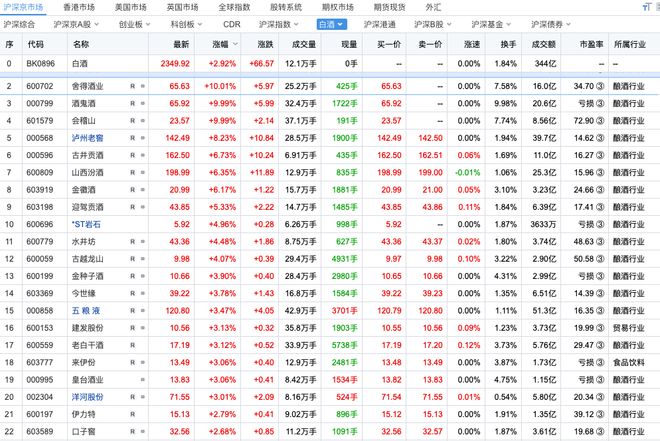
Core Viewpoint - The A-share liquor sector has experienced a significant rebound, driven by favorable policies, expectations of industry recovery, and positive macroeconomic data [1][3][9]. Group 1: Market Performance - As of November 10, the liquor sector index (BK0896) closed at 2349.92, with a rise of 2.92%, and several stocks, including Shede Liquor and Jiu Gui Jiu, reached their daily limit [1]. - Notable stocks such as Luzhou Laojiao and Gujing Gongjiu saw increases exceeding 6% [1]. - The overall market sentiment has improved, with the consumer sector also witnessing a collective rise, indicating a broader recovery trend [7]. Group 2: Policy and Industry Dynamics - A series of supportive policies have been introduced since late September, focusing on expanding domestic demand and promoting consumption, which has attracted capital to the liquor sector [3]. - The Ministry of Industry and Information Technology has included liquor in the "historical classic industries" category, emphasizing its cultural significance and potential for high-quality development [3]. - Recent policies from Guizhou province aim to shift the liquor industry from merely selling products to offering lifestyle services, indicating a strategic transformation in the sector [4]. Group 3: Financial Performance and Valuation - Despite a challenging third quarter for many liquor companies, the overall resilience of the sector has improved compared to previous downturns, with many companies showing better performance metrics [8][9]. - Analysts note that the valuation and sentiment in the sector are at low levels, which has contributed to the recent price increases [5]. - The presence of institutional investors in the market has been significant, with notable purchases in stocks like Jiu Gui Jiu, indicating renewed interest from larger players [5][6]. Group 4: Inventory and Sales Trends - The upcoming "Double 11" shopping festival is expected to help clear some inventory, although it is viewed as a short-term measure rather than a solution to the industry's deeper issues [10]. - Analysts suggest that while there is a limited recovery expected in the fourth quarter, the overall industry remains in a deep adjustment phase, with varying performance among different companies [14]. - The sales performance of premium products like Feitian Moutai has stabilized, contributing positively to market expectations [12][14].



这次能站稳4000点吗?
Sou Hu Cai Jing· 2025-11-10 12:45
Core Viewpoint - The Shanghai Composite Index has reached 4018.60 points, but it is expected to experience fluctuations around the 4000-point mark without a strong upward momentum [1][2]. Technical Analysis - The index remains within a trading range and has not yet broken the previous high of 4025.70 points, requiring confirmation over the next two trading days to validate any breakout [2]. - A significant resistance level at 4025 points may lead to a potential pullback if not surpassed [2]. Market Dynamics - The rise in the index was supported by brokerage firms and banks, indicating a lack of genuine bullish sentiment [2]. - The Hong Kong Hang Seng Index's performance also contributed to the upward movement of the Shanghai Composite Index [2]. Sector Performance - The ChiNext Index fell by 0.92%, highlighting a divergence in market sentiment, with high-tech stocks experiencing a pullback while low-valued consumer stocks saw a rebound [2]. - Notable gains in the liquor sector, with stocks like Shede Liquor and JiuGui Liquor hitting the daily limit, suggest a rotation of existing capital towards underperforming sectors [2]. Trading Volume and Future Outlook - Today's trading volume increased to 1.74 trillion, but the total remains at 2.19 trillion, indicating insufficient capital to sustain a move above 4000 points [3]. - A volume increase to 2.5 trillion and a stabilization of technology stocks are necessary for a sustained breakout above 4000 points [3]. - The current market environment is characterized by stock rotation and opportunities in undervalued stocks, with a focus on individual stock selection rather than index movements [3].
吃喝板块暴力拉升,主力狂买超百亿元!食品ETF(515710)大涨3.64%,估值低位布局正当时?
Xin Lang Ji Jin· 2025-11-10 12:09
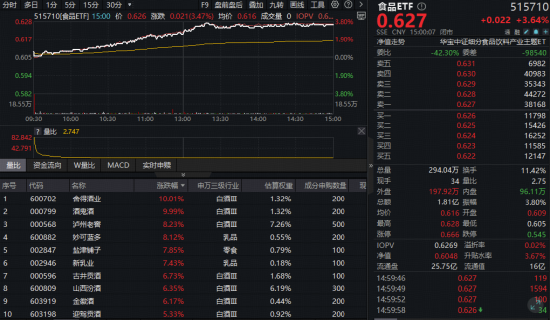
Group 1: Market Performance - The food and beverage sector has shown strong performance, leading the market with a 3.64% increase in the food ETF (515710) as of the close on November 10 [1][3] - Major liquor stocks experienced significant gains, with Shede Liquor and Jiu Gui Liquor hitting the daily limit, and Luzhou Laojiao rising by 8.23% [1][3] Group 2: Capital Inflow - The food and beverage sector attracted over 10 billion CNY in net inflows from main funds in a single day, ranking first among 30 sectors [3][4] - The food ETF (515710) has seen a net inflow of over 1.2 billion CNY in the last five trading days and more than 2.4 billion CNY in the last ten trading days [4][5] Group 3: Valuation and Investment Opportunities - The valuation of the food and beverage sector is currently at a historical low, with the food ETF's underlying index PE ratio at 20.59, indicating a good entry point for long-term investments [6][7] - Analysts suggest that the food and beverage industry is gradually bottoming out, with opportunities to invest in liquor stocks at low prices [7][8]

CPI由降转升,什么信号?沪指重返4000点,吃药喝酒行情回归?食品ETF猛拉3.64%,A股最大医疗ETF反弹1.66%
Xin Lang Ji Jin· 2025-11-10 12:06
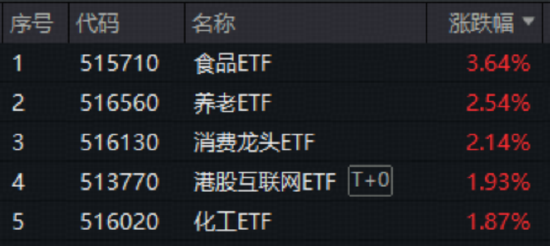
Market Overview - The Shanghai Composite Index rose by 0.53% to return above 4000 points, while the ChiNext Index fell by 0.92% [1] - The total trading volume in the Shanghai and Shenzhen markets reached 2.17 trillion yuan, an increase of 1.754 billion yuan compared to the previous day [1] Sector Performance - The consumer sector saw significant gains, with the Food ETF (515710) surging by 3.64%, the Pension ETF (516560) increasing by 2.54%, and the Consumer Leader ETF (516130) rising by 2.14% [2][5] - The AI computing sector experienced a downturn following the announcement of the Kimi K2 Thinking open-source model, with the ChiNext AI ETF (159363) and the Sci-Tech AI ETF (589520) declining by 0.46% and 1.19%, respectively [1] Economic Indicators - The National Bureau of Statistics reported that the Consumer Price Index (CPI) rose by 0.2% year-on-year in October, reversing a decline from September, while the Producer Price Index (PPI) showed a narrowing year-on-year increase [7] - Analysts noted that the core CPI's growth indicates a stabilization in price levels, suggesting a recovery in demand [2][7] Investment Strategies - According to Industrial Securities, the A-share market is currently positioned for dual-line investment, focusing on cyclical sectors such as chemicals, consumption, and agriculture, while also emphasizing strong industrial trends represented by AI computing [2] - The Food ETF (515710) is highlighted as a favorable investment opportunity due to its low valuation, with a price-to-earnings ratio of 20.59, placing it at a low historical percentile [8][9] Hong Kong Market Dynamics - The Hong Kong market saw the Hang Seng Index and the Hang Seng Tech Index both rise over 1%, driven by continuous inflows from southbound funds and favorable valuations of quality assets [3] - The launch of the Hong Kong Automobile 50 ETF (520783) is noteworthy, as it includes major players in the smart driving sector, providing a convenient investment tool for automotive leaders [3] Sector-Specific Insights - The food and beverage sector has attracted significant capital, with over 100 billion yuan in net inflows recently, indicating strong investor interest [7][8] - The pharmaceutical sector is also showing signs of recovery, with major ETFs in this space experiencing gains, reflecting a broader market rebound [18][25]
逆势新高!资金大举入场!
格隆汇APP· 2025-11-10 11:29
Core Viewpoint - The A-share market is experiencing a significant divergence, with traditional sectors like food and beverage, tourism, chemicals, and energy showing strong performance, while technology growth sectors are undergoing a substantial correction [1][6]. Group 1: Market Performance - On November 10, the Shanghai Composite Index rose by 0.53%, while the ChiNext Index fell by 0.92% [1]. - The Chemical 50 ETF (516120) increased by 2.08%, marking a four-day winning streak and a year-to-date gain of 35.01%, leading among similar indices [1][3]. Group 2: Industry Recovery - The chemical sector, one of the most adjusted industries over the past three years, is witnessing a recovery in both performance and valuation as the A-share market rises [3][18]. - Positive macroeconomic signals, such as CPI and PPI increases, indicate an improving profitability environment for traditional industries, including chemicals [10][18]. Group 3: Catalysts for Growth - The overall rise in the consumer sector is attributed to three main catalysts: continued fiscal policies to boost consumption, positive basic economic signals, and the upcoming significant closure of Hainan Island, which is expected to accelerate economic development [9][8]. - The demand for lithium batteries and energy storage is surging, driven by the explosive growth in the new energy vehicle sector, with domestic sales of new energy vehicles reaching 987,000 units in October, a year-on-year increase of 35.2% [11][10]. Group 4: Price Increases in Chemical Products - Since October, various chemical products have begun to rise in price, with lithium hexafluorophosphate increasing by 13.02% since the beginning of the month, and other related materials also seeing significant price hikes [14][16]. - The chemical price index has risen by 40.24% since the beginning of the year, indicating a recovery from a deep adjustment phase [18]. Group 5: Financial Performance - In the first three quarters of 2025, the basic chemical industry achieved total revenue of 1.71 trillion yuan, a year-on-year increase of 3.79%, and a net profit of 104.48 billion yuan, up 10.56% [21][20]. - The operating cash flow for the basic chemical industry increased by 22.26% year-on-year, reflecting strong financial health [20][21]. Group 6: Investment Trends - The chemical sector is attracting significant capital inflows, with the Chemical Raw Materials Index seeing a net inflow of 225.15 billion yuan over the past five days, indicating strong market interest [24][23]. - The Chemical 50 ETF has seen a substantial increase in shares, with a 394.59% rise in new shares issued this year, reflecting growing investor interest in the sector [25][26].



价值投资的对立面不是“小登科技”
点拾投资· 2025-11-10 11:00
Core Viewpoint - The article discusses the relationship between value investing and technology investment, emphasizing that they are not opposites. Value investors can participate in the benefits of the AI era by applying their investment principles to technology sectors [1][20]. Group 1: Value Investing Principles - Value investing is defined as earning returns from the long-term cash flows of companies, without being restricted to specific industries [1][20]. - The core of value investing is to avoid permanent loss of capital, and careful evaluation may lead to missed opportunities, but value investors can still act decisively when confident [2][20]. - Value investors like Tian Yu focus on long holding periods, high concentration in a few stocks, and the importance of a company's competitive advantages [1][2]. Group 2: Technology Investment Insights - Tian Yu has been researching AI and its implications for value assessment early on, indicating that value assessment does not differentiate between emerging and traditional industries [2][4]. - The evaluation framework for technology companies includes understanding demand limits, assessable business models, and identifiable competitive advantages [4][6]. - The semiconductor industry, particularly wafer foundries, is analyzed through a physical perspective, highlighting the challenges and opportunities in advanced process technologies [5][10]. Group 3: Market Dynamics and Investment Strategy - The demand for AI has increased the value of competitive advantages in technology sectors, as performance differences become more significant [6][10]. - Tian Yu's investment strategy involves a dynamic view of future cash flows rather than static earnings, allowing for investments in companies that may not currently be profitable but have strong long-term potential [7][8]. - The article highlights the importance of understanding the underlying business models and competitive dynamics in technology sectors, which can be complex and require specialized knowledge [6][11]. Group 4: Portfolio Management - Tian Yu maintains a concentrated portfolio with a high percentage of top holdings, reflecting a strategy of focusing on quality investments [16][17]. - The portfolio is diversified across different sectors, including technology and chemicals, to mitigate systemic risks while maintaining a focus on companies with strong supply-side competitive advantages [17][18]. - The article emphasizes that value investing is not limited to traditional industries and can adapt to modern technological advancements, allowing investors to benefit from current market trends [20][22].