南京银行

Search documents
外资持仓超千亿!185家公司被扎堆!这两家公司被中东土豪重仓
Sou Hu Cai Jing· 2025-09-03 03:12
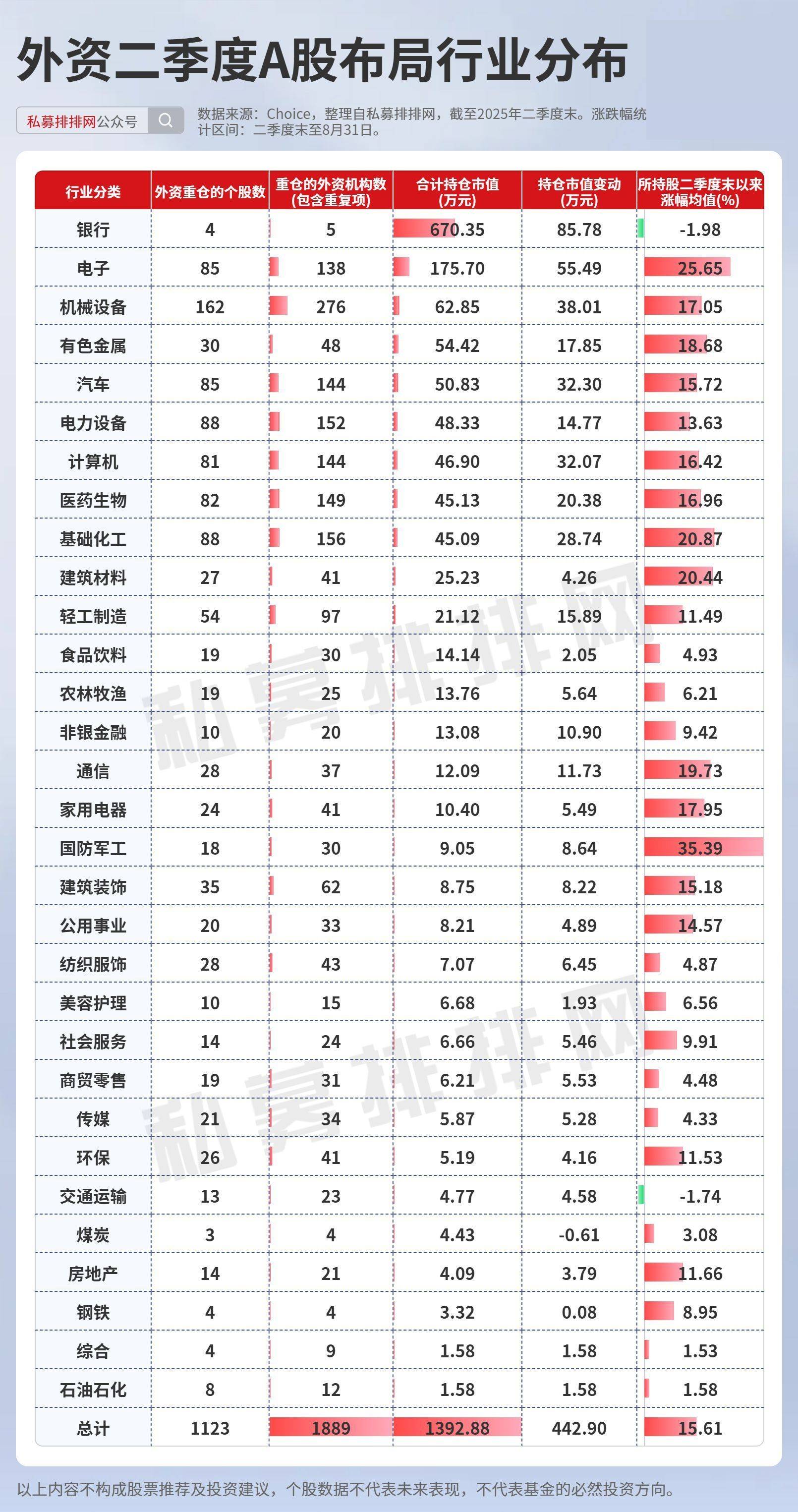
Core Insights - A-shares have entered a slow bull market since April 27, with increasing market activity from foreign capital, particularly evident in the second quarter's disclosures [1] - Foreign capital has heavily invested in 1,123 companies, with a total market value of 139.29 billion yuan, an increase of over 40 billion yuan from the previous quarter [1] - The electronics sector has become the preferred investment area for foreign capital, with a total holding value of 17.57 billion yuan, reflecting a rise of 5.55 billion yuan [1] Industry Summary - **Banking**: 4 companies, 5 foreign institutions, total holding value of 6.70 billion yuan [2] - **Electronics**: 85 companies, 138 foreign institutions, total holding value of 17.57 billion yuan [2] - **Machinery Equipment**: 162 companies, 276 foreign institutions, total holding value of 6.29 billion yuan [2] - **Non-ferrous Metals**: 30 companies, 48 foreign institutions, total holding value of 5.44 billion yuan [2] - **Automobile**: 85 companies, 144 foreign institutions, total holding value of 5.08 billion yuan [2] - **Power Equipment**: 88 companies, 152 foreign institutions, total holding value of 4.83 billion yuan [2] - **Computers**: 81 companies, 144 foreign institutions, total holding value of 4.69 billion yuan [2] - **Pharmaceuticals and Biology**: 82 companies, 149 foreign institutions, total holding value of 4.51 billion yuan [2] - **Basic Chemicals**: 88 companies, 156 foreign institutions, total holding value of 4.51 billion yuan [2] - **Building Materials**: 27 companies, 41 foreign institutions, total holding value of 2.52 billion yuan [2] - **Light Industry Manufacturing**: 54 companies, 97 foreign institutions, total holding value of 2.11 billion yuan [2] - **Food and Beverage**: 19 companies, 30 foreign institutions, total holding value of 1.41 billion yuan [2] - **Agriculture, Forestry, Animal Husbandry, and Fishery**: 19 companies, 25 foreign institutions, total holding value of 1.38 billion yuan [2] Notable Companies - 126 companies have a foreign holding value exceeding 100 million yuan, with significant investments in Ningbo Bank and Nanjing Bank [4] - The average increase in stock prices for these 126 foreign-heavy stocks since the end of Q2 is 19.05%, with 15 companies seeing increases over 50% [4] - Noteworthy is Shengyi Technology, with a foreign holding value of 9.55 billion yuan and a stock price increase of 76.62% since the end of Q2 [4] - The company reported a total revenue of 12.68 billion yuan for the first half of the year, a year-on-year increase of 31.68%, and a net profit of 1.43 billion yuan, up 52.98% [4] Foreign Investment Trends - 185 companies have been heavily invested in by multiple foreign institutions, with 21 companies having investments from more than five foreign entities [12] - Companies like Huafang Co. and Anji Food have seen significant foreign interest, with the former being held by six foreign institutions [12][13] - The top three stocks with the highest price increases since the end of Q2 are Kosen Technology, Deepwater Planning Institute, and Innovative Medical, with increases of 90.05%, 84.10%, and 76.83% respectively [12]






8月A股新开户数同比增长165% 瑞银预期:美联储本月将开启 “四连降”
Sou Hu Cai Jing· 2025-09-03 00:19
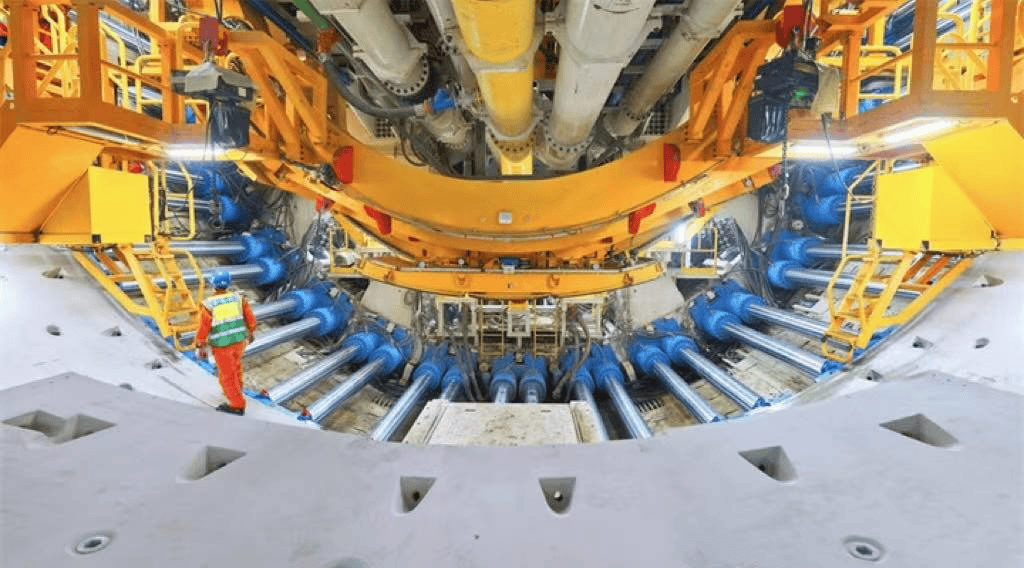
Industry Developments - The Jiangsu province has commenced the construction of the world's longest underwater shield tunnel, marking a significant milestone in infrastructure development [3] - The software industry in China reported a revenue of 83,246 billion yuan in the first seven months of the year, reflecting a year-on-year growth of 12.3% [5] - The wholesale sales of new energy passenger vehicles in China reached 1.3 million units in August, showing a year-on-year increase of 24% and a month-on-month increase of 10% [5] Company Updates - Yuzhu Technology plans to submit its listing application to the stock exchange between October and December 2025, with operational data to be disclosed at that time [6] - Kaisa Group announced significant progress in its offshore debt restructuring plan, which is expected to take effect by the end of September, aiming to reduce debt by approximately 8.6 billion dollars [6] - Tesla has received only about 600 orders in India since its launch in mid-July, which is below the company's expectations, and plans to deliver between 350 to 500 vehicles to the country this year [6]
2000亿公募,副总转任高级专员!
Zhong Guo Ji Jin Bao· 2025-09-02 14:24
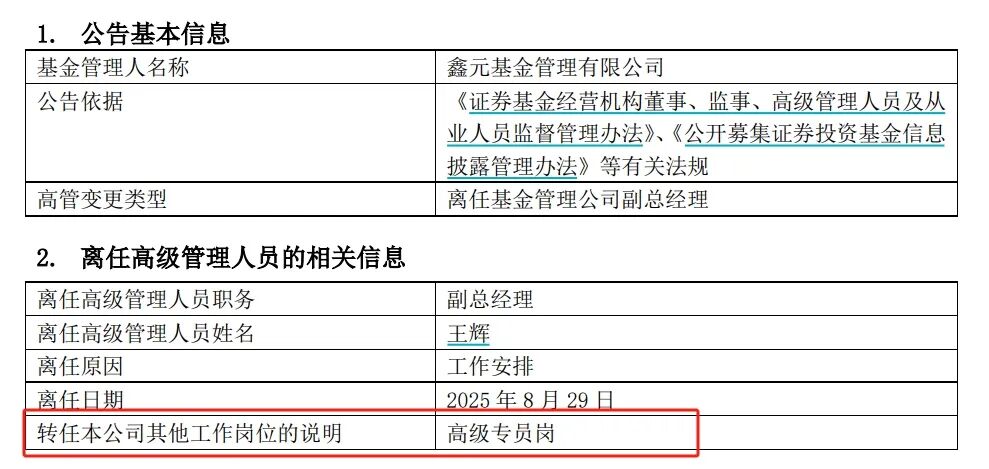
Group 1 - Wang Hui, the Deputy General Manager of Xinyuan Fund, has transitioned to a Senior Specialist position due to work arrangements [1][2][4] - Wang Hui has been with Xinyuan Fund since its establishment in August 2013, previously serving as Chief Marketing Officer and Assistant General Manager before becoming Deputy General Manager in April 2016 [4][5] - As of the end of Q2 2023, Xinyuan Fund's total asset scale reached 211.78 billion yuan, with over 60% in bond funds and over 30% in money market funds [1][6][9] Group 2 - Xinyuan Fund's asset net value has significantly increased from 89.70 billion yuan in mid-2022 to 211.78 billion yuan by mid-2023, improving its industry ranking from 55th to 36th [7][6] - The fund currently manages 80 products, with 54 bond products totaling 136.81 billion yuan, accounting for 64.60% of the total scale [9][6] - The growth in management scale is primarily driven by the expansion of fixed-income products, with bond fund scale increasing by 76.73 billion yuan and money market fund scale increasing by 44.05 billion yuan since mid-2022 [9][10] Group 3 - In the second half of the year, Xinyuan Fund has launched 9 new funds, including 1 FOF, 3 mixed funds, and 5 index equity funds [10] - The company aims to enhance its passive investment capabilities while consolidating its active management, expanding its product line to include various types of index products and strategies [10] - Xinyuan Fund is also exploring QDII investment tools and alternative asset options to diversify its asset allocation strategy [10]
2000亿公募,副总转任高级专员!
中国基金报· 2025-09-02 14:18
Core Viewpoint - The article discusses the resignation of Wang Hui, the Deputy General Manager of Xinyuan Fund, who has transitioned to a senior specialist role within the company due to work arrangements. This change reflects the ongoing adjustments in the management structure of the fund [2][4]. Company Overview - Xinyuan Fund was established in August 2013, initiated by Nanjing Bank and Nanjing Gaoke Co., Ltd., with a registered capital of 1.7 billion RMB and headquartered in Shanghai [6]. - As of the end of Q2 2023, Xinyuan Fund's total asset scale reached 211.784 billion RMB, with over 60% in bond funds and over 30% in money market funds [2][8]. Management Changes - Wang Hui has been with Xinyuan Fund since its inception, serving in various roles including Chief Marketing Officer and Assistant General Manager before becoming Deputy General Manager in April 2016. He has held the Deputy General Manager position for over nine years [6][8]. - The current management team includes Long Yi as Chairman, Yu Jingliang as General Manager, and Li Xiaoyan as Chief Supervisor, with three Deputy General Managers: Wu Ju, Zhang Pengfei, and Yang Xiaoyu [6][7]. Fund Performance and Structure - Xinyuan Fund's asset net value has significantly increased from 89.704 billion RMB in mid-2022 to 211.784 billion RMB by mid-2023, improving its industry ranking from 55th to 36th [8]. - The fund's product structure shows that 54 bond products account for 64.6% of the total scale, while 2 money market funds make up 33.85%. Together, these two categories represent over 98% of the total fund scale [9]. - The growth in management scale is primarily driven by the expansion of fixed-income products, with bond fund scale increasing by 76.729 billion RMB and money market fund scale rising by 44.046 billion RMB since mid-2022 [9]. New Fund Initiatives - In the second half of the year, Xinyuan Fund launched 9 new funds, including 1 FOF, 3 mixed funds, and 5 index equity funds. The company aims to enhance its passive investment capabilities while consolidating its active management strengths [10].

你追我赶!长三角头部城商行业绩背后:新排序靠什么?
Nan Fang Du Shi Bao· 2025-09-02 12:59
Core Viewpoint - The performance of the five leading city commercial banks in the Yangtze River Delta region listed on A-shares showed growth in revenue and net profit for the first half of 2025, but the growth rate has generally slowed compared to the previous year, with significant differentiation among them [2][3]. Group 1: Financial Performance - Jiangsu Bank led with a revenue of 44.86 billion yuan and a net profit of 21.06 billion yuan, maintaining its top position [3][4]. - Nanjing Bank surpassed Shanghai Bank in revenue, dropping Shanghai Bank to fourth place, while net profit rankings remained consistent [2][3]. - All five banks reported year-on-year growth in net profit, with Hangzhou Bank achieving the highest growth rate of 16.7% due to a reduction in credit impairment losses [5][12]. Group 2: Revenue and Profit Growth Rates - Revenue growth rates for the five banks showed a decline compared to last year, with Hangzhou Bank experiencing the largest drop from 9.6% to 3.9% [4][5]. - Jiangsu Bank and Ningbo Bank had revenue growth rates around 8%, while Shanghai Bank and Hangzhou Bank lagged behind with growth rates around 4% [4][5]. Group 3: Interest Income and Non-Interest Income - All five banks saw an increase in net interest income, with Nanjing Bank achieving the highest growth rate of 22.13% [5][6]. - Non-interest income showed mixed results, with four banks reporting growth while Shanghai Bank experienced a decline of 6% [7][11]. Group 4: Asset Quality and Capital Adequacy - The non-performing loan (NPL) ratios remained low, with only Shanghai Bank exceeding 1% at 1.18% [12][13]. - Jiangsu Bank's core Tier 1 capital adequacy ratio fell below 9%, the lowest among the five banks, while Shanghai Bank led with a ratio of 10.78% [14]. Group 5: Financial Investment and Loan Composition - Financial investment assets accounted for a significant portion of total assets, with Hangzhou Bank having the highest ratio at 46.8% [8][9]. - Jiangsu Bank's financial investment assets grew at a rate nearly double that of its loan assets, indicating a shift in asset allocation strategy [10][11].




南京银行“绿色金融债”精准赋能可持续发展
Hua Xia Shi Bao· 2025-09-02 11:50
Group 1 - Nanjing Bank successfully issued the first domestic green financial bond compliant with the Multilateral Common Green Taxonomy (MCGT), raising 10 billion yuan for key areas such as renewable energy development and clean energy system construction [1][2] - As of the end of July, Nanjing Bank has connected with 27 green projects, utilizing over 2 billion yuan of the bond funds, demonstrating commitment to the concept of "green mountains and clear waters are as valuable as mountains of gold and silver" [1][3] - The MCGT, officially released in November 2024, includes 110 climate change mitigation activities recognized by China, the EU, and Singapore, marking a milestone in the convergence of global sustainable finance standards [1] Group 2 - Nanjing Bank adheres to green bond fund management requirements, ensuring funds are directed towards MCGT-compliant green industry projects and low-carbon development initiatives [2][3] - The practical effects of fund utilization are already evident in projects, such as a technology company using funds for a green intelligent casting project for wind power core components, significantly reducing costs for downstream wind power manufacturers [2] - The bank's funding supports local low-carbon transformation projects, such as a zero-carbon demonstration park in Yancheng, optimizing local energy structure and achieving intelligent energy management [2][3] Group 3 - Nanjing Bank's green financial bond funding effectively promotes the conversion of ecological value into economic value, with supported projects achieving significant reductions in greenhouse gas emissions and improving regional environmental quality [3][4] - The bank actively utilizes the MCGT directory to support high-quality projects that excel in climate change mitigation and adaptation, enhancing the international recognition and transparency of fund allocation [3] - Nanjing Bank is committed to aligning local industrial projects with international standards in environmental impact assessment and information disclosure, boosting China's green competitiveness in new industrialization [3][4] Group 4 - The rapid and precise allocation of green financial bond funds reflects Nanjing Bank's commitment to green finance and support for the transformation of the real economy [4] - With accelerated fund deployment and the initiation of more green projects, the benefits of Nanjing Bank's green financial bonds are expected to further materialize [4] - The bank will continue to track the effectiveness of fund usage, aiming to achieve a balance between high-quality economic development and high-level ecological protection [4]
江苏银行晋升城商行“一哥” 长三角四小龙携手迈向3万亿
2 1 Shi Ji Jing Ji Bao Dao· 2025-09-02 11:01
Core Viewpoint - The major city commercial banks in the Yangtze River Delta region have reported strong performance in the first half of the year, achieving growth in both revenue and net profit despite challenges such as narrowing interest margins and weakened credit demand [1][2]. Group 1: Financial Performance - Jiangsu Bank has the highest total assets among city commercial banks, reaching 4.79 trillion yuan, with a year-on-year growth of 26.99% [2][6]. - Ningbo Bank and Shanghai Bank also reported total assets exceeding 3 trillion yuan, with figures of 3.47 trillion yuan and 3.29 trillion yuan respectively [2]. - The net profit growth for Jiangsu Bank was 7.78%, while Ningbo Bank, Nanjing Bank, and Shanghai Bank reported growth rates of 7.91%, 8.64%, and 4.18% respectively [2][4]. Group 2: Asset Quality - The non-performing loan (NPL) ratios for these banks are below 1%, with Ningbo Bank having the lowest at 0.76%, followed by Jiangsu and Nanjing Banks at 0.84%, and Shanghai Bank at 1.18% [3][2]. Group 3: Loan Growth - Jiangsu Bank's loan and advance scale reached 2.37 trillion yuan, with a year-on-year growth of 18.79% [6][7]. - Ningbo Bank's loans and advances totaled 1.67 trillion yuan, with a growth of 13.36% [8]. - Nanjing Bank's total loans reached 1.39 trillion yuan, with a growth of 10.41% [6]. Group 4: Market Performance - The stock prices of these banks have shown an upward trend in the first half of the year, with Ningbo Bank experiencing the highest increase of 23.18% [5]. Group 5: Retail Business Challenges - Retail banking performance has lagged behind corporate banking, with Jiangsu Bank's retail loan growth at only 3.07% compared to 23.30% for corporate loans [11][12]. - Nanjing Bank's personal loan balance increased by 3.67%, while Shanghai Bank's personal loan balance decreased by 4.86% [13][12]. Group 6: Capital Adequacy Concerns - Concerns regarding capital adequacy have arisen due to rapid asset expansion, prompting banks to focus on optimizing asset structures and maintaining stable profit accumulation [9][10].

城商行的二十年:展望“十五五”,谁是未来大赢家?
NORTHEAST SECURITIES· 2025-09-02 09:02
Investment Rating - The report rates the industry as "Outperforming the Market" [4] Core Insights - The report emphasizes that the evolution of local government financing behavior and regulatory adjustments over the past two decades have significantly influenced the financial sector. It predicts that the proportion of bank credit in local government debt will increase from 38% to 42% during the "14th Five-Year Plan" period, with an annual growth rate fluctuating between 10% and 17% [1][18][19] - City commercial banks (CCBs) have played a crucial role in supporting local government debt resolution, with their credit growth in government-related loans outpacing that of other banks. The report identifies a complementary relationship between CCBs' government-related loan growth and the issuance of urban investment bonds [1][2] - The report forecasts that CCBs will take on greater responsibilities in the future, driven by increasing state ownership, leadership changes reflecting regulatory attributes, and strong local government relationships. This will enhance local market competitiveness and provide growth opportunities for CCBs [2][18] Summary by Sections 1. Changes in Local Government Financing Structure - The report outlines the historical evolution of local government debt and financing needs, highlighting the significant role of regulatory and policy adjustments in shaping the financial sector [14][18] - It provides a detailed analysis of local government debt structure changes from 2008 to 2025, noting the shift from bank loans to urban investment bonds and shadow banking during various phases [19][24] 2. CCBs' Role in Debt Resolution - CCBs have shown proactive engagement in local government debt resolution, with their government-related loan growth significantly higher than that of other banks. The report indicates that CCBs have effectively supplied funds during periods of heightened repayment pressure [1][2][19] 3. Future Prospects for CCBs - The report identifies several CCBs, including Chongqing Bank, Xiamen Bank, and Shanghai Bank, as potential winners during the "14th Five-Year Plan" period, expecting them to achieve faster expansion and higher returns for investors [2][3] - It predicts that the overall valuation of CCBs will have substantial room for improvement, estimating a price-to-book (PB) ratio of 0.7x by the end of 2026 and 1.22x by the end of 2030 [2][3] 4. Investment Recommendations - The report recommends focusing on specific CCBs such as Chongqing Bank, Xiamen Bank, Shanghai Bank, Qilu Bank, and Chengdu Bank for potential investment opportunities [3][6]


城商行板块9月2日涨1.65%,齐鲁银行领涨,主力资金净流入3.41亿元
Zheng Xing Xing Ye Ri Bao· 2025-09-02 08:59
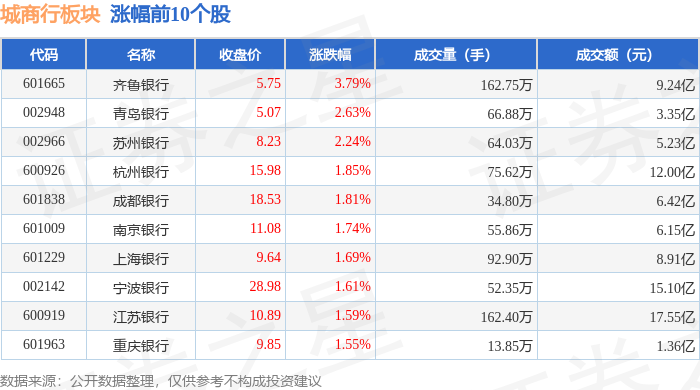
Group 1 - The city commercial bank sector increased by 1.65% on September 2, with Qilu Bank leading the gains [1] - The Shanghai Composite Index closed at 3858.13, down 0.45%, while the Shenzhen Component Index closed at 12553.84, down 2.14% [1] - Qilu Bank's closing price was 5.75, reflecting a 3.79% increase, with a trading volume of 1.6275 million shares and a transaction value of 924 million [1] Group 2 - The city commercial bank sector saw a net inflow of 341 million from main funds, while retail funds experienced a net outflow of 138 million [2] - Jiangsu Bank had a net inflow of 140 million from main funds, but a net outflow of 90.16 million from speculative funds [3] - The overall trading activity in the city commercial bank sector indicates a mixed sentiment among different types of investors, with main funds showing positive interest while retail and speculative funds withdrew [2][3]
中邮核心成长混合8月份逆势下跌2.7% 沪指涨7.97%
Zhong Guo Jing Ji Wang· 2025-09-02 08:13
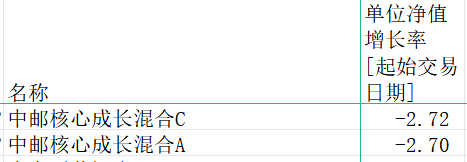
Group 1 - In August 2023, Zhongyou Core Growth Mixed A and C funds experienced declines of 2.7% and 2.72% respectively, while the Shanghai Composite Index rose by 7.97% [1] - Since their inception, Zhongyou Core Growth Mixed A has a return of -46.53%, and Mixed C has a return of -2.18% as of September 1, 2023 [1] - As of June 30, 2025, the total assets under management for Zhongyou Core Growth Mixed A and C combined amounted to 2.609 billion yuan [1] Group 2 - The top ten holdings of Zhongyou Core Growth Mixed A/C include major banks such as Bank of Communications, Industrial and Commercial Bank of China, and China Construction Bank [1] - The fund is currently managed by Chen Liang, who has extensive experience in the investment sector, including roles at Dalian Shide Group and Huaxia Fund Management [1]