华峰化学

Search documents
2025年1-11月化学纤维制造业企业有2485个,同比增长2.6%
Chan Ye Xin Xi Wang· 2026-01-17 04:00
Core Viewpoint - The chemical fiber manufacturing industry in China is experiencing growth, with an increase in the number of enterprises and a positive outlook for the market from 2026 to 2032 [1] Group 1: Industry Overview - As of January to November 2025, the number of chemical fiber manufacturing enterprises reached 2,485, an increase of 63 compared to the same period last year, representing a year-on-year growth of 2.6% [1] - The proportion of chemical fiber manufacturing enterprises in the total industrial enterprises is 0.47% [1] Group 2: Related Companies - The report mentions several listed companies in the chemical fiber sector, including Jilin Chemical Fiber, Hengtian Hailong, Meida Co., Huaxi Co., and others [1]


全球灯塔网络评选出23个新工厂,其中16个来自中国
Zhong Guo Xin Wen Wang· 2026-01-16 13:59
Core Insights - The World Economic Forum has welcomed 23 new lighthouse factories into the Global Lighthouse Network, showcasing how these factories are achieving significant industry transformation amidst geopolitical turmoil, cost pressures, and rapid technological changes [1] - The newly inducted factories are leveraging advanced technologies, particularly AI, to enhance operational resilience, competitiveness, and sustainability [1][2] - The annual white paper released by the Forum outlines pathways for large-scale operational transformation to enhance resilience and impact, drawing insights from over 220 lighthouse factories across more than 30 countries [1][2] Group 1: Operational Transformation - Leading companies are institutionalizing successful practices by integrating AI into daily decision-making and extending transformation across the entire value chain [2] - The newly launched AI industrial intelligence platform, Lumina, consolidates data from over 1,000 successful transformation factories, helping leaders benchmark performance and avoid common pitfalls [2][3] - 94% of successful transformations are attributed to the integration of multiple technologies, with AI being the most widely deployed, followed by IoT, cloud computing, and digital twins [2] Group 2: Performance Metrics - New lighthouse factories have achieved significant improvements in various performance metrics, such as a 400% increase in personalized product range and a 29% reduction in delivery cycles at Carl Zeiss Optical [7] - Hisense Qingdao factory has seen an 84% net promoter score, a 34% reduction in R&D cycles, and an 18% decrease in material costs through comprehensive digital transformation [8] - ACG Packaging Materials achieved a 40% reduction in delivery cycles and a 20% decrease in raw material costs, alongside a 71% drop in product defect rates [10] Group 3: Sustainability and Resilience - Factories are increasingly focusing on sustainability, with Ningde Times reducing carbon footprints by 56% and achieving significant reductions in emissions through innovative energy solutions [32] - The transformation initiatives at SOCAR Carbamide led to a 21% increase in production throughput and a 24% improvement in natural gas utilization efficiency [25] - The focus on sustainable practices is evident in the new lighthouse factories, which aim for net-zero and circular development goals, leading to industry-leading performance in energy conservation and waste reduction [32][36] Group 4: Talent Development - Companies like AUO in Suzhou have implemented digital initiatives to enhance employee engagement and reduce turnover rates by nearly 70%, while also increasing productivity by 29% [37] - Schneider Electric's initiatives in Wuhan focus on advanced solutions for workforce design and talent planning, contributing to significant operational improvements [38]

基础化工行业深度报告:氨纶:产能陆续出清,行业景气度有望改善
Soochow Securities· 2026-01-16 13:50
Investment Rating - The report maintains an "Accumulate" rating for the industry [1] Core Viewpoints - The supply side of the spandex industry is nearing the end of capacity expansion, and the elimination of outdated capacity is expected to improve industry prosperity [4][9] - The demand for spandex is robust due to its excellent performance and wide application, with a CAGR of 11% in apparent consumption from 2017 to 2024 [4][19] - The competitive landscape shows that China is a major producer of spandex, with a high industry concentration, as indicated by a CR5 of 84% by the end of 2025 [4][22] Supply Side Summary - As of the end of 2025, China's spandex capacity is 1.44 million tons/year, with an industry operating rate of 85% [4] - The industry has been experiencing a continuous oversupply from 2022 to 2025, with an average annual operating rate between 70%-80% [4][24] - Major spandex producers include Huafeng Chemical (400,000 tons/year), Xiaoxing Spandex (246,000 tons/year), and others, indicating a significant head effect in the industry [4][24] Demand Side Summary - Spandex is often referred to as the "MSG of textiles," significantly enhancing the performance and quality of fabrics even in small proportions [4][19] - The demand for spandex is expected to grow rapidly as its application range and blending ratio in textiles expand [4][19] Competitive Landscape Summary - China's spandex production capacity accounts for 79% of the global total, with a production capacity of 1.375 million tons in 2024 [22] - The industry is characterized by fierce competition, with many companies operating at a loss due to low overall operating rates [22][24] Price Review and Outlook Summary - As of January 15, 2026, the price of spandex in China is 23,000 yuan/ton, with a price difference of 10,864 yuan/ton [4][28] - The price of spandex has been under pressure due to oversupply, but the report anticipates a recovery in prices as outdated capacity is eliminated [27][31] Investment Targets Summary - Key investment targets in the spandex industry include Huafeng Chemical, Xinxiang Chemical Fiber, and Taihe New Materials, each with varying capacities and profitability levels [33][47] - Huafeng Chemical is noted for its significant market share and cost advantages, while Xinxiang Chemical Fiber is expanding its capacity despite market fluctuations [47][56]


华峰化学申请磺酸基改性聚氨酯纤维制备方法专利,具有优异的力学性能、上色性、色牢度
Jin Rong Jie· 2026-01-16 00:24
Core Viewpoint - Huafeng Chemical Co., Ltd. has applied for a patent for a preparation method of sulfonic acid modified polyurethane fibers, indicating a focus on innovation in material science and potential market expansion in the textile industry [1] Group 1: Patent Application Details - The patent application is titled "A Preparation Method of Sulfonic Acid Modified Polyurethane Fibers" with publication number CN121295377A and was filed on November 2025 [1] - The preparation method involves a three-step process: prepolymerization and chain extension reaction, ring-opening reaction with sulfonic acid lactone compounds, and final spinning process to produce the fibers [1] Group 2: Technical Advantages - The method introduces sulfonic acid groups after the chain extension reaction, which helps avoid adverse effects on polymer stability that could arise from improper timing of sulfonic acid introduction [1] - The resulting sulfonic acid modified polyurethane fibers exhibit excellent mechanical properties along with good dyeing performance and color fastness [1]
化学纤维板块1月15日跌0.41%,同益中领跌,主力资金净流出1.61亿元
Zheng Xing Xing Ye Ri Bao· 2026-01-15 08:53
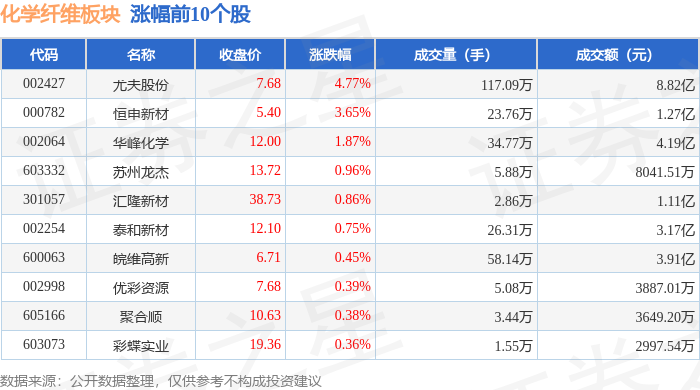
Market Overview - The chemical fiber sector experienced a decline of 0.41% on January 15, with Tongyi leading the drop [1] - The Shanghai Composite Index closed at 4112.6, down 0.33%, while the Shenzhen Component Index rose by 0.41% to 14306.73 [1] Stock Performance - Notable gainers in the chemical fiber sector included: - Youfu Co., Ltd. (002427) with a closing price of 7.68, up 4.77% on a trading volume of 1.171 million shares and a turnover of 882 million yuan [1] - Hengshen New Materials (000782) closed at 5.40, up 3.65% with a trading volume of 237,600 shares and a turnover of 127 million yuan [1] - Huafeng Chemical (002064) closed at 12.00, up 1.87% with a trading volume of 347,700 shares and a turnover of 419 million yuan [1] - Major decliners included: - Tongyi Zhong (688722) closed at 19.76, down 5.14% with a trading volume of 114,300 shares and a turnover of 227 million yuan [2] - Sanfangxiang (600370) closed at 2.56, down 3.40% with a trading volume of 821,300 shares and a turnover of 209 million yuan [2] - Hailide (002206) closed at 6.80, down 3.00% with a trading volume of 462,000 shares and a turnover of 317 million yuan [2] Capital Flow - The chemical fiber sector saw a net outflow of 161 million yuan from main funds, while retail investors contributed a net inflow of 204 million yuan [2] - Specific stock capital flows included: - Wanhui High-tech (600063) had a main fund net inflow of 39.85 million yuan, but a retail net outflow of 44.10 million yuan [3] - Baogangdi (300905) saw a main fund net inflow of 22.94 million yuan, with a retail net outflow of 17.28 million yuan [3] - Youfu Co., Ltd. (002427) had a main fund net inflow of 16.12 million yuan, but a retail net outflow of 21.22 million yuan [3]

化工2026年度策略:供需再平衡,化工新起点
Huafu Securities· 2026-01-12 11:03
Core Insights - The chemical industry is expected to experience a recovery in profitability in 2026, marking a new starting point for supply-demand rebalancing, driven by anti-involution policies and advancements in new productive forces such as AI and robotics [2][5]. Group 1: Industry Overview - The chemical industry faced a downturn in profitability and valuation in 2025, but signs of stabilization and recovery are anticipated in 2026 [2]. - The peak of capital expenditure in the chemical sector has passed, with fixed asset investment turning negative in the second half of 2025, indicating the end of the capacity expansion cycle [5][14]. - The Producer Price Index (PPI) for chemicals is expected to gradually turn positive in 2026 after a prolonged period of decline [14]. Group 2: Investment Themes - Capital expenditure is decreasing, and leading companies like Wanhua Chemical are expected to see a recovery in profitability as they reduce capital spending and increase their global market share in MDI [5]. - The anti-involution policy is reshaping supply dynamics, with a focus on quality development and the exit of outdated capacities, benefiting companies with innovative capabilities and export advantages [5]. - New materials are driving demand growth in traditional chemicals, with companies like Dinglong Technology and Anji Technology positioned to benefit from domestic substitution in high-end materials [5]. Group 3: Market Dynamics - Chemical prices have been under pressure, with the chemical product price index declining approximately 8.8% in 2025, but stock prices in the sector have rebounded by 33.3% [10][16]. - The operating rates of mainstream chemical products are showing signs of weakness, with inventory levels varying significantly across different products [17][18]. - The supply-demand balance for phosphate rock remains tight, with stable prices for high-grade phosphate rock, while the market for phosphate fertilizers is influenced by policy and demand fluctuations [46][43]. Group 4: Global Trends - The global chemical supply is shifting towards China, which has become the largest chemical producer, while European chemical production faces challenges due to high energy costs [31][33]. - The restructuring of supply chains due to tariff disturbances is prompting companies to adapt, with a focus on overseas expansion for leading chemical firms [26][22]. - The anti-involution policies are expected to enhance industry cash flow and promote sustainable development by curbing disorderly expansion and prioritizing profitability [40].




逆向布局精准卡位主动权益基金操作“向ETF看齐”
Zheng Quan Shi Bao· 2026-01-11 17:03
Group 1 - The boundary between passive investment through ETFs and actively managed funds is becoming increasingly blurred, with ETFs evolving into a "duet" with active equity funds [1] - The direction of ETF applications is increasingly serving as a "barometer" for many active equity funds, reflecting market demand and profitability [2] - Active equity funds are adopting ETF-like characteristics, with high concentration in specific sectors to achieve beta returns, often pushing their positions close to the 90% limit [2] Group 2 - The issuance of ETFs is often seen as a precursor to industry booms, as evidenced by the rapid adoption of robotics ETFs leading to a surge in active equity fund investments in the robotics sector [2] - The recent focus on commercial aerospace by active equity funds aligns with the launch of the first satellite ETF, indicating a strategic shift towards this sector [3] - A decrease in ETF applications for consumer sectors correlates with a reduction in active equity fund allocations to those areas, demonstrating a synchronized investment approach [3] Group 3 - The logic behind ETF applications has evolved from merely capturing flows to predicting industry turning points, significantly benefiting the research and investment strategies of active equity funds [4] - The recent surge in chemical ETFs reflects a strategic pivot in ETF product development, aligning with active fund managers' investment strategies [4][5] - The collaboration between ETF product development and research departments enhances the precision of investment strategies, allowing for better positioning in the market [8] Group 4 - The reverse positioning of ETFs during industry downturns often signals the end of a sector's decline and the potential for fundamental recovery, as seen in the solar and battery sectors [7] - The issuance of solar and battery ETFs by leading funds indicates a strategic bet on these sectors, supported by favorable policy changes [7] - The collaborative effect between ETF development and research departments is a significant advantage for precise market positioning [8]
逆向布局精准卡位 主动权益基金操作“向ETF看齐”
Zheng Quan Shi Bao· 2026-01-11 17:00
Group 1 - The boundary between passive investment through ETFs and actively managed funds is becoming increasingly blurred, with ETFs evolving into a "duet" with active equity funds [1] - The direction of ETF applications is increasingly serving as a "barometer" for many active equity funds, reflecting market demand and profitability [2] - Active equity funds are adopting ETF-like characteristics, with high concentration in specific sectors to achieve beta returns, often pushing their positions close to the 90% limit [2] Group 2 - The issuance of ETFs is seen as a signal for industry booms, with examples like the robotics sector where major fund companies launched ETFs, leading to a surge in active fund investments in that area [2] - The recent focus on commercial aerospace by active equity funds aligns with the launch of the first satellite ETF, indicating a strategic shift towards this sector [3] - A decrease in ETF applications for consumer sectors correlates with a reduction in active fund allocations to those areas, demonstrating a synchronized investment approach [3] Group 3 - The logic behind ETF applications has evolved from merely capturing flows to predicting industry turning points, significantly benefiting the research and investment strategies of active equity funds [4] - The recent surge in chemical ETFs reflects a strategic pivot in ETF product development, with active funds adjusting their holdings in response to these new offerings [4][5] - The synchronization between active fund managers and ETF applications indicates a high level of collaboration between public investment research and product development [5] Group 4 - The reverse positioning of ETFs often signals the end of industry downturns, as seen in the solar and battery sectors, where ETFs were launched despite active funds reducing their exposure [6] - The issuance of solar and battery ETFs by leading public funds aligns with policy changes aimed at industry reform, suggesting a strategic move towards enhancing profitability for leading companies [6] Group 5 - The collaboration between ETF product development and research departments has become a significant advantage for public funds in identifying investment opportunities [7] - ETF applications are evolving into precursors for active equity fund strategies, providing liquidity for sectors that are underrepresented or have been overlooked [7]
——基础化工行业周报:多晶硅、丁二烯价格上涨,关注反内卷和铬盐-20260111
Guohai Securities· 2026-01-11 13:03
Investment Rating - The report maintains a "Recommended" rating for the chemical industry [1] Core Insights - The chemical industry is expected to experience an upward cycle due to the implementation of "anti-involution" policies in China and the accelerated exit of some European facilities [29] - The report highlights the potential for domestic substitution of semiconductor materials from Japan due to rising geopolitical tensions, which could benefit various companies in the sector [5] - The chromium salt industry is undergoing a value reassessment driven by increased demand from AI data centers and commercial aircraft engines, with a projected supply-demand gap of 340,900 tons by 2028 [8] Summary by Sections Industry Performance - The chemical industry has shown strong relative performance with a 1-month increase of 10.7%, 3-month increase of 9.6%, and a 12-month increase of 45.1%, outperforming the CSI 300 index [3] Price Trends - Key products such as lithium carbonate and polysilicon have seen significant price increases, supported by policy guidance and industry self-discipline [12] - The price of chromium salts has remained stable, with metal chromium priced at 82,000 CNY/ton as of January 9, 2026 [15] Investment Opportunities - Focus on companies with low-cost expansion capabilities, such as Wanhu Chemical and Hualu Hengsheng, as well as those in sectors with improving market conditions like chromium salts and phosphates [6][9] - High dividend yield opportunities are identified in state-owned enterprises like China Petroleum and China National Chemical [10] Key Company Tracking - Companies such as Dongfang Shenghong and Huabei Yihua are highlighted for their earnings potential, with projected EPS growth for 2026 [30] - The report tracks specific price movements for various chemicals, including a notable increase in the price of ammonium phosphate and a stable price for urea [17][19]


装备新科技挖掘:TPU材料性能优势明显,有望广泛应用于人形机器人
Orient Securities· 2026-01-10 13:16
Investment Rating - The industry investment rating is maintained as "Positive" [6] Core Insights - The trend towards lightweight humanoid robots is irreversible, with the future widespread application of electronic skin expected to drive growth in orders for dexterous hands and related manufacturers, benefiting lightweight material and component suppliers [3] - TPU (Thermoplastic Polyurethane) materials exhibit significant advantages such as good stretchability, abrasion resistance, thermal stability, and corrosion resistance, with sufficient domestic production capacity [9][17] - The global electronic skin market is projected to reach USD 6.44 billion by 2025 and USD 111.53 billion by 2035, with a compound annual growth rate (CAGR) of 33% over the next decade, driven primarily by medical needs, wearable devices, and robotics applications [13][17] Summary by Sections TPU Material Advantages - TPU materials combine the processing capabilities of plastics with the elasticity of rubber, offering excellent biocompatibility, high-temperature resistance, and corrosion resistance. The domestic production capacity is primarily focused on mid-to-low-end products, with leading domestic companies achieving quality comparable to international leaders [9][18] Electronic Skin Market - The electronic skin market is expected to grow rapidly, with robotics applications accounting for approximately 42% of the market. About 68% of robotics laboratories are actively testing electronic skin to enhance tactile perception [13][17] Application in Robotics - TPU materials are well-suited for the performance requirements of electronic skin and lightweight structural components in robots. They have been explored in applications such as the passive support system of the Xiaopeng IRON robot and in collaborations between Fourier Intelligence and BASF [17][18]