
天弘基金

Search documents
“费率刺客”现身货币基金市场,各项费用吃掉近三成年化收益
Sou Hu Cai Jing· 2025-07-02 11:43
Core Viewpoint - The shift of deposits from traditional banks to money market funds (MMFs) may not yield the expected higher returns due to increasing fee rates that significantly reduce actual earnings [1][2][3]. Group 1: Market Trends - In May 2023, several major state-owned banks lowered deposit rates, with three-year fixed deposit rates dropping to the "1" range, prompting a "deposit migration" trend among savers towards MMFs, bond funds, and bank wealth management products [1]. - The total scale of MMFs increased from 13.32 trillion yuan at the end of March to 14.40 trillion yuan by the end of May 2023, reflecting a growth of over 1 trillion yuan in just two months [4][8]. Group 2: Fee Structures - Many MMFs have high fee rates, with nearly 30% of MMFs having management fees of 0.3% or higher, and almost 40% charging sales service fees of 0.25% or more, leading to comprehensive operational fee rates exceeding 0.6% for numerous funds [2][3]. - The average operational comprehensive fee rate for MMFs has surpassed 0.4%, while some funds, particularly those transitioning from brokerage margin products, maintain management fees above 0.7%, with the highest reaching 0.9% [3][4]. Group 3: Impact on Returns - For ordinary investors seeking low-risk and flexible liquidity, high-fee MMFs can significantly diminish net returns, with operational fees potentially consuming nearly 30% of total earnings in some cases [3][6]. - The largest MMF, Tianhong Yu'ebao, has an operational comprehensive fee rate of 0.63%, which, when factored into its net yield of 1.5867% for 2024, indicates that fees substantially impact investor returns [4][6]. Group 4: Challenges in Fee Reduction - The high fee structure of MMFs poses challenges for fee reductions, as they are a crucial revenue source for asset management companies and distribution channels [7]. - The need for fee reductions is acknowledged, especially as MMF fees currently exceed those of index funds, but actual reductions depend on negotiations among asset management firms, banks, and distribution platforms [7][8]. Group 5: Future Considerations - Asset management firms are encouraged to optimize operational costs through improved transaction systems and the use of technology to enhance efficiency, which could create opportunities for lowering management fees [8]. - The balance between operational sustainability and investor experience remains a long-term challenge for asset management institutions in the MMF sector [9].
ETF及指数产品网格策略周报-20250702
HWABAO SECURITIES· 2025-07-02 10:57
Group 1 - The core viewpoint of the report emphasizes the effectiveness of grid trading strategies in volatile markets, allowing investors to profit from price fluctuations without predicting market trends [3][12] - The report identifies suitable characteristics for grid trading targets, including low trading costs, good liquidity, and significant volatility, suggesting that equity ETFs are appropriate for this strategy [3][12] Group 2 - The semiconductor ETF (512480.SH) is highlighted due to the increasing domestic substitution under technical sanctions and the rising demand for computing chips driven by AI applications, with a predicted 20% year-on-year growth in AI PC, tablet, and mobile phone shipments by 2025 [3][13] - The artificial intelligence ETF (159819.SZ) benefits from government policies promoting AI technology across various sectors, with 433 domestic large models registered by June 30, 2025, indicating a significant push towards industrial transformation [4][16] - The robotics ETF (159770.SZ) is supported by national policies aiming to establish a humanoid robot innovation system by 2025, showcasing advancements in technology and commercial viability [5][19] - The medical ETF (512170.SH) is driven by the aging global population and supportive policies for innovative drug development, aiming to enhance the quality and efficiency of clinical trials and drug approvals [6][20]
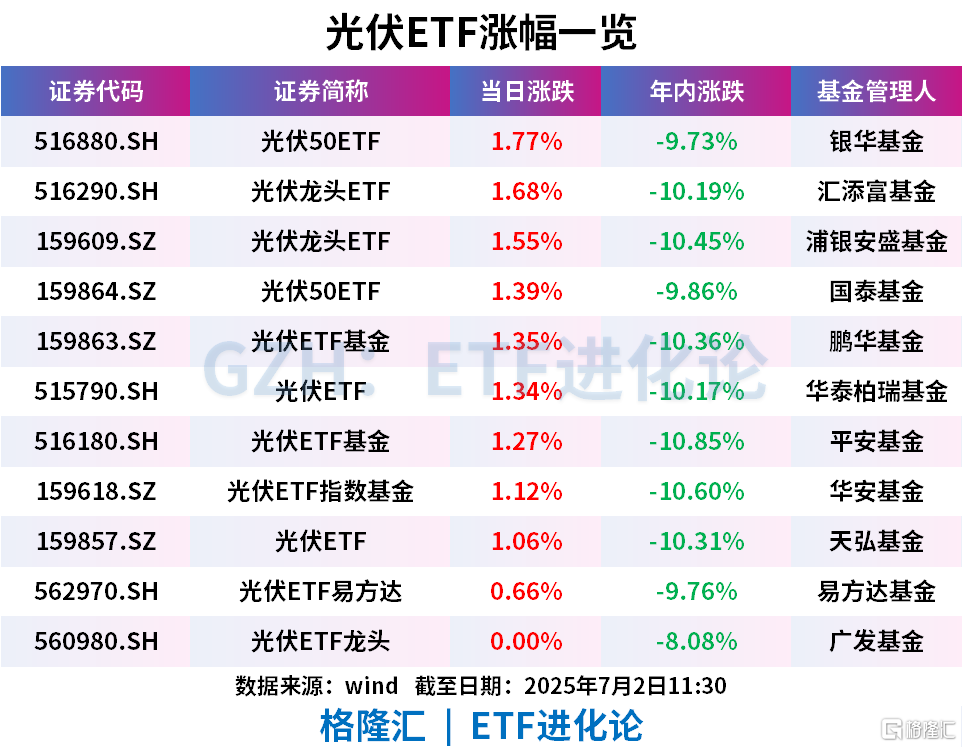
光伏50ETF、光伏龙头ETF、光伏ETF基金上涨,年内超35亿元资金净流入光伏ETF
Ge Long Hui· 2025-07-02 04:35
Core Viewpoint - The photovoltaic equipment sector is experiencing a strong performance, with significant gains in stock prices and inflows into related ETFs, despite a year-to-date decline in ETF values [1][4]. Group 1: Market Performance - Major photovoltaic stocks such as Yijing Photovoltaic and Oujing Technology have reached their daily limit up [1]. - Multiple photovoltaic ETFs, including Silverhua Photovoltaic 50 ETF and Huatai-PB Photovoltaic ETF, have seen increases of over 1% [1]. - Year-to-date, the photovoltaic ETFs have declined nearly 10%, with over 3.5 billion yuan net inflow into these funds [4]. Group 2: Fund Inflows - The top-performing ETFs in terms of net inflow include Huatai-PB Photovoltaic ETF with 2.637 billion yuan and Tianhong Photovoltaic ETF with 546 million yuan [4][6]. - Other ETFs also recorded net inflows, albeit at lower amounts, indicating a general interest in the sector despite the overall decline [6]. Group 3: Industry Dynamics - Recent reports indicate a 30% production cut among major domestic photovoltaic glass manufacturers, with some companies maintaining normal operations [8]. - The photovoltaic industry has seen a significant increase in new installations, with 197.85 GW added in the first five months of 2025, a 150% year-on-year increase [8]. - The industry is facing challenges such as supply-demand mismatches and market failures, which have led to intensified competition and price declines [9].

2025上半年红利低波ETF盘点:华泰柏瑞红利低波ETF龙头地位稳固 景顺长城红利低波100ETF缩水最严重
Xin Lang Ji Jin· 2025-07-02 04:34
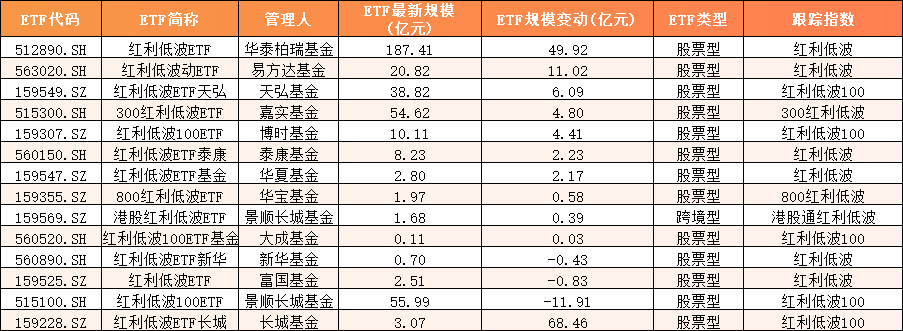
Core Viewpoint - The performance of low-volatility dividend ETFs has shown a positive trend in the first half of 2025, with over 70% of the products experiencing growth in scale and overall net inflow of funds [1][3]. Group 1: ETF Performance - Among 14 major low-volatility dividend ETFs, the total scale reached 38.883 billion yuan, with a net increase of 6.846 billion yuan in the first half of the year [3]. - The Huatai-PB Low Volatility Dividend ETF (512890.SH) saw its scale surge to 18.741 billion yuan, contributing 73% of the total market growth for this type of ETF [3]. - Other notable performers include E Fund, Tianhong, and Harvest, with scale increases of 1.102 billion, 0.609 billion, and 0.480 billion yuan respectively [4]. Group 2: Market Dynamics - The expansion and differentiation of low-volatility dividend ETFs are primarily driven by investors' demand for yield certainty and risk control in a volatile market environment [7]. - Regulatory guidance on dividend ratios has reinforced the logic behind dividend strategies, making low-valuation assets with stable dividends more attractive [7]. - The concentration of funds towards well-recognized and larger-cap products is evident, as smaller or newer products struggle to attract significant investment [5][6]. Group 3: Product Differentiation - Despite being categorized under "low-volatility dividend," the specific tracking indices lead to varied fund flows, with mainstream broad-based indices seeing rapid growth while niche indices experience moderate inflows or even outflows [5][6]. - The Invesco Low Volatility Dividend ETF (515100.SH) faced a significant net redemption of 1.191 billion yuan, marking it as the most severely shrinking product in the market [6]. - The Huatai-PB Low Volatility Dividend ETF is noted as the first hundred-billion-level low-volatility dividend theme ETF, with a holder count exceeding 829,800, making it a standout in the market [7].
资金加速涌入ETF!上半年ETF管理人最新排位出炉
证券时报· 2025-07-02 04:13
Core Viewpoint - The ETF market in China has shown significant growth in the first half of 2025, with total assets surpassing 4 trillion yuan, marking a 15.57% increase from the end of the previous year. The bond ETFs have experienced the most substantial growth, with a 120.71% increase in size [1][10]. ETF Market Overview - The total scale of ETFs reached 4.31 trillion yuan, with bond ETFs growing to 383.98 billion yuan [1]. - The wide-based ETFs account for half of the total ETF market, with a size of 2.23 trillion yuan, despite a modest growth of 2% [1]. Performance of Individual ETFs - Eighteen ETFs saw their scale increase by over 10 billion yuan, with seven being stock ETFs, primarily focusing on broad-based products like the CSI 300 ETF and thematic products like the robotics ETF [2]. - The CSI 300 ETF from Huaxia Fund led in net inflows, gaining 30.32 billion yuan in net inflow and an increase of 8.14 billion shares [4]. Fund Company Performance - Sixteen fund companies had ETFs with a total scale increase of over 10 billion yuan, with Huaxia Fund leading by adding 93.17 billion yuan, bringing its total ETF management scale to 751.34 billion yuan [3][16]. - The top three fund companies by ETF management scale are Huaxia Fund, E Fund, and Huatai-PB, with respective scales of 751.34 billion yuan, 666.23 billion yuan, and 499.47 billion yuan [14]. Bond ETF Growth - The bond ETF market saw a net inflow of nearly 180 billion yuan, with 23 out of 29 products experiencing growth, resulting in a total size of 383.98 billion yuan [10]. - The Hai Fu Tong Short-term Bond ETF led in net inflows with 19.40 billion yuan, while several other bond ETFs also saw inflows exceeding 18 billion yuan [11]. Cross-border ETF Trends - There has been a significant influx of capital into Hong Kong stocks, leading to a 33.23% increase in the total scale of cross-border ETFs [7]. - The Fortune CSI Hong Kong Internet ETF grew by over 19 billion yuan, and the ICBC Credit Suisse Hong Kong Technology 30 ETF increased by approximately 13 billion yuan [7].

ETF融资榜 | 红利低波50ETF(515450)杠杆资金加速流入,港股相关ETF受关注-20250701
Sou Hu Cai Jing· 2025-07-02 03:13
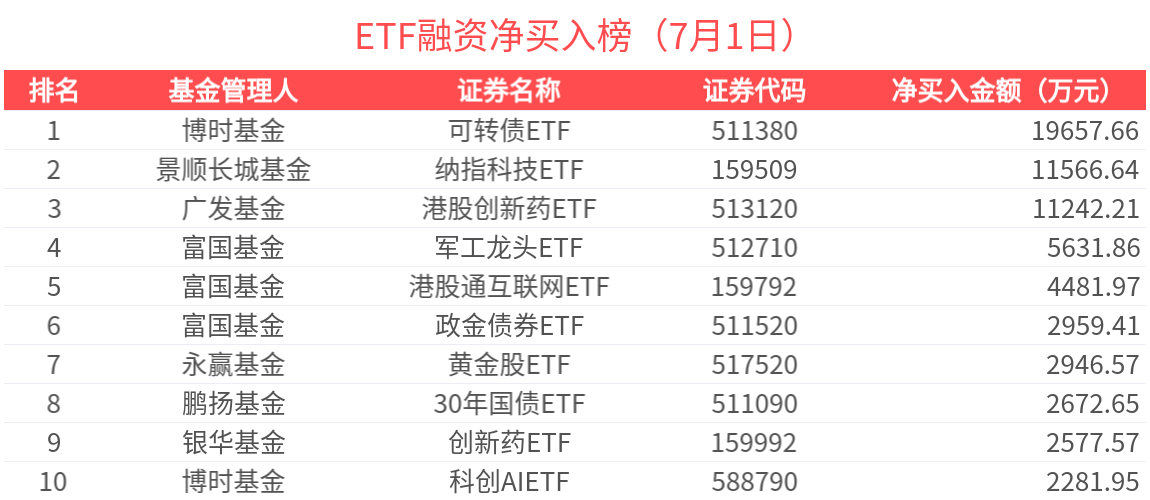
Core Insights - A total of 171 ETF funds experienced net inflows from financing, while 38 funds saw net outflows from securities lending [1] - The top five ETFs with significant net inflows include Convertible Bond ETF, Nasdaq Technology ETF, Hong Kong Innovative Drug ETF, Military Industry Leader ETF, and Hong Kong Internet ETF, with net inflows of 197 million, 116 million, 112 million, 56.3 million, and 44.8 million respectively [1][3] - Conversely, the ETFs with the highest net outflows from securities lending include CSI 1000 ETF, CSI 500 ETF, and CSI 300 ETF, with net outflows of 144.3 million, 72.4 million, and 15.6 million respectively [1][5] Financing and Securities Lending Trends - Recently, 78 ETFs have seen continuous net inflows from leveraged financing, with the top performers being Securities Insurance ETF, Bank ETF, Low Volatility Dividend 50 ETF, Broker ETF, and France CAC40 ETF, accumulating net inflows of 24.5 million, 371 million, 79.9 million, 66.7 million, and 42.9 million respectively [1][6] - In terms of net outflows from leveraged securities lending, 16 ETFs have been identified, with the leading ones being CSI 500 ETF, Convertible Bond ETF, and CSI 300 ETF, which experienced net outflows of 218 million, 20.9 million, and 2.3 million respectively [1][6] Long-term Trends - Over the past five days, 58 ETFs have recorded net inflows exceeding 5 million from leveraged financing, with Bank ETF, Nasdaq Technology ETF, Military Industry Leader ETF, Convertible Bond ETF, and Securities ETF leading the way with net inflows of 371 million, 287 million, 164 million, 149 million, and 119 million respectively [1][6] - In the same timeframe, 8 ETFs have seen net outflows from leveraged securities lending exceeding 5 million, with CSI 500 ETF, CSI 1000 ETF, and CSI 300 ETF being the most affected, showing net outflows of 218 million, 191 million, and 24.2 million respectively [1][10]
ETF资金榜 | 十年国债ETF(511260)近20天连续净流入,货基吸金能力强-20250701
Sou Hu Cai Jing· 2025-07-02 02:40
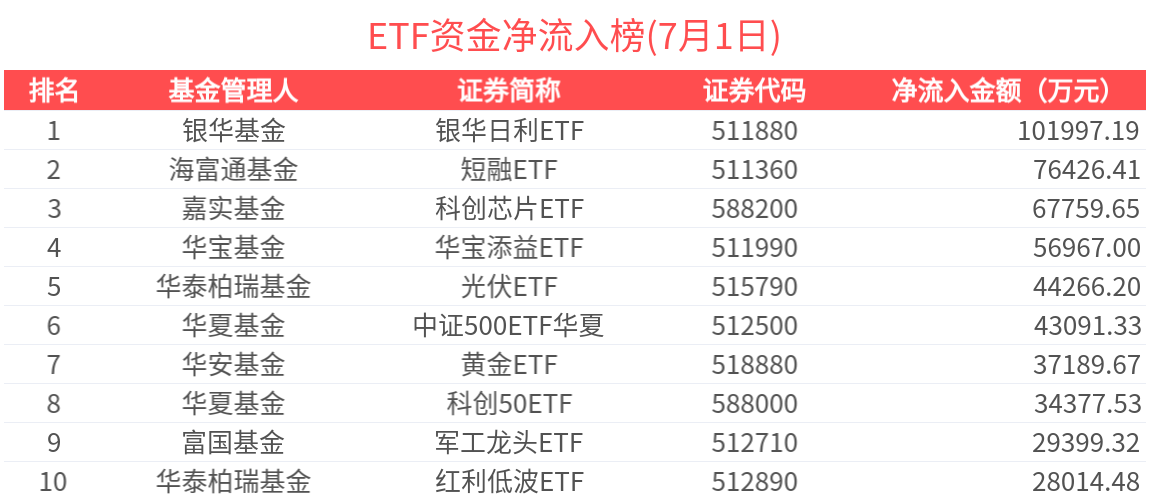
Core Insights - On July 1, 2025, a total of 167 ETFs experienced net inflows, while 461 ETFs saw net outflows, indicating a significant disparity in investor sentiment towards different funds [1] - The top five ETFs with substantial net inflows included Yin Hua Ri Li ETF, Short-term Bond ETF, Sci-Tech Chip ETF, Hua Bao Tian Yi ETF, and Photovoltaic ETF, with net inflows of 1.02 billion, 764 million, 678 million, 570 million, and 443 million respectively [1][3] - Conversely, 32 ETFs had net outflows exceeding 1 billion, with the China A500 ETF, CSI 300 ETF, and others leading the outflows, totaling 2.282 billion, 1.465 billion, and 990 million respectively [1][5] Inflow and Outflow Analysis - The ETFs with the highest net inflows were led by Yin Hua Ri Li ETF and Short-term Bond ETF, which attracted significant capital, reflecting investor confidence in these funds [1][3] - A total of 86 ETFs have seen consecutive net inflows, with the Ten-Year Treasury ETF and Corporate Bond ETF leading the pack, accumulating inflows of 10.134 billion and 9.405 billion respectively [5] - In contrast, 290 ETFs have experienced consecutive net outflows, with the Xin Chuang ETF and CSI 300 Enhanced ETF being the most affected, with outflows of 411 million and 301 million respectively [6][8] Recent Trends - Over the past five days, 89 ETFs recorded net inflows exceeding 1 billion, with the China A500 ETF leading with an inflow of 8.278 billion, indicating a strong recovery in investor interest [6][9] - On the other hand, 115 ETFs saw net outflows surpassing 1 billion in the same period, with Yin Hua Ri Li ETF experiencing the largest outflow of 10.055 billion, suggesting a shift in investor preference [9]
ETF巨头又有大动作!
Zhong Guo Ji Jin Bao· 2025-07-01 12:58
Group 1 - The core point of the article is the renaming of Huatai-PB CSI A500 ETF to "A500ETF Huatai-PB" to enhance product recognition and decision-making efficiency for investors [2][3][6] - As of June 30, the Huatai-PB CSI A500 ETF has reached a scale of 22.64 billion yuan, making it the largest in its category and the only ETF tracking the CSI A500 index to exceed 20 billion yuan [2][3] - The renaming initiative is part of a broader trend in the ETF industry, where multiple fund companies are adopting standardized naming conventions to improve product identification and attract investors [3][6][8] Group 2 - The rapid expansion of the domestic ETF market has led to over 1,200 listed ETF products in the A-share market, with a total scale exceeding 4.3 trillion yuan [3][7] - The standardization of ETF names is becoming an industry consensus, driven by the need for clearer differentiation among similar products [6][8] - Regulatory bodies like the Shanghai and Shenzhen Stock Exchanges have implemented rules to facilitate the expansion of ETF names, promoting a more organized naming structure [7][8]

ETF巨头又有大动作!
中国基金报· 2025-07-01 12:35
Core Viewpoint - The article discusses the renaming of the Huatai-PineBridge CSI A500 ETF to "A500ETF Huatai-PineBridge," aiming to enhance product recognition and improve investor decision-making efficiency in the rapidly growing ETF market in China [2][6][11]. Group 1: ETF Market Overview - The Chinese ETF market has seen rapid expansion, with over 1,200 listed ETFs and a total scale exceeding 4.3 trillion yuan [5]. - The Huatai-PineBridge CSI A500 ETF has reached a scale of 22.64 billion yuan, making it the largest in its category and the only ETF tracking the CSI A500 index to surpass 20 billion yuan [2][5]. Group 2: Renaming Strategy - The renaming of ETFs, including the Huatai-PineBridge CSI A500 ETF, is part of a broader industry trend to standardize product names, which helps investors quickly identify and differentiate between similar products [3][9]. - The new naming format "Index + ETF + Manager Name" is designed to clearly present the fund's core attributes, reducing selection costs for investors and enhancing decision-making efficiency [6][7]. Group 3: Industry Consensus - There is a growing consensus in the fund industry regarding the need to improve the name recognition of ETF products, especially in light of increasing competition and product homogeneity [8][9]. - Regulatory bodies, including the Shanghai and Shenzhen Stock Exchanges, have initiated measures to promote standardized naming for ETFs, which began implementation in 2022 [9][10]. Group 4: Long-term Investment Focus - The renaming initiative aligns with the trend of long-term capital entering the market, emphasizing the importance of product transparency and recognizability for institutional investors such as pension funds and insurance capital [6][11]. - The move is seen as a step towards enhancing the quality of public fund services and fostering a long-term investment ecosystem [7][11].

信用债ETF产品发展迅速
Jin Rong Shi Bao· 2025-07-01 03:09
Group 1 - The core viewpoint is that the first batch of benchmark market-making credit bond ETFs launched earlier this year has seen rapid growth, with all eight products surpassing 10 billion yuan in scale, increasing over five times since their issuance [1][2] - As of June 24, the total scale of the eight benchmark market-making credit bond ETFs reached 116.24 billion yuan, with the largest being Huaxia's ETF at 20.33 billion yuan [2] - The introduction of the market-making system for bonds is considered crucial for the stability and pricing of the bond market, enhancing investor trading convenience and willingness [3] Group 2 - The inclusion of the eight benchmark market-making credit bond ETFs in the general pledge-style repurchase system is significant, as it addresses developmental shortcomings and enhances product attractiveness [4] - The China Securities Regulatory Commission's action plan promotes the development of benchmark market-making credit bond ETFs, allowing them to be used in general repurchase transactions [4] - The ability to conduct pledge-style repurchase transactions is expected to improve capital efficiency for investors and broaden financing channels, thereby increasing the investment value of credit bond ETFs [5] Group 3 - The market for bond index funds has substantial growth potential, with a relatively low market share and limited existing credit bond index funds [6] - The advantages of bond ETFs include flexible trading, ease of pledge, and the ability to achieve better tracking efficiency compared to traditional bond index funds [6]