
华泰证券

Search documents
联美量子:控股股东部分股份质押及解质押,累计质押占比 38.90%
Xin Lang Cai Jing· 2025-11-27 08:19
Core Viewpoint - Lianmei Quantum's controlling shareholder, Lianzhong New Energy, pledged 129,680,000 shares on November 25, 2025, for debt repayment and unpledged 162,680,000 shares on November 26, 2025, both through Huatai Securities [1] Summary by Relevant Sections - **Share Pledge Details** - Lianzhong New Energy has cumulatively pledged 466,780,000 shares, accounting for 38.94% of its holdings [1] - The total shares pledged by Lianzhong New Energy and its concerted party, Lianmei Group, amount to 617,980,000 shares, representing 27.31% of the total share capital and 38.90% of their combined holdings [1] - **Creditworthiness and Risk Management** - Lianzhong New Energy is noted to have good creditworthiness, indicating that the pledge risk is controllable [1]

方正证券:券商综合账户试点再获批 关注事件催化下板块进攻机会
Zhi Tong Cai Jing· 2025-11-27 03:21
Core Viewpoint - The capital market continues to show high prosperity, and the supply-side reform in the industry is accelerating. The current improvement trend in the brokerage sector's fundamentals is diverging from valuation performance, indicating potential opportunities for valuation recovery under event-driven catalysts [1]. Group 1: Brokerage Sector Outlook - The brokerage sector is expected to maintain a high-speed year-on-year profit growth in 2025, with a projected net profit increase of 51% [1]. - The dynamic price-to-book (PB) ratio for the brokerage sector in 2025 is estimated to be 1.30 times, which is at the 33rd percentile of the past 10 years and has not yet reached historical highs, suggesting ample room for valuation adjustment [1]. - Recent catalysts, such as the completion of the China International Capital Corporation (CICC) merger case and the expansion of the comprehensive account pilot program, are expected to drive valuation recovery in the brokerage sector [1]. Group 2: Comprehensive Account Pilot Program - The third batch of the comprehensive account pilot program for brokerages has been expanded, marking a move towards the regularization of brokerage account services [2]. - The pilot program aims to optimize the efficiency of client fund turnover and enhance user experience by allowing inter-account transfers and breaking the closed management of different accounts [2]. - The comprehensive account pilot has opened up opportunities for wealth management business expansion for brokerages, facilitating a shift towards a client-centered service model and improving the ability to provide diversified wealth management services [2].

证券ETF龙头(159993)盘中净申购4200万份,A股公司赴港上市带动中资券商IPO业务
Xin Lang Cai Jing· 2025-11-27 03:20
Group 1 - The core viewpoint indicates that the securities industry is expected to enter a new upward cycle, driven by three major policy opportunities that support the construction of a financial powerhouse [2] - Over 140 A-share companies have proposed plans to list in Hong Kong or spin off subsidiaries for listing in Hong Kong this year, with the total IPO fundraising amount in the Hong Kong stock market exceeding 200 billion HKD, ranking first among global exchanges [1] - Chinese securities firms account for over 60% of the underwriting share among more than 30 brokers participating in Hong Kong IPOs, establishing themselves as dominant underwriters and global coordinators in significant transactions [1] Group 2 - The top ten weighted stocks in the Guozheng Securities Leading Index account for 78.89% of the index, with major companies including Dongfang Caifu, CITIC Securities, and Huatai Securities [3] - Policies are enhancing the long-term investment ecosystem, facilitating the entry of long-term funds such as social security and insurance into the market, which is expected to drive the transformation of the industry towards a more allocation-driven model [2] - The development of the STAR Market and the ChiNext Board is promoting the upgrade of investment banking capabilities, aligning with the financing needs of high-tech enterprises throughout their lifecycle, thus opening up long-term growth space for investment banking businesses [2]
最低费率一档,可T+0交易的港股通红利低波ETF基金(159118)今日上市
Mei Ri Jing Ji Xin Wen· 2025-11-27 03:16
Core Viewpoint - The newly listed Hong Kong Stock Connect Low Volatility Dividend ETF (159118) aims to provide investors with a better investment option focusing on high dividend yield and low volatility stocks [1] Group 1: Fund Overview - The ETF closely tracks the S&P Hong Kong Stock Connect Low Volatility Dividend Index, which balances industry coverage and has a relatively even distribution across sectors [1] - The top three sectors represented in the index are Real Estate (16%), Utilities (15%), and Banks (14%) [1] - The fund has a market capitalization bias towards large-cap stocks, with a price-to-earnings (PE) ratio of less than 9 [1] Group 2: Historical Performance - The historical performance of the S&P Hong Kong Stock Connect Low Volatility Dividend Index is notable, with a total return index (including dividends) showing a cumulative increase of 94.95% from 2021 to October 22, 2025, translating to an annualized return exceeding 16% [1] - This performance significantly outpaces the Hang Seng Index and other dividend-focused indices [1] Group 3: Risk and Return Metrics - According to Huatai Securities, the Low Volatility Dividend style index has strong metrics in terms of return, risk, and dividend yield, with the S&P Hong Kong Stock Connect Low Volatility Dividend Index achieving the highest annualized return this year [1] - The Sharpe ratio and Calmar ratio median for the Low Volatility Dividend style index rank among the top in its category [1]
上海碳市场发展 暨上海碳配额远期业务研讨会举办
Jin Rong Shi Bao· 2025-11-27 03:05
Core Insights - The Shanghai Clearing House and Shanghai Environment and Energy Exchange held a seminar on the development of the Shanghai carbon market and forward carbon quota trading [1][2] - The Shanghai Municipal Ecology and Environment Bureau presented the "Action Plan for Comprehensive Deepening Reform of the Shanghai Carbon Market (2026-2030)", outlining the overall strategy, main goals, and key tasks for the next phase of market development [1] - The Shanghai Clearing House promoted the forward carbon quota central counterparty clearing business, emphasizing its business model, risk control measures, and service advantages to help market participants manage price volatility risks [1] Group 1 - The seminar included representatives from 76 institutions, including regulatory bodies, financial institutions, carbon asset management companies, and research institutions, with nearly a hundred experts in attendance [1] - The Shanghai Economic Information Center explained the core principles and methodologies of the carbon quota allocation scheme, enhancing market understanding of the allocation mechanism [1] - Financial institutions such as Guotai Junan Securities, Huatai Securities, and Dongfang Securities shared their experiences in participating in the Shanghai carbon market and forward trading [2] Group 2 - The forward carbon quota central counterparty clearing business has been operational since 2017, with a cumulative clearing amount of approximately 226 million yuan, serving as an important risk management tool [2] - The Shanghai Clearing House aims to continue optimizing clearing services and contribute to the construction of Shanghai as an international financial center and a hub for international green finance [2]
冲击3连阳!创业50ETF(159682)盘中最高涨超2.2%,机构:光模块景气度再攀升
2 1 Shi Ji Jing Ji Bao Dao· 2025-11-27 02:58
Group 1 - A-shares indices collectively strengthened on November 27, with the ChiNext Index continuing to rise and the CPO concept gaining momentum [1] - The Chuangye 50 ETF (159682) saw a peak increase of over 2.2% before closing up 1%, with a trading volume exceeding 140 million yuan [1] - As of November 26, the latest circulating shares of the Chuangye 50 ETF were 3.523 billion, with a circulating scale of 4.945 billion yuan [1] Group 2 - Google AI infrastructure head Amin Vahdat stated that the company must double its AI computing power every six months and achieve an additional 1000 times growth in the next 4 to 5 years to meet rising AI service demands [1] - Market sources indicate that Zhongji Xuchuang is a supplier of optical modules for Google, although specific cooperation details remain undisclosed [1] - Huatai Securities highlighted that multi-chip interconnection is key to expanding AI computing power, with CPO technology potentially becoming a critical path for overcoming computing power expansion bottlenecks by 2027 [2] - Northeast Securities noted that the demand for optical modules is expected to rise, with continuous upward revisions in order guidance leading to a supply-demand imbalance becoming the norm in the industry [2]



A 股呈现震荡格局,资金持续流向部分红利资产,中证红利ETF(515080)单日获1.12亿元资金净流入
2 1 Shi Ji Jing Ji Bao Dao· 2025-11-27 02:26
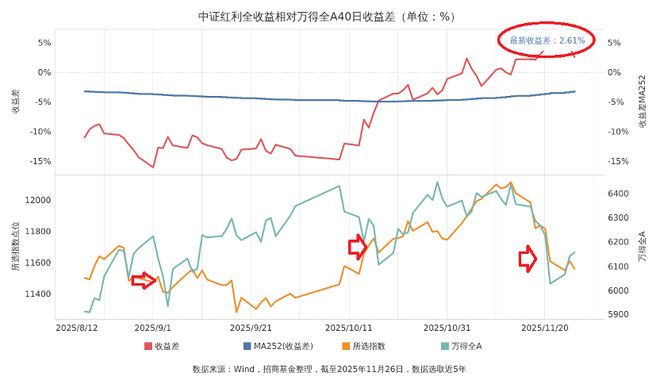
Group 1 - The A-share market has continued to show a correction and fluctuation trend since mid-November, with defensive dividend assets demonstrating a clear relative advantage [1] - As of November 26, the relative return difference of the CSI Dividend Total Return Index compared to the Wind All A Index over 40 days has risen to 2.61%, indicating the recent strength of dividend assets [1] - The recent performance of the CSI Dividend ETF (515080) has been notable, with a net inflow of 112 million yuan yesterday and a cumulative net inflow of 374 million yuan over the past four days [3] Group 2 - Changjiang Securities notes a "high-low switch" phenomenon in the equity market since September, reflecting increasing divergence in funds towards high-valuation sectors [5] - The overall A-share market is currently in a fluctuating pattern, with value style outperforming growth, likely due to the lack of quarterly earnings data to validate investment logic in Q4 [5] - Huatai Securities suggests a short-term barbell strategy for asset allocation, recommending a balanced investment in growth, cyclical, and dividend sectors [6] - The overall industry prosperity index continued to decline in October, but the rate of decline has slowed, with essential consumption, midstream manufacturing, and large financial sectors showing significant improvement [6]
日股ETF反弹,投行提醒:短期波动可能加剧
证券时报· 2025-11-27 02:08
Core Viewpoint - The article discusses the high premium risk associated with Nikkei 225 ETFs in the A-share market, highlighting the ongoing net inflow despite a recent decline in the Nikkei 225 index. It emphasizes the potential short-term economic boost from Japan's new fiscal stimulus plan, while also warning about the risks of inflation detachment and increased volatility in risk assets due to the lack of monetary policy normalization support [1][3][5]. Group 1: High Premium Risk - Four Nikkei 225 ETFs in the A-share market have issued high premium risk warnings, with the E Fund's Nikkei 225 ETF showing a premium of 5.12% as of November 25 [3]. - Other ETFs also reported high premium rates, with the Huashan Mitsubishi Nikkei ETF at 7.31%, and others at 5.78% and 6.21% [3]. - Despite a cumulative net asset value drop of over 8% for these ETFs in November, their total shares increased by 62.5 million, indicating strong investor interest [3]. Group 2: Economic Stimulus and Market Volatility - Japan's government announced a supplementary budget of 21.3 trillion yen, approximately 3% of GDP, which is expected to provide a short-term boost to economic growth [5]. - However, there are concerns that without monetary policy normalization, this fiscal stimulus could exacerbate inflation risks and increase the risk premium in the bond market, leading to heightened volatility in risk assets [5]. - The recent strong performance of the Japanese market may face increased short-term volatility due to geopolitical tensions and influences from the U.S. stock market [5].

港股开盘 | 恒指高开0.07% 万科企业跌超5%
智通财经网· 2025-11-27 01:36
Core Viewpoint - The Hong Kong stock market is experiencing adjustments, but the underlying bullish trend, particularly in technology stocks, is expected to continue over the next two to three years, with a potential shift to a broader bull market by 2026 [2][3][4]. Market Performance - The Hang Seng Index opened up by 0.07%, while the Hang Seng Tech Index fell by 0.1%. Notably, NIO dropped over 2%, and Baidu Group fell more than 1%, while the new stock Quantitative Party surged over 165% [1]. - Vanke Enterprises saw a decline of over 5% as the company plans to hold a meeting regarding the extension of its bond [1]. Investment Outlook - Analysts suggest that the current market volatility is primarily driven by liquidity, sentiment, and risk appetite, with a focus on core assets amid economic data concerns [3]. - Investment strategies should focus on three main areas: AI-driven industry trends, capacity cycle reversals, and sectors related to export and commodities influenced by external uncertainties [2]. - The Hong Kong market is viewed as a "valuation pit," with significant room for valuation recovery, especially in the context of low historical valuations compared to global indices [5][6]. Liquidity and Market Dynamics - The market's performance is largely influenced by liquidity conditions, with expectations of continued inflows from both domestic and foreign investors as the U.S. enters a rate-cutting phase [6]. - Historical data indicates that short-term market adjustments are normal, with average declines of 7% during minor corrections and 17% during significant liquidity tightening [2]. Sector-Specific Insights - The technology sector in Hong Kong is currently undergoing adjustments, but its long-term investment value is becoming increasingly apparent [4]. - The AI sector remains a focal point for investment, with expectations of continued growth despite recent market fluctuations [3][4].



券商晨会精华:人形机器人行情整固待催化,产业在0-1的趋势兑现前夕
Xin Lang Cai Jing· 2025-11-27 00:29
Group 1: Market Overview - The Shenzhen Composite Index and the ChiNext Index both opened lower but closed higher, with the Shanghai and Shenzhen stock markets recording a total turnover of 1.78 trillion, a decrease of 28.8 billion from the previous trading day [1] - By the end of the trading session, the Shanghai Composite Index fell by 0.15%, while the Shenzhen Composite Index rose by 1.02%, and the ChiNext Index increased by 2.14% [1] Group 2: Bad Asset Market - Huatai Securities indicated that the marketization of bad asset transfers is entering a rapid development cycle, with a significant increase in the marketization of bad consumer loans expected in 2024 [2] - The China Banking Asset Management Association reported that the scale of bad loans traded in the first quarter of 2025 reached 48.3 billion, a year-on-year increase of 139% [2] - The demand for bad asset transfers is driven by rising non-performing loan ratios among retail loans and consumer finance companies, with personal loans accounting for over 70% of total transaction volume in the bad asset transfer market [2] Group 3: Robotics Sector - CITIC Construction Investment stated that the humanoid robot sector is in a phase of consolidation after significant adjustments in October, with key developments such as Tesla's Optimus mass production orders supporting market expectations [3] - The industry is on the verge of realizing its potential, but further catalysts are needed for upward revisions in expectations [3] Group 4: Machinery Sector - Galaxy Securities highlighted that the machinery sector outperformed the market in 2025, with technology-related sectors such as humanoid robots, AI PCB equipment, and lithium battery equipment showing significant gains [4] - The investment strategy for the machinery sector in 2026 focuses on AI infrastructure, future industries, and cyclical recovery, emphasizing the importance of new and emerging industries in China's economic transformation [4]
