
晶澳科技

Search documents
“出货王”晶科能源一季度正在加速“出血”?
3 6 Ke· 2025-05-21 00:04
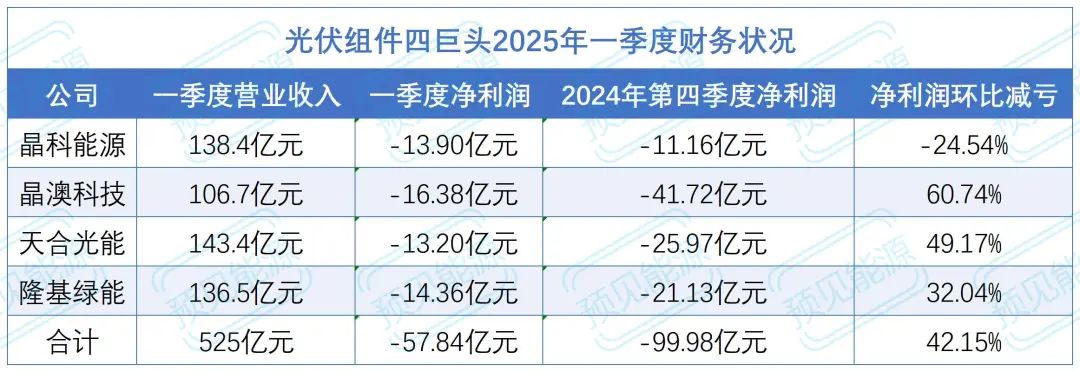
Core Viewpoint - The photovoltaic industry is gradually transitioning from losses to breakeven and then to profitability, as indicated by the exit of some cross-industry photovoltaic companies from market competition [1] Company Performance - JinkoSolar reported a revenue of 92.47 billion yuan in 2024, a year-on-year decline of 22.08%, and a net profit of 9.893 million yuan, down 98.67% year-on-year [1] - In Q1 2025, JinkoSolar's revenue and net profit fell by 40.03% and 218.20% year-on-year, respectively, marking a significant decline in profitability [1] - Despite the overall losses in the photovoltaic sector, JinkoSolar was one of the few companies to remain profitable in 2024, but it began to incur losses in Q4 2024, amounting to 1.116 billion yuan [3] Financial Comparison - In Q1 2025, JinkoSolar's revenue was 13.84 billion yuan with a net loss of 1.39 billion yuan, while its peers, JA Solar, Trina Solar, and LONGi Green Energy, showed signs of reduced losses [2][3] - The total revenue for the four major photovoltaic companies in Q1 2025 was 52.5 billion yuan, with a combined net loss of 5.784 billion yuan, indicating a 42.15% reduction in losses compared to the previous quarter [2] Market Dynamics - JinkoSolar's declining performance is attributed to a significant drop in component delivery prices and a decrease in high-priced overseas orders, leading to a gross margin drop from 15.7% in Q3 to 3.6% in Q4 2024 [3] - The company has faced challenges due to low prices across the photovoltaic supply chain and changes in overseas trade policies, which have pressured profit levels [3] Production and Capacity - JinkoSolar has shipped over 320 GW of photovoltaic modules globally, with a focus on N-type TOPCon technology, achieving an average efficiency of over 26.6% [4] - In Q1 2025, JinkoSolar's total shipment volume was 19,130 MW, a 12.68% decrease year-on-year, with expectations to increase shipments to 20-25 GW in Q2 2025 [4] Financial Health - As of March 2025, JinkoSolar's debt-to-asset ratio was 72.72%, with interest-bearing liabilities totaling 34.877 billion yuan, indicating significant short-term repayment pressure [5] - The company's operating cash flow decreased by 68.3% year-on-year to 7.867 billion yuan in 2024, and turned negative in Q1 2025, highlighting operational funding challenges [6] Strategic Expansion - JinkoSolar has aggressively expanded its production capacity, with plans for a 560 billion yuan investment in a comprehensive production base, but faced delays and financial challenges due to market conditions [7][8] - The company has experienced setbacks, including a fire incident that resulted in a loss exceeding 646 million yuan in Q1 2024, and ongoing funding issues that have delayed project progress [8] Industry Outlook - The TOPCon technology remains the mainstream in the photovoltaic sector, but there are concerns about its potential obsolescence as new technologies emerge [10]


山西证券研究早观点-20250521
Shanxi Securities· 2025-05-21 00:04
Market Trends - The domestic market indices showed positive performance with the Shanghai Composite Index closing at 3,380.48, up by 0.38% [4] - The Shenzhen Component Index closed at 10,249.17, reflecting a 0.77% increase [4] Industry Commentary: Home Appliances - In April 2025, the retail sales of home appliances and audio-visual equipment reached 914 billion yuan, marking a year-on-year growth of 38.8%, the highest among all categories [6] - The overall retail sales in April 2025 totaled 37,174 billion yuan, with a year-on-year increase of 5.1% [6] - The growth in home appliance sales is attributed to policy stimuli and a recovery in housing sales, indicating a strong upward trend in industry sentiment [6][7] - The "green appliance subsidy" and promotional activities from e-commerce platforms have significantly boosted short-term demand [6] - Online retail sales of home appliances grew by 21.8% in April, with standout performances in categories like vacuum robots and electric heaters, which saw increases of 80.6% and 174.9% respectively [6] Industry Commentary: Electric Equipment and New Energy - Huawei and Ubtech signed a comprehensive cooperation agreement focusing on humanoid robots and intelligent applications [11] - The price of polysilicon has decreased by 5.1% to 37.0 yuan/kg, driven by high inventory levels and declining downstream product prices [9][12] - The solar industry is experiencing price declines across the supply chain, with significant drops in silicon wafer and battery prices due to weak demand [13] Industry Commentary: Basic Chemicals - The price of polyester has surged due to cost and macroeconomic changes, with a long-term positive outlook for tire companies with global layouts [13] - The average price of N-type battery cells has decreased by 1.9%, reflecting ongoing price competition in the solar component market [13] Company Commentary: Huichuan Technology - Huichuan Technology reported a revenue of 37.041 billion yuan for 2024, a year-on-year increase of 21.77%, while net profit decreased by 9.62% [21] - The company aims for a revenue growth of 10%-30% and net profit growth of 5%-25% in 2025, driven by the expansion of its new energy vehicle business [21] - The company holds a leading market share in various automation products, with a focus on enhancing its capabilities in the process industry [21] Company Commentary: Bichu Electronics - Bichu Electronics achieved a revenue of 1.735 billion yuan in 2024, with a year-on-year growth of 23.33% and a net profit increase of 21.10% [22] - The company is focusing on expanding its intelligent welding business, which is expected to see significant growth [22][26]
太阳能行业双周报:供应侧加大减产力度 产业链价格有望企稳
Xin Lang Cai Jing· 2025-05-20 02:37
Core Viewpoint - The photovoltaic industry chain prices have fully adjusted, and supply-side optimization is expected to stabilize prices [1] Investment Highlights - This week, photovoltaic industry chain prices continued to decline, with some products falling below cash costs. Some manufacturers are unable to deliver, and previously aggressive manufacturers are adjusting their strategies. Future prices are expected to stop falling, as the prices in the photovoltaic industry chain and the stock prices of the photovoltaic sector have fully adjusted. Demand in centralized and overseas markets is expected to marginally increase, and some positive external and internal factors are gradually accumulating, making the current position worth attention. The photovoltaic industry is rated as "overweight" [2] - Recommended stocks include: new technologies (LONGi Green Energy, Aiko Solar, Dier Laser, Laplace), auxiliary materials (CITIC Bo, Flat Glass, Foster), integrated (JinkoSolar, JA Solar, Trina Solar, Canadian Solar, Hengdian East Magnetic), specialized (Tongwei, GCL-Poly, Daqo New Energy, Junda, TCL Zhonghuan), and inverters (Sungrow, GoodWe, Deye) [2] Recent Performance - In the recent week (May 12-16, 2025), the photovoltaic sector's price change was 1.83%, outperforming the CSI 300 index by 0.13 percentage points, ranking among the top in terms of price change compared to other sectors. The TTM overall valuation of the photovoltaic sector as of May 16, 2025, was 16.98 times, ranking in the middle to lower part compared to other sectors. The sector's price-to-earnings ratio has been declining since the end of 2021 and is currently at the valuation level of the end of 2018. The valuation premium of the photovoltaic sector relative to the CSI 300 is 1.43 times, which is also at a historically low level [3] Price Trends - The prices in the industry chain have partially decreased. The average price of dense materials is 37.0 yuan/kg, down 2 yuan/kg; the average price of N-type 182 silicon wafers is 0.95 yuan/piece, down 0.05 yuan/piece; the average price of N-type 182*210 silicon wafers is 1.10 yuan/piece, down 0.05 yuan/piece; the average price of N-type 210 silicon wafers is 1.30 yuan/piece, down 0.08 yuan/piece; the average price of TOPCon (182) battery cells is 0.26 yuan/W, down 0.005 yuan/W; the average price of TOPCon (182*210) battery cells is 0.265 yuan/W, unchanged; the average price of TOPCon (210) battery cells is 0.28 yuan/W, unchanged; the average price of double-glass 182 TOPCon modules is 0.68 yuan/W, down 0.01 yuan/W; the average prices for centralized and distributed systems in China are 0.67 and 0.68 yuan/W, respectively, both down 0.01 yuan/W; the average price of local TOPCon modules in India is 0.15 USD/W, unchanged; the average prices of local and TOPCon modules in the US are 0.30 and 0.27 USD/W, respectively, both unchanged; the average price of TOPCon modules in Europe is 0.088 USD/W, unchanged [4]

工业硅周报:抢装高峰已过,工业硅反弹有限-20250519
Tong Guan Jin Yuan Qi Huo· 2025-05-19 01:51
Report Industry Investment Rating No relevant content provided. Core Viewpoints of the Report - The rebound of industrial silicon last week was hindered as the market digested the positive sentiment of the China-US truce, and the trading focus returned to the weak supply-demand fundamentals of the commodity. The supply side is operating weakly, with the operating rate in Xinjiang dropping to 50% and that in the Southwest below 30%, and production in Inner Mongolia and Gansu also decreasing. On the demand side, polysilicon discussed production cuts again last week, with the production schedule in May possibly less than 100,000 tons. The downstream price pressure in the silicon wafer market is severe, and enterprises have a strong willingness to cut production. The demand in the photovoltaic cell market is sluggish, and both specialized and integrated manufacturers are considering production cuts to reduce inventory. The peak installation period has passed, and the photovoltaic installation in the second quarter is expected to slow down significantly. After a brief boost from macro sentiment, industrial silicon has returned to a weak fundamental pattern, with social inventory rising slightly to 599,000 tons and the center of the spot market continuing to decline. Technically, the previous bottom support of the futures price is limited, and it is expected to continue to explore the bottom in the short term [2][4][7]. Summary by Relevant Catalogs Market Data - From May 9th to May 16th, the price of the industrial silicon main contract decreased from 8,205 yuan/ton to 8,100 yuan/ton, a decrease of 1.28%. The prices of various grades of industrial silicon and related products such as organic silicon DMC and polysilicon dense materials also showed varying degrees of decline, while the price of 3303 spot remained unchanged. The industrial silicon social inventory increased from 596,000 tons to 599,000 tons, an increase of 0.50% [5]. Market Analysis and Outlook - **Macro aspect**: In April, China's social financing increment was 1.16 trillion yuan, an increase of 1.22 trillion yuan year-on-year. The cumulative social financing increment in the first four months was 16.34 trillion yuan, an increase of 3.61 trillion yuan year-on-year. The issuance of government bonds accelerated beyond expectations, which was the main driving force for the acceleration of social financing in April. As of the end of April, China's social financing scale stock reached 424 trillion yuan, a year-on-year increase of 8.7%, indicating that China's economic credit structure is gradually improving and the long-term foundation for stable economic growth remains solid [8]. - **Supply and demand aspect**: As of May 16th, the weekly output of industrial silicon dropped to 69,000 tons, a month-on-month decrease of 3.94% and a year-on-year decrease of 23.58%. The number of open furnaces in the three major main production areas decreased to 213, with an overall open furnace rate of 26.6%. In April, China's industrial silicon output was only 301,000 tons, a year-on-year decrease of 16.1%. On the demand side, polysilicon discussed production cuts again last week, with the production schedule in May possibly less than 100,000 tons. The downstream price pressure in the silicon wafer market is severe, and enterprises have a strong willingness to cut production. The demand in the photovoltaic cell market is sluggish, and both specialized and integrated manufacturers are considering production cuts to reduce inventory. The peak installation period has passed, and the photovoltaic installation in the second quarter is expected to slow down significantly. The photovoltaic winning projects are mostly small and medium-sized projects, which have a limited impact on the overall installation volume [9]. - **Inventory aspect**: As of May 16th, the national social inventory of industrial silicon rose to 599,000 tons, a month-on-month increase of 3,000 tons. The exchange registered warehouse receipt volume decreased slightly. After the exchange introduced new regulations on the delivery standard of delivery products, most of the 4-series brand warehouse receipts could not be re-registered due to excessive titanium content, while the 5-series warehouse receipts that meet the new delivery standard were actively registered and stored, forming a new source of warehouse receipt inventory. The recent pressure on warehouse receipt inventory has weakened mainly due to the continuous decline in domestic production [10]. Industry News - **Component link**: In the first quarter of 2025, JinkoSolar, LONGi, JA Solar, and Trina Solar still ranked among the top four in the photovoltaic module shipment volume. In 2024, their total component shipment volume exceeded 300GW, accounting for nearly 60% of the global new photovoltaic installation. These four companies have established their moats through technological leadership. They have launched new products with high conversion efficiency and are also competing in the next-generation industrial technology [12]. - **Price trend**: According to Sobee Consulting's price tracking data, the price of silicon materials decreased slightly last week. Silicon material enterprises continued to reduce production schedules, and the inventory backlog problem of polysilicon manufacturers was prominent, with the short-term price downward trend difficult to reverse. The prices of silicon wafers and battery cells remained stable. The price of photovoltaic modules has rebounded since March, but with the end of the peak installation period, the component market price has shown a downward trend. In April 2025, nearly 30GW of photovoltaic modules were tendered [13].
25Q1公募基金可转债持仓点评:被动指数型基金强势,可转债基金跑赢指数
Huachuang Securities· 2025-05-17 12:14
1. Report Industry Investment Rating No information provided in the content. 2. Core Viewpoints of the Report - In 2025Q1, the CSI Convertible Bond Index rose 3.13%, the Wind Convertible Bond Underlying Stock Equal - Weighted Index rose 7.81%, and the average increase in the reinstated unit net value of 39 convertible bond funds was 3.81%, with a median of 3.59%. The overall net subscription was 3.858 billion yuan, and the net subscription rate of 39 convertible bond funds was 51.28%, a 20.51 - percentage - point increase compared to 24Q4. [8][12] - In 2025Q1, the market value of convertible bonds held by public funds was 282.274 billion yuan, a 1.85% decrease from the previous quarter, and the convertible bond position slightly decreased by 0.01 percentage points to 0.88% (the ratio of the market value of convertible bonds held to the net asset value of the fund). The market value of convertible bonds held by 39 convertible bond funds increased, the overall position rose, and the leverage ratio continued to decline quarter - on - quarter. [8][12] - In terms of industry allocation, banks remain an important underlying position for convertible bonds. Both public funds and convertible bond funds increased their positions in convertible bonds of the power equipment industry. In addition, public funds mainly increased their positions in convertible bonds of industries such as basic chemicals and electronics, while convertible bond funds mainly increased their positions in convertible bonds of industries such as agriculture, forestry, animal husbandry, and fishery, and non - ferrous metals. [8][12] 3. Summary According to Relevant Catalogs I. Public Funds Slightly Reduced Convertible Bond Positions and Increased Positions in Basic Chemicals and Power Equipment Convertible Bonds (1) The Market Value of Convertible Bonds Held by Public Funds Decreased Quarter - on - Quarter, and the Position Slightly Declined - In 2025Q1, the market value of convertible bonds held by public funds was 282.274 billion yuan, a 1.85% decrease from the previous quarter but a 3.98% increase year - on - year. The ratio of the market value of convertible bonds held by public funds to the market value of bond investments was 1.43%, a 0.09 - percentage - point decrease from 24Q4; the ratio to the net value was 0.88%, a slight 0.01 - percentage - point decrease from 24Q4. [12] - The market value of convertible bonds held by different types of funds changed differently quarter - on - quarter, with passive index funds performing strongly. Among them, the market value of convertible bonds held by stock - type, hybrid, and bond - type funds in 25Q1 increased by 87.06%, decreased by 19.13%, and increased by 0.63% respectively. [15] - In terms of the absolute amount of change, the hybrid funds had the largest decrease in market value, with a 7.396 - billion - yuan decrease in 25Q1. The stock - type funds increased by 586 million yuan, mainly contributed by passive index funds. The bond - type funds increased by 1.572 billion yuan in total, but there was significant internal differentiation. [2] (2) The Proportion of Public Fund Holdings Increased, and Brokerage Asset Management and Proprietary Trading Increased Positions - As of the end of 2025Q1, the total face value of convertible bonds held by the Shanghai and Shenzhen Stock Exchanges was 696.248 billion yuan, a 29.725 - billion - yuan decrease from the end of 24Q4, a 4.09% quarter - on - quarter decrease. Public funds, insurance institutions, enterprise annuities, and general institutions all significantly reduced their positions. Brokerage proprietary trading and asset management increased their positions. [29] - As of the end of 25Q1, public funds in the Shanghai and Shenzhen Stock Exchanges held a total face value of convertible bonds of 232.441 billion yuan, a 3.50% decrease from the end of 24Q4, but the proportion increased by 0.21 percentage points to 33.38%. [34] (3) Public Funds Adjusted Their Positioning Styles and Increased Positions in Basic Chemicals and Power Equipment Convertible Bonds - In terms of style, the market value of positions in equity - biased and debt - biased convertible bonds decreased, with a decrease of 6.121 billion and 8.660 billion yuan respectively compared to 24Q4, a decline of 18.05% and 7.49%. The market value of balanced convertible bonds increased by 6.933 billion yuan, an increase of 5.31%. [3][38] - In terms of industry layout, in 25Q1, banks were still the primary layout sector. In addition, the power equipment, basic chemicals, and electronics industries had a relatively high total market value of fund positions. [39] - In terms of the quarter - on - quarter change in market value, nearly half of the industries had positive changes. Industries such as social services, national defense and military industry, and basic chemicals had the highest increases. [39] (4) Industrial Bank Convertible Bonds Rose to the Top of the Heavily - Held Bonds, and the Market Value Increment Led - Industrial Bank Convertible Bonds were the most heavily - held bonds by public funds. Industrial Bank and Shanghai United Bank Convertible Bonds had the highest increments. Among the top ten convertible bonds in terms of total market value of fund positions, six were bank convertible bonds. [45] - Excluding bank convertible bonds, among the top ten convertible bonds in terms of the number of fund holdings, six were from the power equipment industry. [45] II. Convertible Bond Funds Outperformed the Index, with an Increase in Convertible Bond Positions and a Decrease in the Leverage Ratio (1) The Reinstated Unit Net Value Rose, and the Overall Performance Showed Net Subscription - As of 2025Q1, there were 39 convertible bond funds in the market that announced relevant data. In 25Q1, the performance of convertible bond funds outperformed the convertible bond index, with an overall net subscription and an increase in scale. [53] - The scale of convertible bond funds in 25Q1 was 54.920 billion yuan, a 3.858 - billion - yuan increase from 24Q4, a 7.56% quarter - on - quarter increase. The overall net subscription was 3.858 billion yuan, and 20 out of 39 convertible bond funds had net subscriptions, with a net subscription rate of 51.28%. [53] (2) The Convertible Bond Position Increased Quarter - on - Quarter, and the Leverage Ratio Decreased Quarter - on - Quarter - The overall position of 39 convertible bond funds increased, and the leverage ratio decreased quarter - on - quarter. In the first quarter of 2025, the ratio of the market value of convertible bonds to the net value of convertible bond funds was 84.70%, a 0.12 - percentage - point increase from the previous quarter, continuing the upward trend in 24Q4. [66] - The average leverage ratio of 39 convertible bond funds in the first quarter of 2025 was 114.81%, a 2.86 - percentage - point decrease from the previous quarter, mainly affected by the relatively high cost of funds in the first quarter. [66] (3) Convertible Bond Funds Mainly Increased Positions in Power Equipment, Agriculture, Forestry, Animal Husbandry, and Fishery - From the perspective of the quarterly change in the number of times funds held convertible bonds, in 25Q1, the number of times most industries were held decreased. Only the basic chemicals, steel, social services, communications, and petroleum and petrochemical industries had an increase in the total number of times held quarter - on - quarter. [5] - From the perspective of the quarterly change in the proportion of the market value of fund positions, the proportions of power equipment, agriculture, forestry, animal husbandry, and fishery, and non - ferrous metals increased by 2.09, 1.48, and 1.35 percentage points respectively. A total of 16 industries had an increase in the proportion of the market value of positions. [5]
2025年《财富》中国ESG影响力榜揭晓
财富FORTUNE· 2025-05-16 04:06
Core Viewpoint - The article discusses the impact of global trade policies and artificial intelligence on ESG practices in China, highlighting how companies are adapting to these challenges while improving their sustainability efforts. Group 1: Impact of Global Trade Policies - Chinese manufacturing is resilient amidst trade policy turbulence, with companies increasing investments in clean technologies and digital transformation to manage supply chain risks [2][3] - Good ESG performance is becoming a "technical ticket" for companies venturing abroad, as they navigate tariffs and green barriers [2] Group 2: Role of Artificial Intelligence - AI presents both opportunities and challenges for ESG, aiding in addressing sustainability issues while also raising concerns about resource consumption and ethical risks [1][2] - Companies are leveraging AI to enhance the use of renewable energy in data centers and to address algorithmic ethical risks [2] Group 3: Improvement in ESG Practices - There is a noticeable improvement in the focus on social and governance aspects among Chinese companies, with many prioritizing employee welfare and community support [3] - A total of 100 companies made it to this year's ESG impact list, showcasing significant efforts in environmental protection, employee care, and community support [3] Group 4: Company Highlights - Haier continues to innovate with energy-efficient appliances, achieving a 30% energy saving with new washing machines and a 40% saving with AI-powered air conditioners [4] - CATL launched the world's first large-scale lithium iron battery recycling project, with an annual capacity of 270,000 tons [5] - JD.com signed labor contracts for all frontline employees and initiated a large-scale campus recruitment drive, enhancing employee benefits [6] - SF Express invested in circular packaging and conducted a successful trial of sustainable aviation fuel, reducing carbon emissions significantly [9] - Lenovo applied AI technology for biodiversity and cultural heritage protection, contributing to environmental conservation efforts [10] Group 5: Financial and Investment Aspects - Industrial Bank's green loan balance reached 967.93 billion yuan, marking a 19.64% increase year-on-year, focusing on clean energy and waste management [12] - Ant Group's "Ant Forest" project has funded the planting of over 548 million trees, showcasing the financial sector's role in promoting sustainability [23] - China Bank's green credit scale surpassed 4 trillion yuan, with significant investments in green bonds and carbon neutrality initiatives [81]
BC电池概念下跌1.08%,主力资金净流出31股
Zheng Quan Shi Bao Wang· 2025-05-14 08:51
BC电池概念资金流出榜 | 代码 | 简称 | 今日涨跌幅(%) | 今日换手率(%) | 主力资金流量(万元) | | --- | --- | --- | --- | --- | | 600438 | 通威股份 | -3.05 | 2.16 | -15722.00 | | 601012 | 隆基绿能 | -0.64 | 1.00 | -6858.10 | | 002459 | 晶澳科技 | -1.77 | 2.47 | -5573.80 | | 600732 | 爱旭股份 | -0.26 | 3.28 | -5223.56 | | 002865 | 钧达股份 | -3.70 | 6.14 | -3400.79 | | 002795 | 永和智控 | -5.12 | 7.73 | -2682.57 | | 300128 | 锦富技术 | 0.18 | 2.43 | -2571.89 | | 603806 | 福斯特 | -0.69 | 0.64 | -2405.58 | | 300724 | 捷佳伟创 | -0.43 | 2.71 | -2293.81 | | 688223 | 晶科能源 | -1.03 | ...



去产能何时结束、如何应对关税 四家光伏组件龙头高管给出答案
Xin Jing Bao· 2025-05-14 07:13
晶科能源董事长李仙德表示,本轮光伏行业的供求失衡是多因素叠加作用的结果,长期维度包括行业从 补贴时代完全进入平价时代的切换,中期维度包括产业自身的扩张——收缩周期,以及主流电池技术从 PERC向TOPCon切换;短期维度包括2022年的一些国际事件对欧洲天然气价格和新能源需求的剧烈刺 激,造成本轮行业供需失衡的程度较大,时间较长。 阿特斯董事、总经理、首席执行官庄岩称,行业供过于求局面目前没有出现根本性变化,2025年公司在 行业产品价格有明显回升之前,继续平衡组件出货量和利润的关系,优先保证高价市场订单。 如何应对关税扰动:预计影响可消化,持续本土化与多元化布局 中国光伏产品作为出口新三样之一,在全球市场享有极高的份额,头部企业营收的相当部分来自海外市 场。近期国际关税政策的扰动也让企业再度思考出海策略。 5月13日,四家光伏组件头部企业晶科能源(688223.SH)、晶澳科技(002459)(002459.SZ)、天合 光能(688599.SH)、阿特斯(688472.SH)同日召开业绩会。 光伏行业曾是新能源板块最热门的赛道,但在供需失衡、贸易壁垒等多重因素冲击下,去年多家光伏企 业交出了史上最差成绩单 ...


打新赚钱效应显著提升港股新股有望持续受资金关注
Zhong Guo Zheng Quan Bao· 2025-05-13 21:49
Group 1 - The core viewpoint is that the Hong Kong IPO market is experiencing a significant increase in the profitability of new stock listings, with all five new stocks listed since April 14 showing gains on their first trading day [1][2] - The first five new stocks listed since April 14 include Zhengli New Energy, Ying'en Biotechnology-B, Boleton, Junda Co., and Hu Shang Ayi, with first-day price increases of 1.45%, 116.70%, 38.33%, 20.09%, and 40.03% respectively [1] - The overall rate of new stocks breaking their issue price is gradually decreasing, with a break rate of 23.81% for 21 new stocks listed in 2025, compared to 34.29% for the entire year of 2024 [2] Group 2 - The Hong Kong IPO market remains active, with 154 companies currently in the IPO application queue, of which 151 are applying for the main board and 3 for the growth enterprise board [3] - Among the 154 companies, 88 are making their first application in 2025, representing over 57% of the total [3] - The IPO market is characterized by a dual drive of "technology + consumption," with emerging consumer sectors and advanced technology fields being the focus [3]
政策面转强,转债投资思路有何变化
2025-05-13 15:19
Summary of Key Points from Conference Call Records Industry or Company Involved - Focus on various sectors including banking, photovoltaic, AI, robotics, chemical, and new energy vehicles Core Insights and Arguments - **Investment Strategy**: A "barbell" investment strategy is recommended, focusing on banks and high-dividend cyclical stocks while also considering valuation-driven thematic rotation opportunities, especially in a market shifting from domestic demand to export orientation [1][2] - **Financial Policy Impact**: A comprehensive financial policy is beneficial for bank convertible bonds. Although interest rate cuts may pressure asset prices, they will enhance credit issuance and improve bank asset structures, supported by new capital inflows from insurance and public funds [1][8][9] - **Trade Negotiation Effects**: U.S.-China trade negotiations may impact export-oriented convertible bonds, particularly in the photovoltaic sector, where companies like JA Solar and Trina Solar, with over 20% revenue from the Americas, could see rebound opportunities if tariff conditions improve [1][10] - **New Energy Vehicle Growth**: Minglida is adjusting its business structure to significantly increase production of structural components for new energy vehicles, with expectations of turning losses into profits as overseas production capacity ramps up [1][18] - **Phosphate Chemical Industry Outlook**: The phosphate chemical industry remains robust due to stable demand and supply constraints, although high-grade phosphate resource depletion and policy restrictions may delay capacity release. Companies like Chuanheng are highlighted for their capacity expansion potential [1][23][24] Other Important but Potentially Overlooked Content - **AI Industry Potential**: Deepin Technology's AI industrialization efforts, including products like GPT and AI agents, are expected to stimulate local enterprise demand for AI applications and cloud services [1][29][30] - **Robotics Sector**: The robotics sector shows significant potential, particularly in pneumatic components and reducers, with companies like Keda Li and Haoneng being key players [1][6] - **Emerging Technologies**: Investment opportunities in emerging technologies such as brain-computer interfaces and controlled nuclear fusion are noted, with companies like Guo Da and Xin Da being mentioned [1][7] - **Banking Sector Performance**: The banking sector is experiencing strong credit growth, with several banks exceeding expectations in their first-quarter performance, supported by favorable monetary policies [1][14] - **Wind Power and PCB Markets**: Companies in the wind power sector, such as Guo Da and Tong Yu, are recommended due to strong demand and good performance in their first-quarter reports [1][15][25] - **East Material Technology's Development**: The company is focusing on high-frequency and high-speed materials, with significant revenue growth expected from new production capacity in the second half of the year [1][26][27] - **Health and Wellness Products**: Rongtai Health is expanding its massage chair business, with notable growth in overseas markets driven by e-commerce [1][19][20][22]