泸州老窖

Search documents
多元化、年轻化、数字化齐发力,泸州老窖在调整期实现“稳中有进”
Zhong Guo Jing Ji Wang· 2025-11-03 23:54
Core Viewpoint - Luzhou Laojiao has demonstrated resilience and adaptability in a challenging white liquor industry, achieving steady growth through strategic adjustments and product diversification [4][20]. Financial Performance - In Q3 2025, Luzhou Laojiao reported revenue of 6.674 billion yuan and a net profit of 3.099 billion yuan. For the first three quarters, the company achieved a total revenue of 23.127 billion yuan and a net profit of 10.762 billion yuan [1]. Industry Context - The white liquor industry is currently undergoing a deep adjustment period with intensified competition, necessitating companies to adopt effective strategies for growth [3][20]. Product Strategy - Luzhou Laojiao has implemented a "dual brand, three product lines, and major products" strategy, optimizing its product structure to cover all price segments from high-end to low-end [6][8]. - The company is focusing on high-end products like Guojiao 1573 while also introducing new products such as Luzhou Laojiao Erqu to strengthen its position in the mass market [8][12]. - The introduction of a low-alcohol product, 38-degree Guojiao 1573, has positioned it as a leading product in the low-alcohol segment, achieving over 10 billion yuan in sales [8]. Channel Development - Luzhou Laojiao is enhancing its distribution channels by implementing a "Hundred Cities Plan" and focusing on lower-tier markets to capture consumer demand [13]. - The company is also advancing its digital marketing strategies and building an integrated online and offline sales network to improve consumer engagement [14]. Brand Strength - The company is committed to enhancing its brand image through high-end, youthful, and international product offerings, which has led to recognition in global brand value rankings [16][18]. - Luzhou Laojiao has been included in the "First Batch of Chinese Consumer Famous Products List," further solidifying its brand influence [18]. Future Outlook - Despite short-term pressures, signs of recovery in the industry are emerging, with various companies, including Luzhou Laojiao, actively managing inventory and responding to market demands [20]. - The company is focusing on quality improvement and brand influence, moving away from past expansion models towards a more sustainable growth strategy [20].


谁杀死了白酒?90%企业营收倒退,已到最危险的时刻?
Sou Hu Cai Jing· 2025-11-03 23:44
Core Viewpoint - The Chinese liquor industry is facing a severe downturn, characterized by plummeting sales, rising inventory, and a significant shift in consumer behavior, leading to widespread closures of traditional liquor stores and a crisis among liquor companies [1][3][5]. Industry Overview - The number of liquor stores in China is projected to decrease by 17% to 22% in 2025, with some regions experiencing closure rates exceeding 30% [3]. - The average inventory turnover days for the liquor industry reached 900 days in the first half of 2025, a 10% increase from the previous year, indicating a severe liquidity issue for distributors [3]. - Price inversion is prevalent across all price segments, with 32% of high-end liquor priced below cost, leading to minimal profit margins for retailers [3]. Sales and Revenue Trends - In June 2025, sales dropped by 70% due to new alcohol restrictions, with traditional stores struggling to maintain revenue during peak seasons [5]. - Over 90% of liquor companies reported revenue declines in the third quarter of 2025, with notable drops in companies like Shede and Yingjia, which saw revenue decreases of 17% and 18.09% respectively [5][7]. - The overall revenue of 20 listed liquor companies in A-shares fell by 0.86% in the first half of 2025, marking a significant shift in the industry [5]. Consumer Behavior Changes - The proportion of drinkers in China has decreased from 38% in 2016 to 29% in 2024, with a notable decline in the core consumer group of men aged 30-60 [8]. - Younger consumers are increasingly turning to alternatives like beer and cocktails, with white liquor's market share among young people dropping to 31.8% [8][10]. - Traditional consumption scenarios, such as government and business events, have drastically reduced, leading to a shift towards more casual drinking occasions [8][10]. Market Dynamics - The liquor industry is experiencing a crisis of overcapacity, with production declining from a peak of 13.58 million kiloliters in 2016 to 4.145 million kiloliters in 2024 [7]. - The stock market for liquor has also suffered, with the China Securities White Liquor Index halving over four years, and significant drops in stock prices for major companies like Yanghe and Jiu Gui [7]. Strategic Responses - The Ministry of Industry and Information Technology's reclassification of liquor as a historical classic industry aims to provide policy support, but the industry faces challenges from high inventory and changing consumer preferences [10][11]. - There is a debate within the industry about whether to adapt to younger consumers by introducing lower-alcohol products or to maintain traditional practices and cultural heritage [11].





共赴诗酒之约 揭晓三大奖项
Si Chuan Ri Bao· 2025-11-03 22:03
Core Points - The 2025 International Poetry and Wine Culture Conference, part of the 9th Luzhou Laojiao Cultural Arts Week, commenced in Luzhou, featuring poets and artists from various countries [1][2] - The event announced three major awards: the "1573 International Poetry Award," "1573 International Poetry Translation Award," and "1573 International Composer Award" [1] - Zhang Zhenhui and Wolfgang Kubin received the "1573 International Poetry Translation Award" for their contributions to poetry translation and cultural exchange [1] - José María Vitier from Cuba won the "1573 International Composer Award" for his achievements in contemporary music [1] - Russian poet Maxim Alekseev was awarded the "1573 International Poetry Award" [1] - The conference included various activities such as forums, creative exchanges, poetry recitals, and cultural explorations, enhancing cultural experiences for the local community [1] Industry Insights - The International Poetry and Wine Culture Conference is a significant IP event aimed at promoting and popularizing poetry and wine culture, organized by the Luzhou municipal government and Poetry Magazine [2] - Over nine years, the conference has hosted more than 200 cultural exchange activities and collected over 500,000 excellent poetry works, connecting with poets and scholars from over 60 countries [2] - The event has established itself as a major gathering in the national and global poetry and arts culture sector [2]
白酒上市公司业绩分化加剧山西汾酒再超泸州老窖跻身前三
Xin Lang Cai Jing· 2025-11-03 21:05
Core Insights - The A-share liquor industry is experiencing significant performance divergence, with only Kweichow Moutai and Shanxi Fenjiu achieving both revenue and net profit growth in the first three quarters of 2025, while 18 other companies reported declines in both metrics [1][2] Industry Performance - Kweichow Moutai reported revenue of 130.9 billion yuan, a year-on-year increase of 6.32%, and a net profit of 64.63 billion yuan, up 6.25% [2] - Shanxi Fenjiu's revenue reached 8.96 billion yuan in Q3 2025, surpassing Wuliangye to become the second-largest in quarterly revenue [1][2] - Other major companies like Wuliangye, Luzhou Laojiao, and Yanghe saw revenue declines of 10.26%, 4%, and significant drops in net profits, with Luzhou Laojiao's net profit down 65.62% [2][3] Cash Flow and Inventory Issues - The industry is facing a contraction in operating cash flow, with several regional companies reporting negative cash flow, indicating financial strain [1][6] - Inventory levels remain high among leading companies, with Kweichow Moutai, Yanghe, Wuliangye, Luzhou Laojiao, and Shanxi Fenjiu all exceeding 10 billion yuan in inventory [3][4] - Luzhou Laojiao's inventory increased from 4.696 billion yuan at the end of 2020 to 13.747 billion yuan in Q3 2025, marking a 192.74% increase [4] Market Dynamics - The high inventory and sluggish sales have led to price pressures in the market, with some distributors resorting to discounting strategies to recover cash [5][6] - The industry is undergoing a "deep adjustment" phase, characterized by a shift from high growth to a focus on existing market share, leading to intensified competition among top players [1][3][6] - Shanxi Fenjiu's rise in revenue has disrupted the traditional ranking of the top three liquor companies, indicating a shift in competitive dynamics within the industry [6]


白酒行业格局生变,山西汾酒逆袭,泸州老窖承压
Sou Hu Cai Jing· 2025-11-03 19:50
Core Insights - The Chinese liquor industry is undergoing a significant restructuring, with the top three companies—Kweichow Moutai, Wuliangye, and Shanxi Fenjiu—achieving record revenues, marking a shift in market dynamics [1][3][5] Group 1: Industry Performance - Kweichow Moutai leads the industry with a revenue of 1708.99 billion yuan, a year-on-year increase of 15.71%, and a net profit of 862.28 billion yuan, up 15.38% [3][5] - Wuliangye remains in second place with a revenue of 891.75 billion yuan, but its growth has slowed, with a revenue increase of only 7.09% and a net profit increase of 5.44% [3][5] - Shanxi Fenjiu has made significant gains, achieving a revenue of 360.11 billion yuan, a 17.29% increase, surpassing Luzhou Laojiao for the first time [3][7] Group 2: Luzhou Laojiao's Decline - Luzhou Laojiao's revenue reached 311.96 billion yuan, with a modest growth of 3.19%, marking its first single-digit net profit growth since 2014 [5][9] - The company's revenue growth has drastically decreased from 20.34% in 2023 to only 3.19% in 2024, indicating a significant decline in performance compared to its peers [5][9] Group 3: Market Dynamics - The overall performance of the liquor industry shows a clear divergence, with A-share liquor companies reporting a total revenue of 4422.27 billion yuan, a 2.28% increase, and a net profit of 1666.31 billion yuan, up 4.32% [9][11] - While leading companies like Moutai and Fenjiu continue to grow, many regional companies face challenges with inventory and sales pressure, leading to noticeable declines in performance [9][11] Group 4: Inventory and Challenges - The industry is facing challenges of high inventory and price inversion, with total inventory among 17 A-share liquor companies reaching 1463.35 billion yuan, a 12.50% increase [11][13] - Approximately 70% of companies are experiencing increased inventory turnover days, with some struggling with poor sales and incurring losses [11][13] Group 5: Export Growth and Future Outlook - In 2024, China's liquor export total reached 1.9 billion USD, with white liquor exports at 970 million USD, a 20.4% increase, making up 51% of total liquor exports [13] - The competition logic in the liquor industry is shifting from quantity growth to quality breakthroughs, emphasizing the need for innovation in quality, culture, and consumer experience to thrive in a saturated market [13]

白酒Q3总结及观点更新:加速出清,底部渐显
2025-11-03 15:48
Summary of the Q3 2025 Baijiu Industry Conference Call Industry Overview - The Baijiu industry experienced a significant decline in Q3 2025, with revenues and profits dropping by 18.4% and 22.2% respectively, marking the largest quarterly decline in nearly 20 years [1][2] - Excluding Moutai, revenue and net profit attributable to shareholders fell by 31.5% and 48% year-on-year [2] - The industry is entering a deep adjustment phase, with major companies adopting different strategies to cope with market challenges [1] Performance by Segment - **High-end Baijiu**: Revenue decreased by 15% and profit by 14.8%, heavily impacted by policy changes [4] - **Mid-range Baijiu**: Revenue fell by 8.8% and profit by 18.4% [4] - **Regional Baijiu**: Experienced a drastic revenue decline of 30.3% and profit plummeted by 80.5% [4] Company-Specific Insights - **Moutai**: Despite high profits, the wholesale price of Feitian Moutai dropped rapidly to around 1,600 RMB [5] - **Wuliangye**: Reported a 50% revenue drop and a 65% profit decline, indicating severe market pressure [2] - **Luzhou Laojiao**: Revenue and profit decreased by 10% and 13% respectively [5] - **Fenjiu**: Achieved positive growth in a single quarter but saw a slight profit decline of about 1% [5] - **Yanghe**: Successfully reduced inventory and saw an increase in wholesale prices for certain products [5] - **Jinshuiyuan**: Experienced a profit decline of 48.7%, but future declines are expected to moderate [7] - **Guqingongjiu**: Revenue and profit fell by 51.6% and 74.6% respectively, with a strategy shift to allow distributors to complete 80% of their targets [8] - **Yinjia Company**: Showed resilience with no further deterioration in performance after four quarters of adjustments [9] Financial Metrics and Trends - The overall industry balance sheet shows a 4.7% year-on-year increase in contract liabilities, indicating some recovery signals [10] - Accounts receivable decreased by 23.3% year-on-year, reflecting a trend towards deleveraging in the industry [10] - The cash flow situation indicates that the pressure on distributors is easing, although achieving annual targets remains challenging for most companies [11] Investment Recommendations - Focus on companies with strong brand power and market share, such as Shanxi Fenjiu, Guizhou Moutai, Wuliangye, and Guqingongjiu, which are expected to navigate through the cycle effectively [3][15] - Investors should prioritize the health of distributors, inventory reduction rates, and market share over short-term profitability [6] - The Baijiu sector is anticipated to see a recovery in stock prices as the worst period has passed, with potential for significant profit growth in the future [14][17] Future Outlook - The Baijiu industry is expected to continue facing challenges, but the worst is believed to be over, with opportunities for investment in leading companies and those that have adjusted early [17] - The focus should be on companies that are improving market share and those that have undergone significant adjustments, as they present good investment opportunities [17]

中国必选消费品10月需求报告:双节并未带动商品消费改善
Haitong Securities International· 2025-11-03 15:27
Investment Rating - The investment rating for the consumer staples sector in China is "Outperform" for multiple companies including Guizhou Moutai, Wuliangye, and Yili [1]. Core Insights - In October 2025, five out of eight key consumer goods sectors maintained positive growth, while three sectors experienced negative growth. The sectors with single-digit growth included frozen foods, soft drinks, beer, condiments, and catering services. The declining sectors were mid-to-high-end and premium baijiu, mass-market and lower-tier baijiu, and dairy products. Despite the extended holiday period due to the overlap of National Day and Mid-Autumn festivals, consumer spending remained sluggish, with goods consumption growing by 3.9% and services consumption by 7.6% during the holiday [3][29]. Summary by Sector 1. Mid-to-High-End Baijiu - In October, the revenue for mid-to-high-end baijiu was 27.7 billion yuan, a year-on-year decline of 11.7%. Cumulative revenue from January to October was 325.2 billion yuan, down 5.6% year-on-year. The consumption structure is shifting downwards, with products priced between 100-300 yuan accounting for 60% of sales [4][12]. 2. Mass-Market and Lower-Tier Baijiu - The revenue for mass-market and lower-tier baijiu in October was 16.3 billion yuan, a year-on-year decline of 3.0%. Cumulative revenue from January to October was 162.1 billion yuan, down 9.1% year-on-year. The production of baijiu in September was 306,000 kiloliters, a year-on-year decline of 15.0% [5][14]. 3. Beer - The beer sector reported revenue of 10.3 billion yuan in October, a year-on-year increase of 2.0%. Cumulative revenue from January to October was 152.9 billion yuan, up 0.5% year-on-year. The sector is experiencing a mild recovery, although regional performance varies significantly [6][16]. 4. Condiments - The revenue for the condiment sector in October was 37.6 billion yuan, a year-on-year increase of 1.0%. Cumulative revenue from January to October was 371.1 billion yuan, up 1.3% year-on-year. Demand from the catering sector is gradually recovering, but profitability remains under pressure [7][18]. 5. Dairy Products - The dairy sector's revenue in October was 36.5 billion yuan, a year-on-year decline of 4.2%. Cumulative revenue from January to October was 387.5 billion yuan, down 2.0% year-on-year. Demand remains under pressure, and inventory levels are high post-holiday [8][20]. 6. Frozen Foods - The frozen food sector reported revenue of 7.77 billion yuan in October, a year-on-year increase of 5.0%. Cumulative revenue from January to October was 88.2 billion yuan, up 2.0% year-on-year. Demand is supported by catering recovery and stable growth in customized products [9][22]. 7. Soft Drinks - The soft drink sector's revenue in October was 46.7 billion yuan, a year-on-year increase of 2.6%. Cumulative revenue from January to October was 619.5 billion yuan, up 4.3% year-on-year. The competitive landscape has softened post-peak season [10][24]. 8. Catering - The catering sector reported revenue of 16.2 billion yuan in October, a year-on-year increase of 1.2%. Cumulative revenue from January to October was 148.1 billion yuan, down 0.5% year-on-year. The sector is showing signs of stabilization, benefiting from holiday demand [11][26].


千年酒城奏响诗酒乐章 “让诗酒温暖每个人”荣耀盛典之夜在泸州举行
Zheng Quan Ri Bao Wang· 2025-11-03 13:47
Core Insights - The 9th International Poetry and Wine Culture Conference was held in Luzhou, showcasing a blend of poetry, music, drama, and dance, emphasizing cultural integration and artistic expression [1][4] - The "1573 International Poetry Award," established in 2018, has gained global recognition, with Russian poet Maxim Amelin winning the 2025 award for his contributions to poetry and cultural exchange [2][3] - The conference has evolved to include the "1573 International Poetry Translation Award" and the "1573 International Composer Award," promoting outstanding translators and composers worldwide [2][3] Company and Industry Highlights - Luzhou Laojiao, a prominent Chinese liquor brand, has a rich history of over 2,000 years in liquor production and is recognized for its cultural heritage, including the "1573 National Treasure Cellar" [7] - The International Poetry and Wine Culture Conference has been held annually since 2017, conducting over 200 cultural exchange activities and attracting poets and scholars from over 60 countries, enhancing Luzhou's cultural influence [4] - The event serves as a platform for cultural exchange, showcasing the charm of Chinese culture and promoting international dialogue through poetry and wine [6][7]
第九届国际诗酒文化大会在泸州举行
Zhong Guo Jing Ying Bao· 2025-11-03 13:17
Core Insights - The "1573 International Poetry Awards" were announced during the "Honor Ceremony Night," showcasing a blend of poetry, music, and various art forms, emphasizing cultural integration and the significance of wine in poetry [1][2] Group 1: Event Overview - The "1573 International Poetry Awards" recognized Russian poet Maxim Amelin for his contributions to contemporary Russian poetry, highlighting his role in fostering dialogue between Russian and Chinese poetry [2][3] - The event featured participation from poets and artists from multiple countries, including China, Russia, Cuba, and Peru, indicating its international appeal and cultural significance [1][2] Group 2: Industry Trends - The white wine industry is evolving, with companies like Luzhou Laojiao transforming wine from a mere consumer product into a cultural medium, enhancing emotional connections and identity recognition among high-net-worth individuals [1][6] - The integration of traditional culture into marketing strategies is becoming crucial for wine companies, as they seek to differentiate themselves in a saturated market where conventional sales tactics are no longer effective [1][6] Group 3: Cultural Impact - The International Poetry and Wine Culture Conference has been held for nine consecutive years, facilitating over 200 cultural exchange activities and gathering more than 500,000 poetry submissions, thus becoming a significant platform for cultural exchange [4][5] - Luzhou Laojiao has expanded its international presence, establishing brand showcases in over 70 countries and promoting a dual strategy of cultural and product development [5][6]
11月3日投资时钟(399391)指数涨0.23%,成份股星辉娱乐(300043)领涨
Sou Hu Cai Jing· 2025-11-03 11:10
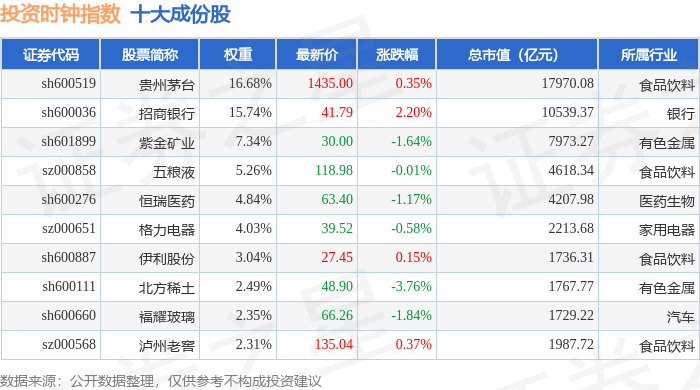
Core Points - The Investment Clock Index (399391) closed at 3364.41 points, up 0.23%, with a trading volume of 95.671 billion yuan and a turnover rate of 0.98% [1] - Among the index constituents, 66 stocks rose, with Xinghui Entertainment leading at a 9.29% increase, while 33 stocks fell, with Lingnan Holdings leading the decline at 5.24% [1] Index Constituents Summary - Major constituents include: - Kweichow Moutai (16.68% weight) at 1435.00 yuan, up 0.35%, with a market cap of 1797.008 billion yuan [1] - China Merchants Bank (15.74% weight) at 41.79 yuan, up 2.20%, with a market cap of 1053.937 billion yuan [1] - Zijin Mining (7.34% weight) at 30.00 yuan, down 1.64%, with a market cap of 797.327 billion yuan [1] - Wuliangye (5.26% weight) at 118.98 yuan, down 0.01%, with a market cap of 461.834 billion yuan [1] - Hengrui Medicine (4.84% weight) at 63.40 yuan, down 1.17%, with a market cap of 420.798 billion yuan [1] Capital Flow Summary - The index constituents experienced a net outflow of 2.407 billion yuan from institutional investors and 0.251 billion yuan from retail investors, while retail investors saw a net inflow of 2.658 billion yuan [3] - Notable capital flows include: - China Merchants Bank with a net inflow of 433.16 million yuan from institutional investors [3] - China Petroleum with a net inflow of 326 million yuan from institutional investors [3] - China Shipbuilding with a net inflow of 284 million yuan from institutional investors [3]