
长江存储

Search documents
HBM成“新石油”:AI军备竞赛推高存储价格50%手机被挤出坏日子刚刚开始!2026半导体市场“冰火两重天” !
Xin Lang Cai Jing· 2026-01-10 00:55
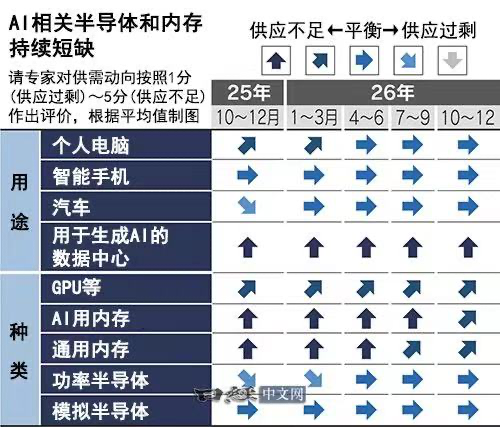
Core Insights - The semiconductor industry is experiencing a significant shift due to the rise of AI, with High Bandwidth Memory (HBM) becoming the new essential resource, akin to "new oil" [1][2][8] - Major players like Samsung, SK Hynix, and Micron dominate the HBM market, leading to a supply-demand imbalance that is pushing prices up and affecting other sectors like smartphones and PCs [2][3][4] Group 1: HBM and AI Impact - HBM's strategic importance has surged, with prices for AI-related DRAM increasing by 50% and NAND flash by 33% due to extreme scarcity [2][3] - The dominance of HBM by a few companies (over 95% market share) has led to tech giants securing production capacity well in advance, indicating a fierce competition for HBM resources [2][3] - The financial performance of major semiconductor companies has improved dramatically, with Samsung reporting a 210% year-on-year increase in operating profit, reflecting the profitability of HBM [3] Group 2: Consumer Electronics Challenges - The demand for HBM has led to a significant reduction in the production of general DRAM/NAND used in smartphones and PCs, creating a supply shortage in the consumer electronics sector [4][5] - Major manufacturers are prioritizing HBM production due to its higher profit margins, leaving lower-margin products like smartphone memory struggling [4][5] - Analysts warn that the shortage of storage will directly impact the overall shipment volumes of smartphones and PCs, with many OEMs already reducing their orders for the first half of 2026 [4][5] Group 3: Structural Risks in the Semiconductor Market - Despite optimistic forecasts predicting the semiconductor market will approach $975.4 billion in 2026, structural imbalances pose systemic risks, including power constraints and potential demand bubbles [2][6] - The exponential power consumption of AI data centers is becoming a critical bottleneck, with energy supply lagging behind the rapid expansion of chip manufacturing [6] - The sustainability of AI-related capital expenditures is in question, as the commercial viability of large AI models may not meet expectations, potentially leading to an inventory crisis in the HBM market [6][7] Group 4: Opportunities and Challenges for Chinese Companies - Chinese companies face both challenges and opportunities in the HBM market, with high technical barriers but increasing domestic demand for alternatives in AI servers and other sectors [7] - The ability to innovate in areas like power semiconductors and integrated architectures will be crucial for determining the competitive landscape over the next five years [7]


广钢气体20260108
2026-01-08 16:02
Summary of Guanggang Gas Conference Call Company Overview - Guanggang Gas is one of the few domestic companies capable of competing with international giants like Linde and Air Liquide in the electronic bulk gas market, having secured significant orders from key clients such as Changxin Storage and BOE, ensuring stable long-term cash flow [2][5] Industry Insights - Electronic bulk gases are critical materials in semiconductor manufacturing, with demand increasing due to technological upgrades and capacity expansions. A semiconductor factory with an investment of 30-40 billion RMB can have electronic bulk gas orders reaching 4-5 billion RMB, with long-term contracts over 15 years potentially amounting to 6-7 billion RMB [2][6] - The global storage market is entering a prosperous cycle, benefiting companies like Guanggang, especially with major clients like Changxin and Yangtze Memory Technologies expanding production [7] Financial Performance and Projections - Guanggang's stock has performed well since September 2025, driven by the global storage boom and the upcoming IPOs of major storage companies [7] - Revenue is expected to exceed 10 billion RMB in the future, with a high profit margin due to the strong demand from existing clients [7] - Profit is projected to grow significantly starting from Q3 2025, with estimates for 2026 reaching between 450 million to 500 million RMB, indicating a compound annual growth rate of 40-50% or higher [3][14] Business Model and Competitive Advantage - Guanggang's core business focuses on semiconductor materials, particularly electronic bulk gases, providing long-term stable gas supply services to downstream clients, typically under 15-year contracts, ensuring consistent cash flow [4] - The company has established deep cooperative relationships with major clients, which enhances its competitive edge in a high-barrier industry [8][9] Market Position - While global electronic bulk gas markets are dominated by companies with market capitalizations in the hundreds of billions, Guanggang holds a significant position in the domestic market, successfully competing for orders against these international players [5] Future Market Opportunities - Guanggang has substantial market potential in the field of self-controlled equipment materials and components, with long-term prospects suggesting a market capitalization exceeding 100 billion RMB [10] - The company is actively expanding into overseas markets, particularly in South Korea, leveraging its gas production capabilities and cost advantages [11] Challenges and Strategic Responses - Guanggang has maintained stable supply even during periods of tight supply for specific electronic bulk gases, demonstrating its operational resilience [8] - The company is well-positioned to navigate industry challenges and competition through its established supply relationships and operational expertise [9] Conclusion - Guanggang Gas is poised for significant growth in the coming years, driven by strong demand in the semiconductor sector and strategic positioning in both domestic and international markets. The company's financial outlook is promising, with expectations of robust profit growth and market expansion opportunities [12][13]

涨疯了,一盒内存条堪比上海一套房!
Jin Tou Wang· 2026-01-08 09:35
Core Viewpoint - The rising cost pressure in the automotive industry is primarily driven by memory prices rather than metal raw materials, with significant price increases in memory components impacting the overall cost of smartphones, computers, and cars [1][4]. Group 1: Memory Price Increases - The price of a 265G DDR5 server memory module has reached 40,000, with a box of 100 costing 4 million, comparable to the price of a house in some areas of Shanghai [4]. - The price of 16GB DDR4 memory modules surged by 1800% last year, while DDR5 modules increased by over 500% [1][5]. - The demand for memory in AI applications is significantly higher, with a single AI server requiring 8-10 times more memory than a standard server, leading to a supply shortage [5][7]. Group 2: Impact on Consumer Electronics - The increase in memory prices is expected to lead to higher prices for smartphones and computers, with memory accounting for 10%-20% of hardware costs [4]. - Smartphone manufacturers like Xiaomi, OPPO, and others have already raised prices by 100 to 600 yuan for new models since last October due to rising costs [7]. - The global smartphone shipment volume is projected to decline by 2.1% in 2026 due to these price increases [7]. Group 3: PC Market Dynamics - Major PC manufacturers such as Dell and Lenovo are planning price increases ranging from 10% to 30% for commercial PCs [9]. - The domestic memory manufacturers like Yangtze Memory Technologies and ChangXin Memory are gaining market share due to their price advantages of 15%-20% [9]. Group 4: AI Infrastructure and Market Competition - Tech giants like Apple, Google, and Amazon are aggressively competing for memory supply, with procurement teams stationed in South Korea to secure long-term contracts [11]. - Samsung and SK Hynix are maintaining a strong stance on pricing, opting for quarterly pricing rather than long-term contracts, which has led to significant price increases [11]. - The current memory price surge is expected to persist until 2026, with predictions of price hikes of up to 70% from major manufacturers [9][11].
半导体设备,AI时代金铲铲,马年劲蹄狂奔!
Jin Rong Jie· 2026-01-08 01:45
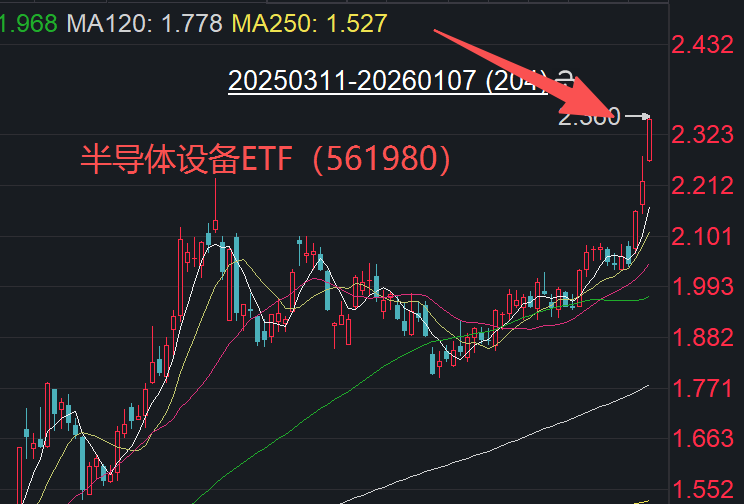
Core Viewpoint - The semiconductor equipment sector is experiencing significant growth, driven by the AI era and domestic production capabilities, with notable companies reaching historical highs and substantial investment forecasts for the coming years [1][4][5]. Group 1: Market Performance - The Shanghai Composite Index has achieved a rare 14 consecutive days of gains, with domestic semiconductor equipment manufacturers like North Huachuang, Zhongwei Company, Tuojing Technology, and Changchuan Technology hitting historical highs [1]. - The semiconductor equipment ETF (561980) has also reached new highs in both scale and net value, with a remarkable increase of over 15% in just three trading days [1]. Group 2: Industry Drivers - The strength of the semiconductor equipment sector is attributed to its role as the "golden shovel" in the AI era, essential for the manufacturing of AI chips in wafer fabs [3][4]. - A significant supply-demand imbalance in the memory chip market is expected, with DDR4 16Gb prices projected to rise by as much as 1800% in 2025, benefiting not only memory manufacturers but also upstream equipment suppliers [4]. Group 3: Investment Opportunities - Major domestic memory manufacturers like Yangtze Memory Technologies and Changxin Memory Technologies are initiating large-scale expansion plans, which could drive semiconductor equipment orders exceeding 10 billion [4]. - Predictions indicate that the combined investment in new capacity by these two memory giants could reach between $15.5 billion and $18 billion by 2026, providing a strong order growth and profit accumulation for companies like North Huachuang and Zhongwei Company [4]. Group 4: Domestic Production and Growth Potential - The domestic semiconductor equipment sector is accelerating its self-sufficiency, with projections suggesting that the overall domestic production rate could rise to 22% by 2025, indicating significant room for replacement and clear growth pathways [5]. - The increasing domestic production rate will enable continuous breakthroughs in advanced logic processes, leading to sustained expansion of wafer fabs and consistent equipment procurement [7]. Group 5: ETF Performance and Composition - The semiconductor equipment ETF (561980) has a high concentration of nearly 80% in its top ten holdings, primarily consisting of leading domestic equipment manufacturers, making it a strong performer in its category [7]. - The ETF's composition, with nearly 60% in equipment content, positions it as a robust investment option, particularly for those seeking high elasticity and alpha in their portfolios [7].




存储芯片巨头股价刷新纪录,AI带动行业发展!国际存储巨头或再提价超60%
Jin Rong Jie· 2026-01-08 00:56
来源:光大证券微资讯 产品涨价、股价暴涨,存储芯片行业上演"疯狂一幕"! 1月6日,美国存储芯片巨头闪迪大幅上涨27.56%,总市值一举突破500亿美元。韩国存储芯片巨头SK海 力士、三星电子股价也持续上涨,延续2025年以来的疯狂势头。 在AI基础设施快速发展的背景下,存储芯片的需求进入高景气阶段,科技巨头纷纷囤积存储芯片。在 供应紧张的背景下,国际存储芯片巨头屡次涨价,三星电子、SK海力士计划在本季度上调服务器 DRAM售价60%-70%。 与此同时,国产存储芯片行业迎来重要进展,上交所已经受理长鑫科技在科创板IPO的申请。 1、存储芯片巨头股价屡创纪录,AI带动行业热潮 谁也没有想到,黄仁勋一席话,让存储芯片巨头股价狂飙。美国当地时间1月5日,英伟达创始人黄仁勋 在2026年国际消费电子展(CES)发表主题演讲,正式发布新一代超级计算平台Vera Rubin,从GPU到 CPU,从机柜到互联方式,全部优化升级。 Vera CPU为服务器级别的CPU,拥有88核、176线程;Rubin GPU晶体管数量增加60%,但是AI浮点性 能五倍于Blackwell GPU,核心在于配备了可以实现自主调度能力的 M ...
内存条涨疯了,国产替代如何破局?
虎嗅APP· 2026-01-08 00:10
Core Viewpoint - The article discusses the significant price increase of memory chips, particularly 32GB memory modules, which have surged from under 800 yuan at the beginning of the year to over 2200 yuan currently, leading to comparisons with gold bars due to their high value [4][5]. Group 1: Price Trends and Market Dynamics - Since Q3 2025, the global memory chip market has experienced an "epic" price surge, with DRAM prices increasing by 171.8% compared to the same period in 2024, significantly outpacing the less than 110% increase in international spot gold prices [12]. - Major storage manufacturers, including Samsung, Micron, and SK Hynix, have reported substantial profit increases due to rising memory prices, with Samsung's operating profit reaching approximately $8.56 billion, a 32.2% year-on-year increase [17]. - Analysts predict that memory prices will continue to rise, with a forecasted additional increase of 20% early next year and sustained price growth potentially lasting until mid-2026 [14][15]. Group 2: Impact on Supply Chain and Consumer Electronics - The rising cost of memory chips is expected to increase the overall costs of smartphones and computers, as memory components account for 10%-20% of the BOM (Bill of Materials) costs [23][24]. - Smartphone and computer manufacturers face three difficult choices in response to rising memory costs: maintain configurations at original prices, reduce configurations while keeping prices stable, or increase prices, which may deter consumers and impact sales [25][26]. Group 3: Supply and Demand Factors - The price increase is attributed to a dynamic interplay between supply and demand, with supply constraints arising from manufacturers' previous production cuts during industry downturns and demand surges driven by applications such as artificial intelligence [28][32]. - The production of memory chips is capital-intensive and has long lead times, making it difficult for supply to quickly respond to sudden increases in demand [37]. Group 4: Market Structure and Competitive Landscape - The global memory market is dominated by manufacturers from the US, Japan, and South Korea, with Samsung, SK Hynix, and Micron holding over 93% of the DRAM market share [53]. - Chinese companies like Changxin Storage and Yangtze Memory Technologies are emerging but still lag significantly behind leading firms, particularly in high-bandwidth memory (HBM), where 99% of the market is controlled by the top three companies [57]. Group 5: Geopolitical and Technological Challenges - The Chinese memory chip industry faces significant challenges, including geopolitical tensions and technology barriers, which hinder its ability to compete effectively in the global market [64][66]. - The recent price surge presents both challenges and opportunities for Chinese companies to accelerate technological advancements and improve efficiency, while also highlighting the need for a comprehensive strategy to overcome systemic issues in the industry [68][69].

龙虎榜复盘丨光刻胶大涨,半导体持续活跃
Xuan Gu Bao· 2026-01-07 10:47
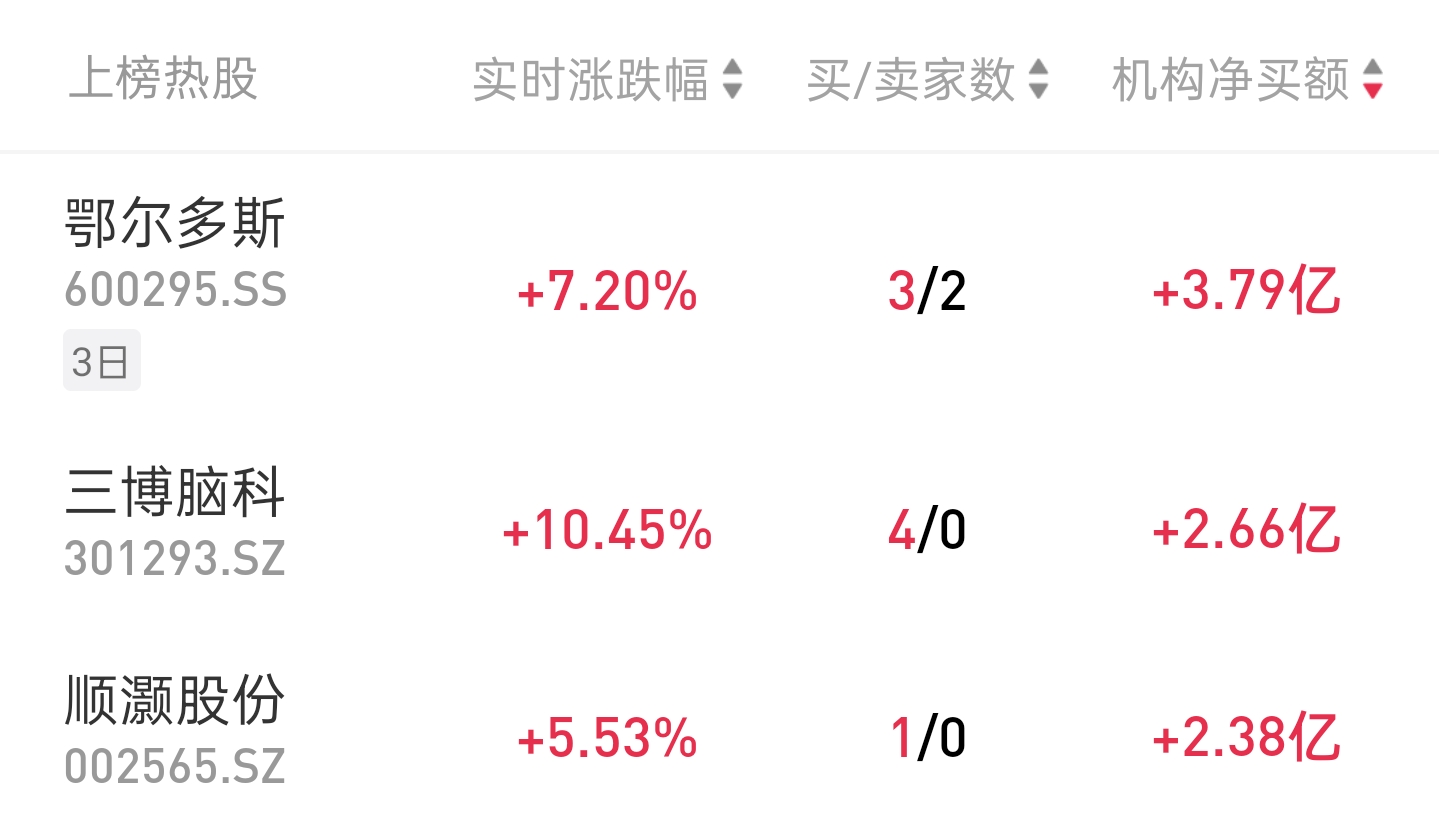
Group 1 - Institutions ranked 40 stocks today, with a net purchase of 25 stocks and a net sale of 15 stocks [1] - The top three stocks with the highest net purchases by institutions are: Ordos (CNY 379 million), Sanbo Brain Science (CNY 266 million), and Shunhao Co. (CNY 238 million) [1][2] - Ordos relies on local coal and mineral resources to achieve resource conversion, forming a circular industrial chain of coal and mineral resource development, electricity, and metallurgy [2] Group 2 - The semiconductor industry is experiencing significant growth, with global 300mm wafer fab equipment spending expected to increase by 24% to USD 101.9 billion in 2025, reaching a historical high of USD 118.8 billion in 2026 [4] - China consumed one-third of the global chip consumption in 2023, indicating strong domestic production demand [4] - The semiconductor industry has high technical barriers and is strategically important, especially given the ongoing capital expenditure and strict overseas technology controls [5] Group 3 - Companies like Guanggang Gas and Chip Source Micro are key players in the semiconductor industry, providing essential materials and equipment [6] - The stock prices of major U.S. storage companies surged, with Micron Technology rising over 10%, SanDisk increasing by over 27%, and Western Digital up over 16% [6] - Chinese storage chip manufacturers, such as Yangtze Memory Technologies and Changxin Memory Technologies, are expected to accelerate production expansion between 2025 and 2027, with plans to increase the use of domestic equipment [6]

东方证券:英伟达推出推理上下文内存存储平台 AI存储需求持续扩张
智通财经网· 2026-01-07 07:38
Core Viewpoint - NVIDIA has launched a context memory storage platform at CES 2026, aimed at creating a new memory layer optimized for AI inference, bridging GPU memory and traditional storage [1][2]. Group 1: NVIDIA's New Platform - The context memory storage platform is a POD-level AI-native storage infrastructure designed to support long-term AI operations by optimizing data management and access [2]. - The platform includes hardware and software components such as BlueField-4 for data management, Spectrum-X Ethernet for high-performance networking, and various software tools to enhance system efficiency [2]. Group 2: Shift in AI Inference Bottlenecks - The bottleneck in AI inference is shifting from computation to context storage, necessitating a restructured AI storage architecture to handle increased context data from complex tasks [3]. - There is an anticipated significant growth in demand for storage chips as AI evolves from simple chatbots to intelligent collaborative agents requiring extensive context capacity [3]. Group 3: Domestic Storage Industry Opportunities - The ongoing shortage of storage capacity presents a historic opportunity for domestic storage manufacturers, especially as international competitors may face limitations in expanding production [4]. - Companies like Changxin Technology and Yangtze Memory Technologies are making strides in DRAM and NAND technologies, respectively, which could lead to substantial production increases following their IPOs [4]. Group 4: Related Companies - Key semiconductor equipment companies include Zhongwei Company, Jingzhida, and Beifang Huachuang, while notable packaging and testing firms are Deep Technology and Huicheng Shares [5][6]. - Companies involved in AI storage solutions and benefiting from storage technology iterations include Zhaoyi Innovation and Jiangbolong [6].


东方证券:英伟达(NVDA.US)推出推理上下文内存存储平台 AI存储需求持续扩张
智通财经网· 2026-01-07 07:37
Core Viewpoint - NVIDIA has introduced a context memory storage platform at CES 2026, aimed at creating a new memory layer optimized for AI inference, bridging GPU memory and traditional storage [1][2]. Group 1: NVIDIA's New Platform - The context memory storage platform is a POD-level AI-native storage infrastructure designed to support long-term AI operations by optimizing data access and management [2]. - The platform includes hardware and software components such as BlueField-4 for data management, Spectrum-X Ethernet for high-performance networking, and various software tools to enhance system efficiency [2]. Group 2: Shift in AI Inference Bottlenecks - The bottleneck in AI inference is shifting from computation to context storage, necessitating a restructured AI storage architecture to handle increased context data from complex tasks [3]. - There is an expectation that the demand for storage chips will grow significantly as AI evolves from simple chatbots to more complex collaborative entities requiring extensive context capacity [3]. Group 3: Domestic Storage Industry Opportunities - The ongoing supply-demand imbalance in storage, coupled with limited expansion from overseas storage giants, presents a historic opportunity for domestic storage manufacturers to increase their market share [4]. - Companies like Changxin Technology and Yangtze Memory Technologies are making significant advancements in DRAM and NAND technologies, respectively, which could lead to substantial production capacity increases post-IPO [4]. Group 4: Related Companies - Key domestic semiconductor equipment companies include Zhongwei Company, Jingzhida, and Beifang Huachuang, among others [5]. - Companies involved in packaging and testing include Deep Technology and Huicheng Shares [6]. - Firms focusing on AI storage solutions and benefiting from storage technology iterations include Zhaoyi Innovation and Lianyun Technology [6].
武汉加快打造6G创新领跑高地
Di Yi Cai Jing· 2026-01-07 05:38
瞄准这一新赛道的城市不止武汉。 武汉提前打开了6G的大门。 而6G亚毫秒级的时延则利好全息通信、自动驾驶、远程精密医疗等应用场景。朱哲学说,武汉经开区 可在智能网联汽车测试场基础上建设"6G+智能网联汽车"先导区,全域部署支持L5级自动驾驶的6G车 联网,吸引全球车企、方案商开展测试和商业化运营,形成技术、标准、产业的闭环。将东湖高新区作 为6G综合应用示范区,构建园区级数字孪生平台,实现能源、交通、安防的智能化精细管理。在长江 治理上,可利用6G网络构建覆盖水文、水质、生态、航运的立体感知网络,探索"6G+长江大保护"方 案。 近日,武汉东湖高新区发布顶尖人才(团队)专项实施办法,向全球6G顶尖人才抛出橄榄枝,最高支 持1亿元。当地还在武汉东湖综保区建设了通信设备研发和制造基地项目,主要承载6G"空天地"网络装 备的研发迭代和制造,并计划在其周围布局6G领域顶尖人才团队项目。 在产业生态层面,以"中国光谷"为核心的武汉光电子信息产业集群,是全国最大的光纤光缆、光器件、 光模块生产基地,也是全球重要的光通信研发高地。中国信科集团作为央企,在6G标准制定、原型系 统开发中深度参与国际竞争;华为武汉研究所聚焦无线 ...
