易方达基金

Search documents
6万亿里程碑!2025成ETF市场史上最强大年,深市跑出三大创新赛道
Sou Hu Cai Jing· 2026-02-09 13:25
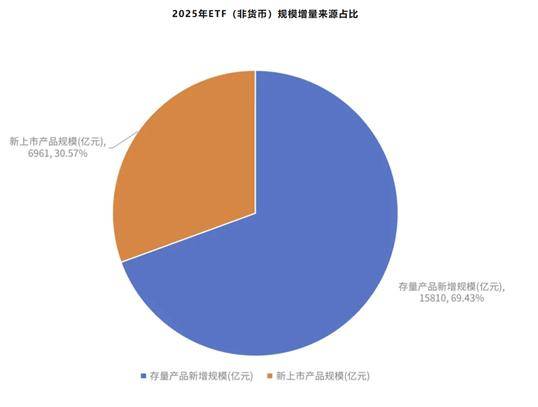
Core Insights - The Shenzhen Stock Exchange has released the "ETF Market Development White Paper (2025)", outlining the innovative trajectory of new ETF products driven by policy guidance and market demand [1] - By the end of 2025, the total scale of domestic ETFs is expected to exceed 6 trillion yuan, with an annual growth rate of 62% [2] Group 1: ETF Product Development - The white paper highlights a clear strategy for the development of ETFs in Shenzhen, focusing on the economic transformation and reform of the ChiNext market, with the introduction of multiple ChiNext 50 and ChiNext Composite Index ETFs [1] - The launch of thematic ETFs in artificial intelligence and robotics allows investors to easily share in the benefits of industrial transformation [1] - The bond ETF sector has seen significant innovation, with the introduction of 4 benchmark credit bond ETFs and 10 sci-tech bond ETFs, totaling a scale of 203.1 billion yuan, which is a 4.35 times increase compared to before listing [1] Group 2: Market Growth and Structure - The growth of the ETF market is primarily driven by the increase in existing product scales and the issuance of high-quality new products, contributing nearly 70% to the market increment [2] - The structure of new product issuance shows a solid multi-dimensional development pattern, with broad-based ETFs expanding steadily, while industry-themed ETFs have experienced explosive growth, particularly in the technology sector [4] - Strategy ETFs, such as those focused on dividends and free cash flow, have seen a nearly doubling in number, while bond ETFs contributed 489 billion yuan in new issuance [4] Group 3: Institutional Participation - The year 2025 is marked as a significant year for the issuance of new ETF products, with E Fund leading the industry by launching 32 new ETFs [4] - Other major institutions like China Universal Asset Management and Penghua Fund have also contributed significantly, with over 20 new ETFs each [4] - A total of 16 fund companies launched more than 10 new ETFs in the year, indicating a competitive landscape that injects continuous innovation into the ETF market [4]

红利板块震荡上行,恒生红利低波ETF易方达(159545)最新规模突破80亿元,创历史新高
Sou Hu Cai Jing· 2026-02-09 11:18
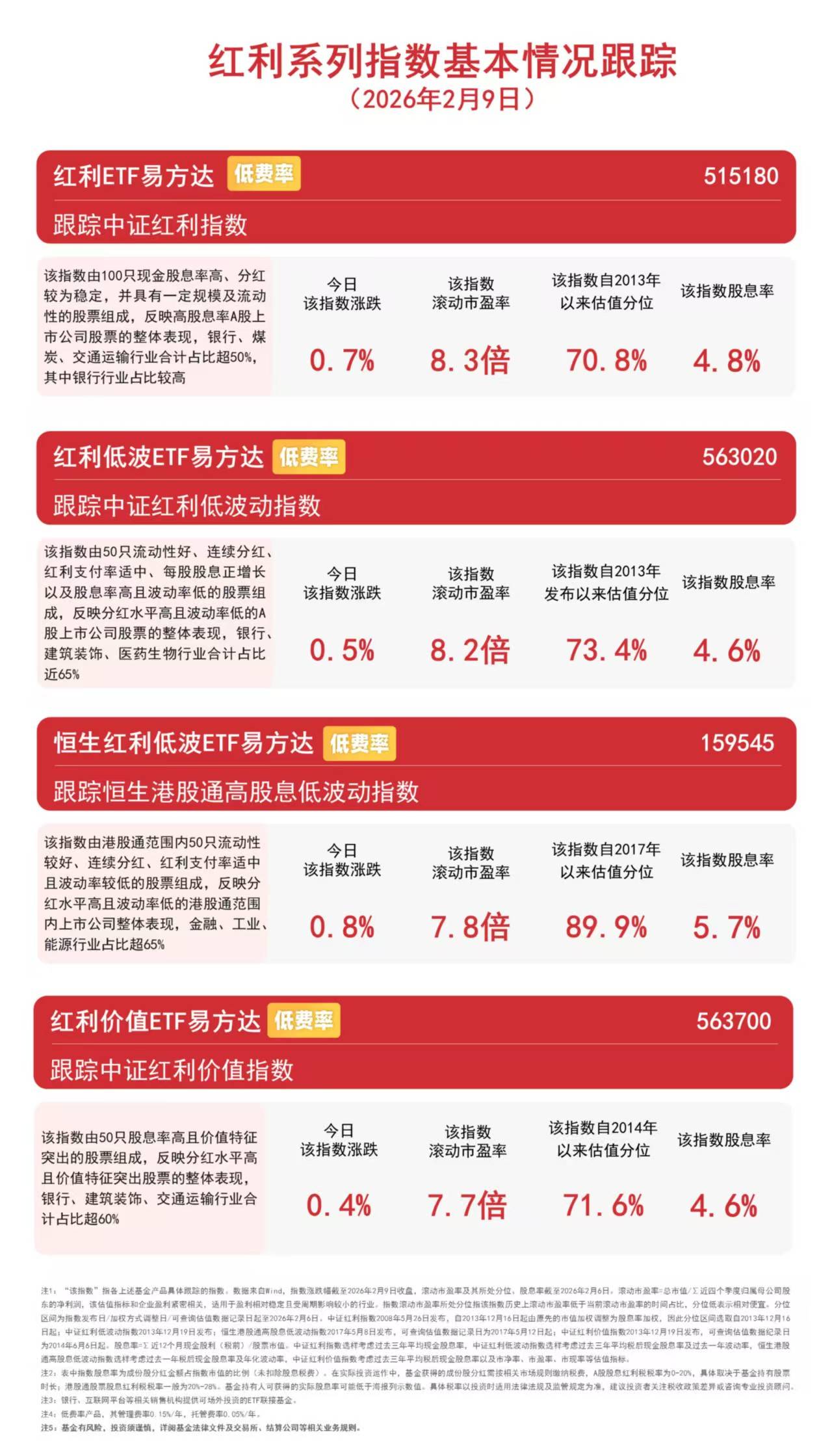
Core Viewpoint - The article highlights the performance of various dividend-focused ETFs managed by E Fund, emphasizing their low fee structure and recent growth in assets under management, particularly the Hang Seng Dividend Low Volatility ETF which has surpassed 8 billion yuan in size, marking a historical high [1][3]. Group 1: ETF Performance - The Hang Seng Dividend Low Volatility Index increased by 0.8%, the CSI Dividend Index rose by 0.7%, the CSI Dividend Low Volatility Index went up by 0.5%, and the CSI Dividend Value Index saw a 0.4% increase [1]. - E Fund's Hang Seng Dividend Low Volatility ETF (159545) experienced a net subscription of approximately 20 million units today, bringing its total size to over 8 billion yuan [1]. Group 2: Fee Structure - E Fund is noted as the only fund company that implements a low fee rate across all its dividend ETFs, with a management fee rate of 0.15% per year for products including the Hang Seng Dividend Low Volatility ETF (159545) and others [1][4]. Group 3: Index Composition - The CSI Dividend Index consists of 100 stocks with high cash dividend yields and stable performance, with significant representation from the banking, coal, and transportation sectors, which together account for over 50% [3]. - The CSI Dividend Low Volatility Index is composed of 50 stocks characterized by good liquidity, continuous dividends, and low volatility, with a notable presence in the banking, construction, and pharmaceutical sectors [3]. - The Hang Seng Dividend Low Volatility Index includes 50 stocks from the Hong Kong Stock Connect that exhibit high dividend levels and low volatility, with major sectors being finance and industry [3].
通信ETF领涨;多只消费主题ETF获资金净流入丨ETF晚报
2 1 Shi Ji Jing Ji Bao Dao· 2026-02-09 10:02
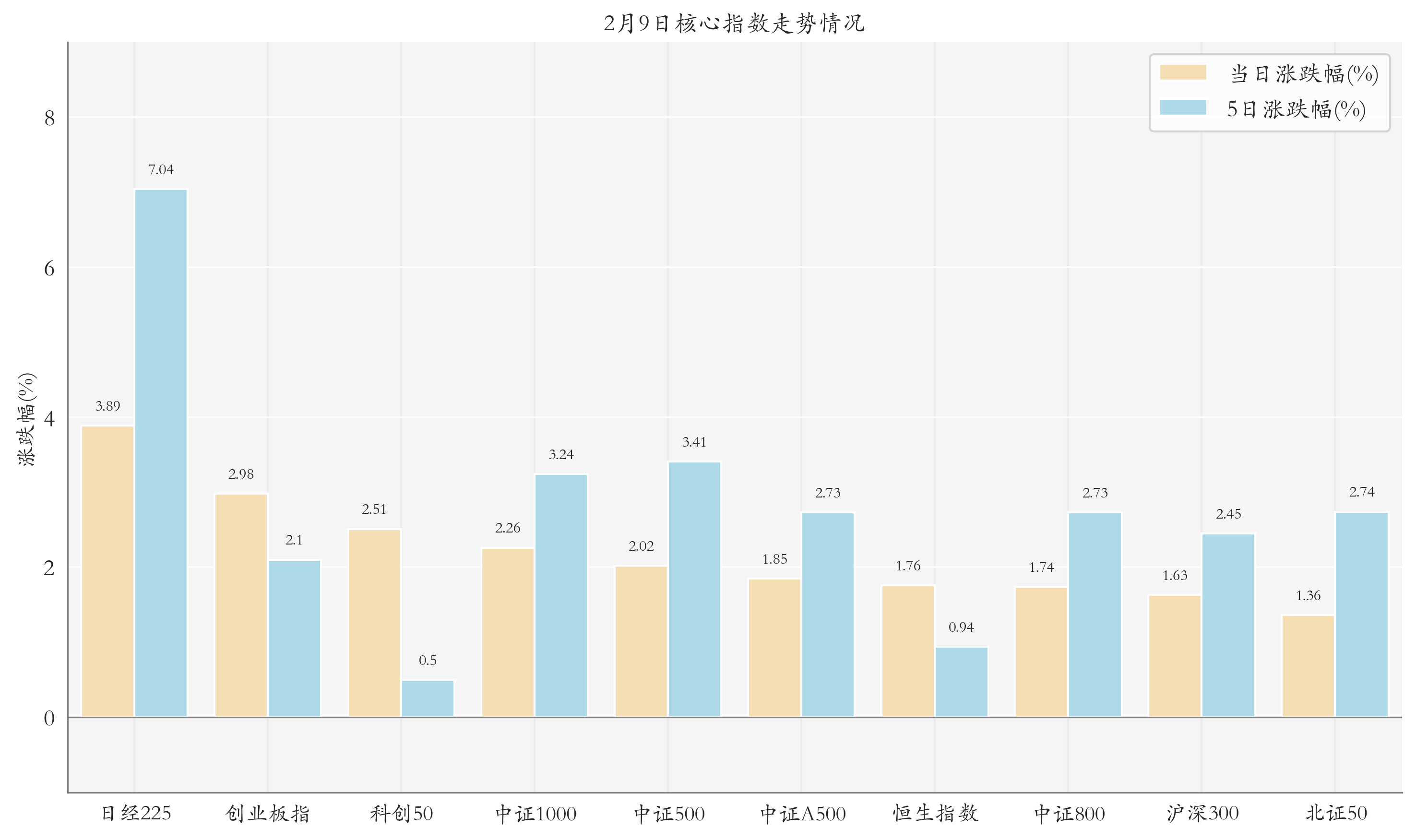
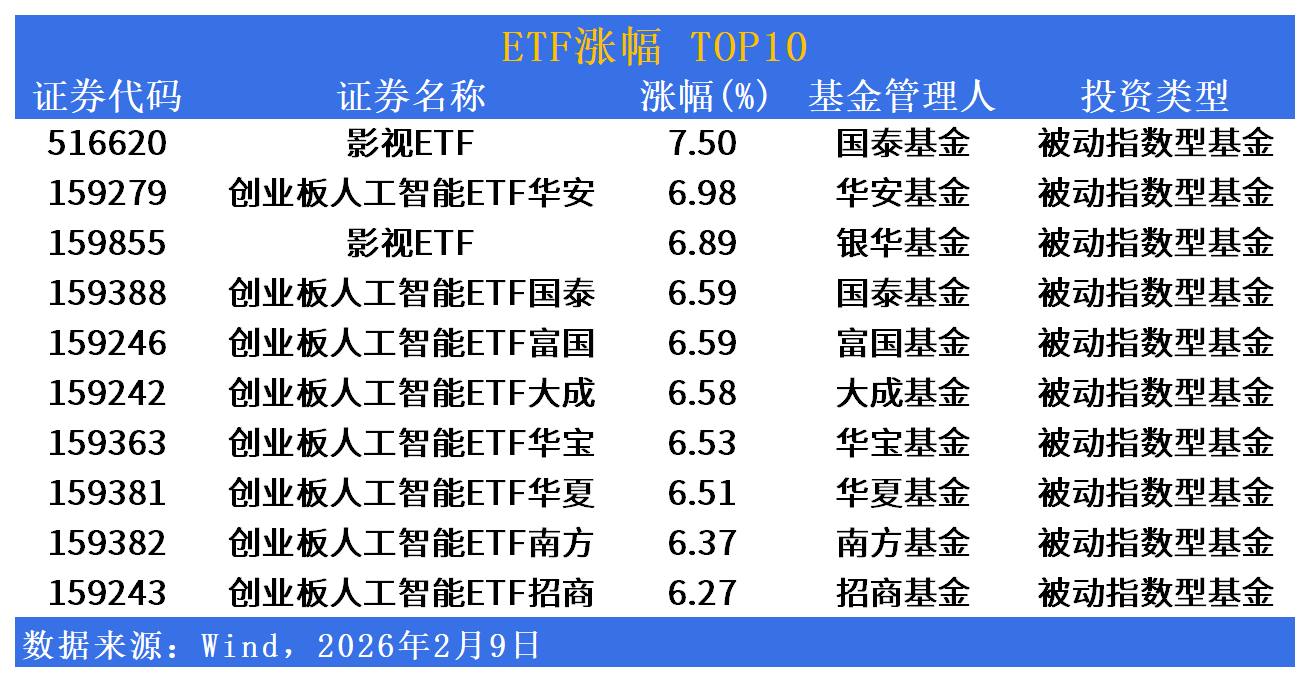
一、ETF行业快讯 1.三大指数集体上涨,通信ETF领涨 今日,三大指数集体上涨,上证综指上涨1.41%,深证成指上涨2.17%,创业板指上涨2.98%。多只通信板块ETF上涨,其中,创业板人工智能ETF华安 (159279.SZ)上涨6.98%,创业板人工智能ETF国泰(159388.SZ)上涨6.59%,创业板人工智能ETF富国(159246.SZ)上涨6.59%。 2.多只消费主题ETF获资金净流入 据中证报,随着春节的临近,近期A股大消费板块整体表现强势。上周以来,多只消费主题ETF明显上涨,并且迎来较为显著的资金净流入。多家机构表 示,大消费板块在经历长期调整后,估值已进入具有吸引力的区间,叠加春节旺季催化与促消费政策发力,板块配置价值正逐步显现。 二、今日行情速览 1.指数走势 统计A股与海外主要核心指数走势,今日(2月9日,下同)三大指数集体上涨,其中上证指数上涨1.41%,收于4123.09点,日内最高4123.16点;深证成指上 涨2.17%,收于14208.44点,日内最高14211.7点;创业板指上涨2.98%,收于3332.77点,日内最高3340.33点。今日日经225、创业板指与科 ...
万亿华夏基金的“规模悖论”:被动ETF狂飙,主动权益陷“迷你基”困局
Xin Lang Cai Jing· 2026-02-09 09:12
Core Viewpoint - 华夏基金 maintains its leading position in the ETF market, approaching a scale of 1 trillion, but faces significant challenges with a sharp decline in the scale of actively managed equity funds, leading to multiple products nearing liquidation [1][13]. Group 1: ETF Business Performance - As of the end of 2025, 华夏基金's ETF (non-monetary) management scale reached 956.9 billion, ranking first in the market, although its market share decreased by 2.09% compared to 2024 [2][19]. - The gap between 华夏基金 and the second-ranked 易方达基金 expanded from 56.3 billion at the end of 2024 to 79.3 billion by the end of 2025, indicating an increasing competitive advantage [2][14]. - On January 12, 2026, 华夏基金's ETF management scale briefly exceeded 1 trillion, reaching 1,016.7 billion, but by February 6, it had shrunk to approximately 750 billion, a decline of over 25% [10][20]. Group 2: Active Equity Fund Challenges - The scale of 华夏基金's actively managed equity funds has significantly decreased, with stock fund assets dropping from 43.4 billion at the end of 2021 to 24.4 billion by the end of 2025, a reduction of nearly 20 billion [11][21]. - The scale of mixed funds also fell from 210.1 billion to 128.4 billion during the same period, resulting in a total decline of over 100 billion across actively managed equity funds [11][21]. - The persistent shrinkage has led to a proliferation of "mini funds," with several products, including 华夏红利量化选股股票 and 华夏新锦升混合, falling below the 50 million liquidation threshold [12][23]. Group 3: Fund Launches and Liquidations - As of February 6, 2026, 81 out of 282 newly launched funds in the year had announced early termination of fundraising, including 华夏基金's 华夏经典回报混合 [3][15]. - Two ETF linked funds, 华夏中证沪港深500ETF and 华夏中证新能源ETF, were liquidated due to asset sizes falling below 200 million, triggering automatic termination clauses [6][18]. - The 华夏新材料龙头混合发起式 fund is particularly at risk, having issued a notice regarding potential contract termination if its net asset value remains below 200 million by February 24, 2026 [12][24].
ETF市场日报 | 影视ETF暴涨超7%领跑市场!能源化工ETF微跌0.08%
Sou Hu Cai Jing· 2026-02-09 08:48
Market Overview - The A-share market saw a collective rise in the three major indices, with the Shanghai Composite Index recovering the 4100-point mark, closing up 1.41% [1] - The total trading volume in the Shanghai, Shenzhen, and Beijing markets reached 2.27 trillion yuan, an increase of 106.7 billion yuan compared to the previous trading day [1] ETF Performance - The film and AI ETFs led the market with significant gains, with the Guotai Film ETF (516620) surging 7.50% and the Huazhang AI ETF (159279) rising 6.98% [2] - Other AI-related ETFs also performed well, with several exceeding a 6.50% increase, indicating strong investor interest in AI applications and computing infrastructure [2] - The new energy sector also showed positive movement, with the Invesco Battery ETF (159757) up 2.20% and the Fortune Lithium Battery ETF (561160) rising 2.12% [2] ETF Declines - Commodity and bond ETFs experienced slight adjustments, with the maximum decline being less than 0.1%, indicating a stable market environment [3][4] Trading Activity - The Short-term Bond ETF (211360) had a trading volume of 52.734 billion yuan, leading the market, followed by the Yin Hua Daily ETF (211880) at 17.104 billion yuan [5][7] - The Huaxia Brazil ETF (159100) had a turnover rate of 211.93%, reflecting a high level of speculative trading in cross-border products [6][7] New ETF Launch - The E Fund Shanghai Composite Index ETF (530060) is set to launch on February 10, 2026, with 321 million shares issued, tracking the overall performance of stocks listed on the Shanghai Stock Exchange [8]
ETF午评 | CPO板块大爆发,创业板人工智能ETF大成涨7%
Ge Long Hui· 2026-02-09 06:57
Group 1 - The three major A-share indices collectively rose in the morning session, with the Shanghai Composite Index up 1.17%, the Shenzhen Component Index up 2.07%, and the ChiNext Index up 3.11% [1] - The total trading volume in the Shanghai, Shenzhen, and Beijing markets reached 1,504.5 billion yuan, an increase of 109.6 billion yuan compared to the previous day [1] - Over 4,400 stocks in the market experienced gains, indicating a broad-based rally [1] Group 2 - The CPO sector saw significant gains, with the AI ETFs on the ChiNext rising by 7.08%, 6.94%, and 6.91% respectively [1] - The film and television sector was active, with the Silver Hua Fund Film ETF and the Guotai Fund Film ETF increasing by 6% and 5.73% respectively [1] - The photovoltaic sector also performed well, with the Guotai Photovoltaic ETF and the E Fund Photovoltaic ETF both rising by 4.46% [1] Group 3 - The white wine sector underperformed, with the wine ETF and consumer ETF declining by 0.54% and 0.38% respectively [2] - The basic ETF from Jianxin fell by 1% [2]

宝信软件股价涨5.05%,易方达基金旗下1只基金位居十大流通股东,持有1063.16万股浮盈赚取1190.74万元
Xin Lang Ji Jin· 2026-02-09 06:43
Group 1 - The core point of the news is that Baosight Software's stock price increased by 5.05%, reaching 23.30 CNY per share, with a trading volume of 495 million CNY and a turnover rate of 1.02%, resulting in a total market capitalization of 66.889 billion CNY [1] - Baosight Software, established on August 15, 1994, is located in the China (Shanghai) Pilot Free Trade Zone and was listed on March 11, 1994. The company specializes in research, design, development, manufacturing, integration, and related outsourcing, maintenance, and consulting services for computer, automation, and network communication systems [1] - The main revenue composition of Baosight Software includes software development and engineering services at 64.02%, service outsourcing at 35.31%, system integration at 0.48%, and other supplementary services at 0.20% [1] Group 2 - Among the top ten circulating shareholders of Baosight Software, E Fund's HuShen 300 ETF (510310) reduced its holdings by 366,700 shares in the third quarter, now holding 10.6316 million shares, which accounts for 0.37% of the circulating shares. The estimated floating profit today is approximately 11.9074 million CNY [2] - E Fund's HuShen 300 ETF (510310) was established on March 6, 2013, with a current scale of 300.22 billion CNY. Year-to-date return is 0.45%, ranking 4397 out of 5580 in its category; the one-year return is 24.09%, ranking 2737 out of 4290; and the return since inception is 139.41% [2] Group 3 - The fund managers of E Fund's HuShen 300 ETF (510310) are Yu Haiyan and Pang Yaping. As of the report, Yu Haiyan has a cumulative tenure of 15 years and 66 days, with a total fund asset scale of 433.297 billion CNY, achieving a best fund return of 174.06% and a worst return of -78.9% during the tenure [3] - Pang Yaping has a cumulative tenure of 7 years and 116 days, managing a total fund asset scale of 368.472 billion CNY, with a best fund return of 114.63% and a worst return of -37.67% during the tenure [3]

大幅净流出结束!ETF市场上周净流入百亿元,跨境股票ETF净流入174亿
Ge Long Hui· 2026-02-09 06:00
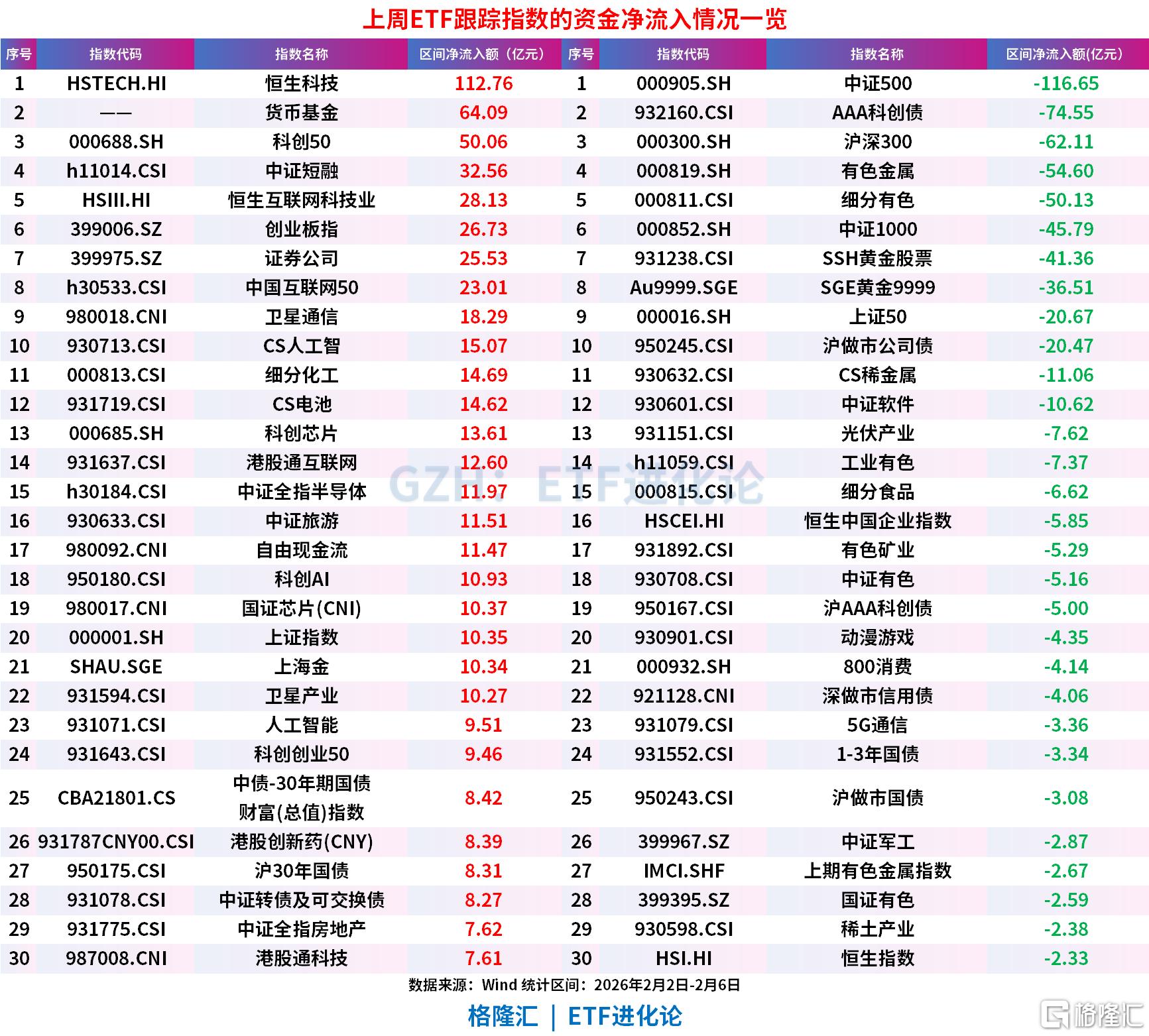
Market Performance - The A-share market saw a decline across major indices last week, with the small and medium-sized board index, Shanghai Composite Index, and CSI 300 Index showing returns of -1.16%, -1.27%, and -1.33% respectively. In contrast, the STAR 50, ChiNext Index, and CSI 500 Index had poorer returns of -5.76%, -3.28%, and -2.68% respectively [1] - Trading volume for major indices decreased last week, with the food and beverage, textile and apparel, and banking sectors leading in returns at 4.44%, 2.23%, and 2.08% respectively. Conversely, the non-ferrous metals, communication, and electronics sectors lagged with returns of -8.46%, -6.73%, and -5.09% respectively [1] Fund Flows - The ETF market experienced a net inflow of 148.79 billion yuan last week, with cross-border stock ETFs seeing a net inflow of 174.48 billion yuan, while stock ETFs had a net outflow of 14.52 billion yuan [2] - Major indices such as Hang Seng Tech, money market funds, STAR 50, and ChiNext Index saw net inflows of 112.76 billion yuan, 64.09 billion yuan, 50.06 billion yuan, and 26.73 billion yuan respectively. On the other hand, CSI 500, AAA STAR bonds, and CSI 300 experienced net outflows of 116.65 billion yuan, 74.55 billion yuan, and 62.11 billion yuan respectively [2][4] ETF Performance - Specific ETFs such as Huabao Tianyi ETF, Hang Seng Tech ETF, and STAR 50 ETF saw net inflows of 40.59 billion yuan, 38.84 billion yuan, and 30.31 billion yuan respectively. However, the CSI 500 ETF and CSI 300 ETF experienced significant net outflows of 107.94 billion yuan and 56.96 billion yuan respectively [5][9] - The average decline for stock ETFs was 12.22%, with the Hang Seng consumption ETFs showing a relatively high increase of 4.81% [13][15] New ETF Products - A total of 92 funds were reported last week, including 17 ETFs, with new products such as the Hang Seng A-share Electric Grid Equipment ETF and the National Index Oil and Gas ETF [21] - The domestic ETF market has become the largest in Asia, surpassing Japan in scale as of 2025, reflecting rapid growth and diversification since its inception in 2004 [22] New Index Launch - The Hang Seng Index Company introduced the Hang Seng Dual Technology Index, which allocates 75% of its weight to the Hang Seng Technology Index and 25% to the Hang Seng Biotech Index, aiming to reflect the market capitalization differences and represent dual themes [23]
经济稳增+政策托底,2026年A股投资机遇凸显
Sou Hu Cai Jing· 2026-02-09 05:44
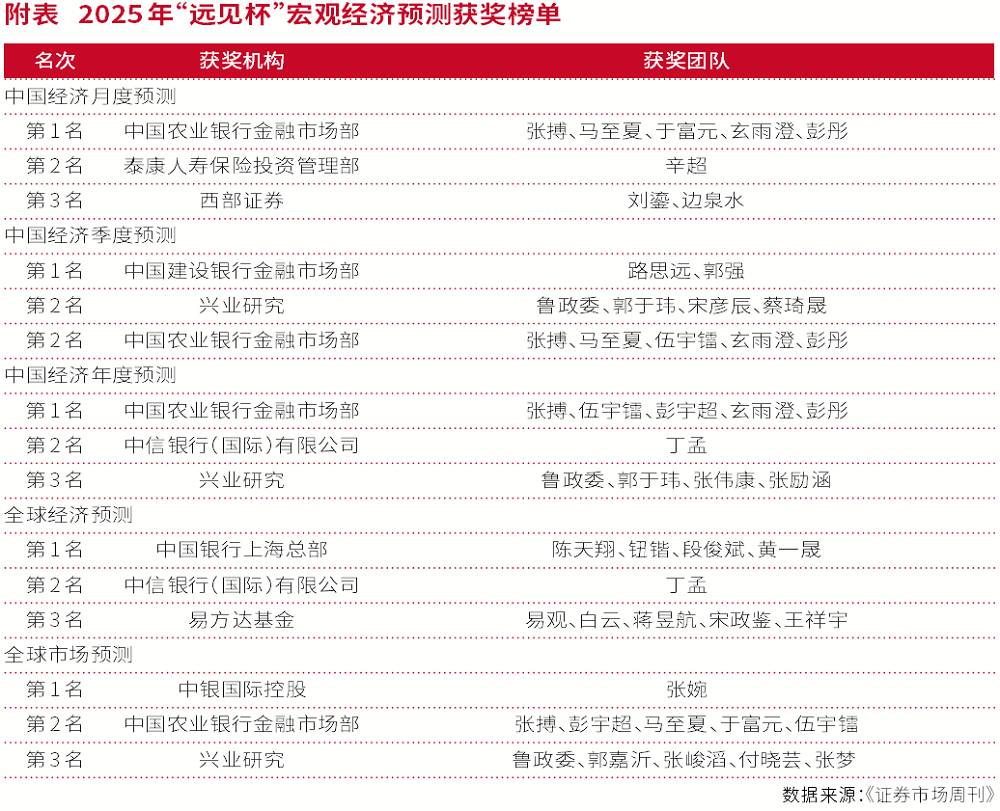
编者按: 2026年作为"十五五"的开局之年,中国经济与A股走向备受瞩目。 多地把2026年经济增长目标设定在4.5%-5.5%,机构预测中值为4.8%,经济稳中向好态势明确。在一系列政策发力见效背景下,中国的投资有 望企稳,消费则稳步回升,出口继续保持韧劲,物价水平或延续温和回暖的势头。 货币政策将继续保持宽松基调,同时在去美元化趋势不断加强的国际背景下,人民币汇率有望继续稳中走强,为A股高质量"慢牛""长牛"格局 奠定了坚实基础。 廖宗魁/文 2026年作为"十五五"的开局之年,中国经济能否延续2024年下半年以来的持续复苏势头,A股能否连续三年走牛,全球经济和国际市场又会如 何演进,成为当下投资者较为关心的问题。 从已经召开的地方两会看,绝大多数省份把2026年经济增长目标设定在4.5%—5.5%,意味着即将召开的全国两会很可能把2026年全国经济增 长目标定在5%左右。《证券市场周刊》"远见杯"宏观经济预测调查(以下简称"预测调查")显示,机构们对2026年中国GDP增长预测中值为 4.8%,经济稳中向好的态势延续。 在一系列政策发力见效的背景下,中国的投资有望企稳,消费则稳步回升,出口继续保持韧劲, ...
超110亿 加仓
Zhong Guo Ji Jin Bao· 2026-02-09 04:56
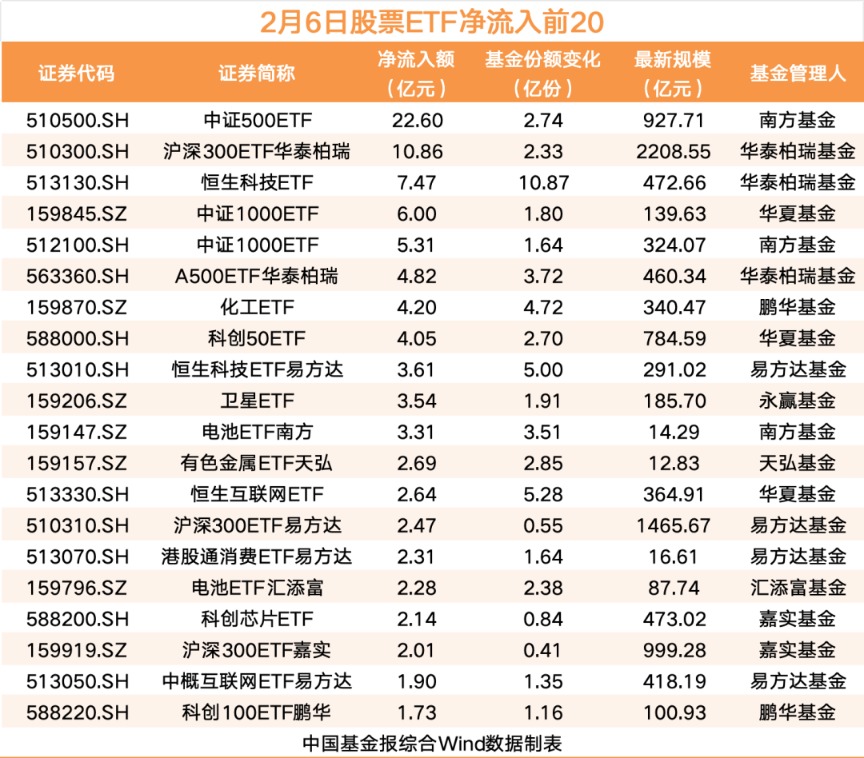
Core Viewpoint - The A-share market experienced a collective decline on February 6, with significant net inflows into stock ETFs, exceeding 11 billion yuan on that day [1]. Group 1: ETF Market Overview - As of February 6, the total scale of 1,333 stock ETFs in the market reached 4.1 trillion yuan, with a net inflow of 11.764 billion yuan and an increase of 9.347 billion fund shares [3]. - The leading categories for net inflows were broad-based ETFs and Hong Kong stock ETFs, with inflows of 7.112 billion yuan and 2.518 billion yuan, respectively [3]. - The CSI 500 Index ETF saw the highest net inflow at 2.585 billion yuan, while the Hang Seng Technology Index ETF and the Sci-Tech 50 Index ETF attracted over 11.2 billion yuan and 5 billion yuan, respectively, over the past five trading days [3]. Group 2: Top ETFs by Net Inflow - On February 6, 35 ETFs recorded net inflows exceeding 1 billion yuan, with the top three being the CSI 500 ETF (2.26 billion yuan), the CSI 300 ETF by Huatai-PB (1.086 billion yuan), and the Hang Seng Technology ETF (747 million yuan) [4]. - Notable inflows were also observed in the China Securities 1000 ETF and the Sci-Tech 50 ETF, with net inflows of 600 million yuan and 405 million yuan, respectively [5]. Group 3: ETFs with Net Outflows - The gold stock ETF experienced the largest net outflow, totaling 812 million yuan on February 6 [5]. - Other ETFs with significant outflows included the Tongwen Stock ETF (-559 million yuan), the SSE 50 ETF (-331 million yuan), and the Food and Beverage ETF (-324 million yuan) [6]. Group 4: Market Outlook - Fund managers from E Fund expressed optimism about the domestic macroeconomic outlook, expecting continued stability and progress, with emerging industries likely to see further development [7]. - Bosera Fund noted that financial conditions remain favorable for equity assets, suggesting that ETF outflows may have reached a turning point, with a potential return to growth in financing balances [7].