汇丰银行

Search documents
港股异动 | 黄金股早盘集体回暖 招金矿业(01818)涨超5% 多因素助推金价强势反弹
智通财经网· 2025-10-21 01:48
Group 1 - Gold stocks experienced a collective rebound in early trading, with notable increases in companies such as Zhaojin Mining (01818) up 4.91% to HKD 32.02, Zijin Mining (02899) up 3.33% to HKD 33.56, and Shandong Gold (01787) up 2.35% to HKD 36.56 [1][1][1] - The surge in gold prices is attributed to the ongoing U.S. federal government "shutdown," which has led to increased market optimism regarding the Federal Reserve's interest rate cuts and the prospect of global central banks increasing their gold holdings [1][1][1] - As of the close, the December gold futures price on the New York Commodity Exchange reached USD 4,359.4 per ounce, marking a 3.47% increase and setting a new intraday historical high [1][1][1] Group 2 - HSBC's recent commodity outlook report indicates that the upward momentum for gold is expected to continue until 2026, driven by strong gold purchases from central banks, ongoing fiscal concerns in the U.S., and expectations of further monetary easing [1][1][1] - HSBC has set a target price for gold at USD 5,000, reflecting the anticipated sustained demand and market conditions [1][1][1]

美联储降息后,你的钱该放哪里?黄金、存款、股票全解析
Sou Hu Cai Jing· 2025-10-20 18:57
Group 1 - The Federal Reserve announced a 25 basis point interest rate cut, lowering the target range for the federal funds rate to 4.00-4.25% [1] - Following the rate cut, gold prices experienced significant volatility, with London spot gold reaching a historical high of $3,700 per ounce before dropping to around $3,654 per ounce [4] - The market behavior reflects a "buy the expectation, sell the fact" logic, as gold prices were driven up prior to the rate cut, leading to profit-taking afterward [5] Group 2 - The long-term support for gold remains intact, with over half of the Federal Reserve officials expecting two more rate cuts within the year, which may continue to lower the opportunity cost of holding gold [7] - Central bank demand for gold is strong, with the People's Bank of China increasing its reserves to 74.02 million ounces, and Deutsche Bank predicting gold prices could rise to $4,000 per ounce by 2026 [7] - In the stock market, the A-share and Hong Kong stock markets are showing divergence, with growth sectors outperforming, particularly in the tech sector following the Fed's rate cut [7][9] Group 3 - The response of the A-share market is complex, as it may attract northbound capital inflows for tech growth sectors, but is also heavily influenced by domestic economic fundamentals [9] - The recent CPI decline in China indicates that external benefits need to align with internal policies for effective market support [9] - Following the Fed's rate cut, domestic banks are adjusting their deposit rates, with HSBC lowering its one-year rate for USD deposits to 3.5% [10] Group 4 - Investment strategies need to be adjusted in light of the Fed's rate cut, with recommendations for a "laddered deposit" strategy to balance high interest rates and liquidity [13] - The impact of the Fed's rate cut extends beyond three asset classes, potentially lowering monthly payments for those with floating-rate mortgages and benefiting the import sector due to RMB appreciation [15] - The global easing cycle may lead to increased commodity prices, affecting domestic living costs for items like gasoline and plastic products [15]


深夜,黄金白银突然下跌!
Sou Hu Cai Jing· 2025-10-19 04:25
Core Viewpoint - The recent decline in spot gold prices has continued, dropping below $4200 per ounce with a decrease of over 3% [1] Group 1: Market Performance - On October 17, international gold and silver prices experienced significant declines, with London spot gold falling below $4220 per ounce, showing a daily drop of over 2% [1] - London spot silver also fell below $52 per ounce, with a daily decline exceeding 4% [1] - COMEX gold futures prices dropped to a low of $4226 per ounce, while COMEX silver futures fell over 5%, reaching around $50 per ounce [4] Group 2: Institutional Insights - HSBC recently indicated that gold remains supported by strong investor sentiment and ongoing diversification by official institutions, predicting that structural and macro factors will drive gold prices upward until 2026 [7] - However, HSBC warned that if the Federal Reserve's rate cuts are fewer than market expectations, the upward trajectory of gold may face resistance [7] - Longcheng Futures noted that the combination of macroeconomic easing expectations, risk aversion, and capital inflows has driven gold prices to show a volatile upward trend, but cautioned against technical pullbacks due to profit-taking [7] - Guojin Futures highlighted that the easing of geopolitical tensions and profit-taking by some long positions could lead to significant price corrections in precious metals after recent sharp increases [7] Group 3: Broader Market Context - The U.S. stock market showed a slight rebound on October 17, with the Dow Jones up 0.22% to 46053.43 points, the Nasdaq up 0.07% to 22579.42 points, and the S&P 500 up 0.11% to 6636.43 points [7]
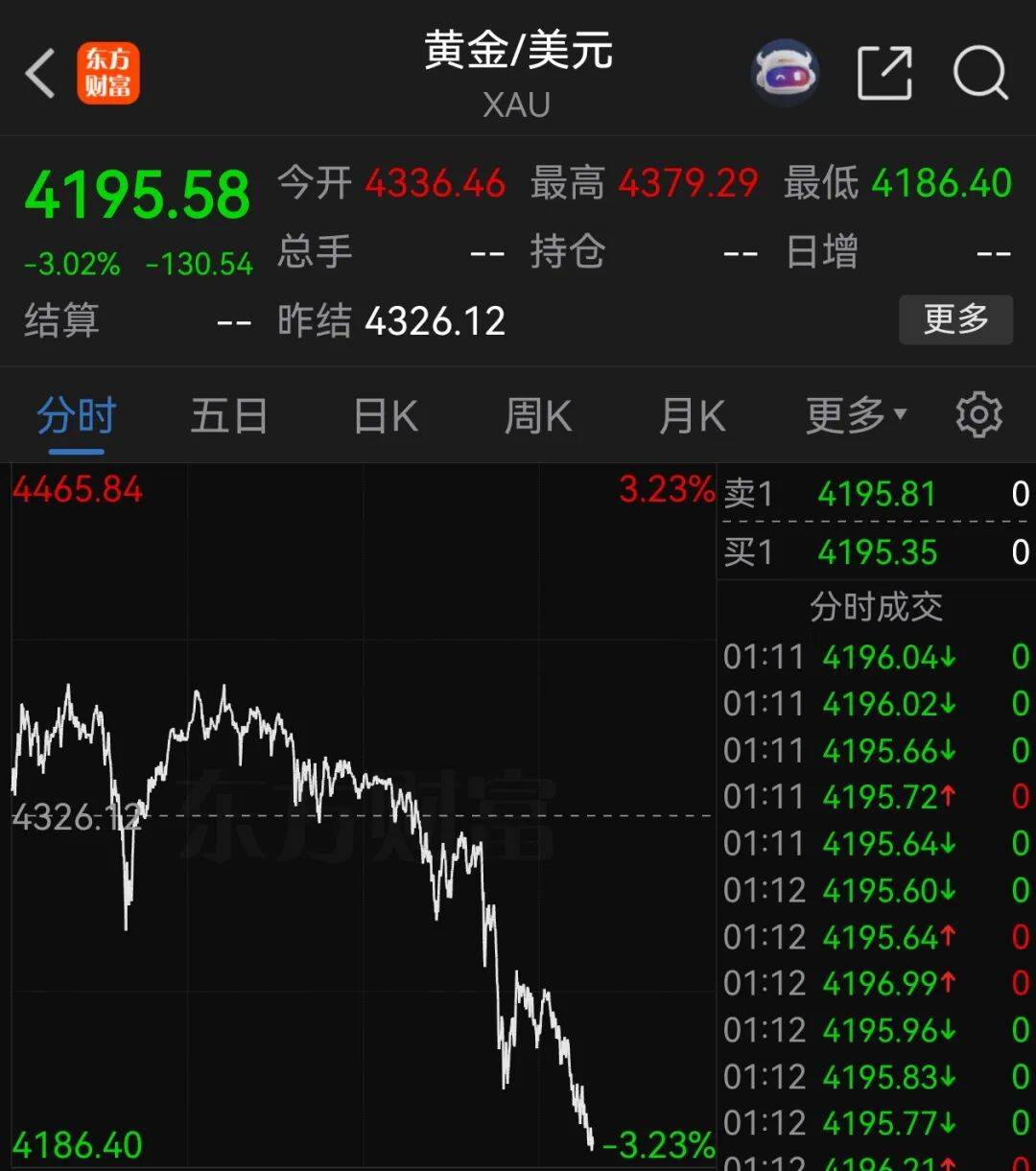
最猛资产,突然变脸
Hua Er Jie Jian Wen· 2025-10-18 09:27
Core Viewpoint - The recent dramatic drop in gold prices, following a record high, raises concerns about whether the current gold bull market, driven by both safe-haven demand and speculative fervor, has reached a critical turning point [1][3]. Price Movement - On October 17, spot gold prices approached $4,380, setting a new historical record, but subsequently fell over 2% during the day, marking the largest single-day drop since Thanksgiving 2024, despite a nearly 5% increase for the week [1][3]. Market Sentiment and Technical Indicators - Bill Gross, a legendary investor, warned that gold has become a "momentum/meme asset," suggesting potential buyers should wait [3]. - Technical indicators, market sentiment, and positioning show signs of overcrowding in gold trading, indicating that while gold may still be a "correct" asset, its price may no longer be "appropriate" [3][4]. - The distance between current prices and short-term moving averages is unusually large, with the 21-day moving average around $3,950 and the 50-day at $3,675, suggesting that a pullback to the 21-day average would not necessarily damage the long-term upward trend [5]. Volatility and Institutional Positioning - The Gold Volatility Index (GVZ) has surged to extreme levels, reflecting a market driven by panic buying of call options, which could exacerbate price declines if sentiment reverses [9][11]. - Institutional positioning is at an extreme, with commodity trading advisors (CTAs) maintaining their highest long exposure to gold, indicating that any price reversal could trigger significant programmed selling [15][17]. Divergence from Traditional Fundamentals - The current gold bull market shows significant divergence from traditional fundamental drivers, with gold prices rising despite increasing stock market performance and a strengthening dollar [18][19]. - The recent surge in gold prices has outpaced the decline in real interest rates, leading to confusion among investors relying on traditional models [18][19]. - The VIX index's recent volatility has diminished gold's short-term appeal as a "panic hedge," while the dollar's strength poses potential pressure on gold prices [21][23]. Diverging Opinions on Market Outlook - A divide exists among Wall Street analysts regarding whether the current gold market represents a bubble or a new paradigm, with bearish views warning of a potential end to the current fervor, while bullish perspectives cite strong physical demand and geopolitical uncertainties as ongoing support for gold prices [24][25].
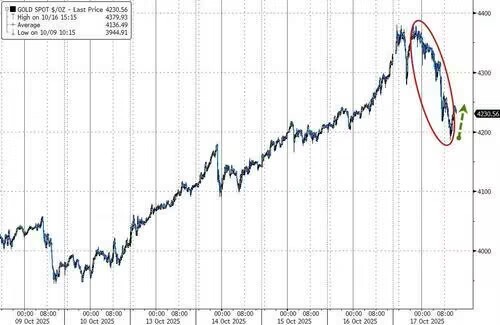
黄金冲高回落后上涨动能犹存,后市走向引关注
Sou Hu Cai Jing· 2025-10-18 04:40
Group 1 - The U.S. stock market indices collectively rose on October 17, indicating a rebound in market risk appetite compared to the previous week [1] - Major U.S. tech stocks mostly increased, while popular Chinese concept stocks showed mixed performance [1] - International precious metal prices experienced a collective decline, with gold prices falling below $4,300 per ounce and briefly dipping below $4,200 per ounce [1] Group 2 - U.S. regional banks showed signs of credit pressure, leading investors to seek safe-haven assets, which pushed international gold prices to briefly exceed $4,380 per ounce, marking a weekly increase of over 8% [3] - The performance of Western Alliance Bancorp and Fifth Third Bancorp indicated a slowdown in risk, contributing to a slight rise in U.S. stock indices [3] Group 3 - Despite a short-term pullback, gold's upward momentum remains strong, driven by geopolitical tensions, interest rate cut expectations, central bank gold purchases, and significant inflows into ETFs [4] - Gold prices have increased by over 66% this year, and it has become the first asset to surpass a total market value of $30 trillion after breaking the $4,300 mark [4] - The SPDR Gold Trust reported a record holding of 1,034.62 tons, the highest level since July 2022, indicating strong ETF inflows supporting gold prices [4] Group 4 - HSBC forecasts that gold's upward momentum may continue until 2026, driven by strong central bank purchases and ongoing fiscal concerns in the U.S., with a target price of $5,000 [5] - The report emphasizes that the U.S. fiscal deficit is a significant factor driving gold demand as investors increasingly view gold as a hedge against debt sustainability risks [5] - Bank of America strategist Hartnett notes that current gold allocations are low, and expectations regarding the new Fed chair and potential monetary devaluation are favorable for gold investments [5][6]
深夜突发!金价,大跳水
Di Yi Cai Jing Zi Xun· 2025-10-18 01:16
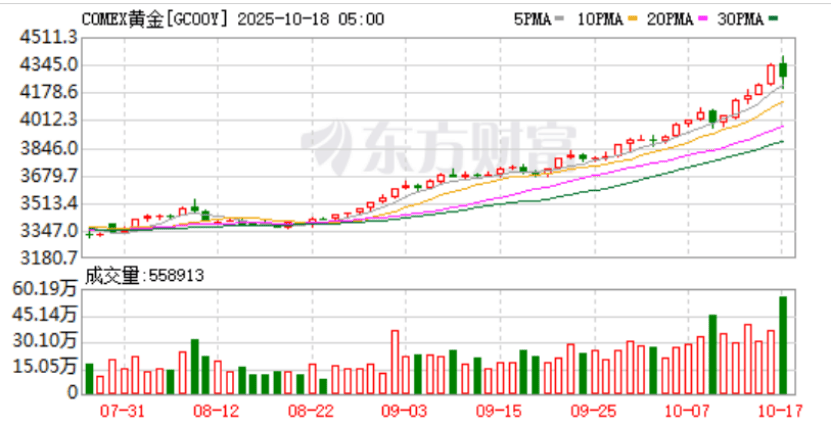
Core Viewpoint - The recent fluctuations in gold prices are influenced by a combination of market sentiment, geopolitical tensions, and economic indicators, with a notable increase in demand for gold as a safe-haven asset amid rising uncertainties [2][3][4]. Market Analysis - Gold prices experienced a significant rise, with COMEX gold futures reaching nearly $4,400 per ounce before closing at $4,240.20, marking a weekly increase of over 8% [2][3]. - The market is currently assessing the implications of U.S. President Trump's more moderate stance on trade, which has contributed to a cooling of gold prices [3]. - Concerns regarding credit risks in U.S. regional banks have also prompted investors to seek refuge in gold, although these fears have not escalated significantly [3]. Technical Indicators - The Relative Strength Index (RSI) for gold has surpassed 88, indicating an overbought condition, with historical patterns suggesting that such prolonged upward trends are rare [4]. - The current gold price movement shows signs of excessive deviation from the 200-week moving average, a situation that has historically required a market correction [4]. Demand Drivers - Gold has seen a cumulative increase of over 66% this year, driven by geopolitical tensions, expectations of interest rate cuts, and significant inflows into gold exchange-traded funds (ETFs) [4][5]. - The SPDR Gold Trust reported its holdings have risen to 1,034.62 tons, the highest level since July 2022, reflecting strong investor interest [5]. Future Outlook - HSBC forecasts that the upward momentum for gold could continue until 2026, supported by strong central bank purchases and ongoing concerns about U.S. fiscal health [5][6]. - Bank of America analysts suggest that the current low allocation to gold among investors, combined with expectations of further monetary easing, could lead to significant price increases, potentially reaching $6,000 by spring next year [6].
深夜突发!金价,大跳水
第一财经· 2025-10-18 01:09
Core Viewpoint - The article discusses the recent fluctuations in gold prices, highlighting the impact of market sentiment, geopolitical tensions, and economic indicators on gold as a safe-haven asset. It emphasizes that despite short-term volatility, the overall environment remains supportive for gold prices due to ongoing geopolitical risks and expectations of monetary easing [3][4][10]. Market Analysis - Gold prices experienced a significant rise, with a weekly increase of over 8%, reaching a peak near $4380 per ounce before a late-week drop [6][10]. - The recent surge in gold prices is attributed to various factors, including concerns over regional bank credit risks and geopolitical tensions, particularly related to the U.S.-China trade situation and the Russia-Ukraine conflict [7][10]. - The relative strength index (RSI) for gold has surpassed 88, indicating an overbought condition, suggesting a potential need for market correction [8]. Technical Indicators - Historical data shows that gold has not experienced a continuous rise for more than nine weeks since the 1970s, indicating a potential for a market adjustment [8]. - The current gold price movement has deviated significantly from the 200-week moving average, a situation that has historically led to corrections [8]. Investment Trends - Gold has risen over 66% this year, driven by geopolitical tensions, expectations of interest rate cuts, and significant inflows into gold exchange-traded funds (ETFs) [10][11]. - The SPDR Gold Trust reported its highest holdings since July 2022, with 1034.62 tons, reflecting strong investor interest in gold as a hedge against economic uncertainty [11]. - HSBC forecasts that gold's upward momentum may continue until 2026, driven by strong central bank purchases and ongoing fiscal concerns in the U.S., with a target price of $5000 per ounce [11]. Future Projections - Analysts predict that if the Federal Reserve does not meet market expectations for interest rate cuts, gold's upward trajectory may face challenges [11]. - Bank of America strategists suggest that the current low allocation to gold among investors, combined with expectations of monetary easing, could lead to significant price increases, potentially reaching $6000 by next spring [12].
巨震超4%!国际金价冲击4400美元未果
Di Yi Cai Jing· 2025-10-18 00:29
Core Viewpoint - The recent fluctuations in gold prices are influenced by a combination of market sentiment, geopolitical tensions, and economic indicators, with a notable increase in demand for gold as a safe-haven asset amid uncertainties [1][2][3]. Market Trends - Gold prices experienced a significant rise, with a weekly increase of over 8%, reaching a peak close to 4380 USD/oz, marking the largest weekly gain since September 2008 [2]. - The price of gold has risen more than 66% this year, driven by geopolitical tensions, expectations of interest rate cuts, and substantial inflows into gold ETFs [3][5]. Technical Analysis - The Relative Strength Index (RSI) for gold surpassed 88, indicating an overbought condition, suggesting a potential need for market correction [3]. - Historical data shows that gold has not experienced a consecutive 10-week increase, with only four instances of nine-week increases since the 1970s [3]. Institutional Insights - The SPDR Gold Trust reported a record high holding of 1034.62 tons, the highest since July 2022, reflecting strong investor interest [4]. - HSBC forecasts that gold's upward momentum may continue until 2026, driven by central bank purchases and ongoing fiscal concerns in the U.S., with a target price of 5000 USD [5]. Economic Factors - The expectation of further interest rate cuts by the Federal Reserve is influencing gold demand, as investors seek to hedge against potential economic instability [4][5]. - Concerns over the U.S. fiscal deficit are leading investors to view gold as a hedge against debt sustainability risks and potential dollar weakness [5].
今年年内46次创新高,黄金ETF华夏(518850)成交明显放量
Sou Hu Cai Jing· 2025-10-17 06:15
Core Insights - The A-share market experienced a collective decline, with the three major indices opening lower and further expanding their losses. Meanwhile, COMEX gold prices continued to show strength, trading around $4,371 per ounce. [1] - Year-to-date, international gold prices have risen over 60%, with 46 new historical highs reached this year. This surge is attributed to geopolitical tensions, aggressive interest rate cut expectations, central bank purchases, de-dollarization trends, and concerns over potential U.S. government shutdowns. [1] - HSBC's commodity outlook report indicates that the upward momentum for gold is expected to continue until 2026, driven by strong central bank demand for gold, long-term concerns about U.S. fiscal health, and expectations for further monetary easing. [1] - The management and custody fees for the Hua Xia Gold ETF (518850) and Gold Stock ETF (159562) are at a competitive rate of 0.2%, which is among the lowest in their category, facilitating lower-cost participation for investors in the gold market. [1] Market Performance - As of 13:55, the Hua Xia Gold ETF (518850) increased by 3.56%, with a trading volume of 1.7 billion, indicating significant capital inflow. [1] - The Gold Stock ETF (159562) rose by 0.79%, while the Non-ferrous Metals ETF (516650) fell by 0.95%. [1]
突然跳水!3000亿巨头重挫,超4100只个股下跌!2.6万亿银行股11连阳,再创历史新高...
雪球· 2025-10-17 04:23
Market Overview - The market experienced a downward trend, with the Shanghai Composite Index falling by 1%, the Shenzhen Component Index by 1.99%, and the ChiNext Index by 2.37% [1] - Over 4,100 stocks declined, with a total trading volume of 1.18 trillion yuan, a decrease of 32.6 billion yuan compared to the previous trading day [1] - Defensive sectors, such as coal and gas, showed strong performance, with Dayou Energy achieving five consecutive trading limits and Guo New Energy hitting three trading limits in four days [1] Sector Performance - The wind power, photovoltaic, semiconductor, and consumer electronics sectors faced significant declines, with Sunshine Power dropping by 8% and ZTE Communications falling over 4% [1][3] - The semiconductor sector also saw a downturn, with companies like Shenkong Co., Tongfu Microelectronics, and others experiencing notable declines [5][6] Banking Sector - Agricultural Bank of China saw its stock price rise over 2%, reaching a historical high and a market capitalization exceeding 2.6 trillion yuan, marking a 10-day consecutive increase [9][12] - The bank's price-to-book ratio recently surpassed 1, indicating a significant milestone for the banking sector, which has historically struggled to achieve this level [13] Gold Market - On October 17, spot gold prices surpassed $4,380 per ounce, marking a new historical high, with an increase of over 8% for the week [15] - Factors supporting the rise in gold prices include concerns over trade tensions, ongoing U.S. government shutdown, and expectations of increased monetary easing by the Federal Reserve [16][21] - HSBC's commodity outlook report suggests that the upward momentum for gold could continue until 2026, driven by strong central bank purchases and ongoing fiscal concerns in the U.S. [22]