泉峰控股

Search documents
智通港股解盘 | 中美会谈超预期 短期估值修复是主旋律
Zhi Tong Cai Jing· 2025-05-12 12:32
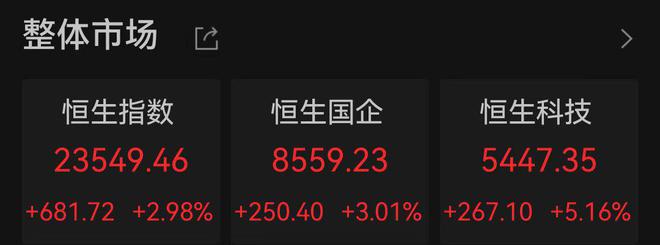
Market Overview - The recent US-China talks exceeded market expectations, leading to a significant surge in the Hang Seng Index by 2.98% with trading volume reaching 322.4 billion [1] - The ceasefire agreement between India and Pakistan has positively impacted both countries' stock markets, with Pakistan's KSE-30 index soaring by 9.2%, marking its largest increase since 2008 [1] US-China Trade Relations - The US announced a suspension of a 24% tariff set to take effect on April 2, 2025, while maintaining a 10% tariff, effectively reducing the overall tariff on Chinese goods from 145% to 30% [2] - This significant concession from the US is attributed to several factors, including the need to replenish dwindling inventories and the urgency to achieve results ahead of the upcoming elections [3] Sector Performance - The consumer electronics sector, particularly companies within Apple's supply chain, benefited the most from the tariff reductions, with stocks like Highway Electronics and AAC Technologies rising over 13% [4] - Automotive parts suppliers with significant North American business exposure, such as Minth Group and Quanfeng Holdings, saw stock increases of nearly 10% [4] Financial Sector Response - Major financial institutions, including Hongye Futures and CITIC Securities, experienced stock price increases of over 6%, reflecting positive market sentiment following the trade talks [5] Individual Company Highlights - Midea Group reported a record revenue of 128.4 billion yuan in Q1 2025, a 20.61% year-on-year increase, and plans to enhance its overseas presence through strategic partnerships [10] - The company is also making strides in the commercial air conditioning sector and aims to expand its robotics division with new product testing scheduled for May [11] International Relations and Infrastructure - Brazilian President Lula's visit to China aims to strengthen bilateral relations and discuss infrastructure projects, including a railway connecting Brazil to China, which could reshape international trade logistics [8]

港股、中概股大爆发!黄金跌超3%,避险情绪降温,最新解读来了
2 1 Shi Ji Jing Ji Bao Dao· 2025-05-12 09:16
5月12日,中美资产双双大涨,避险资产出现回落。 消息面上,《中美日内瓦经贸会谈联合声明》今日发布。 中泰国际策略分析师颜招骏在接受南财快讯记者采访时表示,中美双方关税税率短时间内的大幅下调超 出了市场预期,对港股、美股及全球资产均会产生积极影响。此举可能会降低美国通胀反弹风险,为美 联储六月降息创造空间,进一步利好中国资产。 具体来看,恒生科技指数一度涨超6%,恒生指数、恒生国企指数也一度涨超3.5%。截至收盘,香港恒 生指数涨2.98%,恒生国企指数涨3.01%,恒生科技指数涨5.16%。 港股科技股巨头涨幅持续扩大,阿里巴巴-W(09988.HK)、京东集团(09618.HK)涨超6%,腾讯控股 (00700.HK)涨超4.5%。 港股苹果指数也直线拉升,收涨13.40%。成分股份中高伟电子(01415.HK)涨超18%,瑞声科技 (02018.HK)涨超15%,比亚迪电子(00285.HK)、舜宇光学科技(02382.HK)、丘钛科技 美股期货走高,纳指期货涨超3.4%,道指期货涨近2%,标普500指数期货也涨超2.5%。 美股盘前热门中概股普涨,万国数据(GDS)涨超10%,小鹏汽车(XPEV)涨超 ...


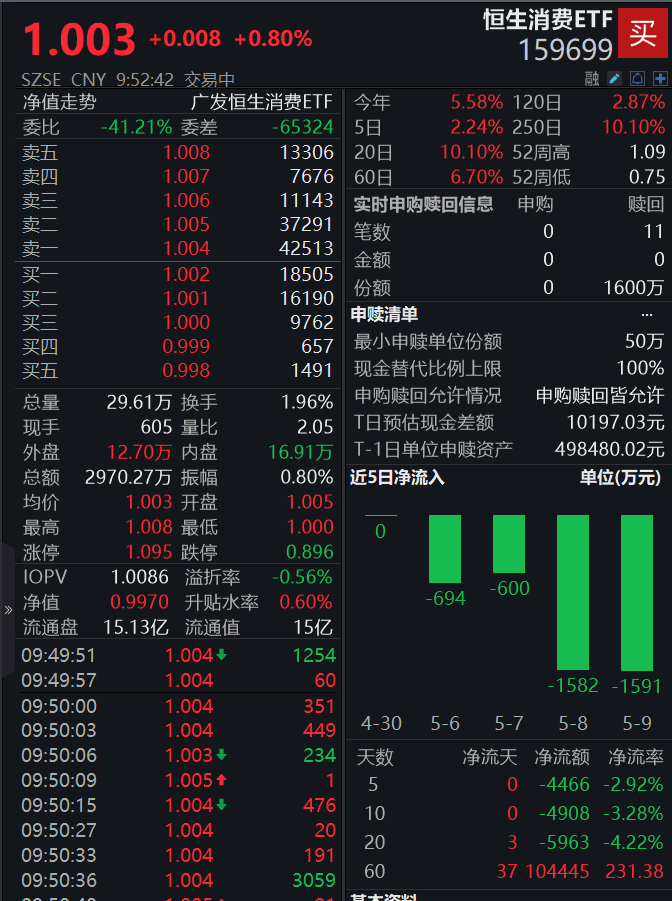
消费类企业密集赴港上市,恒生消费ETF(159699)交投活跃,近一个月日均成交1.82亿元,同类第一!
Xin Lang Cai Jing· 2025-05-12 06:27
Group 1 - The Hang Seng Consumption Index (HSCGSI) has shown a positive trend, with a 0.89% increase as of May 12, 2025, and notable gains in constituent stocks such as Techtronic Industries (00669) up 5.50% and Haier Smart Home (06690) up 5.04% [1] - The Hang Seng Consumption ETF (159699) has also increased by 0.50%, with a nearly 10% rise over the last 20 trading days, indicating strong market performance [1] - The latest valuation of the Hang Seng Consumption ETF shows a price-to-earnings ratio (PE-TTM) of 17.53, which is below 87.07% of the historical levels over the past five years, suggesting it is at a historical low [1] Group 2 - As of May 8, 2025, the top ten weighted stocks in the Hang Seng Consumption Index account for 58.88%, with companies like Pop Mart (09992) and Anta Sports (02020) leading the list [2] - There has been a surge in consumer companies seeking to list in Hong Kong, with over ten applications submitted this year, covering various sectors such as food and beverage and retail [2] - Factors driving this trend include the introduction of a fast-track policy for A+H shares by the Hong Kong Stock Exchange, improved liquidity in the Hong Kong market, and the diversion effect from stricter IPO standards in the A-share market [2] Group 3 - Huatai Securities expresses a positive outlook on Hong Kong stocks, particularly in the context of domestic consumption, amidst external disturbances and rising uncertainties [3]
4月CPI环比由降转涨!恒生消费ETF(159699)高开逾1%,冲击2连阳
Sou Hu Cai Jing· 2025-05-12 02:26
Economic Indicators - In April, the Consumer Price Index (CPI) shifted from a month-on-month decrease of 0.4% to an increase of 0.1%, while the year-on-year CPI fell by 0.1%, maintaining the same decline as the previous month [1] - The core CPI increased by 0.2% month-on-month and rose by 0.5% year-on-year, showing stable growth [1] - The Producer Price Index (PPI) decreased by 0.4% month-on-month and fell by 2.7% year-on-year, with the decline expanding by 0.2 percentage points compared to the previous month [1] Market Performance - On May 12, the Hang Seng Consumption Index (HSCGSI) surged by 1.06%, with notable increases in constituent stocks such as Quan Feng Holdings (+6.59%), Cha Baidao (+4.84%), and Guoquan (+4.51%) [1] - The Hang Seng Consumption ETF (159699) opened over 1% higher on May 12, with an average daily trading volume of 182 million yuan over the past month, ranking first among comparable funds [1] - The Hang Seng Consumption ETF has seen net inflows from leveraged funds for three consecutive days, with a peak single-day net inflow of 7.15 million yuan, bringing the latest financing balance to 14.76 million yuan [1] Financial Support for Consumption - The People's Bank of China (PBOC) announced a 500 billion yuan loan facility aimed at supporting consumption and elderly care, indicating a commitment to enhance financial support for these sectors [3] - The PBOC emphasized the importance of boosting consumption as a key goal of monetary policy, reflecting a structural shift towards enhancing consumer demand rather than merely increasing investment [4] Investment Opportunities - The Hang Seng Consumption ETF (159699) is positioned to benefit from new consumption stimulus policies and supports T+0 trading, focusing on four major sectors: food and beverages, textiles and apparel, household appliances, and tourism and leisure facilities [5] - The ETF includes leading consumer companies that complement the A-share market, featuring well-known domestic brands and emerging consumer firms, enhancing its attractiveness to investors [6] - The ETF is noted for its significant scale and flexibility, making it a prominent choice in the Hong Kong market for investors looking to capitalize on consumer trends [7]
这个千亿制造业不会回流美国!
第一财经· 2025-05-10 09:44
Core Viewpoint - The article discusses the challenges faced by Chinese companies, particularly泉峰控股 and 巨星科技, in the U.S. market due to high tariffs and manufacturing costs, emphasizing the shift of production to Vietnam as a strategic response to these challenges [1][4][10]. Group 1: Market Dynamics - The U.S. electric tools and outdoor power equipment market exceeded 170 billion RMB in 2020, with a significant portion of products being manufactured in China [1]. - After the U.S. imposed a 145% tariff,泉峰控股 halted exports from China and increased production in Vietnam, which has also faced a 10% tariff [4][5]. - The U.S. market is the largest for tools, with an estimated 50% of tools sold being manufactured in China, particularly for electric tools [4][10]. Group 2: Production Strategy -泉峰控股 has been preparing to increase its production capacity in Vietnam since Trump's first term, with plans for a second manufacturing base in 2024 [5]. -巨星科技 has also expanded its production in Vietnam, moving from manual to electric tools to meet U.S. demand [5][6]. - Both companies are adjusting their supply chains to mitigate the impact of tariffs, collaborating with U.S. retailers to find solutions [6][10]. Group 3: Cost Considerations - The cost of manufacturing in the U.S. is estimated to be at least 50% higher than in China, making it unfeasible for companies to produce there [9][10]. - The lack of a complete supply chain in the U.S. for tool manufacturing further complicates the feasibility of local production [10]. - The imposition of tariffs on raw materials has increased manufacturing costs in the U.S., reducing competitiveness [10]. Group 4: Globalization and Competition - Chinese companies are pursuing globalization and brand development, with泉峰控股's global sales revenue quadrupling over the past decade [14]. - The competition with established brands like Stanley Black & Decker is intensifying, with Chinese companies gradually capturing market share [14][15]. - Despite progress, Chinese companies still face challenges in brand recognition and high-end product offerings compared to their Western counterparts [14][15].


中国工具制造业难回流美国
news flash· 2025-05-10 07:11
Core Viewpoint - The high manufacturing costs in the United States hinder the return of manufacturing industries, while demand for Chinese-made tool products, especially power tools, remains strong in the U.S. market [1] Group 1: Manufacturing and Supply Chain - U.S. manufacturing costs are significantly higher, making it difficult for manufacturing to return [1] - Many Chinese companies have shifted part of their production capacity to Vietnam in response to high tariffs imposed by the U.S. [1] - Companies like QuanFeng Holdings and JuXing Technology are adjusting their supply chains and increasing production in Vietnam to expand their market share in the U.S. [1] Group 2: Market Expansion and Competitiveness - Despite challenges to globalization, Chinese companies are actively exploring international markets [1] - Companies are enhancing their competitiveness through acquisitions and building their own brands [1]
中国出口企业放言,这个千亿制造业不会回流美国 | 海斌访谈
Di Yi Cai Jing· 2025-05-10 06:50
Core Viewpoint - The manufacturing landscape in the U.S. for tools is unlikely to return to previous levels due to high costs and supply chain issues, making it impractical for companies to produce domestically [1][10][11]. Group 1: Company Strategies - QuanFeng Holdings has shifted its production focus to Vietnam due to increased tariffs on Chinese exports to the U.S., with plans to expand its manufacturing capacity there [3][4]. - The company estimates that its sales in 2024 will reach approximately 13 billion RMB, with over 70% coming from the U.S. market [3]. - Giant Star Technology has also established production facilities in Vietnam to mitigate tariff impacts and plans to expand its product range from hand tools to electric tools [4][5]. Group 2: Market Dynamics - The U.S. tool market is the largest globally, with an estimated market size exceeding 170 billion RMB in 2020, and at least half of the tools sold in the U.S. are manufactured in China [1][3]. - The imposition of tariffs has led to a significant increase in costs, with U.S. manufacturers unable to absorb these costs, resulting in a pause in exports from China [3][4][11]. - Major U.S. retailers are seeking solutions to manage tariff costs, indicating a collective concern over the sustainability of high tariffs on consumer goods [6]. Group 3: Competitive Landscape - Companies like QuanFeng Holdings and Giant Star Technology are increasingly competing with established brands such as Stanley Black & Decker, Bosch, and Makita, as they expand their market presence in the U.S. and Europe [13][14]. - The global sales revenue of QuanFeng Holdings is projected to reach 1.77 billion USD in 2024, while Stanley Black & Decker's revenue is expected to be around 15.3 billion USD, highlighting the competitive gap [14]. - The shift in market share from established brands to Chinese companies is evident, with Chinese brands gradually replacing traditional market leaders in various segments [14][15].

家电行业一季报总结:布局新消费,把握关税黄金坑
CMS· 2025-05-08 13:35
Investment Rating - The report maintains a strong buy rating for major companies in the home appliance sector, including Midea Group, Gree Electric, Hisense Home Appliances, and others, all receiving a "Strong Buy" recommendation [2]. Core Insights - The home appliance industry showed strong performance in Q1 2025, supported by national subsidies, booming exports to emerging markets, and increased shipments to North America. The report suggests focusing on new consumer trends domestically and leveraging tariff opportunities for exports [1][6]. - Major appliances reported impressive results, with Midea's exports growing over 30%, particularly in air conditioning and kitchen appliances. Hisense and other second-tier brands also experienced significant export growth [6]. - The report highlights the emergence of new consumer trends in small appliances, with companies like Ninebot and Roborock showing exceptional growth. The tariff situation presents a strategic opportunity for companies with high exposure to the U.S. market [6]. Industry Overview - The home appliance sector consists of 88 listed companies, with a total market capitalization of 1,846.4 billion and a circulating market value of 1,761.9 billion [3]. - The industry index has shown varied performance, with absolute performance at -1.4% over one month, but a relative performance of 14.9% over six months [5]. Company Performance - Midea Group's EPS for 2024 is projected at 5.03, increasing to 5.62 in 2025, with a PE ratio of 13.4 and a PB of 2.5 [2]. - Gree Electric is expected to see EPS rise from 5.75 in 2024 to 6.25 in 2025, with a PE of 7.4 and a PB of 1.8 [2]. - Hisense Home Appliances anticipates an EPS increase from 2.42 to 2.71, with a PE of 10.3 and a PB of 2.3 [2].




开源证券晨会纪要-20250507
KAIYUAN SECURITIES· 2025-05-07 14:46
2025 年 05 月 08 日 开源晨会 0508 ——晨会纪要 | 沪深300 | 及创业板指数近1年走势 | | 吴梦迪(分析师) | | --- | --- | --- | --- | | 沪深300 | 创业板指 | | wumengdi@kysec.cn | | 48% | | | 证书编号:S0790521070001 | | 32% | | | 观点精粹 | | 16% | | | | | 0% | | | 总量视角 | | -16% | | | 年以来南下累计净流入超 月增配成 【金融工程】港股量化:2025 6000 亿港元,5 | | -32% | | | 长——金融工程定期-20250507 | | 2024-05 | 2024-09 2025-01 | | 【金融工程】基金投顾产品 4 月调仓一览——基金投顾产品月报系列(17) | | 数据来源:聚源 | | | -20250507 | | 昨日涨跌幅前五行业 | | | | | 行业名称 | | 涨跌幅(%) | | | | | | 【海外】短期波动仍存,聚焦经济转型方向——海外市场 年度中期投资策略 2025 | | 国防军工 ...
24、25Q1工具板块综述:加速全球布局,危中亦有机
Xinda Securities· 2025-05-07 09:17
Investment Rating - The investment rating for the light industry manufacturing sector is "Positive" [2] Core Viewpoints - The tool sector is experiencing a recovery from the cyclical bottom as of late 2024, primarily driven by demand from the United States, with key home improvement retailers like Home Depot and Lowe's showing relatively low inventory levels [3][7] - The overall growth of the sector in 2024 and Q1 2025 is attributed to stable demand and inventory replenishment, with significant revenue growth reported by key companies such as Keter Group (+7.9%), Giant Star Technology (+35.4%), and others [9] - The high overseas exposure of the industry necessitates an accelerated global supply chain layout, with major companies like Giant Star Technology and Greebo having over 94% of their revenue from international markets [10][12] - Profitability in the tool sector has improved significantly, with average gross margins reaching 29.6% in 2024 and 30.2% in Q1 2025, indicating a recovery in profit margins [14][17] Summary by Sections Tool Sector Overview - The tool sector's demand is heavily reliant on the U.S. market, with signs of recovery noted as of late 2024, including a stabilization in U.S. home sales and low inventory levels at major retailers [7] - The sector faces potential challenges from rising supply-side costs due to tariffs, which may impact demand if passed on to consumers [3] Growth and Performance - The overall growth in 2024 and Q1 2025 is supported by a stable demand environment and inventory replenishment, with key companies reporting substantial revenue increases [9] - Notable revenue growth figures include Keter Group (+7.9%), Giant Star Technology (+35.4%), and others, with profit margins also showing improvement [9][14] Global Supply Chain and Strategy - Companies are accelerating their global supply chain strategies, with significant overseas revenue contributions from major players [10][12] - Giant Star Technology aims to increase its production capacity in Southeast Asia to 60% by the end of 2025 to meet North American market demands [12] Profitability and Financial Metrics - The tool sector has seen a notable recovery in profitability, with average gross margins improving to 29.6% in 2024 and 30.2% in Q1 2025 [14] - Companies are actively managing costs, leading to a decrease in expense ratios, which further supports profitability [17]