
雅克科技

Search documents
雅克科技(002409) - 2025年第二次临时股东会法律意见书
2025-11-17 10:31
中国 上海 山西北路 99 号苏河湾中心 25-28 层 邮编:200085 电话: (8621) 5234-1668 传真: (8621) 5243-3320 网址:http://www.grandall.com.cn 股东会法律意见书 国浩律师(上海)事务所 关于江苏雅克科技股份有限公司 2025 年第二次临时股东会的法律意见书 致:江苏雅克科技股份有限公司 江苏雅克科技股份有限公司(以下简称"公司")2025 年第二次临时股东 会现场会议于 2025 年 11 月 17 日(星期一)下午 13:30 在江苏省宜兴市经济技 术开发区荆溪北路 88 号公司会议室召开。国浩律师(上海)事务所(以下简称 "本所")接受公司的委托,指派林琳律师、米豪律师(以下简称"本所律师") 出席会议并见证。现依据《中华人民共和国公司法》(以下简称"《公司法》")、 《中华人民共和国证券法》(以下简称"《证券法》")和《江苏雅克科技股份有限 公司章程》(以下简称"《公司章程》")出具本法律意见书。 本所律师按照有关法律、法规及规范性文件的规定对本次临时股东会的召集、 召开程序是否合法及是否符合《公司章程》的规定、出席会议人员资 ...

中银晨会聚焦-20251117
Bank of China Securities· 2025-11-17 00:23
Key Insights - The report highlights a significant decline in the real estate market, with October sales area dropping by 18.8% year-on-year, marking the lowest level since 2009 [19][20] - The total investment in real estate development for October was 585.7 billion, reflecting a year-on-year decrease of 23.0%, which is the largest monthly decline since December 2022 [19][23] - New construction area also saw a substantial decline of 29.5% year-on-year, indicating ongoing challenges in the sector [19][23] Macro Economic Overview - The macroeconomic analysis indicates that the financing demand in the real economy remains weak, with October's social financing scale at 816.1 billion, down 595.9 billion from the previous year [6][9] - Industrial value-added growth for October was reported at 4.9%, while fixed asset investment showed a cumulative year-on-year decline of 1.7% [13][14] - Consumer retail sales in October reached 46.291 trillion, growing by 2.8% year-on-year, driven by the holiday season [7][15] Real Estate Market Dynamics - The report notes that the average selling price of residential properties in October decreased by 6.8% year-on-year, despite a month-on-month increase of 3.4% [20][27] - The inventory pressure in the housing market remains significant, with the broad inventory area at 1.55 billion square meters, indicating a 25.5-month depleting cycle [22] - The report anticipates that the real estate market will continue to face downward pressure, with projected declines in sales area and investment for 2025 [20][23] Price Trends - In October, new home prices in 70 major cities fell by 0.5% month-on-month, while second-hand home prices decreased by 0.7%, marking a trend of declining prices across the board [27][28] - The report highlights that all 70 cities experienced a drop in second-hand home prices for two consecutive months, a first since data collection began in 2011 [27][28] Investment and Financing - The report indicates that the funding for real estate developers decreased by 21.9% year-on-year in October, with both sales returns and external financing weakening [25] - The total amount of funds available to developers for the first ten months of the year was 7.89 trillion, down 9.7% compared to the previous year [25]
化工行业周报20251116:海外天然气价格、六氟磷酸锂价格上涨,蛋氨酸价格下跌-20251116
Bank of China Securities· 2025-11-16 08:20
Investment Rating - The report rates the chemical industry as "Outperform the Market" [3] Core Views - The report highlights the increase in overseas natural gas prices and lithium hexafluorophosphate prices, while methionine prices have decreased. It suggests focusing on sectors mentioned in the "14th Five-Year Plan," undervalued leading companies, the impact of "anti-involution" on supply, and electronic materials companies under the context of self-sufficiency [3][10]. Summary by Sections Industry Dynamics - In the week of November 10-16, 2025, among 100 tracked chemical products, 42 saw price increases, 30 saw price decreases, and 28 remained stable. The average price of 31% of products increased month-on-month, while 56% decreased, and 13% remained unchanged. The top gainers included butyl acetate and sulfur, while the largest declines were seen in pure pyridine and methionine [8][29]. Price Trends - The average price of lithium hexafluorophosphate rose to 135,000 CNY/ton, marking a 13.45% increase week-on-week and a 141.07% increase year-on-year. Conversely, methionine's average price fell to 19.55 CNY/kg, down 1.76% week-on-week and 0.91% year-on-year [31][32]. Investment Recommendations - The report recommends focusing on sectors highlighted in the "14th Five-Year Plan," undervalued leading companies, and the impact of supply-side reforms. It suggests a mid-to-long-term investment strategy that includes companies in emerging fields such as semiconductor materials and new energy materials, with specific recommendations for companies like Wanhua Chemical and Hualu Hengsheng [10][29]. Market Performance - The basic chemical industry index rose by 2.61%, ranking 9th among 31 primary industries, while the oil and petrochemical sector increased by 2.29%, ranking 11th [8][10]. Key Stocks - The report identifies "Golden Stocks" for November as Hualu Hengsheng and Yake Technology, highlighting their strong performance and growth potential [5][11][17].

40只中证A500基金集体下挫,总规模维持2000亿元以上
2 1 Shi Ji Jing Ji Bao Dao· 2025-11-14 11:06
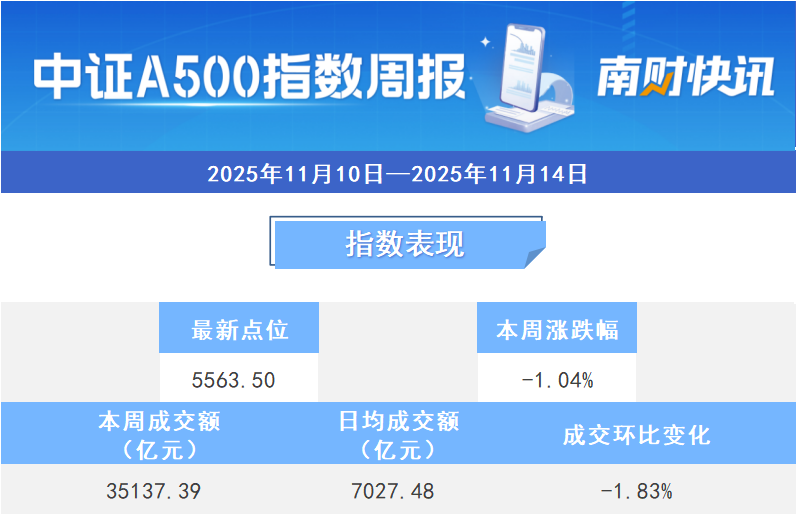
Index Performance - The China Securities A500 Index decreased by 1.04%, closing at 5563.50 points on November 14, 2025 [4] - The average daily trading volume for the week was 7027.48 billion yuan, reflecting a week-on-week decline of 1.83% [4] Component Stocks Performance - The top ten gainers for the week included: 1. Aerospace Development (000547.SZ) with a gain of 10.06% 2. China International Marine Containers (000039.SZ) with a gain of 9.96% 3. Jerry Holdings (002353.SZ) with a gain of 8.21% [3] - The top ten losers for the week included: 1. Zhaoyi Innovation (603986.SH) with a loss of 9.55% 2. Yake Technology (002409.SZ) with a loss of 8.28% 3. BlueFocus Communication Group (300058.SZ) with a loss of 6.76% [3] Fund Performance - All 40 China Securities A500 funds experienced declines, with notable drops including: - Guolian An Fund and Fortune Fund both down by 1.12% [5] - The total fund size remained above 200 billion yuan, with the largest funds being: - Huatai-PB A500 ETF at 266.66 billion yuan - E Fund A500 ETF at 234.26 billion yuan - Guotai Fund's A500 ETF at 218.60 billion yuan [5] Market Insights - Guotai Junan Securities indicated that the overall profitability of A-shares showed clear signs of a "bottom rebound" in Q3 2025, with a net asset return rate of 6.48%, up from 6.27% in Q2 [7] - The rebound in return on equity (ROE) was primarily driven by improvements in net profit margins rather than increases in asset turnover or leverage, indicating a quality-driven recovery in profitability [7]

A股异动丨铠侠暴雷,存储芯片股集体重挫,佰维存储跌11%
Ge Long Hui A P P· 2025-11-14 03:54
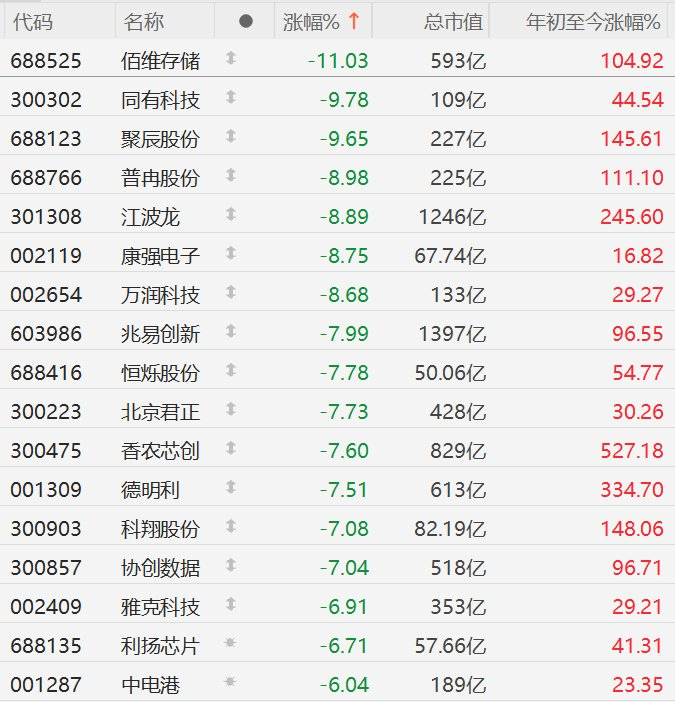
Core Viewpoint - Kioxia's poor performance has negatively impacted the A-share market, leading to a significant decline in storage chip concept stocks, raising concerns about the overall health of the storage industry [1] Company Performance - Kioxia's adjusted net profit for the second fiscal quarter plummeted over 60% year-on-year, amounting to 41.7 billion yen (approximately 284 million USD), a substantial drop compared to the same period last year [1] - The company is facing dual pressures of declining revenue and rising costs, which has triggered market worries regarding the storage industry's outlook [1] Market Reaction - Following Kioxia's earnings report, several storage-related stocks in the A-share market experienced sharp declines, with notable drops including: - Baiwei Storage down 11% - Tongyou Technology and Jucheng Co. down over 9% - Other companies like Purang Co., Jiangbolong, and Kangqiang Electronics down over 8% [2] - The overall market sentiment reflects a lack of confidence in the storage sector, influenced by Kioxia's performance [1][2] Pricing Mechanism Impact - Analysts suggest that Kioxia's disappointing results may be attributed to its fixed-price agreements for supplying mobile NAND chips to Apple, which prevented the company from benefiting from the significant increases in spot prices [1]



中银晨会聚焦-20251114
Bank of China Securities· 2025-11-14 01:16
Core Insights - The report highlights a potential rotation in consumer styles, driven by a recovery in CPI and favorable profit-valuation comparisons, suggesting that consumer sectors may experience a rebound [6][2][7] Company Summaries 1. China Eastern Airlines (600115.SH) - Notable inclusion in the November stock selection list, indicating positive sentiment towards the airline sector [1] 2. Baijiu Industry - The baijiu industry is experiencing a significant decline, with revenue and net profit growth rates of -5.8% and -6.9% respectively for the first three quarters of 2025. The third quarter saw a sharper decline with revenue and net profit growth rates of -18.5% and -22.1% respectively. The industry is transitioning from "over-competition" to "orderly competition" as companies reduce channel expenses to stabilize prices [8][7] 3. Baijun Medical (佰仁医疗) - The company reported a revenue of 382 million yuan for the first three quarters of 2025, a year-on-year increase of 30.58%. The net profit attributable to shareholders was 93 million yuan, up 57.93%. The third quarter alone saw a revenue of 134 million yuan, a 31.54% increase year-on-year, although net profit decreased by 9.39% [3][11][12] 4. Food and Beverage Sector - The food and beverage industry is expected to recover due to policies aimed at boosting consumer spending and improving macroeconomic data. The report notes that the core CPI has shown signs of recovery, with September and October figures at 1.0% and 1.2% respectively, indicating a positive trend in consumer prices [7][2][6] 5. Frozen Food and Beer Sectors - The frozen food sector is closely linked to the restaurant industry, with leading companies showing significant recovery as they adapt to market changes. The beer sector, while still facing challenges, is expected to benefit from the recovery in restaurant consumption in 2026 [9][8] 6. Consumer Spending - The report emphasizes that improving consumer spending is a key goal in the "14th Five-Year Plan," with a focus on enhancing domestic demand as a primary driver of economic growth. The contribution of final consumption expenditure to GDP growth has been higher than that of capital formation in recent years [7][6] 7. Research and Development in Baijun Medical - Baijun Medical has increased its R&D investment, with 118 million yuan spent in the first three quarters, accounting for 30.81% of its revenue. The company has several products in the approval process, which are expected to contribute to future growth [13][12][11]




AI把闪存链烧断了
投中网· 2025-11-13 06:43
Core Viewpoint - The rising demand for AI is creating significant opportunities and challenges in the NAND flash memory market, particularly for Chinese manufacturers like Yangtze Memory Technologies Co. (YMTC) [4][5]. NAND Price Surge - SanDisk, a leading NAND flash manufacturer, announced a price increase of up to 50% for NAND contracts due to overwhelming market demand, causing a ripple effect throughout the storage supply chain [4][6]. - Other manufacturers, including Micron and Samsung, have also raised prices following SanDisk's lead, indicating a strong demand for NAND products [6]. Impact on AI Server Production - The price hikes have led to module manufacturers like Transcend and Innodisk pausing shipments to reassess pricing, which could disrupt the production of AI servers for major companies like Oracle and Microsoft [4][6]. Market Demand and Projections - TrendForce predicts that AI server shipments will grow by over 20% year-on-year by 2026, with NAND usage in AI servers potentially three times that of traditional servers [6][7]. - The global NAND flash market exceeds $60 billion, dominated by a few major players with approximately 90% market share, leaving limited space for Chinese manufacturers [7]. Opportunities for Chinese Manufacturers - YMTC is positioned to capitalize on the current market dynamics, with plans to increase its monthly production capacity from 100,000 wafers to 150,000 by the end of 2025, aiming for a 15% global market share by 2028 [8]. - The company is also targeting the enterprise SSD market, which offers higher profit margins compared to consumer products [8]. Challenges in Entering the Enterprise Market - YMTC faces significant hurdles in obtaining necessary compatibility certifications from major platform providers and software vendors, which can take 6 to 12 months [10]. - The validation process for large-scale deployment of its products may take up to two years, despite having met technical standards [10]. Industry-Wide Implications - The opportunity for domestic alternatives extends to the entire supply chain, particularly in packaging and testing, with companies like Huatian Technology and Tongfu Microelectronics investing heavily in advanced packaging capabilities [12][13]. - The domestic semiconductor equipment and materials sector is also seeing rapid advancements, with companies like North Huachuang and Zhongwei making significant inroads into the market [14]. Current State of Domestic Production - Despite progress, the overall domestic production rate remains low, with semiconductor equipment localization at about 30% and photolithography equipment at 0-1% [15]. - The NAND market breakthrough could lead to substantial growth in the materials and equipment sectors, as domestic manufacturers seek to reduce reliance on foreign suppliers [16].

氟化工概念持续走强,天赐材料涨停
Xin Lang Cai Jing· 2025-11-13 02:14
Core Viewpoint - The fluorochemical sector continues to strengthen, with Tianqi Materials hitting the daily limit, and companies such as Xinzhou Bang, Shenzhen New Star, Yongtai Technology, Duofluor, ST Lianchuang, and Yake Technology also experiencing gains [1] Company Summary - Tianqi Materials has reached the daily trading limit, indicating strong investor interest and confidence in the company's performance within the fluorochemical industry [1] - Other companies in the sector, including Xinzhou Bang, Shenzhen New Star, Yongtai Technology, Duofluor, ST Lianchuang, and Yake Technology, are also witnessing significant stock price increases, reflecting a broader positive trend in the industry [1] Industry Summary - The fluorochemical concept is gaining momentum, suggesting a robust market outlook and potential for further investment opportunities within this sector [1]

2025年中国半导体光刻胶行业政策、产业链图谱、发展现状、企业布局及未来发展趋势研判:国产替代加速,光刻胶百亿空间开启[图]
Chan Ye Xin Xi Wang· 2025-11-13 01:05
Core Insights - The semiconductor photoresist industry is crucial for chip manufacturing, directly impacting chip resolution, yield, and cost, and is characterized by high technical barriers [1][2] - China is prioritizing the development of photoresists through multi-dimensional policy support, aiming for a market size of approximately $13.46 billion by 2024 [1][8] - Domestic companies are forming a multi-tiered industrial structure, with leading firms like Nanda Optoelectronics and Tongcheng New Materials achieving mass production and integration into supply chains [1][12] Industry Overview - Semiconductor photoresists, also known as photoresists, are materials that change solubility when exposed to radiation, playing a key role in accurately transferring circuit patterns onto wafers [2][3] - The market for semiconductor materials in China is projected to reach $13.46 billion in 2024, with a growth rate of approximately 2.85% [8][12] Policy Support - The Chinese government has established a comprehensive policy framework to support the semiconductor industry, including tax incentives and application demonstrations, to accelerate the development of photoresists [5][6] - Key policy documents include the "14th Five-Year Plan for the Development of Raw Materials Industry" and the "Action Plan for Stable Growth of Electronic Information Manufacturing Industry 2025-2026" [6][8] Industry Chain - The semiconductor photoresist industry chain in China is characterized by strong collaboration across upstream, midstream, and downstream sectors, with a clear path towards domestic production [6][8] - Domestic companies have achieved high self-sufficiency in mid-to-low-end raw materials, while high-end materials still require breakthroughs [6][10] Market Dynamics - The demand for high-end photoresists is increasing as chip manufacturing processes advance, with the market for photoresists expected to reach approximately 5.63 billion yuan in 2024 [12][14] - The domestic market is seeing a shift towards local alternatives, with KrF photoresists becoming the mainstay for mid-to-high-end applications and ArF photoresists achieving significant breakthroughs [12][14] Competitive Landscape - The global photoresist market is dominated by foreign giants, with Japanese and American companies holding about 87% of the market share [12][14] - Domestic companies are gradually increasing their market share in mature processes, with firms like Nanda Optoelectronics leading in ArF photoresists and Tongcheng New Materials dominating KrF photoresists [14][16] Future Trends - The semiconductor photoresist industry in China is expected to evolve along three main lines: technological breakthroughs, ecological collaboration, and competitive restructuring [15][16] - Future developments will focus on enhancing the performance of KrF and ArF photoresists, advancing EUV photoresist technology, and fostering vertical integration within the industry [15][16]




新材料:大国博弈下的破局关键,产业升级的坚定选择
材料汇· 2025-11-12 15:48
Core Viewpoint - New materials are a key development direction for China's chemical industry, driven by new industrial demands, policy initiatives, and technological advancements in various sectors such as humanoid robots, AI, and sustainable aviation fuel [2][8]. Group 1: New Materials Development - The main focus for new materials in the second half of 2025 includes industrial new demands, such as those from humanoid robots requiring specific chemical materials like PEEK and high-strength PE, as well as policy-driven demands like bio-jet fuel [2][8]. - The development of synthetic biology, COC materials, and other high-value products is also noteworthy, alongside the progress in domestic alternatives to U.S. products post-tariff [2][8]. Group 2: Humanoid Robots - Humanoid robots are gaining attention due to their potential applications across various fields, including industrial, medical, and entertainment sectors, with significant investments from major tech companies [10][12]. - The focus on lightweight materials in humanoid robots is crucial, as seen in Tesla's Optimus Gen-2, which has reduced weight by 10 kg, enhancing energy efficiency and operational flexibility [12][13]. Group 3: Sustainable Aviation Fuel (SAF) - The global aviation fuel consumption is approximately 328 million tons, with SAF recognized as a viable solution to reduce carbon emissions by up to 85% compared to traditional fuels [17][20]. - The implementation of the CORSIA mechanism starting in 2025 is expected to drive rapid growth in SAF demand, with various countries setting ambitious blending targets [20][21]. Group 4: Electronic Specialty Gases - The electronic specialty gas market is projected to reach $6.023 billion by 2025, with a CAGR of 6.39% from 2022 to 2025, driven by the semiconductor industry's recovery and domestic substitution [27][29]. - The semiconductor industry's growth is expected to boost the demand for electronic specialty gases, with significant investments in advanced logic and storage applications [27][29]. Group 5: OLED Market - The OLED market is expanding rapidly, with mobile devices increasingly adopting OLED screens, which accounted for 57% of smartphone displays in 2021 [30][31]. - The penetration of OLED technology into tablets and automotive displays is anticipated to further drive demand, supported by major manufacturers' investments in production capacity [34][31]. Group 6: PCB Resin and Upgrades - The demand for high-end PCB resins is increasing due to the upgrade of computing power and servers, with a focus on domestic substitution in the supply chain [35][46]. - The transition to high-speed data transmission requires advanced resin materials, creating opportunities for domestic manufacturers to meet the growing demand [40][46]. Group 7: Synthetic Biology - The global synthetic biology market is expected to grow from $5.3 billion in 2019 to $18.9 billion by 2024, with a CAGR of 29% [59]. - Advances in gene sequencing and editing technologies are driving the rapid development of synthetic biology, with significant implications for various industries [59].
