
长安汽车

Search documents
汽车帮热评:工信部发放L3准入资格意味着什么
2 1 Shi Ji Jing Ji Bao Dao· 2025-12-17 14:52
Group 1 - The core viewpoint of the article highlights a significant shift in the competitive landscape of the Chinese automotive market, driven by the issuance of L3-level conditional autonomous driving licenses and Tesla's plans for L4 Robotaxi operations [1][2][3] Group 2 - The focus of competition is shifting from hardware capabilities to a dual-track ability involving regulations and operations, as traditional automakers can only sell L3 vehicles in limited scenarios, while Tesla aims to monetize its vehicles directly through L4 operations [1][2] - The technological competition is evolving into a race for data closure, where L3 vehicles are limited by the data they can collect, whereas Tesla's Robotaxi can generate vast amounts of real-world data for rapid model iteration [2] - The industry is transitioning from price wars to a dual screening process based on qualifications and funding, with L3 licenses only granted to companies that meet stringent safety and operational criteria, effectively sidelining smaller manufacturers [3]
我国自动驾驶迈入L3级时代
Shen Zhen Shang Bao· 2025-12-17 14:30
Core Viewpoint - The official approval of two L3 autonomous driving models marks a significant advancement in the transition from assisted driving to higher levels of automation in China [1][6]. Group 1: L3 Autonomous Driving Models - The Ministry of Industry and Information Technology has granted permission for two L3 autonomous driving models: Changan SC7000AAARBEV and Arcfox BJ7001A61NBEV [1][3]. - L3 level is a critical threshold in autonomous driving, allowing the system to perform all driving tasks under specific conditions, unlike L2 which requires driver supervision [2][3]. Group 2: Conditions and Limitations - The approved models are subject to strict conditions, including limitations on vehicle types, designated areas, and speed restrictions [3]. - Changan's model can operate at a maximum speed of 50 km/h in specific urban and highway conditions, while Arcfox's model can reach 80 km/h, both limited to single-lane operations in designated routes [3]. Group 3: Technological Background - Changan's SC7000AAARBEV features the self-developed "Tianshu Intelligent" driving system, while Arcfox's model is equipped with Huawei's ADS [4][5]. - Both companies have a strong technological foundation, with extensive testing and data accumulation to support their L3 capabilities [4][5]. Group 4: Strategic Importance - The selection of Changan and Arcfox for this pilot program reflects their early strategic positioning and technological readiness in the autonomous driving sector [4][5]. - The testing locations in Chongqing and Beijing are chosen for their complex terrains and traffic scenarios, allowing for comprehensive system adaptability testing [5]. Group 5: Future Implications - The approval of L3 models is seen as a pivotal step towards enhancing the reliability and commercial viability of autonomous driving in China [6][7]. - Industry experts believe this will accelerate the transition from technology validation to mass production applications in the autonomous vehicle sector [7].


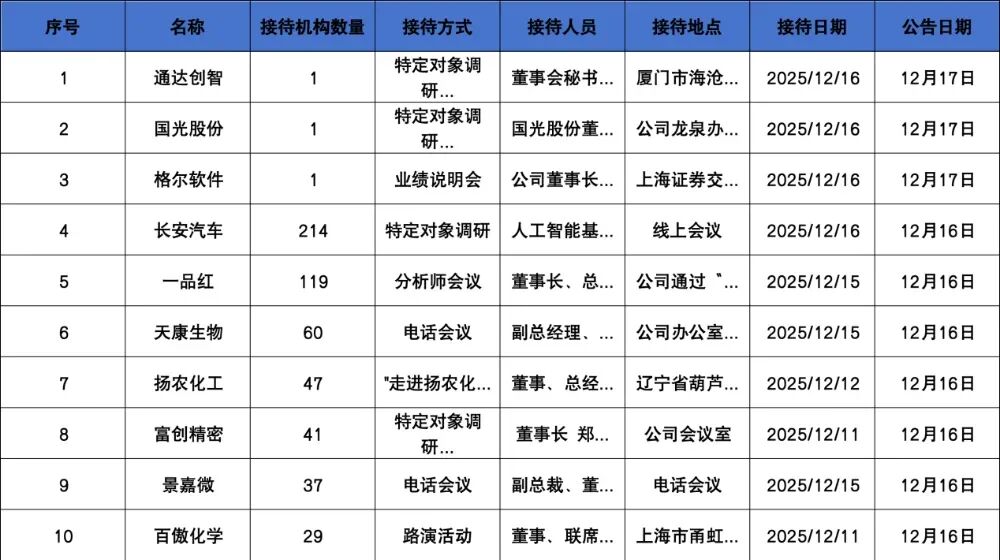
调研汇总:易方达、中欧、富国基金等214家明星机构调研长安汽车!
Xin Lang Cai Jing· 2025-12-17 14:20
| 序号 | 名称 | 接待机构数量 | 接待方式 | 接待人员 | 接待地点 | 接待日期 | 公告日期 | | --- | --- | --- | --- | --- | --- | --- | --- | | 1 | 通达创智 | 1 | 特定对象调 研 ... | 董事会秘书 ... | 厦门市海沧 ... | 2025/12/16 | 12月17日 | | 2 | 国光股份 | 1 | 特定对象调 | 国光股份董 ... | 公司龙泉办 ... | 2025/12/16 | 12月17日 | | | | | 研 ... | | | | | | 3 | 格尔软件 | 1 | 业绩说明会 | 公司董事长 ... | 上海证券交 ... | 2025/12/16 | 12月17日 | | 4 | 长安汽车 | 214 | 特定对象调研 | 人工智能基 ... | 线上会议 | 2025/12/16 | 12月16日 | | 5 | 一品红 | 119 | 分析师会议 | 董事长、总 ... | 公司通过" ... | 2025/12/15 | 12月16日 | | 6 | 天康生物 | 60 | 电话会议 ...

“凯式布道”和“苏式焦虑”背后 地平线的野心是什么?
Xin Lang Cai Jing· 2025-12-17 14:19
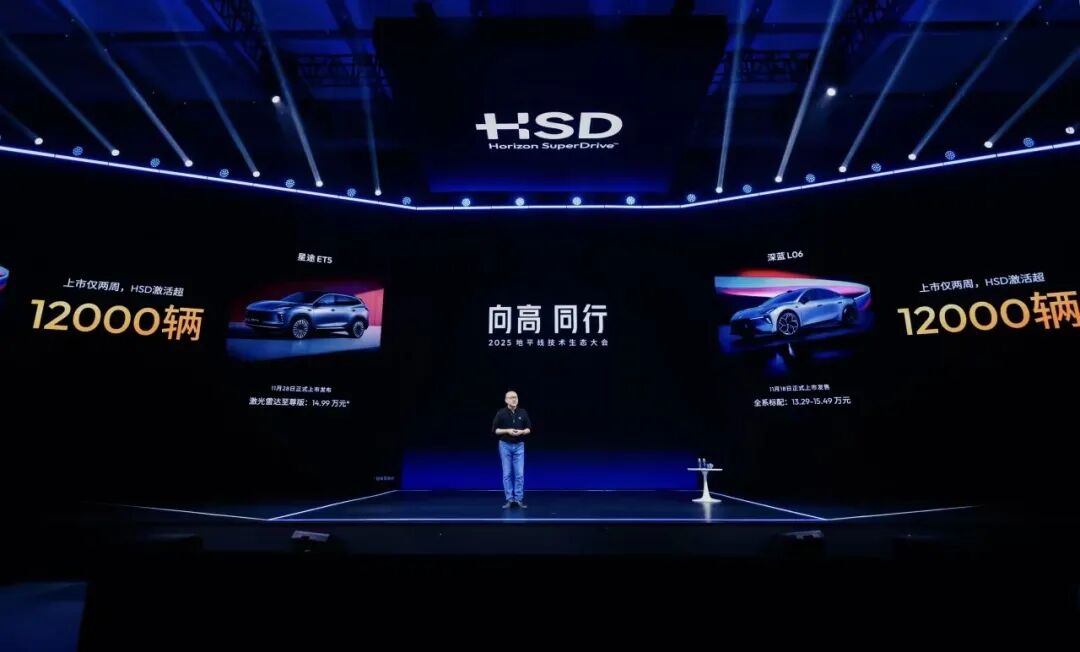
Core Insights - Horizon Robotics, led by CEO Yu Kai, aims to solidify its position in the smart technology sector through its first technology ecosystem conference, showcasing its ADAS and AD solutions [2][15] - The company is transitioning from a chip supplier to an integrated technology service provider, emphasizing the importance of ecosystem collaboration over in-house development by automakers [3][16] Group 1: Company Strategy and Vision - Yu Kai's vision includes making advanced driving technology accessible to the mass market, with the goal of integrating smart driving into vehicles priced under 150,000 yuan [18] - Horizon Robotics has launched the HSD (Horizon City Driving) system, achieving over 12,000 activations within two weeks of its launch, indicating strong market demand [18] - The company plans to expand its ecosystem by offering a full-stack solution that includes chips, algorithms, and reference designs, which can significantly reduce development cycles for automakers [19][20] Group 2: Technological Developments - The HSD system's mass production marks a significant step towards Yu Kai's vision of becoming a foundational player in the robotics era, likening the company to a "Wintel" for the robotics industry [19] - Horizon Robotics is focusing on three technological pillars: BPU, compilers, and algorithms, with the fourth-generation BPU architecture and compiler serving as the foundation for both smart driving and general robotics [19] - The introduction of the "HSD Together" model aims to alleviate challenges faced by automakers, such as high training costs and talent shortages, by allowing them to build on Horizon's validated algorithms [20][25] Group 3: Market Position and Competition - Horizon Robotics is positioning itself to capture a significant share of the market by targeting vehicles priced at 130,000 yuan and below, with plans to enter the 100,000 yuan national car market [21][26] - The company views Tesla as its primary competitor, with the upcoming release of Tesla's FSD V12 expected to set a new standard in the industry [23] - The automotive ecosystem is becoming increasingly competitive, with various players, including Huawei, also vying for dominance in the smart driving space [17][26] Group 4: Industry Challenges and Collaboration - The industry faces significant challenges, including high costs of AI training, scarcity of top talent, and imbalanced iteration speeds, which Horizon aims to address through collaborative ecosystem models [20][25] - There is a consensus among industry players that building a collaborative ecosystem is essential for overcoming the technological and scalability gaps in smart driving [25][27] - The shift in supplier roles is evident, with companies like Horizon Robotics moving from behind-the-scenes support to defining technology routes and participating in standard-setting [27]
首批真正“自动驾驶”车型确定了,以后出事谁担责?
凤凰网财经· 2025-12-17 13:47
Core Viewpoint - The approval of the first L3-level conditional autonomous driving models in China marks a significant step towards the commercialization of L3 autonomous driving technology, transitioning from testing to practical application [1][2]. Group 1: Approved Models and Their Features - The two approved models are the Changan SC7000AAARBEV and the Arcfox BJ7001A61NBEV, with specific operational capabilities in designated areas [2]. - The Changan model can operate in congested traffic environments at a maximum speed of 50 km/h, limited to certain routes in Chongqing [2][5]. - The Arcfox model can operate at a maximum speed of 80 km/h on highways and urban expressways, limited to specific routes in Beijing [2][5]. Group 2: Strategic Locations and Data Collection - Changan's focus on Chongqing, known for its complex traffic conditions, aims to tackle real-world challenges in autonomous driving [5][6]. - Arcfox's operations in Beijing, a hub for smart vehicle policy innovation, allow for testing in a more standardized environment [5][6]. - The simultaneous efforts in both cities are intended to gather diverse data to support the development of legal and technical standards for autonomous vehicles [6]. Group 3: Future Operations and Market Strategy - The two models will undergo pilot operations in their respective regions, with monitoring and safety measures in place by the Ministry of Industry and Information Technology [7]. - Initial L3 functionalities may be offered through specific service models like Robotaxi or premium ride services, rather than direct sales to individual consumers [7][8]. - The market anticipates that L3 vehicles will initially be available under restricted conditions, allowing for data collection and risk monitoring [7][8]. Group 4: Legal and Responsibility Framework - The transition from L2 to L3 represents a critical shift in driving automation, with L3 allowing for conditional autonomous driving where the system takes over driving tasks [9][10]. - The responsibility for accidents during L3 operation is a key issue, with current legal frameworks facing challenges in defining liability [16][19]. - In international contexts, companies like Mercedes have begun to assume liability during L3 operation, indicating a potential shift in responsibility dynamics in China as well [16][19].

首批L3车型获准上路,自动驾驶“拐点”来了?丨财经早察
2 1 Shi Ji Jing Ji Bao Dao· 2025-12-17 12:44
Core Insights - The first batch of L3 conditional autonomous vehicles in China has received operational permits, marking a significant milestone in the country's autonomous driving era [1] Group 1: Definition and Implications of L3 - L3 level represents conditional automation where the system can fully take over driving tasks in specific scenarios, allowing the driver to temporarily disengage [2] - A key revolutionary aspect of L3 is the shift in responsibility from the driver to the vehicle manufacturer in case of accidents caused by system failures, as per regulations effective in 2025 [2] Group 2: Companies Involved - The first two companies to receive L3 permits are Changan Automobile and BAIC's Arcfox, with Changan focusing on congested scenarios and BAIC targeting high-speed efficient travel [3] - Both companies' vehicles will initially be operated by specific service entities rather than being sold directly to consumers, reflecting a cautious approach by regulatory authorities [3] Group 3: Market Opportunities - The launch of L3 vehicles provides a first-mover advantage for Changan and BAIC, with other manufacturers like BYD, NIO, and GAC likely to accelerate their efforts to obtain similar permits [4] - Transitioning from L2 to L3 involves significant hardware advancements, benefiting core components such as intelligent driving domain controllers and automotive-grade chips [4] - The shift in responsibility will necessitate the development of new insurance products, accident assessment processes, data security regulations, and maintenance systems [4]
首批L3车型获准上路,自动驾驶“拐点”来了?
2 1 Shi Ji Jing Ji Bao Dao· 2025-12-17 12:36
Group 1 - The first batch of L3 conditional autonomous vehicles in China has received operational permits, marking a significant milestone in the country's autonomous driving era [1][3] - L3 level automation allows the system to take over driving tasks in specific scenarios, enabling drivers to temporarily disengage from their responsibilities, with the caveat that they must be ready to take control in complex situations [2][3] - The shift in liability from the driver to the vehicle manufacturer in the event of an accident due to system failure is a revolutionary aspect of L3, establishing a legal foundation for "machine drivers" [2][3] Group 2 - The first two companies to receive L3 permits are Changan Automobile and BAIC's Arcfox, with Changan focusing on congested scenarios and BAIC targeting high-speed efficient travel [3][4] - The initial deployment of these vehicles is limited to specific routes and operated by designated companies rather than individual consumers, reflecting a cautious approach by regulatory authorities [3][4] - The launch of L3 vehicles is expected to accelerate advancements in core hardware, such as intelligent driving domain controllers and automotive-grade chips, as well as the development of new ecosystems and service models in the automotive industry [4]
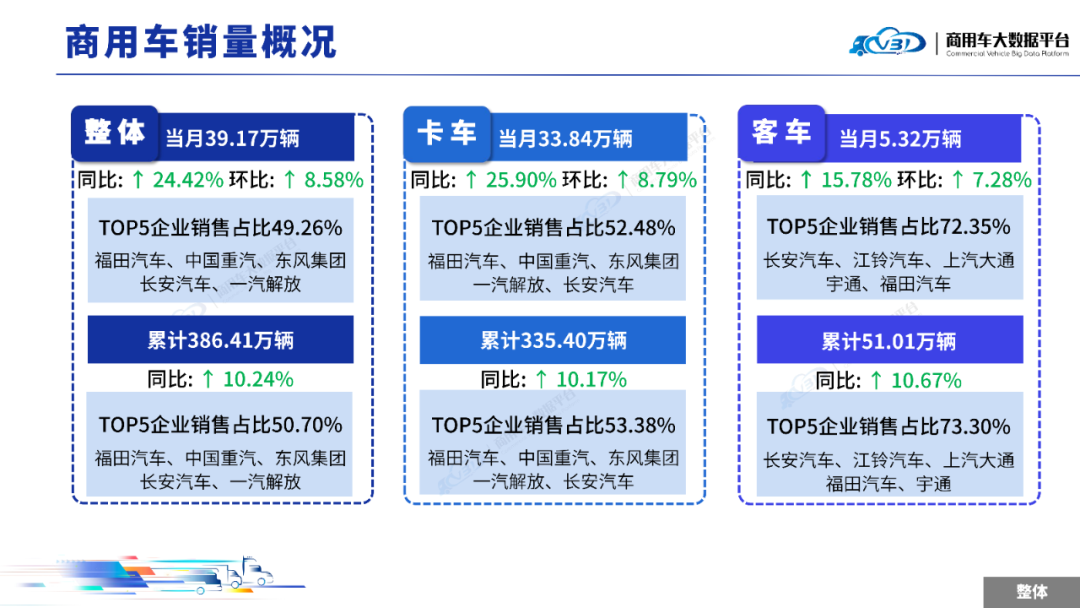
中国汽车流通协会:11月全国商用车整体销量(批发)为39.17万辆 同比增长24.42%
Zhi Tong Cai Jing· 2025-12-17 12:06
智通财经APP获悉,12月17日,中国汽车流通协会发布2025年11月全国商用车销量概况(批发)。2025年11月全国商用车整体销量(批发)为39.17万辆,同比 增长24.42%,环比增长8.58%;1-11月全国商用车累计整体销量(批发)为386.41万辆,累计同比增长10.24%。 2025年11月全国商用车整体销量(批发)为39.17万辆,同比增长24.42%,环比增长8.58%;1-11月全国商用车累计整体销量(批发)为386.41万辆,累计同比增 长10.24%。 2025年11月新能源商用车销量(批发)为10.50万辆,同比增长61.55%,环比增长18.15%;1-11月累计销量(批发)增长82.49万辆,同比增长63.11%。 连续12个月商用车销量变化趋势 销量(万辆) 环比增长率(%) 50.00 80.00 60.00 40.00 40.00 30.00 20.00 0.00 20.00 -20.00 10.00 -40.00 0.00 -60.00 202412 202501 202502 202503 202504 202505 202506 202507 202508 20250 ...




L3上路,妥了
36氪· 2025-12-17 11:45
Core Viewpoint - The approval of L3-level conditional autonomous driving vehicles marks a significant step towards the commercialization of autonomous driving in China, transitioning from testing to official road use under specific conditions [8][9][10]. Group 1: Approval Details - The Ministry of Industry and Information Technology (MIIT) has approved two L3-level autonomous vehicles: Changan SC7000AAARBEV and BAIC Alpha S6, allowing them to operate under specific conditions in designated areas of Chongqing and Beijing [5][6][16]. - The Changan vehicle can achieve autonomous driving at speeds up to 50 km/h in congested traffic and on specific roads in Chongqing, while the BAIC vehicle can operate at speeds up to 80 km/h on certain highways in Beijing [17][19]. Group 2: Significance of Approval - This approval signifies the transition of autonomous vehicles into a "certified era," indicating that L3-level vehicles are now recognized for their operational capabilities under real-world conditions [8][12]. - The distinction between "product approval" and "testing licenses" is crucial, as the former indicates a higher level of regulatory recognition and the ability to operate on public roads [10][11][12]. Group 3: Future Implications - The approval is part of a gradual process that began with policy discussions in 2022, leading to the current stage where L3 and L4 vehicles can be tested under specific conditions [26][28]. - The industry anticipates a rapid increase in L3 vehicle approvals, with many companies setting 2026 as a target for widespread deployment of L3 autonomous driving technology [30][31][32].

欧盟撤销全面电动化计划
Di Yi Cai Jing· 2025-12-17 11:29
Group 1: Core Views - The European Commission proposed a new amendment to relax the 2035 ban on the sale of fuel and diesel vehicles, changing the carbon emission reduction target from 100% to 90% [1] - Major automotive companies such as Mercedes-Benz, BMW, Stellantis, Volkswagen, and Renault support this amendment, citing high costs of electric vehicles and insufficient charging infrastructure as barriers to achieving the expected electric vehicle penetration by 2035 [1] - There are opposing views from companies like Volvo and Polestar, which argue that changing the ban could hinder the electric transition and lead to a lag behind other countries [1] Group 2: Market Trends - The global automotive market, including Europe, is undergoing an electrification transformation, with fuel vehicles losing market share to hybrid and electric vehicles [2] - According to ACEA data, new car registrations in the EU increased by 1.4% year-on-year in the first ten months of 2025, with hybrid vehicle registrations rising to 3.11 million, accounting for 34.6% of the market [2] - The market share of gasoline vehicles decreased from 34% to 27.4%, while pure electric vehicle registrations reached approximately 1.47 million, growing from 13.2% to 16.4% year-on-year [2] Group 3: Growth of Plug-in Hybrid Vehicles - The registration of plug-in hybrid vehicles in the EU surged to 819,200 units, with a market share of 9.1%, up from 7% the previous year [3] - Significant growth was observed in Spain (109.6%), Italy (76.5%), and Germany (63.4%) for plug-in hybrid vehicle sales [3] - Chinese automaker BYD reported substantial sales growth in the EU, with a 452.3% increase in Spain and a 647.5% increase in Germany [3] Group 4: Challenges for Traditional Automakers - Traditional automakers like Ford and Stellantis experienced a decline in sales, with Stellantis reporting a 6% drop in the first ten months of the year [4] - These companies face challenges in electric vehicle sales and rely heavily on external supply chains for key components like batteries [4] - German Chancellor Merz and Volkswagen CEO Oliver Blume expressed skepticism about the feasibility of a complete ban on internal combustion engines by 2035 [4] Group 5: Long-term Electrification Goals - The EU's new proposal includes a policy to support small electric vehicles, offering a reward mechanism for manufacturers that assemble small electric vehicles and battery packs in the EU [5] - Renault welcomed the new plan, emphasizing the need to accelerate the promotion of electric vehicles and the introduction of small electric cars [5][6] - Volkswagen described the new proposal as economically reasonable, highlighting the special support for small electric vehicles as a positive development [6]
