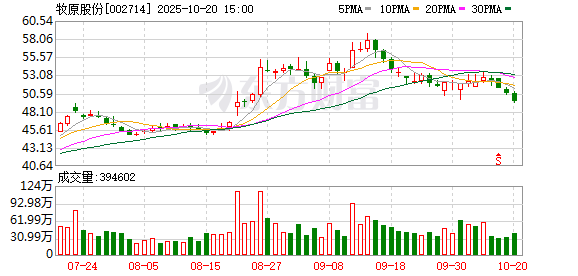
牧原股份

Search documents
2026届河南省高校毕业生金秋校园招聘月启动 校企双向奔赴 就业精准高效
He Nan Ri Bao· 2025-10-20 23:19
Group 1 - The 2026 Henan Province College Graduates Autumn Recruitment Fair marks the beginning of a series of recruitment activities aimed at facilitating early employment for graduates [2] - The fair attracted over 450 companies, offering 27,000 job positions, with 18,000 graduates attending and over 44,000 resumes submitted, resulting in more than 9,000 preliminary employment intentions [1] - A cross-provincial talent recruitment team from Jiangsu, consisting of 46 companies, specifically targeted Henan's skilled graduates, highlighting the recognition of Henan talent by employers [1] Group 2 - The province anticipates 996,000 graduates in 2026 and has initiated the "2026 Graduate Employment Expansion and Quality Improvement Action" to broaden employment channels [2] - Seven universities signed cooperation agreements with companies to establish "Graduate Employment Internship Bases," facilitating direct connections between talent cultivation and job demand [3] - Companies emphasize the need for versatile talents in traditional industries undergoing transformation, with a focus on integrating technical standards and market needs into university curricula [3]
数说“十四五” ESG笔墨绘就企业发展新底色
Zhong Guo Zheng Quan Bao· 2025-10-20 20:17
Core Insights - The disclosure rate of ESG reports among A-share listed companies has steadily increased, with a 71% year-on-year growth in the number of reports published for the 2024 fiscal year compared to 2021 [2] - ESG has evolved from a conceptual framework to a critical dimension for measuring corporate competitiveness, aligning with national development goals [2][3] - Companies are increasingly integrating sustainable development principles into their corporate culture and operations, demonstrating a commitment to ESG practices [2][3] ESG Disclosure and Performance - As of September 2025, 2,521 A-share listed companies have published ESG reports, representing 46.83% of all listed companies [2] - The quality of ESG disclosures has significantly improved, with 342 companies included in MSCI ESG ratings, and 100 companies receiving upgrades in their ratings [2] - The shift towards actionable ESG practices is evident across various industries, with companies adopting international ESG standards to enhance report quality [2] Green Development Initiatives - The share of renewable energy in China's power generation capacity has increased from 40% to approximately 60% during the "14th Five-Year Plan" period [4] - Significant reductions in carbon emissions have been achieved, with a reported decrease of 11.6% in energy consumption per unit of GDP, equating to a reduction of 1.1 billion tons of CO2 emissions [5] - Companies are increasingly adopting green technologies and practices, contributing to a sustainable business model and enhancing their competitive edge [3][4] Social Responsibility and Community Engagement - A growing number of companies are embedding social responsibility into their operations, with 67.16% engaging in community services and 66.67% supporting educational resources [6] - The third sector's employment capacity has strengthened, with 35.87 million people employed in this sector by the end of 2024, marking a 1.1 percentage point increase from 2020 [6] - Companies are actively participating in housing and elderly care initiatives, significantly improving living conditions and support networks for communities [6][7] Agricultural and Rural Development - Companies are integrating ESG practices with rural revitalization strategies, exemplified by successful projects like the silk industry in Guangxi, which is expected to generate over 8 million yuan in output by 2025 [8] - Digital solutions are being implemented to enhance agricultural productivity, with platforms connecting over 1,000 agricultural regions and benefiting millions of farmers [8] - The contribution of agricultural technology to productivity has reached 63.2%, with mechanization rates exceeding 75%, showcasing the role of innovation in modern agriculture [8]
数说“十四五”ESG笔墨绘就企业发展新底色
Shang Hai Zheng Quan Bao· 2025-10-20 18:13
Group 1: ESG Reporting Growth - As of September 2025, 2,521 A-share listed companies have published their 2024 ESG reports, representing a 71% increase compared to 2021 [2][4] - Among 389 mandatory disclosure entities that have released sustainability reports, 97.94% (381 companies) have initiated carbon reduction actions [2][9] - The disclosure rate of ESG reports has steadily increased over the past five years, with 46.83% of all A-share companies disclosing ESG reports for 2024 [4] Group 2: Corporate Social Responsibility - 67.16% of listed companies are engaged in community service, and 66.67% provide assistance to educational resources [2][10] - The third industry has seen an increase in employment capacity, with 35.866 million employed by the end of 2024, an increase of 600,000 since 2020 [10] - Over 24,000 urban old residential communities have been renovated, benefiting over 40 million households [10][11] Group 3: Green Energy and Low-Carbon Initiatives - The share of renewable energy generation capacity has increased from 40% to approximately 60% during the "14th Five-Year Plan" period [8] - The carbon emissions intensity and energy consumption per unit of GDP have decreased by 11.6% cumulatively over four years, equivalent to a reduction of 1.1 billion tons of CO2 emissions [8][9] - A zero-carbon intelligent manufacturing base in Jiangsu has achieved 100% green electricity supply and net-zero emissions, reducing CO2 emissions by over 400,000 tons annually [8] Group 4: Rural Revitalization and Economic Development - Over 6,000 enterprises have supported the consolidation and expansion of poverty alleviation efforts since the "14th Five-Year Plan" [14][15] - The income from leisure agriculture reached 900 billion yuan last year, showcasing the economic impact of rural revitalization [15] - Agricultural technology contribution rates have reached 63.2%, with over 75% mechanization in crop farming [15][16]

猪价跌跌不休 “保险+期货”为养殖户捂紧钱袋子
Zheng Quan Shi Bao· 2025-10-20 17:11
Group 1 - After the National Day and Mid-Autumn Festival holiday, the price of live pigs has accelerated its decline, with recent futures contracts falling below 12,000 yuan/ton. Despite multiple state interventions in frozen pork reserves, the market's recovery effect has been limited [1] - On October 10, the state stored 15,000 tons of frozen pork, marking the latest action in a series of state interventions. Even with five previous storage actions in August and September, and the traditional consumption peak during the holidays, pig prices have not improved, leading to further price drops post-holiday [1] - On October 9, the first trading day after the holiday, the main futures contract for live pigs closed at 11,595 yuan/ton, with a single-day decline of 6.15%. On October 17, the contract price dropped to as low as 11,020 yuan/ton, although there was a slight rebound on October 20, remaining below 11,500 yuan/ton [1] Group 2 - In the context of a "cold winter" for the domestic pig market, the "insurance + futures" project, driven by futures, insurance, and local governments, has played a crucial role in supporting small and medium-sized farmers. The "Luohe sample" is a benchmark project for the Dalian Commodity Exchange's "Farmer Income Protection Plan" [2] - Luohe, an important pig-producing city in Henan Province, has an annual output of over 3 million pigs, with the pig industry accounting for nearly 70% of the livestock industry's output value. The project was initiated in 2021, allowing farmers to manage price risks effectively [2] - The first domestic pig revenue index "insurance + futures" project was implemented in Luohe, with a payout of over 180,000 yuan, achieving a compensation rate of nearly 364%, which helped farmers mitigate losses from falling prices and stabilize operations [2] Group 3 - Facing continuous price declines, listed pig companies have shown increasing enthusiasm for engaging in commodity futures hedging. Since 2021, companies such as Haida Group, Tiankang Biological, and Muyuan Foods have announced their involvement in commodity futures hedging activities [3]
10月港股消费观察:风格切换助力消费
2025-10-20 14:49
Summary of Key Points from Conference Call Records Industry Overview - **Consumer Sector**: The retail sales growth is slowing down, with both commodity retail and catering revenues performing poorly. Appliance sales are particularly weak due to the cooling real estate market, while only a few categories like sports and entertainment products have seen growth exceeding 10% [1][3][4]. - **Pork Farming Sector**: The sector is undergoing a capacity reduction, with a focus on large-scale, low-cost producers like Muyuan and Wens, as well as significant improvements in New Hope [2][34][35]. - **E-commerce and Internet Sector**: Major players like Alibaba, JD, and Pinduoduo are currently at low levels, with expectations for cloud business growth to accelerate to around 30% in Q3 [22][23]. Key Insights and Arguments - **Retail Sales Performance**: In September 2025, the year-on-year growth rate of social retail sales was only 3%, a decline from August. This trend indicates a significant drop in consumer spending since the second half of the year [3][4][8]. - **Weakness in Commodity Retail**: The commodity retail sector saw a year-on-year growth of only 3.3% in September, the lowest for 2025, primarily dragging down overall retail sales [4][5]. - **Challenges in Consumer Market**: The slowing growth of disposable income, which fell to 4.5% in Q3, is a major challenge for the consumer market. Measures to increase income and reduce burdens are necessary to improve consumer confidence [8][9][10]. - **Beverage Industry Performance**: Notable companies like Nongfu Spring are expected to see over 25% growth in Q3, while the Dongfang Shuying brand is projected to grow over 50% [11]. - **Snack Industry Dynamics**: The snack sector, particularly Wei Long's spicy strips, has rebounded, with konjac products maintaining a growth rate of 40-50% [12]. - **Jewelry Sector Trends**: Brands like Chow Tai Fook have benefited from rising gold prices, achieving better-than-expected sales, while established brands have a competitive edge due to their brand strength and design capabilities [13]. - **Cloud and E-commerce Business Outlook**: The cloud business is expected to grow by around 30%, while traditional e-commerce is stabilizing with a projected 10% growth in customer management revenue [23][25]. Additional Important Insights - **Policy Measures for Consumer Confidence**: Key policy measures include reducing burdens related to healthcare and pensions to increase disposable income and improve public service supply [9][10]. - **Investment Recommendations**: Companies like Alibaba and JD are recommended for their strong fundamentals and potential for recovery, despite current low valuations [22][26][27]. - **Pork Farming Capacity Reduction Logic**: The logic behind capacity reduction in the pork farming sector is strengthening, with a focus on large producers to stabilize prices [34]. - **Hai Da Group's IPO Plans**: Hai Da Group plans to IPO its overseas assets, which is expected to support long-term growth despite potential short-term dilution concerns [37][38]. This summary encapsulates the critical insights and trends across various sectors, highlighting both challenges and opportunities for investors.



缩量反弹,关注宏观事件密集落地
Tebon Securities· 2025-10-20 12:55
Market Analysis - The A-share market experienced a volume contraction rebound with over 4,000 stocks rising, but trading volume hit a two-month low, indicating a cautious market sentiment [4][5] - The Shanghai Composite Index rose by 0.63% to 3,863.89 points, while the Shenzhen Component increased by 0.98% to 12,813.21 points, and the ChiNext Index surged by 1.98% to 2,993.45 points [5] - The dividend sector continued to lead the market with a 0.75% increase, showing a cumulative rise of 5.60% in October, outperforming the Shanghai Composite Index's decline of 0.49% [7] Macroeconomic Events - A series of macroeconomic events are expected to unfold from late October to early November, including the Fourth Plenary Session of the 19th Central Committee, the Federal Reserve's interest rate meeting, and the APEC Leaders' Meeting [9] - These events are anticipated to influence market sentiment and risk appetite, with a balanced allocation strategy likely to prevail in the short term [9] Bond Market - The bond futures market saw a general decline, with long-term contracts experiencing more significant drops compared to short-term ones, reflecting profit-taking sentiment [9] - The 30-year main contract closed at 115.30, down 0.37%, while the 10-year contract fell 0.14% to 108.110 [9] Commodity Market - The commodity market displayed a mixed performance, with live pig futures rebounding by 2.88% and coking coal maintaining strength with a 2.66% increase [10] - The live pig market is showing signs of recovery as the pig-to-grain ratio reached a two-year low, prompting expectations of price rebounds [10] - Coking coal prices are supported by year-end safety inspections and recent temperature drops, with spot prices rising from 699 RMB/ton to 748 RMB/ton in October [10] Investment Strategy - The report suggests maintaining a balanced allocation strategy in equities due to prevailing low risk appetite ahead of significant macro events [11] - In the bond market, the report indicates a need to monitor policy signals from upcoming events, particularly the Federal Reserve's interest rate decisions [11] - For commodities, the report maintains a long-term bullish outlook on precious metals while noting potential shifts in industrial products driven by policy expectations [11]
政策强压叠加深度亏损,农牧渔板块继续回调!生猪去产能+估值历史低位,布局时机或至?
Xin Lang Ji Jin· 2025-10-20 11:55
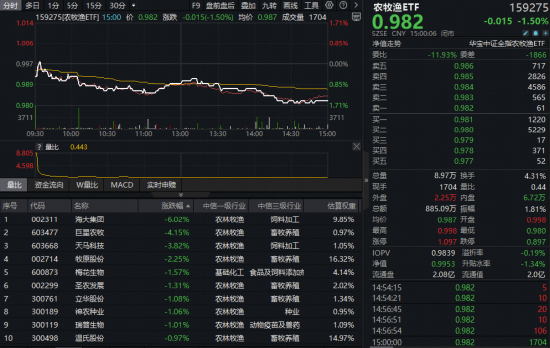
Core Viewpoint - The agricultural, animal husbandry, and fishery sector continues to show weakness, with the first agricultural ETF (159275) experiencing a decline of 1.5% by market close on October 20, 2023 [1][2] Market Performance - The agricultural ETF (159275) closed at 0.982, down 0.015 from the previous day, reflecting a 1.5% decrease [2] - Key stocks in the sector, including Haida Group, Juxing Agriculture, and Tianma Technology, saw significant declines, with Haida Group dropping over 6% and Juxing Agriculture falling over 4% [1][2] Industry Trends - The 14th World Pig Industry Expo opened on October 18, 2025, showcasing over 800 global enterprises and focusing on smart farming equipment and technology [1] - The Ministry of Agriculture and Rural Affairs, along with five other departments, issued guidelines to strengthen modern agricultural service centers, enhancing support for feed production and animal disease prevention [1] Regulatory Environment - From May to September 2023, multiple meetings were held regarding pig farming, with policies aimed at reducing production by 1 million heads by the end of the year [3] - The pig farming industry is entering a phase of capacity reduction, with a reported decrease of 50,000 breeding sows from July to August 2023 [3] Valuation Insights - The agricultural and fishery sector is currently at a relatively low valuation level, with the agricultural ETF's underlying index price-to-book ratio at 2.59, placing it in the 31.64 percentile over the past decade [3] - This suggests a favorable configuration opportunity for long-term investments in the sector [3] Future Outlook - The pig farming industry is expected to see a rise in price levels due to ongoing capacity reduction and regulatory policies [5] - The focus will be on improving quality and efficiency in the industry, with a gradual elimination of outdated production capacity [4]


持续下跌!猪价遭遇“寒冬”,“漯河样本”价值显现
券商中国· 2025-10-20 11:07
Core Viewpoint - The pig farming industry is experiencing a prolonged downturn, with prices continuing to decline and the entire sector facing significant losses [2][3][4]. Price Decline and Industry Losses - After the National Day holiday, pig prices have accelerated their decline, leading to widespread losses across the industry. Despite multiple government interventions, including the storage of frozen pork, the market remains unresponsive [2][3]. - On October 9, the first trading day after the holiday, the main pig futures contract closed at 11,595 yuan/ton, a single-day drop of 6.15%. By October 17, the price fell to 11,020 yuan/ton, although there was a slight rebound by October 20, remaining below 11,500 yuan/ton [3]. - The average purchase price for pigs was reported at 13.45 yuan/kg, down 3.0% week-on-week and 29.2% year-on-year, while the average ex-factory price for pork was 17.58 yuan/kg, down 2.7% week-on-week and 28.5% year-on-year [3]. - The price of pigs has dropped to 11.18 yuan/kg, a year-on-year decrease of 35.41%, which is below the cost line for most farmers [3][4]. Impact on Farmers - The continuous decline in pig prices has resulted in significant losses for pig farming operations. For instance, the largest pig farming company, Muyuan Foods, reported a sales average of 12.88 yuan/kg in September, a year-on-year decrease of 30.94% [4]. - Small and medium-sized farmers are facing increasing risks of cash flow issues, with losses per pig reaching over 50 yuan for self-bred pigs and around 150 yuan for those purchasing piglets for fattening [4]. "Luohe Sample" Support - The "Luohe Sample," a project combining insurance and futures, has been instrumental in providing financial support to farmers during this downturn. This initiative has been in place since 2021 and has helped local farmers manage their financial risks [5][6]. - The project has been successful in mitigating losses for farmers, with one farm receiving over 180,000 yuan in compensation due to price declines, demonstrating a compensation rate of nearly 364% [6][7]. - Over the past five years, the project has served approximately 239 farmers, covering 22,580 pigs, with total premiums exceeding 25.7 million yuan and project amounts nearing 400 million yuan [7][8]. Evolution of the Insurance and Futures Model - The "insurance + futures" model has evolved significantly since its introduction, becoming a crucial tool for agricultural risk management. It has expanded from pilot projects to nationwide implementation, benefiting various agricultural sectors [8][9]. - The Luohe project has not only protected local farmers' interests but has also filled gaps in traditional agricultural insurance, promoting a more integrated approach to risk management in the pig farming industry [8][9].

双十一开启,关注宠物板块行情:农林牧渔行业周报-20251020
Guohai Securities· 2025-10-20 09:33
Investment Rating - The report maintains a "Recommended" rating for the agricultural, forestry, animal husbandry, and fishery industry [9][62]. Core Views - The swine sector is undergoing deepening regulation, with a focus on value reassessment opportunities. The report suggests that the price of pigs may face downward pressure in the short term due to increased market supply, but regulatory measures are expected to stabilize prices in the long run [1][16]. - The poultry sector is anticipated to improve, with data indicating a rise in the number of breeding stock and a shift towards self-breeding [2][27]. - The animal health sector is seeing a potential improvement in competitive dynamics, particularly with the progress of clinical trials for African swine fever vaccines, which could enhance market conditions [3][35]. - The pet economy is thriving, with domestic brands gaining strength and the market expected to continue its rapid growth [9][55]. Summary by Sections Swine - The swine industry is in a regulatory phase aimed at controlling prices through capacity reduction. The average price of pigs is reported at 11.02 yuan/kg, with a weekly decrease of 0.87 yuan/kg. The number of breeding sows is stable at 40.38 million heads [15][16]. - Recommended companies include Muyuan Foods and Wens Foodstuffs, with additional attention on Dekang Agriculture, Shennong Group, and Juxing Agriculture [1][16]. Poultry - The poultry sector shows signs of improvement, with a total of 80.33 thousand sets of breeding stock updated in the first three quarters of 2025. The report highlights a shift towards self-breeding, with self-bred stock accounting for 59% [2][27]. - Recommended companies in this sector are Shennong Development and Lihua Stock [2][27]. Animal Health - The competitive landscape in the animal health sector is expected to improve, supported by government initiatives to optimize the veterinary drug industry. The report notes that clinical trials for African swine fever vaccines are underway, which could lead to commercialization [3][35]. - Recommended companies include Kexin Biological and Ruipu Biological, with additional focus on Huisheng Biological, Zhongmu Biological, and others [3][35]. Planting - The report indicates a declining pig-to-grain price ratio, with the current ratio at 4.95. The prices of corn and soybean meal have shown slight fluctuations, with corn priced at 2181 yuan/ton [39][44]. - Companies to watch include Suqian Agricultural Development, Longping High-Tech, and Denghai Seeds [7][44]. Feed - Feed prices are experiencing fluctuations, with the price for fattening pig feed at 3.34 yuan/kg. The report notes a year-on-year increase in industrial feed production [45][46]. - Recommended companies include Haida Group and He Feng Shares [45][46]. Pets - The pet market is projected to reach 300.2 billion yuan in 2024, with a year-on-year growth of 7.5%. The report highlights the increasing consumption per pet, with dogs averaging 2961 yuan and cats 2020 yuan annually [55][56]. - Recommended companies in the pet food sector include Guibao Pet, Zhongchong Shares, and Petty Shares, with Ruipu Biological in the pet medical sector [9][55].




农林牧渔行业资金流出榜:牧原股份、中粮糖业等净流出资金居前
Zheng Quan Shi Bao Wang· 2025-10-20 09:08
Market Overview - The Shanghai Composite Index rose by 0.63% on October 20, with 26 out of 28 sectors experiencing gains, led by the communication and coal sectors, which increased by 3.21% and 3.04% respectively [2] - The sectors with the largest declines were non-ferrous metals and agriculture, forestry, animal husbandry, and fishery, which fell by 1.34% and 0.88% respectively [2] Capital Flow Analysis - The main capital outflow from the two markets totaled 4.601 billion yuan, with 12 sectors seeing net inflows [2] - The communication sector had the highest net inflow of 4.397 billion yuan, while the coal sector followed with a net inflow of 1.148 billion yuan [2] - The non-ferrous metals sector experienced the largest net outflow, totaling 4.699 billion yuan, followed by the computer sector with a net outflow of 2.390 billion yuan [2] Agriculture, Forestry, Animal Husbandry, and Fishery Sector - This sector declined by 0.88% with a net capital outflow of 364 million yuan [3] - Out of 105 stocks in this sector, 66 rose, including 2 that hit the daily limit, while 37 fell [3] - The top three stocks with net inflows were Pingtan Development (82.6318 million yuan), Zhengbang Technology (26.6823 million yuan), and Xianfeng Holdings (22.6113 million yuan) [3][4] Capital Inflow and Outflow in Agriculture, Forestry, Animal Husbandry, and Fishery - The top inflow stocks included: - Pingtan Development: +9.97%, 16.94% turnover, 82.6318 million yuan inflow [4] - Zhengbang Technology: +0.34%, 0.92% turnover, 26.6823 million yuan inflow [4] - Xianfeng Holdings: +5.45%, 5.70% turnover, 22.6113 million yuan inflow [4] - The top outflow stocks included: - Muyuan Foods: -2.25%, 1.04% turnover, -1256.918 million yuan outflow [5] - COFCO Sugar: -2.35%, 1.62% turnover, -1174.155 million yuan outflow [5] - Shennong Seed Industry: -1.06%, 11.71% turnover, -365.578 million yuan outflow [5]