
南钢股份

Search documents
研判2025!中国预硬化高速工具钢行业产业链全景、市场规模、竞争格局、发展趋势分析:下游需求爆发,预硬化高速工具钢市场规模稳步增长[图]
Chan Ye Xin Xi Wang· 2025-12-30 01:26
Core Insights - The Chinese pre-hardened high-speed tool steel industry is experiencing growth, with a market size projected to reach 3.1 billion yuan in 2024, reflecting a year-on-year increase of 12.7% [1][7] - This growth is driven by the rapid development of key downstream industries such as automotive manufacturing, aerospace, and mold manufacturing, which significantly increases the demand for high-performance tool steel [1][7] - The "Made in China 2025" initiative and related plans for high-quality manufacturing development are creating a favorable environment for the growth of the pre-hardened high-speed tool steel industry [1][7] - The market size is expected to continue growing, reaching 3.5 billion yuan by 2025 [1][7] Industry Overview - Pre-hardened high-speed tool steel is a type of high-speed tool steel that has undergone special heat treatment to achieve a specific hardness before manufacturing, simplifying processing and reducing deformation risks [3] - The industry supply chain includes upstream resources such as iron ore and strategic metals, midstream production, and downstream applications in automotive, aerospace, mold manufacturing, and energy equipment [4][5] Market Dynamics - The production of iron ore in China has been increasing, from 84.4 million tons in 2019 to 104.2 million tons in 2024, although a slight decline of 3.2% was noted in early 2025 [6] - The automotive sector is a significant application area for pre-hardened high-speed tool steel, with production and sales of automobiles in China rising from 25.7 million units in 2019 to 31.3 million units in 2024, indicating a growing demand for automotive components [6][7] Competitive Landscape - The industry features a diverse competitive landscape, with leading companies like Baosteel and Ansteel holding significant market positions due to their strong R&D capabilities and brand influence [8] - Baosteel, a key player, reported a revenue of 232.4 billion yuan in the first nine months of 2025, with a net profit of 7.96 billion yuan, reflecting a year-on-year profit increase of 35.32% [9] Future Trends - The pre-hardened high-speed tool steel industry is expected to adapt to raw material price fluctuations and international trade uncertainties by enhancing supply chain resilience [10] - The industry is also expanding into new applications beyond traditional sectors, such as renewable energy and high-end medical products, indicating a diversification of market opportunities [10]


钢铁行业2026年度投资策略
2025-12-29 15:50
Steel Industry Research Summary Industry Overview - The steel industry is expected to see profitability bottom out in Q3 2024, with overall earnings remaining below historical averages. The profit outlook for 2025 is poor, except for a few months in Q2 and Q3 [1][2] Key Points on Demand - Demand for steel in the real estate sector is expected to continue declining until 2026, although the rate of decline is narrowing. Manufacturing and exports are emerging as new growth drivers, particularly in high-end manufacturing sectors such as machinery, home appliances, and new energy [1][3][4] - The overall steel consumption in the construction chain is stabilizing, with exports and manufacturing becoming critical growth points. Recent export license management policies may lead to some steel returning to the domestic market, affecting supply and inventory levels [1][6] Production and Cost Dynamics - There are discrepancies in growth rates and statistical data across different stages of steel production (pig iron, crude steel, and finished steel), leading to varied market expectations regarding raw material price support [1][5] - Upstream raw material prices (iron ore and coking coal) are severely squeezing the profitability of midstream steel producers. The potential for upstream concessions, such as the commissioning of the Simandou mine, could lower costs [1][7] Policy Impacts - The implementation of anti-involution policies is expected to improve supply-demand fundamentals and stabilize steel prices. The effectiveness of the 50 million ton production cut plan is crucial for market expectations [1][8] - The carbon emissions trading system will create significant differentiation among steel companies, with those holding excess quotas able to profit from selling them, while those lacking quotas will face increased costs [1][11] Environmental and Regulatory Trends - The steel industry is entering a phase of stricter environmental and energy consumption management, with policies expected to be fully implemented by the end of 2025. The year 2026 will be critical for assessing the effectiveness of these measures [1][9][10] Investment Opportunities - In 2026, leading companies like Nanjing Steel, Baosteel, and Hesteel have already seen valuation increases due to their strong performance in product demand and cost management. However, second-tier companies with production capacities of 10-20 million tons, which have historically underperformed, may present significant investment opportunities if they can reduce production costs by 100-200 RMB per ton, potentially doubling their profits [1][12][13]
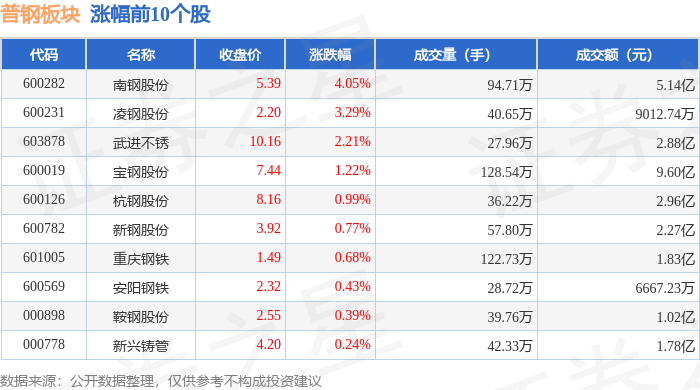
普钢板块12月29日涨0.61%,南钢股份领涨,主力资金净流出1.25亿元
Zheng Xing Xing Ye Ri Bao· 2025-12-29 08:58
Market Performance - The steel sector saw an increase of 0.61% on December 29, with Nanjing Steel leading the gains [1] - The Shanghai Composite Index closed at 3965.28, up 0.04%, while the Shenzhen Component Index closed at 13537.1, down 0.49% [1] Individual Stock Performance - Nanjing Steel (600282) closed at 5.39, up 4.05% with a trading volume of 947,100 shares and a transaction value of 514 million [1] - Ling Steel (600231) closed at 2.20, up 3.29% with a trading volume of 406,500 shares [1] - Wujin Stainless Steel (603878) closed at 10.16, up 2.21% with a trading volume of 279,600 shares [1] - Baosteel (600019) closed at 7.44, up 1.22% with a trading volume of 1,285,400 shares [1] - Other notable performances include Hangang (600126) up 0.99% and Xinguang Steel (600782) up 0.77% [1] Capital Flow Analysis - The steel sector experienced a net outflow of 125 million from main funds, while retail investors saw a net inflow of 102 million [2] - Speculative funds had a net inflow of 22.98 million [2] Detailed Capital Flow for Selected Stocks - Nanjing Steel (600282) had a main fund net outflow of 31.31 million, with retail investors contributing a net outflow of 41.04 million [3] - Shougang (000959) saw a main fund net inflow of 14.06 million, while retail investors had a net outflow of 11.25 million [3] - New Steel Pipe (000778) had a main fund net inflow of 7.50 million, with a retail net outflow of 8.54 million [3] - Ansteel (000898) reported a main fund net inflow of 5.83 million, while retail investors had a net outflow of 6.39 million [3]


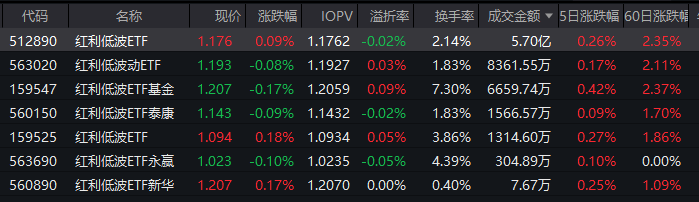
关注现金流价值!红利低波ETF(512890)交投与资金双活跃:日成交5.7亿居同类首位 近60个交易日吸金59亿!
Xin Lang Ji Jin· 2025-12-29 08:29
Market Overview - On December 29, the three major A-share indices showed mixed results, with the Shanghai Composite Index slightly rising, achieving a "nine consecutive days of gains" [1] - The ChiNext Index experienced a decline of over 1% at one point during the day [1] ETF Performance - The Dividend Low Volatility ETF (512890) closed up 0.09% at 1.176 CNY, with a turnover rate of 2.14% and a trading volume of 570 million CNY, leading among similar ETFs [1][3] - Over the past 20 trading days, the ETF accumulated a total trading volume of 12.2 billion CNY, averaging 610 million CNY per day; since the beginning of the year, the total trading volume reached 116.1 billion CNY, averaging 482 million CNY per day [2] Fund Inflows - The ETF has seen consistent net inflows, with 3.8 million CNY over the last 5 trading days, 14.7 million CNY over the last 10 days, and 58.6 million CNY over the last 60 days [2] - The current overall circulation scale of the ETF is 26.6 billion CNY [2] Top Holdings - As of September 30, 2025, the top ten holdings of the Dividend Low Volatility ETF include major companies such as COFCO Sugar, Nanjing Bank, and Agricultural Bank of China, with a total market value of approximately 5.5 billion CNY, accounting for 27.47% of the total stock market value and 27.29% of the fund's net value [4] Investment Strategy - Current market conditions suggest a phase of "solidifying the bottom before preparing for the pre-Spring Festival market," with investors adopting a strategy of "buying on dips and structural switching" rather than aggressive accumulation at high levels [5] - The Dividend Low Volatility ETF, established in December 2018, has shown a robust historical performance with a return of 135% since inception, significantly outperforming its benchmark [5]
中信建投:成本红利与结构优化驱动钢铁行业利润大增
智通财经网· 2025-12-29 06:13
Core Viewpoint - The Chinese steel industry has achieved significant profit recovery in the context of weak demand, characterized by a unique phenomenon of "total contraction but profit growth" [1][3] Group 1: Profit Recovery Factors - From January to November 2025, the black metal smelting and rolling industry achieved a total profit of 111.5 billion yuan, a substantial year-on-year increase of 1752.2% [1] - The profit improvement is attributed to multiple factors including cost reductions, supply discipline, and product structure upgrades, with cost reductions being the primary driver [1][2] - The price decline of raw materials such as iron ore and coking coal has outpaced the decline in steel prices, creating a profit window for steel mills [2] Group 2: Supply and Demand Dynamics - National crude steel production decreased by 3.9% year-on-year from January to October, while high-value-added products like coated plates and electrical steel saw production growth [2][3] - The steel industry is expected to continue in a weak balance of "supply contraction and demand pressure" in 2026, with ongoing policy-driven capacity reductions and a challenging real estate market [3] Group 3: Market Trends and Inventory - The total inventory of five major steel products increased by 13.4% year-on-year, indicating persistent demand weakness [3] - Weekly steel consumption showed a mixed trend, with construction materials declining by 3.2% while plate consumption increased by 1.4% [4] Group 4: Investment Recommendations - For ordinary steel, it is suggested to focus on high-dividend and leading companies in various downstream sectors due to the unclear recovery timeline in real estate [5] - The special steel sector is expected to grow rapidly, driven by domestic demand and global market share increases, with specific companies recommended for investment [5][6]

供给减量博弈需求淡季,钢价有望韧性上行 | 投研报告
Zhong Guo Neng Yuan Wang· 2025-12-29 04:02
Market Performance - The steel sector increased by 3.42% this week, outperforming the broader market [1][2] - The special steel segment rose by 4.80%, long products by 1.27%, and flat products by 1.94% [1][2] - Iron ore segment surged by 10.15%, steel consumables by 2.94%, and trade circulation by 4.33% [1][2] Supply Situation - As of December 26, the capacity utilization rate of blast furnaces in sample steel enterprises was 84.9%, up by 0.01 percentage points week-on-week [2] - Electric furnace capacity utilization rate was 53.2%, down by 1.12 percentage points week-on-week [2] - The output of five major steel products was 6.92 million tons, an increase of 0.15 million tons week-on-week [2] - Daily average pig iron output was 2.2658 million tons, up by 0.03 million tons week-on-week, but down by 28,300 tons year-on-year [2][5] Demand Situation - Consumption of five major steel products was 8.336 million tons, down by 16,700 tons week-on-week [2] - Mainstream traders' sales volume of construction steel was 95,000 tons, down by 4.3% week-on-week [2] Inventory Situation - Social inventory of five major steel products was 8.726 million tons, down by 339,100 tons week-on-week [3] - Factory inventory was 3.854 million tons, down by 28,800 tons week-on-week [3] Price and Profit - The comprehensive index for ordinary steel was 3,439.2 yuan/ton, down by 9.57 yuan/ton week-on-week [3] - The comprehensive index for special steel was 6,571.8 yuan/ton, up by 1.81 yuan/ton week-on-week [3] - The profit for rebar from blast furnaces was 50 yuan/ton, up by 8.0 yuan/ton week-on-week [3] - The profit for electric furnace construction steel was -4 yuan/ton, up by 3.0 yuan/ton week-on-week [3] Raw Material Situation - The spot price index for Australian powder ore (62% Fe) was 800 yuan/ton, up by 2.0 yuan/ton week-on-week [4] - The price for main coking coal remained stable at 1,700 yuan/ton [4] - The average available days of iron ore for sample steel enterprises was 25.18 days, down by 0.2 days week-on-week [4] Investment Outlook - The steel industry is expected to maintain a stable supply-demand situation despite current challenges [6][7] - The demand for steel is anticipated to improve marginally due to government "stability growth" policies supporting real estate and infrastructure [6][7] - Companies with high gross margins and strong cost control are expected to see valuation recovery opportunities [7] - Recommended companies include regional leaders with advanced equipment and environmental standards, as well as those benefiting from the new energy cycle [7]
六个维度看懂中证红利ETF长期价值!机构:红利底仓价值突出,2026年或表现更优
Jin Rong Jie· 2025-12-29 03:01
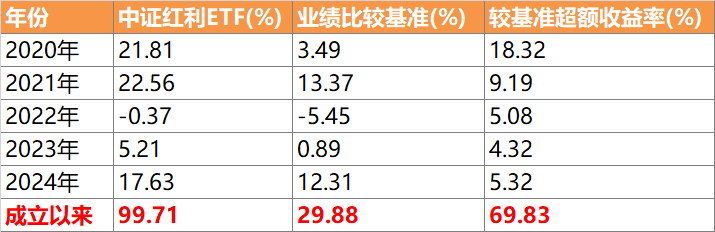
Core Viewpoint - The China Securities Dividend ETF (515080) has become a stable investment choice for many investors over its six years since listing, demonstrating strong performance and consistent dividend distribution [1][2]. Performance Overview - Since its inception, the China Securities Dividend ETF has outperformed its benchmark index, achieving a cumulative excess return of 69.83% as of Q3 2025 [2][3]. - The ETF has consistently outperformed its benchmark for five consecutive years since 2020, with annual returns as follows: 21.81% in 2020, 22.56% in 2021, -0.37% in 2022, 5.21% in 2023, and 17.63% in 2024 [3][19]. Dividend Distribution - The ETF has completed its fourth dividend distribution for the year in December 2025, with a distribution ratio of 1.26%, amounting to 0.2 yuan per ten shares [4]. - Since its listing, the ETF has distributed dividends 15 times, totaling 3.65 yuan per ten shares [4][5]. Growth in Scale and Investor Base - The scale of the China Securities Dividend ETF has increased from 340 million yuan at listing to 8.527 billion yuan, representing a 24-fold growth [7]. - The number of accounts holding the ETF has risen from 3,932 to 64,987, making it the leading ETF in its category [7]. Index Evolution - The underlying index of the ETF has undergone significant changes, with no overlap in the top ten constituent stocks compared to six years ago, indicating the index's adaptability and vitality [10][11]. Dividend Yield Comparison - The dividend yield of the China Securities Dividend Index has widened significantly compared to the 10-year government bond yield since 2019, with the current dividend yield at 5.12% versus 1.84% for government bonds [13]. Future Outlook - Analysts expect that the low interest rate environment will continue, making dividend assets attractive for long-term investors seeking stable cash flows [17]. - The market is anticipated to experience a "slow bull" trend in 2026, with dividend stocks expected to perform better than in 2025 due to their stable cash flow characteristics [17].
时间为友,共赴红利之约:六个维度,看中证红利ETF(515080)上市6周年
Sou Hu Cai Jing· 2025-12-29 02:55
Core Viewpoint - The China Securities Dividend ETF (515080) has become a stable investment choice for many investors over its six years since listing, demonstrating strong performance and consistent dividend payouts [1][2]. Performance Summary - Since its inception, the China Securities Dividend ETF has outperformed its benchmark index, achieving a cumulative excess return of 69.83% as of Q3 2025 [2][3]. - The ETF has consistently outperformed the benchmark for five consecutive years since 2020, with annual returns as follows: - 2020: 21.81% vs. 3.49% - 2021: 22.56% vs. 13.37% - 2022: -0.37% vs. -5.45% - 2023: 5.21% vs. 0.89% - 2024: 17.63% vs. 12.31% [3][19]. Dividend Distribution - The ETF has completed its fourth dividend distribution for the year, with a distribution ratio of 1.26% and a total of 3.65 yuan distributed per ten units since its inception [4][5]. - The ETF has maintained a quarterly dividend assessment rhythm since 2024, with a total of eight distributions planned for 2024-2025 [4]. Growth in Scale and Investor Base - The fund's scale has increased from 340 million yuan at listing to 8.527 billion yuan, marking a 24-fold growth over six years [7]. - The average daily trading volume has risen to 217 million yuan, making it the top ETF in its index [7]. - The number of accounts has grown from 3,932 at listing to 64,987, also ranking first among similar ETFs [7]. Index Evolution - The underlying index has undergone significant changes, with no overlap in the top ten constituent stocks compared to six years ago, indicating the index's ability to adapt and maintain vitality [10][11]. Dividend Yield Advantage - The dividend yield of the China Securities Dividend Index has widened significantly compared to the 10-year government bond yield since 2019, with the current dividend yield at 5.12% versus 1.84% for government bonds [13]. - This trend suggests that dividend-paying stocks are becoming increasingly attractive in a low-interest-rate environment, appealing to long-term capital [13]. Future Outlook - Analysts expect that the low-interest-rate environment will continue, with a stable demand for dividend assets as they provide reliable cash flow [17]. - The market is anticipated to experience a "slow bull" trend in 2026, with dividend stocks expected to perform better than in 2025 due to their stable cash flow characteristics [17].

周期的进攻与防守
2025-12-29 01:04
Summary of Key Points from Conference Call Records Industry Overview Chinese Companies and Global Demand - Chinese listed companies maintain higher overseas gross margins compared to domestic margins, particularly in capital and technology-intensive industries, indicating a significant competitive advantage [1] - The global demand in 2026 is expected to be favorable for Chinese outbound enterprises, benefiting from the latter half of the Federal Reserve's easing cycle, with an uptrend in global industrial and infrastructure capital expenditure [1][5] Aviation Industry - The aviation sector is viewed as a major investment opportunity, with ticket prices showing positive year-on-year growth, serving as a catalyst for the industry [1][6] - Despite fluctuations in December ticket prices, strong travel demand during the holiday season is anticipated to support price increases post-New Year [6] - Recommended stocks include China National Aviation, Juneyao Airlines, China Eastern Airlines, Southern Airlines, and Spring Airlines [6] Shipping and Oil Transportation - The oil shipping market experienced significant price fluctuations recently, with a notable drop in TCE rates for VLOCs [7] - Long-term outlook remains optimistic due to increased oil production driving demand, with a recommendation to focus on COSCO Shipping Energy, China Merchants Energy Shipping, and China Ship Leasing [8] Chemical Industry - The chemical sector, particularly the spandex segment, is performing well, with Huafeng Chemical showing significant cost advantages and benefiting from demand growth [9] - Other noteworthy areas include coal chemical companies like Hualu Hengsheng and soda ash producers like Boyuan Chemical [9] Metals Sector - The metals sector is experiencing strong performance, with gold reaching new highs and significant increases in silver, copper, aluminum, and lithium carbonate prices [11] - The supply side remains rigid, and the demand recovery driven by liquidity and AI-related factors is expected to keep prices on an upward trend [11][12] Company-Specific Insights Coal Market - Current coal prices are declining, with expectations of stabilizing around 670 RMB/ton as a bottom [3][18] - The outlook for 2026 suggests a rebound in coal demand due to a recovery in thermal power generation [21] Petrochemical Industry - The petrochemical sector is optimistic for 2026, with signs of inventory replenishment and a favorable price index for products [16] - The polyester supply chain is particularly promising, with recommendations for Tongkun Co., New Fengming, and Hengyi Petrochemical [17] New Materials - Focus areas in the new materials sector include lubricant additives, storage materials, and AI-related high-speed technologies, with specific companies recommended for investment [10] Energy Metals - The lithium carbonate market is expected to remain strong due to increasing storage demand, with recommendations for stocks in the energy metals sector [14] Steel Industry - Leading steel companies like Nanjing Steel and Baosteel are seen as good investment opportunities despite recent adjustments, with a projected decline in capital expenditure for 2026 [15] Additional Considerations - The overall sentiment for the Chinese stock market in 2026 is optimistic, driven by economic reforms and increased capital inflows [3] - The impact of monetary policy, geopolitical factors, and supply uncertainties on various sectors should be closely monitored [2]
金属行业继续共舞
2025-12-29 01:04
Summary of Key Points from Conference Call Industry Overview - The conference call primarily discusses the **metal industry**, focusing on precious metals, lithium carbonate, industrial base metals, and steel. Precious Metals - The outlook for precious metals remains optimistic due to factors such as liquidity turning points, geopolitical risks, de-dollarization trends, and central banks' ongoing gold purchases. [4] - Silver, driven by its industrial properties and demand from photovoltaic new energy and AI, is expected to see strong support. Leading companies in this sector are currently undervalued, presenting opportunities for price recovery and allocation. [4] Lithium Carbonate - Lithium carbonate prices have surged recently due to increased demand expectations and delayed supply recovery. [5] - Mid-term demand for lithium carbonate is expected to grow due to energy storage needs, while supply growth remains limited, leading to a positive long-term price outlook. [5] Industrial Base Metals - The future outlook for industrial base metals is optimistic, supported by declining interest rates, recovery in traditional demand, and new demand from AI. [6] - Copper supply is particularly tight, with potential strikes in Chile and encouragement from China's National Development and Reform Commission for mergers in the smelting industry, which may tighten supply further. [7] - The aluminum market is experiencing high prices despite being in the off-season, with a copper-aluminum ratio reaching 4.4. Supply is weaker than expected, and the introduction of copper-free air conditioning systems may further expand aluminum applications. [12] Inventory and Supply Risks - Non-US regions are experiencing low inventory days due to a siphoning effect towards the US, which may lead to risks of soft and hard squeezes in these areas. [8] Steel Industry - The steel industry is currently at a bottoming phase, presenting a good opportunity for gradual investment, especially in leading companies whose valuations have dropped to around 10 times earnings. [18] - Capital expenditures for these companies are expected to decrease next year, with increased dividends enhancing their attractiveness. [18] - Upcoming supply-side reform measures and the implementation of the "Steel Industry Normative Conditions" are anticipated to have a substantial impact on the market. [19] Rare Earth Market - The rare earth market is experiencing mixed performance, with light rare earth prices rising while medium and heavy rare earth prices are declining. [14] - Short-term price adjustments are expected, but long-term demand from strategic sectors like electric vehicles and wind power is likely to support price increases. [17] Investment Recommendations - Investors are encouraged to focus on sectors with low valuations and high dividend yields, particularly in copper, aluminum, tin, and tungsten. [16] - Recommended stocks include those with high dividend yields and potential growth, such as Yun Aluminum, Zhongfu Industrial, and China Hongqiao. [16] Overall Market Sentiment - The overall sentiment for the metal sector is positive, with expectations of a super cycle driven by macroeconomic factors, liquidity, rigid supply, and recovering demand. [20]