
宜明昂科

Search documents
创新药周报:全球首个口服HAE急性发作按需治疗药物获批上市-20250713
Huachuang Securities· 2025-07-13 14:22
Investment Rating - The report indicates a positive investment outlook for the hereditary angioedema (HAE) treatment sector, particularly following the approval of the first oral on-demand treatment, sebetralstat [14][21]. Core Insights - The report highlights the urgent need for effective HAE treatments due to the high risk of life-threatening episodes, with nearly half of HAE patients facing potential asphyxiation [10][16]. - Sebetralstat, approved by the FDA, is noted for its rapid onset of action, achieving near-complete inhibition of plasma kallikrein within 15 minutes of administration [21]. - The KONFIDENT trial results demonstrate that sebetralstat significantly reduces symptom relief time compared to placebo, with median relief times of 1.61 hours for the 300 mg dose and 1.79 hours for the 600 mg dose [20][21]. Summary by Sections Section 1: HAE Overview - HAE is characterized by recurrent episodes of angioedema without urticaria, with a prevalence of approximately 1.5 per 100,000 individuals [7]. - The disease can lead to severe complications, including laryngeal edema, which has a mortality rate of up to 40% among patients [7][10]. Section 2: Current Treatment Landscape - Existing treatments include long-term preventive therapies (LTP) and on-demand treatments for acute episodes [10][11]. - The global HAE drug market reached $2.9 billion in 2022, with $2 billion attributed to long-term prevention and $900 million to acute on-demand treatments [13]. Section 3: Sebetralstat Approval and Efficacy - Sebetralstat is the first oral on-demand treatment for HAE, approved on July 7, 2025, and is expected to address unmet needs in the treatment landscape [21]. - The KONFIDENT trial, involving 136 patients across 20 countries, confirmed the efficacy and safety of sebetralstat, showing significant improvements in symptom relief and severity reduction compared to placebo [21]. Section 4: Future Developments - Pharvaris is developing deucrictibant, a competitive oral antagonist for HAE, with promising Phase II trial results indicating effective management of HAE attacks [26]. - The report anticipates further advancements in HAE treatments, with ongoing clinical trials expected to yield additional data in the coming years [26].
华创医药投资观点、研究专题周周谈第134期:中药企业的创新布局-20250712
Huachuang Securities· 2025-07-12 07:39
Investment Rating - The report maintains an optimistic outlook on the pharmaceutical industry, particularly for 2025, suggesting a potential for diverse investment opportunities as the sector recovers from low valuations and public fund allocations [10]. Core Insights - The pharmaceutical sector is currently experiencing low valuations, with public funds under-allocating to this area. The report anticipates a recovery driven by macroeconomic factors and significant product launches [10]. - The report emphasizes a shift in the innovative drug sector from quantity to quality, highlighting the importance of differentiated products and international expansion for profitability [10]. - The medical device sector is seeing a rebound in bidding volumes, particularly in imaging equipment, and is expected to benefit from domestic product upgrades and international market expansion [10]. - The report identifies a growing trend in the CXO and life sciences services sector, with expectations for increased investment and a recovery in demand [10]. - The traditional Chinese medicine sector is projected to benefit from policy changes and market dynamics, with specific companies recommended for investment based on their unique product offerings and market positions [12]. Summary by Sections Market Review - The report notes a 1.80% increase in the CITIC Pharmaceutical Index, outperforming the CSI 300 Index by 0.98 percentage points, ranking 16th among 30 sectors [7]. - The top-performing stocks include Frontline Bio-U, MediWest, and Lianhuan Pharmaceutical, while the worst performers include ST Weiming and Innovent Biologics [7]. Overall Perspective and Investment Themes - The report suggests that the pharmaceutical industry is poised for growth, with a focus on innovative drugs, medical devices, and traditional Chinese medicine. Specific companies are highlighted for their potential in these areas [10][12]. - The report also discusses the implications of policy changes and market trends for the pharmaceutical and medical device sectors, indicating a favorable environment for investment [10][12]. Company-Specific Insights - Companies like Baiyi, Xinda, and Kangfang are highlighted for their innovative drug pipelines and potential for growth in the coming years [10][12]. - The report provides detailed insights into the clinical progress of various drugs across different companies, indicating a robust pipeline that could drive future revenue [13][20][24][30][35][38].



华创医药周观点:中药企业的创新布局2025/07/12
华创医药组公众平台· 2025-07-12 07:05
Market Review - The CITIC Pharmaceutical Index increased by 1.80%, outperforming the CSI 300 Index by 0.98 percentage points, ranking 16th among 30 CITIC first-level industry indices [5] - The top ten stocks by increase this week include Frontier Biologics-U, Medici, Lianhuan Pharmaceutical, Kangchen Pharmaceutical, and others, with Frontier Biologics-U leading at 41.43% [4][5] - The bottom ten stocks by decrease include ST Weiming, Shenzhou Cell, and Shuotai Shen, with ST Weiming dropping by 18.51% [4][5] Overall Viewpoint and Investment Themes - The current valuation of the pharmaceutical sector is at a low point, with public funds (excluding pharmaceutical funds) having low allocation to the sector. The company remains optimistic about the growth of the pharmaceutical industry by 2025, driven by macroeconomic factors and the demand from major categories [9] - In the innovative drug sector, there is a shift from quantity logic to quality logic, focusing on differentiated domestic and international pipelines. The company suggests paying more attention to products and companies that can ultimately realize profits [9] - In the medical device sector, there is a noticeable recovery in bidding volumes for imaging equipment, and the home medical device market is expected to benefit from subsidy policies. The company highlights the potential for import substitution and growth in the orthopedic sector post-collection [9] - The innovation chain (CXO + life sciences services) is expected to see a rebound in overseas investment and a bottoming out in domestic investment, with a potential return to high growth by 2025 [9] - The pharmaceutical industry is anticipated to enter a new growth cycle, with a focus on specialty raw materials and the expiration of patents leading to new growth opportunities [9] Industry and Company Events - The company highlights the innovative layout of traditional Chinese medicine enterprises, with several products in clinical II and III phases, including those targeting chronic insomnia and primary acute gouty arthritis [29][30] - Yunnan Baiyao has several drugs in various clinical stages, including those for prostate cancer and other conditions, indicating a robust pipeline [16][19] - The company emphasizes the importance of the blood products sector, which is expected to see significant growth due to relaxed approval processes and increased production capacity [14] - The innovative drug pipeline of Yiling Pharmaceutical focuses on cardiovascular, respiratory, and endocrine diseases, with multiple drugs in clinical trials [20][21]


君实生物午后涨超10% PD-(L)1/VEGF赛道景气度提高 机构称JS207具备BD潜力
Zhi Tong Cai Jing· 2025-07-04 06:09
Group 1 - Junshi Biosciences (01877) saw its stock price increase by over 10%, currently trading at 26.2 HKD with a transaction volume of 4.52 billion HKD [1] - The preclinical research results of JS207, a recombinant humanized PD-1 and VEGF bispecific antibody developed by Junshi, were published in the journal "Frontiers in Immunology," detailing its molecular design, in vitro characteristics, functions, and anti-tumor efficacy [1] - According to Founder Securities, the preclinical data of JS207 demonstrates the potential of second-generation PD-1 antibodies in anti-tumor applications, indicating its business development (BD) potential [1] Group 2 - Reports indicate that AstraZeneca is in discussions with Summit regarding a collaboration on the AK112 drug, with a potential deal value of up to 15 billion USD [2] - PD-(L)1/VEGF bispecific antibodies are expected to be the next-generation cornerstone drugs in the immuno-oncology market, with ongoing combinations with ADC/TCE likely to expand market opportunities [2] - As of May 2025, only Pfizer and Merck have entered this market segment among multinational corporations, suggesting that other early-stage PD-(L)1/VEGF bispecific antibodies from China may have opportunities for business development abroad as data matures [2]

合成生物学周报:工信部征集非粮生物基材料案例,常德市出台全国首部合成生物制造法规-20250703
Huaan Securities· 2025-07-03 05:38
Investment Rating - The report does not explicitly state an investment rating for the synthetic biology industry Core Insights - The synthetic biology sector is experiencing a global technological revolution, providing innovative solutions to major challenges such as health, climate change, and food security, as highlighted by the National Development and Reform Commission's "14th Five-Year Plan for Bioeconomic Development" [4] - The Huazhong Securities Synthetic Biology Index, which includes 58 companies across various sectors, has seen a decline of 3.42% recently, underperforming compared to the Shanghai Composite Index and the ChiNext Index [5][17] - The first local regulations for synthetic biology manufacturing were passed in Changde, Hunan, aimed at promoting industry development and addressing issues like talent shortages and approval efficiency [8][10] Summary by Sections 1.1 Secondary Market Performance - The synthetic biology sector's stocks have shown poor performance, with a recent decline of 3.42%, ranking 32nd among sectors [17] - The top-performing companies include Jincheng Pharmaceutical (+11%), Xinhai Hengli (+10%), and Dongbao Biological (+7%) [18] 1.2 Company Business Progress - Kexin Pharmaceutical's CAR-T therapy targeting Claudin18.2 has received regulatory acceptance for market application, offering new treatment options for advanced gastric cancer patients [23] - Angel Yeast announced a significant investment of 5.56 billion yuan to expand its biological manufacturing center and enhance its product lines [23] - Internationally, Covestro acquired Swiss film technology company Pontacol to strengthen its specialty materials business [25] 1.3 Industry Financing Tracking - The synthetic biology sector is witnessing accelerated financing, with nearly 100 companies completing new funding rounds since the beginning of 2025 [31] - Zhejiang Rongrui Technology completed nearly 100 million yuan in Pre-A financing, focusing on green biological manufacturing [31] - Avantium, a Dutch biobased PEF company, secured 10 million euros to alleviate short-term liquidity pressures [31]

生物医药企业集体大涨,中国生物药原创时代来了吗?
Di Yi Cai Jing· 2025-06-09 06:53
Core Viewpoint - The innovation speed and cost-effectiveness of Chinese biopharmaceutical companies have surpassed that of American companies, leading to a surge in stock prices for several Chinese biopharma firms [1][2]. Group 1: Market Performance - On June 9, 2023, Chinese biopharmaceutical companies saw a collective stock price increase, with Kelun-Botai (6990.HK) rising nearly 6% to a market cap exceeding HKD 80 billion, BeiGene (688235.SH) up over 8%, and Junshi Biosciences (688180.SH) up over 5% [1]. - The optimism surrounding original drug licensing contributed to the stock price increases, particularly following data presentations from Chinese companies at the recent ASCO annual meeting [1]. Group 2: International Interest - In recent months, American and European pharmaceutical companies have invested billions in acquiring Chinese-developed drugs, yielding returns for these companies [2]. - During the ASCO conference, BioNTech's resale of a tumor dual-antibody drug acquired from China's Pumice Biotech for over USD 10 billion to Bristol-Myers Squibb (BMS) highlighted the market's excitement [2]. - BMS is betting on a dual-antibody drug targeting PD-L1 and VEGF for treating various solid tumors, which shows potential to replace Merck's leading cancer drug, Keytruda [2]. Group 3: Competitive Landscape - The valuation of Chinese innovative drugs is considered reasonable by multinational companies, as they seek products with patent protection for lifecycle management [4]. - China has surpassed the U.S. in the number of clinical trials and has seen a significant increase in patent filings, attracting multinational pharmaceutical companies [4]. - AstraZeneca announced a USD 2.5 billion investment to establish a research center in Beijing, reflecting the growing interest in China's biopharmaceutical sector [4]. Group 4: Innovation and Development - Chinese biopharmaceutical companies have made rapid advancements in innovation over the past decade, although they still have a long way to go in achieving "original innovation" [4]. - The PD-L1/VEGF dual-antibody drug represents a significant innovation compared to traditional combination therapies, offering easier administration and potential cost reductions [4]. - Local companies like Kelun-Botai and InnoCare Pharma are actively investing in the development of antibody-drug conjugates (ADCs) in the competitive oncology market [4]. Group 5: Clinical Achievements - On June 6, 2023, Kelun-Botai's ADC drug, SKB264, received approval from the National Medical Products Administration (NMPA) and became the first TROP2 ADC drug approved for lung cancer indications globally [5]. - InnoCare Pharma presented data at ASCO indicating that its HER3-targeting ADC drug has potential comparable to Kelun-Botai's SKB264 for treating EGFR-resistant non-small cell lung cancer [5].

谁是下一个三生制药?
Hu Xiu· 2025-06-09 04:25
Core Insights - The PD-1/VEGF dual antibody is currently a hot topic in innovative drug development, with significant collaborations and financial transactions highlighting its potential [1][2][3] Group 1: Industry Dynamics - Chinese biotech companies are emerging as key players in the global PD-(L)1/VEGF dual antibody development race, demonstrating advanced research progress and achieving international recognition through high-value business development (BD) deals [2][3] - Major collaborations include 12.5 billion USD upfront payment and 60.5 billion USD total deal value between 3SBio and Pfizer for SSGJ-707, and BioNTech's 15 billion USD upfront payment for BNT327 licensed to BMS, totaling over 90 billion USD [1][2] Group 2: Clinical Developments - The PD-(L)1/VEGF target gained traction after Kangfang Biotech's AK112 outperformed the benchmark drug, Pembrolizumab (K drug), in head-to-head trials, leading to increased interest from multinational corporations (MNCs) [3][4] - AK112 demonstrated a higher objective response rate (ORR) of 50% compared to K drug's 38.5% and a disease control rate (DCR) of 89.9% versus 70.5% in late-stage non-small cell lung cancer (NSCLC) trials [4][6] Group 3: Competitive Landscape - The success of AK112 has intensified competition among MNCs, with companies eager to capitalize on the potential of PD-(L)1/VEGF dual antibodies, as evidenced by Pfizer's strategic investments [9][10] - As of May 2025, there are 14 PD-(L)1/VEGF dual antibodies in clinical stages globally, with half originating from Chinese biotech firms, indicating a robust pipeline and potential for further BD opportunities [15][24] Group 4: Future Prospects - Companies like Junshi Biosciences, I-Mab, and Hualan Biological Engineering are actively pursuing PD-(L)1/VEGF dual antibodies, with significant investments and clinical trials underway [15][20][22] - The shift from merely imitating existing drugs to innovating new targets and technologies marks a significant evolution in the Chinese pharmaceutical industry, enhancing its international competitiveness [24][25]

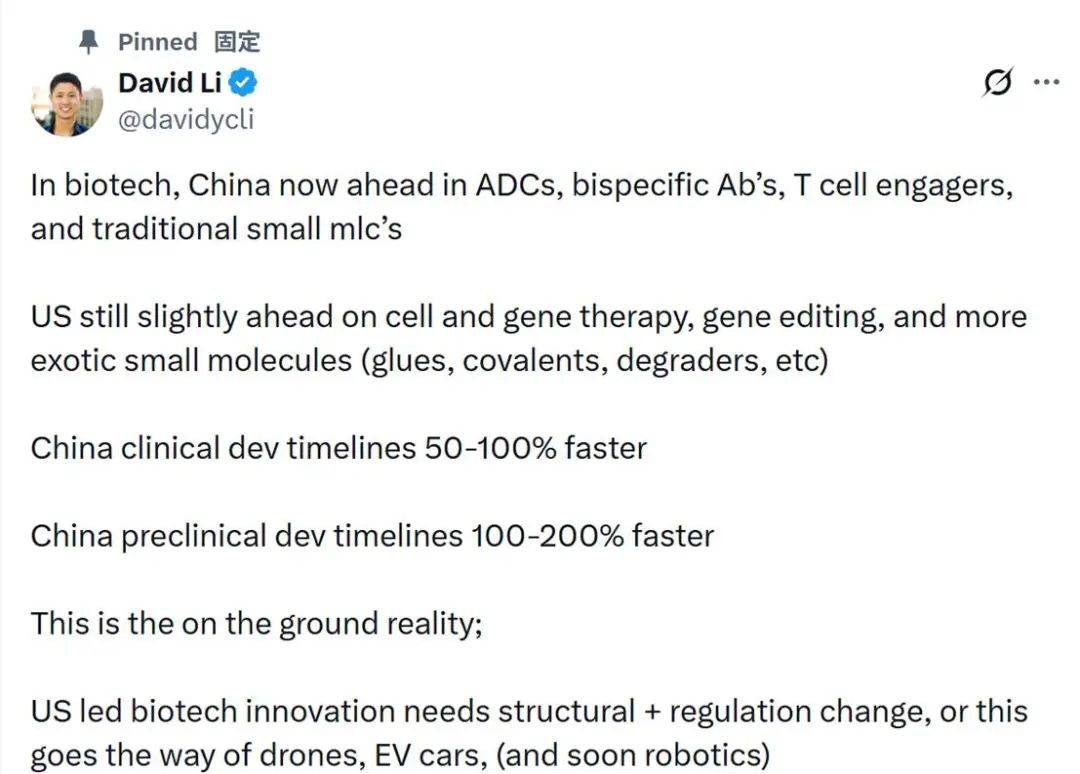
中国创新药,正让美国担心会是下一个DeepSeek、无人机、电动车
Hu Xiu· 2025-06-04 01:57
Core Insights - The article highlights the increasing recognition among U.S. pharmaceutical insiders of China's innovative drug sector reaching a "DeepSeek moment," where U.S. companies are investing heavily in Chinese new drugs as a strategic bet on their potential [1][5] - The competitive advantage of Chinese innovation still hinges on breakthroughs in core innovation, despite the current advantages in cost and efficiency [1][4] Group 1: Investment Trends - Pfizer acquired overseas rights for a PD-1/VEGF dual antibody from 3SBio for over $6 billion, including an upfront payment of $1.25 billion [1] - Bristol-Myers Squibb secured co-development rights for a similar drug from BioNTech for $11.1 billion, with an upfront payment of $1.5 billion [1] - Chinese companies have sold overseas rights for innovative drugs to U.S. firms, with total commitments nearing $30 billion [3][12] Group 2: Competitive Landscape - There are currently 35 PD-1/VEGF dual antibodies in development globally, with 20 originating from China, indicating a strong clinical advancement from Chinese firms [2] - Chinese companies have evolved from being five years behind in PD-1 monoclonal antibodies to being approximately three years ahead in the dual antibody space [3] Group 3: Research and Development Efficiency - Chinese firms are leveraging engineering optimization as a competitive advantage, combining different monoclonal antibodies and small molecules to create innovative therapies [4] - The cost and speed advantages of Chinese teams in drug development are significant, with estimates suggesting 2-3 times lower costs and about double the speed compared to U.S. teams [6] Group 4: Market Dynamics - In Q1 of this year, 37% of innovative drug transactions with upfront payments over $50 million originated from Chinese companies, nearly doubling from two years ago [7] - Chinese companies now account for 67% of global transactions in oncology, 60% in cardiovascular diseases, and 50% in endocrine and autoimmune diseases [7] Group 5: Future Outlook - The trend of Chinese innovation in pharmaceuticals is expected to continue expanding into other therapeutic areas, with increasing competition anticipated between Chinese and U.S. firms [10] - The "DeepSeek moment" in Chinese biopharmaceuticals is raising awareness among U.S. markets, prompting significant acquisitions and strategic partnerships [10][12]

BioNTech不到十亿美元收购中国公司获得的药,转手卖了超百亿美元
Di Yi Cai Jing· 2025-06-03 03:56
Core Insights - Chinese biotechnology companies are leading the development of PD-L1/VEGF bispecific antibody drugs, with BMS partnering with BioNTech to commercialize a next-generation cancer immunotherapy [1][5] - BioNTech acquired the drug BNT327 from a Chinese company for less than $1 billion, and within six months, it was sold for over $11 billion [1][3] Group 1: Company Developments - BMS plans to invest up to $11.1 billion in collaboration with BioNTech to develop and commercialize BNT327, a bispecific antibody targeting PD-L1 and VEGF-A for various solid tumors [1][4] - BNT327 is currently undergoing clinical trials as a first-line treatment for extensive-stage small cell lung cancer and non-small cell lung cancer, with over 1,000 patients treated so far [4] Group 2: Market Impact - The announcement of the BMS and BioNTech deal led to a more than 20% increase in BioNTech's stock price and a nearly 30% rise in Instil Bio's stock price, indicating strong market interest in PD-L1/VEGF bispecific antibodies [5] - PD-L1/VEGF bispecific antibodies are becoming a hot research area in the pharmaceutical industry, with potential to replace Merck's Keytruda, which is projected to generate $29.5 billion in sales for the fiscal year 2024 [5] Group 3: Clinical Data and Collaborations - Recent clinical trial results from Kangfang Biotech and Summit Therapeutics showed that their PD-1/VEGF bispecific antibody, ivonescimab, reduced the risk of disease progression or death by 48% in previously treated patients with EGFR-mutant non-squamous non-small cell lung cancer [5] - Pfizer announced a collaboration with China's 3SBio for the PD-1/VEGF bispecific antibody SSGJ-707, with an upfront payment of $1.25 billion and potential milestone payments of up to $4.8 billion [6]


MCE:B细胞自免疾病治疗新方向
Huachuang Securities· 2025-05-14 10:10
Investment Rating - The report provides a positive investment rating for the MCE therapy in the treatment of B cell autoimmune diseases, particularly systemic lupus erythematosus (SLE) [8][10]. Core Insights - The report highlights the urgent need for effective treatments for SLE, which currently lacks a root-cause therapy, and emphasizes the potential of B cell-targeted therapies like MCE to address this unmet clinical need [10][22]. - It discusses the advantages of MCE therapy over existing treatments such as CAR-T and TCE, particularly in terms of safety and efficacy in depleting pathogenic B cells [10][42]. - The report identifies key companies to watch in the clinical progress of MCE therapies, including 宜明昂科, 赛诺菲, Dren Bio, and LTZ Therapeutics [11][12]. Summary by Sections 1. B Cell Autoimmune Diseases: Diverse Types and Large Population - Autoimmune diseases involve the immune system mistakenly attacking the body's own tissues, with significant prevalence among conditions like rheumatoid arthritis (RA), systemic lupus erythematosus (SLE), multiple sclerosis (MS), and others [14][15]. 2. SLE: Large Population and Heavy Disease Burden - SLE affects approximately 7.8 million people globally, with a significant patient population in China, estimated at around 1 million [18][19]. - The disease presents severe symptoms and complications, leading to a high demand for effective treatments [19]. 3. SLE Treatment: Significant Unmet Clinical Needs, B Cell Therapy as a Mainstream Development - Current treatments for SLE are inadequate, with a low long-term remission rate and high recurrence risk [20][21]. - Innovative therapies that can achieve long-term remission or potential cures are urgently needed in the SLE treatment landscape [22]. 4. T Cell Killing: CAR-T and TCE - CAR-T and TCE therapies are explored for their potential to target and deplete pathogenic B cells, with CAR-T showing promising long-term efficacy in SLE patients [25][26]. - However, challenges such as high costs and safety concerns remain significant barriers to widespread adoption [32][33]. 5. Myeloid Cell Killing: MCE - MCE therapy utilizes myeloid cells to target and eliminate pathogenic B cells, showing potential for improved safety profiles compared to CAR-T and TCE therapies [47][50]. - The report emphasizes the innovative mechanisms of MCE and its potential to address the limitations of existing therapies [52].
