
百利天恒

Search documents
科创板收盘播报:科创50指数跌2.8% 生物制药股表现活跃
Xin Hua Cai Jing· 2026-01-13 07:38
Core Viewpoint - The Sci-Tech Innovation 50 Index experienced a significant decline on January 13, closing at 1469.57 points, down 2.8%, with a trading volume of approximately 104.4 billion yuan [1]. Group 1: Index Performance - The Sci-Tech Innovation Composite Index also fell by 2.66%, closing at 1806.02 points, with a total trading volume of about 375.2 billion yuan [1]. - The average decline for the 600 stocks on the Sci-Tech Board was 1.79%, with an average turnover rate of 4.95% and an average volatility of 6.22% [1]. Group 2: Stock Performance - Rongchang Biopharmaceuticals reached the daily limit, showing the highest increase [2]. - Aerospace Hanyu experienced the largest drop, falling by 18.33% [2]. Group 3: Trading Volume - Cambrian's trading volume was 14.47 billion yuan, ranking first [3]. - ST Pava had the lowest trading volume at 867,000 yuan [3]. Group 4: Turnover Rate - Jianxin Superconducting had the highest turnover rate at 25.97% [4]. - Baile Tianheng recorded the lowest turnover rate at 0.26% [4].
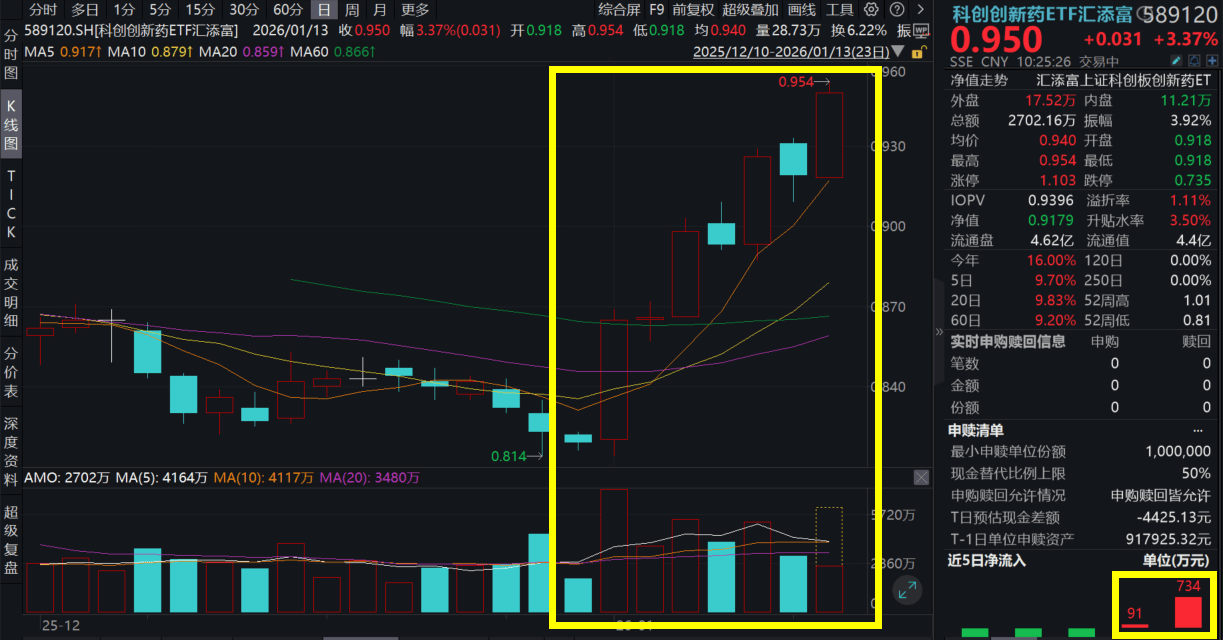
重磅BD!荣昌生物双抗新药56亿美元出海,爆涨17%!20CM科创创新药ETF汇添富(589120)放量大涨超3%,连续2日吸金!BD出海+AI催化,创新药新征途
Sou Hu Cai Jing· 2026-01-13 02:49
Group 1 - The A-share market experienced fluctuations with the Shanghai Composite Index showing volatility, while trading volume exceeded 1.8 trillion yuan, indicating sustained active trading [1] - The innovative drug sector saw significant strength, with the Science and Technology Innovation Drug ETF Huatai (589120) surging over 3% as funds continued to flow into it for two consecutive days, driven by optimism around "BD going global + AI healthcare + brain-computer interfaces" [1] - The top ten constituent stocks of the Huatai ETF include companies like BeiGene (688235) and Junshi Biosciences (688180), with Rongchang Biopharmaceuticals (688331) leading with a 17.29% increase [1][5] Group 2 - Rongchang Biopharmaceuticals announced a licensing agreement with AbbVie for RC148, which includes a $650 million upfront payment and potential milestone payments up to $4.95 billion, along with double-digit royalties on net sales outside Greater China [1][2] - The transaction size of the upfront payment ranks among the top ten for domestic innovative drug companies going global, indicating the potential of RC148 in the global market [2] - The trend in the industry is shifting from "early licensing" to "deep binding" partnerships, with companies like Hengrui Medicine and Qianxin Biopharmaceuticals actively engaging in new cooperative models that share risks and long-term benefits [4][6] Group 3 - The innovative drug sector is expected to enter a phase of significant growth, with a focus on the lifecycle of BD transactions, which includes achieving overseas clinical validation and profit-sharing from sales [3][4] - The market anticipates a busy period for BD transactions, with 49 deals totaling over $39 billion since October, as multinational corporations continue to expand in China [6] - The upcoming JPM conference in January 2026 is expected to catalyze further activity in the sector, coinciding with the annual report cycle, suggesting a peak in data disclosures and BD transactions [6]


创新药概念股早盘上扬 “医药春晚”JPM大会正式启幕 中国创新药企将集体亮相
Zhi Tong Cai Jing· 2026-01-13 02:15
Group 1 - The core viewpoint of the articles highlights a significant rise in Chinese innovative pharmaceutical stocks, driven by the upcoming 44th JPMorgan Healthcare Conference, where multiple Chinese companies are set to showcase their products [1][2] - Notable stock performances include a 6.35% increase for 3SBio, a 7.22% increase for WuXi AppTec, and a 6.64% increase for Lepu Biopharma, indicating strong market interest in these companies [1] - The conference serves as a critical platform for domestic pharmaceutical companies to demonstrate their core molecular product capabilities and advance overseas business development collaborations [2] Group 2 - The industry is transitioning back to a phase of global value verification for products, with a focus on global clinical advancements and the release of significant data [2] - Chinese innovative drug valuations have shifted from being perceived as "assets to be bought" to a stage of "global value," reflecting a broader recognition of their potential in the international market [2] - The Chinese pharmaceutical industry has largely completed the transition from old to new growth drivers, with innovative drugs significantly contributing to new growth trajectories for companies [2]

港股异动 | 创新药概念股早盘上扬 “医药春晚”JPM大会正式启幕 中国创新药企将集体亮相
智通财经网· 2026-01-13 02:05
Core Viewpoint - The innovative pharmaceutical stocks have shown significant gains, driven by the upcoming 44th JPMorgan Healthcare Conference, where multiple Chinese innovative drug companies are set to participate [1] Group 1: Stock Performance - Innovent Biologics (01530) increased by 6.35%, trading at HKD 28.82 [1] - WuXi AppTec (02359) rose by 7.22%, trading at HKD 118.8 [1] - Lepu Biopharma-B (02157) saw a rise of 6.64%, trading at HKD 28.9 [1] - Galenica-B (01672) increased by 4.09%, trading at HKD 12.97 [1] - Genscript Biotech (01952) rose by 3.97%, trading at HKD 40.84 [1] Group 2: Conference Participation - The 44th JPMorgan Healthcare Conference is set to begin on January 12, 2026, in San Francisco, with several Chinese innovative drug companies confirming their attendance [1] - Key speakers include WuXi AppTec, WuXi Biologics, and WuXi AppTec's subsidiary, along with innovative drug companies such as BeiGene, Zai Lab, Ascentage Pharma, and Legend Biotech [1] - A total of 17 companies, including Hengrui Medicine, Baillie Gifford, Innovent Biologics, and Rongchang Biologics, will participate in the Asia-Pacific session [1] Group 3: Industry Insights - According to Guojin Securities, the conference serves as a critical platform for domestic pharmaceutical companies to showcase their core molecular product capabilities and advance overseas business development collaborations [1] - The industry is transitioning back to a phase of global value verification for products, with ongoing clinical advancements, significant data releases, and improved competitive dynamics driving multiple rounds of revaluation for product global value and corporate valuations [1] - Huayuan Securities indicates that the Chinese pharmaceutical industry has largely completed the transition from old to new growth drivers, with innovative drugs significantly opening new growth trajectories for companies [1]

科创综指创历史新高 17股收于约20%涨停 软件服务股领涨
Zhong Guo Jin Rong Xin Xi Wang· 2026-01-12 07:37
Market Performance - The STAR Market indices opened significantly higher on January 12, with the STAR Composite Index closing at 1855.38 points, up 2.88%, and the STAR 50 Index closing at 1511.84 points, up 2.43% [1] - The total trading volume for the STAR Market reached approximately 381.8 billion yuan, with the STAR 50 Index contributing around 106.6 billion yuan [1] Historical Context - The closing level of the STAR Composite Index on January 12, 2026, surpassed its previous closing level of 1809.82 points on July 13, 2020, marking a historical high [1] Stock Performance - On January 12, 447 stocks on the STAR Market rose, accounting for 74.5% of the total, with 17 stocks, including Puyuan Information and Xinke Mobile, hitting the 20% daily limit up [1] - The average increase for 600 stocks on the STAR Market was 3.02%, with an average turnover rate of 5.14% and a total trading volume of approximately 381.76 billion yuan [1] Sector Analysis - Software service stocks performed well, with 9 stocks reaching the 20% limit up, while biopharmaceutical and chemical raw material stocks showed relative weakness [1] - The stock with the highest trading volume was Cambrian, at 14.379 billion yuan, while ST Pava had the lowest at 915.97 million yuan [2] Turnover Rate - The stock with the highest turnover rate was Bibet, at 27.07%, while Baili Tianheng had the lowest turnover rate at 0.23% [3]
JPM 2026医疗健康峰会:系统性梳理530家参会公司之后,我们看见什么新趋势?
GLP1减重宝典· 2026-01-12 04:07
Core Insights - The article discusses the upcoming 44th J.P. Morgan Global Healthcare Conference, focusing on the evolving landscape of the healthcare industry and investment opportunities within various sectors [4][28]. - It highlights the shift in investment focus from conceptual discussions to tangible clinical and commercialization pathways, particularly in biotechnology and biopharmaceuticals [6][24]. Group 1: Conference Overview - The conference will feature approximately 530 participating entities, categorized into six main sectors, with biotechnology and biopharmaceuticals representing 44.1% of the total [6]. - The event aims to address key investment questions regarding which sectors are transitioning from theoretical discussions to practical applications and which companies are likely to achieve cross-cycle premium valuations [4]. Group 2: Sector Analysis - **Biotechnology Sector**: Comprises 24.1% of participants, focusing on clinical and regulatory milestones. Companies like BridgeBio and Sarepta are highlighted for their advancements in genetic therapies [13]. - **Biopharmaceutical Sector**: Accounts for 20.0% of participants, with a focus on stable cash flows and research efficiency. Companies such as AbbVie and Amgen are noted for their strong market positions and innovative pipelines [14][15]. - **Medical Devices Sector**: Represents 7.6% of participants, emphasizing the importance of clinical integration and operational efficiency in device adoption. Companies like Intuitive Surgical and Dexcom are recognized for their impactful innovations [17]. - **Healthcare Services and Payments Sector**: Also at 7.6%, this sector faces challenges due to regulatory changes and market dynamics. The focus is on understanding profit structures and cost management [18]. - **Digital Health Sector**: Comprises 3.7% of participants, with companies like Veeva and Teladoc addressing efficiency and cost control in healthcare delivery [19]. - **Diagnostics and Precision Medicine Sector**: Focuses on the integration of diagnostic tools into clinical pathways, with companies like Illumina and Guardant Health leading the way [20][21]. Group 3: Trends and Opportunities - The article notes a significant shift in the role of Chinese CXO companies in the global pharmaceutical innovation ecosystem, moving from cost-driven outsourcing to integral participants in drug development [11]. - The conference reflects a consensus on the need for clear pricing strategies and the importance of clinical, payment, and commercialization pathways in determining company valuations [28][30]. - Chinese pharmaceutical companies are transitioning from domestic validation of technologies to proving their global indispensability, with a focus on international clinical trial efficiency and global registration pathways [22][24][26].

多笔里程碑款项到账,中国创新药“兑现价值” ,1.5万亿美元大市场加速成长
Jin Rong Jie· 2026-01-12 00:44
Group 1 - The core viewpoint of the articles highlights the acceleration of innovation in the biopharmaceutical sector in Guangzhou, focusing on monoclonal antibodies, vaccines, blood products, and diagnostic reagents, aiming for high-end and international development [1] - By 2025, the total value of China's innovation drug license-out transactions is expected to reach $135.655 billion, with an upfront payment of $7 billion and a total of 157 transactions, significantly surpassing the 2024 figures of $51.9 billion and 94 transactions [1] - The collaboration between Bai Li Tian Heng and Bristol-Myers Squibb (BMS) resulted in a milestone payment of $250 million, setting a record for domestic ADC projects, while other partnerships are also expected to yield substantial payments [1] Group 2 - The National Medical Products Administration reports that by the first half of 2025, China's innovation drug license-out transaction scale is nearing one-third of the global market, with 210 innovative drugs approved during the "14th Five-Year Plan" period [2] - The "15th Five-Year Plan" suggests that specialized funds for cell therapy and gene editing will exceed 30 billion yuan, indicating a strong future for these sectors [2] - The domestic innovation drug market is projected to grow, with the share of overseas revenue increasing from 15% in 2025 to 30% by 2030, contributing to a new growth driver for the industry [2]
JPM 2026医疗健康峰会:系统性梳理530家参会公司之后,我们看见什么新趋势?
GLP1减重宝典· 2026-01-10 15:22
Core Insights - The article discusses the upcoming 44th J.P. Morgan Global Healthcare Conference, focusing on the evolving landscape of the healthcare industry and investment opportunities within various sectors [4][28]. Group 1: Conference Overview - The conference will feature approximately 530 participating entities, categorized into six major sectors, with a focus on identifying which sectors are transitioning from theoretical discussions to practical implementations [4][6]. - The sectors include biotechnology (24.1%), biopharmaceuticals (20.0%), medical devices (7.6%), healthcare services and payments (7.6%), digital health (3.7%), and diagnostics and precision medicine (3.5%) [6]. Group 2: Sector Analysis - **Biotechnology**: Companies are shifting focus from technological breakthroughs to the validation of clinical and regulatory milestones. Notable companies include BridgeBio and Sarepta, which are advancing towards commercialization [13][15]. - **Biopharmaceuticals**: The sector is undergoing a repricing of its fundamentals, emphasizing cash flow stability and R&D efficiency. Companies like AbbVie and Merck are highlighted for their strong market positions [14][15]. - **Medical Devices**: The focus is on the ability of devices to integrate into clinical pathways and improve operational metrics. Companies like Intuitive Surgical and Dexcom are noted for their innovative approaches [17]. - **Healthcare Services and Payments**: This sector faces challenges due to policy impacts and utilization rates. The market is increasingly focused on the ability to clearly explain profit structures [18]. - **Digital Health**: Although smaller in representation, this sector is gaining attention for its role in enhancing hospital efficiency and cost management. Companies like Veeva and Teladoc are leading discussions on sustainable business models [19]. - **Diagnostics and Precision Medicine**: The focus is on the integration of diagnostic tools into clinical decision-making processes. Companies like Illumina and Guardant Health are key players in this space [20][21]. Group 3: China’s Role in Global Healthcare - Chinese companies are transitioning from demonstrating innovation to proving their irreplaceability in the global market. This shift is characterized by a dual approach of independent R&D and international collaborations [22][24]. - Companies like HengRui and BeiGene are highlighted for their efforts in advancing their clinical pipelines and establishing a global presence [26][27]. Group 4: Investment Focus - The article emphasizes that the market is increasingly focused on a few verifiable variables across all sectors, rather than broad narratives. This includes the ability to demonstrate clinical, payment, and commercialization effectiveness [28][30]. - The 2026 outlook suggests a reliance on structural choices and execution capabilities, with companies that can provide clear answers to these questions likely to achieve cross-cycle premium valuations [30].

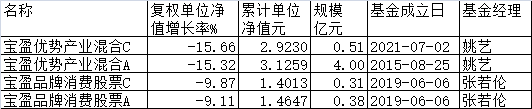
2025年宝盈基金旗下4只基金跌超9%?2只基金跌幅达15%
Zhong Guo Jing Ji Wang· 2026-01-09 14:34
Group 1 - The core point of the article highlights that four funds under Baoying Fund experienced a decline of over 9% in 2025, with specific funds managed by Yao Yi and Zhang Ruolun showing significant losses [1][2] - Baoying Advantage Industry Mixed C and A funds reported declines of 15.66% and 15.32% respectively, with Yao Yi managing these funds since March 2021 after a tenure at Huatai Securities [1][2] - The top ten holdings of Baoying Advantage Industry Mixed fund include companies such as Bai Li Tianheng, Heng Rui Pharmaceutical, and WuXi AppTec, indicating a focus on the pharmaceutical sector [1] Group 2 - Baoying Brand Consumption Stock C and A funds recorded declines of 9.87% and 9.11% respectively, managed by Zhang Ruolun since August 2025 [1][2] - The Baoying Brand Consumption fund maintains a diversified portfolio across major consumer sectors, with top holdings including Kweichow Moutai, Tencent Holdings, and Haidilao [1][2] - The funds have been operational since 2019, with the Brand Consumption funds focusing on sectors like liquor, home appliances, and leisure food [1][2]
森瑞投资林存:创新药2026年开了个好头!|生物医药大健康2026思享汇
Jin Rong Jie· 2026-01-09 10:43
Core Insights - The biopharmaceutical industry is at a pivotal moment as it transitions from the "14th Five-Year Plan" to the "15th Five-Year Plan," emphasizing the balance between technological innovation and value-driven growth [1] - The recent surge in the innovative drug sector, with the Shanghai Composite Index achieving a 14-day winning streak and the Hong Kong innovative drug index rising by an average of 12% over three days, indicates strong market support for innovative pharmaceuticals [4] - The Chinese government has reinforced its commitment to the innovative drug sector through policies like "Full Chain Support for Innovative Drug Development," which is expected to create significant industry opportunities [4] Industry Growth Drivers - Innovative drugs are recognized as a critical new productive force, comparable in priority to AI and other emerging technologies, with substantial government backing [4] - In 2025, China signed over 150 new business development (BD) agreements in the innovative drug sector, totaling more than $130 billion, a 150% increase from 2024, with upfront payments reaching $7 billion [5] - The anticipated "milestone" rewards from these agreements could exceed $30 billion in the next 3-5 years, fostering the growth of China's innovative drug market despite inherent development risks [5] Market Dynamics - The global biopharmaceutical development landscape is revitalizing due to expiring drug patents and a favorable interest rate environment, with major pharmaceutical companies increasing their R&D investments [6] - The emergence of blockbuster innovative drugs in China, such as AK112 and SKB264, showcases the potential for significant sales in the global market, with some products challenging established leaders [6][7] - The international geopolitical climate is expected to enhance China's economic prospects, leading to increased capital inflows into A-shares and Hong Kong stocks, signaling the onset of a major bull market [7] Future Outlook - The period between 2026 and 2027 is anticipated to yield significant clinical breakthroughs in innovative drugs, potentially leading to substantial stock price revaluations [7] - The next 20 years are projected to be a prosperous era for China, with substantial returns expected for those following technological innovations in the biopharmaceutical sector [8]
