绿城中国

Search documents
房地产行业跟踪周报:周度成交阶段性承压,商业用房首付比例下限下调
CAITONG SECURITIES· 2026-01-21 07:30
Market Performance - The real estate sector (CITIC) experienced a decline of -3.3% last week, while the CSI 300 and Wind All A indices changed by -0.6% and +0.5% respectively, resulting in excess returns of -2.7% and -3.8%[46] - Among 29 CITIC industry sectors, real estate ranked 26th in performance[46] New Housing Market - New home sales increased by 0.6% week-on-week but decreased by 36.8% year-on-year during the period from January 10 to January 16, 2026[8] - In major cities, new home transaction areas changed as follows: Beijing +16.3%, Shanghai +1.9%, Guangzhou +18.8%, and Shenzhen -0.6%[8] Second-Hand Housing Market - The transaction area for second-hand homes in 15 cities was 162.3 million square meters, down 1.8% week-on-week and down 8.4% year-on-year[14] - Cumulative transactions from January 1 to January 16, 2026, totaled 331.5 million square meters, reflecting a year-on-year decrease of 14.4%[14] Inventory and Absorption - Cumulative new home inventory in 13 cities reached 77.9 million square meters, with a week-on-week change of -0.1% and a year-on-year change of -4.7%[21] - The absorption cycle for new homes in 13 cities is 23.0 months, with a year-on-year increase of 6.6 months[21] Land Market - Land transaction area from January 12 to January 18, 2026, was 11.746 million square meters, down 21.9% week-on-week and down 49.7% year-on-year[38] - The average land price was 700 RMB/square meter, reflecting a week-on-week decrease of 44.4% and a year-on-year decrease of 51.1%[38] Investment Recommendations - Recommended mainland developers include: A-shares: Binjiang Group, China Merchants Shekou; Hong Kong stocks: China Overseas Development, Greentown China, China Resources Land, Jianfa International Group[7] - Suggested light-asset operation companies include: Property management: Greentown Service; Commercial management: China Resources Mixc Life; Leading intermediary platform: Beike-W[7] Risk Factors - Risks include potential underperformance of real estate regulatory policy relaxation, continued industry downturn, and persistent credit risks leading to liquidity deterioration[7]





未知机构:下阶段地产行业的机遇在哪-20260121
未知机构· 2026-01-21 02:05
Summary of Conference Call Notes Industry Overview - The focus is on the real estate industry, specifically the residential development sector, which is adapting to the needs of core cities, housing types, and product strength [1][2]. Key Insights - Demand is consolidating in core cities, providing growth opportunities for real estate companies heavily invested in these areas. In the period from January to November 2025, the transaction value of new homes in first and second-tier cities accounted for 43% of the total, with residential land transaction value at 61%, marking a year-on-year increase of 7 percentage points, the highest level since 2017 [2][3]. - Among 60 tracked real estate companies, the average sales share in 23 key first and second-tier cities was 72%, with an average market share of 1%. Companies with high sales proportions in core cities include: China Resources, Yuexiu, China Overseas, Greentown, Zhenro, China Resources, Jianfa, Poly Real Estate, and Longfor [3]. - Market demand is shifting towards larger, improvement-oriented products, particularly those over 120 square meters. Companies focusing on high-end improvement products are better aligned with market needs. Notable companies in this category include: China Resources, Greentown, China Overseas, Longfor, and Jianfa [3]. - Companies with strong product capabilities are at an advantage under the "good house" logic. Brands like China Resources, China Overseas, Greentown, Jianfa, Yuexiu, and Poly Real Estate have the highest brand premiums, with over 35% of their cities showing a premium rate exceeding 20% [3]. Investment Recommendations - Among mainstream real estate companies, Poly Real Estate, Yuexiu, Zhenro, and Greentown possess two of the three advantages identified. These companies are primarily state-owned or regionally focused [4]. - The current industry still faces significant pressure from macro, micro, and market perspectives, necessitating vigilance against potential market downturns [4][5]. - A policy adjustment is anticipated by the end of Q1 2026, which could help mitigate the ongoing downward spiral if executed effectively. However, until market stabilization is confirmed, the overall real estate sector may struggle to exhibit clear upward trends [6]. - Companies to watch include: China Resources, Longfor, Zhenro, Yuexiu, Jianfa, Poly Real Estate, as well as commercial real estate firms like China Resources Wanjia Life, Swire Properties, Ruian Real Estate, Kerry Properties, Dayuecheng, and Bailian [6]. Risk Factors - Risks include potential delays in policy implementation, continued declines in sales and housing prices, and slower-than-expected recovery of market confidence [7].
未知机构:地产观点0120政策预期提升业绩预期降低地产板块亦有春季躁动-20260121
未知机构· 2026-01-21 02:05
政策预期提升,低估值地产板块有布局机会。 地产观点0120:政策预期提升&业绩预期降低,地产板块亦有"春季躁动" 保利发展昨晚发布业绩预减公告,毛利率波动和资产 各行业"春季躁动"中,地产关注春节后的"小阳春"成色,政策面预计个别城市限购优化力度或超预期,配合利率调 整形成政策组合拳,或带动地产基本面逐步企稳。 头部房企业绩预告释放压力,引导市场正视调整。 头部房企业绩预告释放压力,引导市场正视调整。 保利发展昨晚发布业绩预减公告,毛利率波动和资产减值导致利润下滑,通过业绩预告释放压力,同时引导市场 正视房企在行业调整阶段的业绩波动。 积极的政策氛围或带动楼市一季度迎来成色较高的"小阳春"。 推荐基本面优质的头部改善性房企,如绿城中国、建发国际集团、中国金茂、华润置地、滨江集团等;建议关注 估值受房价影响弹性大的标的,如新世界发展、新城控股等。 地产观点0120:政策预期提升&业绩预期降低,地产板块亦有"春季躁动" 政策预期提升,低估值地产板块有布局机会。 各行业"春季躁动"中,地产关注春节后的"小阳春"成色,政策面预计个别城市限购优化力度或超预期,配合利率调 整形成政策组合拳,或带动地产基本面逐步企稳。 ...
未知机构:天风地产今日简讯2026年1月20日行情速览A股今日申万房地产指数-20260121
未知机构· 2026-01-21 02:05
Summary of Key Points from Conference Call Records Industry Overview - The records pertain to the real estate industry in China, specifically focusing on policies and market dynamics affecting urban development and housing. Core Insights and Arguments - The Ministry of Natural Resources and the Ministry of Housing and Urban-Rural Development issued measures to support urban renewal, allowing the use of existing land and property resources for state-supported industries with a transitional policy period not exceeding 5 years [2] - The 2026 National Housing and Urban-Rural Development Work Conference identified "high-quality urban renewal" as a key annual focus, emphasizing the implementation of various livelihood, development, and safety projects [2] - A sustainable model for urban renewal is proposed, involving government guidance, market operations, and public participation, with an emphasis on community engagement and the revitalization of idle assets [2] - The Guangzhou Housing and Urban-Rural Development Bureau plans to promote real estate market stability through strategies focused on "controlling growth, reducing inventory, and optimizing supply" [3] - In 2026, Guangzhou aims to complete fixed asset investments of 120 billion yuan in urban village renovations, with a focus on 52 new model projects to ensure the availability of resettlement housing [3] - The Beijing Planning and Natural Resources Committee has set a land supply plan for 2026, aiming for 65% of land supply to come from existing construction, with a specific focus on urban renewal [3] Additional Important Content - The records highlight the importance of legislative efforts for updating old housing and urban areas, including dilapidated buildings and historical districts, to enhance urban quality [3] - The emphasis on community involvement and the establishment of a legal framework for urban renewal indicates a shift towards more participatory governance in urban development [2][3]


中泰国际:美股方面,特朗普威胁向反对美国征收额外关税,市场避险情绪升温
ZHONGTAI INTERNATIONAL SECURITIES· 2026-01-21 01:55
Market Overview - On January 20, the Hang Seng Index fell by 76 points (0.3%) to close at 26,487 points, influenced by a decline in technology stocks[1] - The Hang Seng Tech Index dropped by 66 points (1.1%) to close at 5,683 points, with total market turnover reaching HKD 237.8 billion, an increase of HKD 12.1 billion from the previous day[1] - Southbound capital recorded a net inflow of HKD 3.66 billion[1] Sector Performance - Gold and precious metal stocks surged due to international gold prices hitting a record high, with Zijin Mining (2899 HK) up 1.7%, Shandong Gold (1787 HK) up 2.7%, and Zijin Gold International (2259 HK) up 5.5%[1] - Real estate stocks rose as China announced financial measures for the sector, including a 25 basis point cut in the re-lending rate and a reduction in the minimum down payment ratio for commercial real estate from 50% to 30%[1] - Greentown China (3900 HK) increased by 5.6%, China Resources Land (1109 HK) by 3.7%, and China Overseas (688 HK) by 2.6%[1] U.S. Market Reaction - The Dow Jones Index fell by 870 points (1.8%) to close at 48,488 points, while the Nasdaq Index dropped by 561 points (1.5%) to 22,954 points, and the S&P 500 Index decreased by 143 points to 6,796 points[2] - Technology stocks faced significant declines, with Tesla (TSLA US) down 4.2%, Amazon (AMZN US) down 3.4%, and Google (GOOG US) down 2.5%[2] Macroeconomic Data - The National Bureau of Statistics reported that the per capita disposable income for residents in 2025 is projected to be RMB 43,377, with a real year-on-year growth of 5%[3] - Urban residents' per capita disposable income is expected to be RMB 56,502, reflecting a real growth of 4.2%, while rural residents' income is projected at RMB 24,456, with a real growth of 6%[3] Industry Developments - Pop Mart (9992 HK) shares rose by 9.1% following the announcement of a share buyback of 1.4 million shares at prices between HKD 177.7 and 181.2, totaling approximately HKD 250 million[4] - Weisheng Holdings (3393 HK) increased by 5.5% amid news of a planned investment of RMB 4 trillion by the State Grid during the 14th Five-Year Plan[4] - In the healthcare sector, the Hang Seng Healthcare Index fell by 0.8%, but Insilico Medicine (3696 HK) rose by 1.9% due to a collaboration agreement with Shenzhen Hengtai Biotechnology[5]
西部证券晨会纪要-20260121
Western Securities· 2026-01-21 00:41
Group 1: Company Overview - The report on Yihai International (1579.HK) highlights its attractive dividend returns and positive cash distribution, indicating a strong financial position [5][6] - The company has transitioned from a phase of rapid growth to a more stable valuation, with a focus on increasing dividend payouts as it navigates market fluctuations [5][6] - Yihai International's revenue is expected to grow steadily, with projections of CNY 65.7 billion, CNY 69.6 billion, and CNY 73.8 billion for the years 2025 to 2027, reflecting year-on-year growth rates of 0.5%, 5.9%, and 6.0% respectively [6] Group 2: Industry Insights - The compound seasoning market in China is projected to reach CNY 126.5 billion, with significant segments including chicken essence, hot pot seasoning, and recipe-based seasonings [5] - The report notes that the restaurant industry's recovery, particularly in the B-end market, is a key growth driver for Yihai International, with a focus on both large and small business clients [6] - The overseas market is also expanding rapidly, with notable growth in Southeast Asia, the United States, and South Korea, indicating a successful localization strategy [6] Group 3: Market Trends - The real estate sector is experiencing a rebound due to expectations of interest rate cuts and mortgage subsidies, with a recommendation for moderate participation in policy-driven market movements [8][10] - In the pig farming industry, December 2025 saw a year-on-year increase in the number of pigs slaughtered by listed companies, with a total of 19.5 million heads, reflecting a 9.57% increase [12] - However, the revenue for these companies decreased by 24.24% year-on-year in December 2025, primarily due to low pork prices, indicating a challenging market environment despite increased output [13]
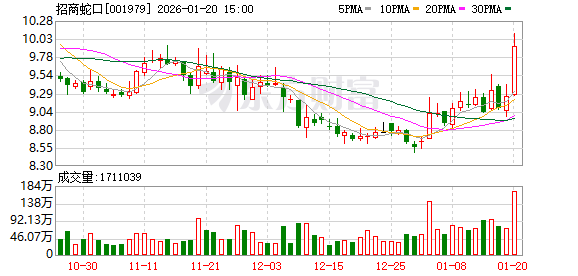
房企穿越周期:龙头转型不动产运营 招商蛇口押中沐曦、长鑫
2 1 Shi Ji Jing Ji Bao Dao· 2026-01-20 12:51
Core Viewpoint - The performance of real estate companies is expected to stabilize as they navigate through the current market challenges, with a focus on asset impairment provisions and strategic investments in long-cycle industries [2][3][4]. Group 1: Company Performance - Poly Developments announced a projected revenue of approximately 308.26 billion yuan for 2025, a year-on-year decrease of 1.09%, with a net profit attributable to shareholders of about 1.03 billion yuan, reflecting a decline compared to 2024 [2][4]. - The company plans to recognize asset impairment and credit impairment losses totaling approximately 6.9 billion yuan, which is expected to reduce the net profit for 2025 by about 4.2 billion yuan [4]. - Excluding the impact of impairment provisions, Poly Developments' net profit for 2025 is estimated to be around 5.2 billion yuan, with the fourth quarter contributing approximately 3.3 billion yuan [4]. Group 2: Industry Trends - The real estate sector is experiencing a cautious yet orderly expansion in investment, with companies exploring new revenue streams beyond traditional real estate development, such as entering long-cycle industries and enhancing service offerings [3][6]. - The top 100 real estate companies are projected to have a total land acquisition amount of 964 billion yuan in 2025, representing a year-on-year increase of 3.9%, driven by favorable policies and the need for sustainable development [5]. - The industry is expected to enter a new development phase in 2026, as many companies have passed the peak of delivery and debt repayment, indicating a potential for recovery and stabilization in performance [2][8]. Group 3: Future Outlook - Real estate companies are increasingly focusing on property operations and other sectors, with many adopting strategies to enhance their operational efficiency and capitalize on the growing REITs market [6][7]. - Companies like China Resources Land and China Merchants Shekou are also expanding their presence in property operations, with significant growth in recurring income and rental revenues [6]. - The market conditions are improving, with expectations for a recovery in 2026, as companies work towards repairing their balance sheets and potentially achieving profitability [8].


房企穿越周期:龙头转型不动产运营,招商蛇口押中沐曦、长鑫
2 1 Shi Ji Jing Ji Bao Dao· 2026-01-20 12:42
Core Viewpoint - The real estate industry is expected to stabilize as companies navigate through the current market challenges and explore new growth avenues, with major players like Poly Developments taking significant steps to adjust their strategies and financials [2][3][6]. Group 1: Company Performance - Poly Developments reported an estimated revenue of approximately 308.26 billion yuan for 2025, reflecting a year-on-year decrease of 1.09%, with a projected net profit attributable to shareholders of about 1.03 billion yuan, a decline compared to 2024 [2][3]. - The company plans to recognize asset impairment and credit impairment losses totaling around 6.9 billion yuan, which is expected to reduce the net profit for 2025 by approximately 4.2 billion yuan [3][4]. - Excluding the impact of impairment provisions, Poly Developments' net profit for 2025 is estimated to be around 5.2 billion yuan, with the fourth quarter contributing approximately 3.3 billion yuan [4]. Group 2: Industry Trends - The real estate sector is witnessing a cautious yet orderly expansion in investments, with companies focusing on stabilizing their operations and gradually reducing the impact of impairment provisions [2][3]. - The top 100 real estate companies in China are projected to have a total land acquisition amount of 964 billion yuan in 2025, marking a year-on-year increase of 3.9% [4]. - The market is expected to see a recovery in 2026 as companies navigate through the peak of delivery and debt repayment, entering a new development phase [2][6]. Group 3: Strategic Shifts - Many leading real estate firms are diversifying into long-cycle industries and real estate operations, with plans to invest in high-tech sectors and enhance service offerings [3][5]. - Poly Developments has expanded its operational assets to 5.73 million square meters, including 26,000 rental housing units, which increased by 18% compared to the end of 2024 [5]. - Other companies like China Resources Land and China Merchants Shekou are also pursuing similar strategies in real estate operations and indirect investments through industry funds [5].
深度调整,动态筑底 2025年房地产行业数据解读
Zhong Guo Jing Ji Wang· 2026-01-20 08:37
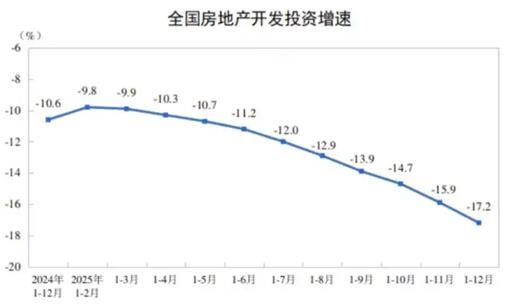
Core Insights - The real estate industry in China is undergoing a deep adjustment, with significant declines in investment and sales metrics for 2025 [1][3][5] Group 1: Investment and Sales Data - Real estate development investment reached 82,788 billion yuan in 2025, a year-on-year decrease of 17.2% [1] - The sales area of new commercial housing was 88,101 million square meters, down 8.7% year-on-year, while the sales amount was 83,937 billion yuan, reflecting a 12.6% decline [1] - The total construction area for real estate enterprises was 659,890 million square meters, a decrease of 10.0% year-on-year, with residential construction down 10.3% [3] Group 2: Market Dynamics - The new housing starts area was 58,770 million square meters, down 20.4%, indicating a continued downward trend in new construction [3] - The completion area of houses was 60,348 million square meters, down 18.1%, with residential completions declining by 20.2% [3] - The market is still in a "de-inventory" phase, influenced by declining new home sales and reduced land transactions over the past two years [3] Group 3: Company Performance - In 2025, ten real estate companies achieved sales exceeding 100 billion yuan, with four surpassing 200 billion yuan, including major players like Poly Development and China Overseas Land [5] - The top ten companies by investment are primarily state-owned enterprises, with significant contributions from China Overseas, China Resources, and Poly Development, which together account for over 30% of total investment [5] - These leading companies are leveraging core city demand to maintain operational resilience, while many private firms are still seeking opportunities to rebuild their core value [5] Group 4: Market Trends and Future Outlook - December 2025 showed signs of improvement, with new housing sales area increasing by 39.87% month-on-month and sales amount rising by 44.07% [7] - The price of new residential properties in first-tier cities saw a slight decrease of 0.3%, indicating a narrowing decline compared to previous months [7] - The second-hand housing market is gaining traction, with an increasing proportion of transactions occurring in this segment, as buyers often turn to second-hand homes to meet their housing needs [8]
港股收盘 | 恒指收跌0.29% 黄金、消费股走高 泡泡玛特劲升9%领跑蓝筹
Zhi Tong Cai Jing· 2026-01-20 08:37
Market Overview - The Hong Kong stock market experienced fluctuations today, with all three major indices closing lower. The Hang Seng Index fell by 0.29% or 76.39 points to 26,487.51 points, with a total turnover of HKD 2,377.66 million. The Hang Seng China Enterprises Index decreased by 0.43% to 9,094.76 points, and the Hang Seng Tech Index dropped by 1.16% to 5,683.44 points [1] Blue Chip Performance - Pop Mart (09992) led the blue-chip stocks, rising by 9.07% to HKD 197.2, contributing 19.52 points to the Hang Seng Index. The company announced a share buyback of 1.4 million shares for HKD 2.51 million at prices between HKD 177.7 and HKD 181.2. Morgan Stanley noted that this buyback could attract more investors [2] - Other notable blue-chip performances included China Life (601628) (02628) up 4.31% to HKD 33.4, contributing 16.6 points, and China Resources Land (01109) up 3.71% to HKD 29.64, contributing 5.52 points. Conversely, WuXi AppTec (603259) (02359) fell by 4.13% to HKD 113.7, detracting 3.73 points, and SMIC (00981) dropped by 3.25% to HKD 74.5, detracting 18.11 points [2] Sector Highlights - The technology sector showed mixed results, with Baidu rising by 0.95% while Tencent fell over 1%. Gold stocks rebounded, with spot gold surpassing USD 4,700 for the first time, and consumer stocks gained traction due to favorable consumption policies. Notably, Pop Mart's buyback led to a price increase of over 10% [3] - Gold stocks saw a recovery, with Zijin Mining International (02259) up 5.47% to HKD 179.4, Chifeng Jilong Gold Mining (600988) (06693) up 3.6% to HKD 33.94, Shandong Gold Mining (600547) (01787) up 2.73% to HKD 43.7, and China National Gold International (600916) (02099) up 2.04% to HKD 195 [3] Real Estate Sector - The National Bureau of Statistics reported a 0.3% month-on-month decline in new residential sales prices in first-tier cities for December 2025, with the decline narrowing by 0.1 percentage points from the previous month. Shenwan Hongyuan believes that the real estate sector has undergone deep adjustments, and recent central government directives to stabilize the market may lead to positive policy changes [5] - The real estate sector showed positive performance, with China Overseas Land & Investment (00081) up 4.93% to HKD 2.13, and China Resources Land (01109) up 3.71% to HKD 29.64 [4][5] Insurance Sector - The insurance sector performed well, with China Pacific Insurance (00966) up 4.39% to HKD 23.8, China Life (02628) up 4.31% to HKD 33.4, and New China Life Insurance (601336) (01336) up 2.72% to HKD 62.35. Reports indicated that major insurance companies saw significant growth in premium income through bancassurance channels [4][5] Aviation Sector - The aviation sector continued its upward trend, with China Southern Airlines (600029) (01055) up 4.57% to HKD 6.18, China National Aviation (601111) (00753) up 3.91% to HKD 7.45, and Cathay Pacific (00293) up 1.63% to HKD 12.49. Analysts expect strong demand during the upcoming Spring Festival travel season, with improved ticket pricing and revenue management driving profitability [6] Notable Stock Movements - Youjia Innovation (02431) saw a significant increase of 7.21% to HKD 15.77 after signing a memorandum of understanding with India's Sterling Tools Ltd. to focus on the automotive market [7] - Nanshan Aluminum International (02610) reached a new high, rising 6.04% to HKD 71.95, as the company plans to initiate a 250,000-ton electrolytic aluminum project with an estimated investment of USD 436.6 million [8] - GigaDevice Semiconductor (603986) (03986) continued to rise by 5.52% to HKD 306, benefiting from a tight supply of memory chips [9] - Shanghai Petrochemical (600688) (00338) issued a profit warning, expecting a net loss of approximately RMB 1.289 billion to RMB 1.576 billion for the year ending December 31, 2025 [10]