
牧原股份

Search documents
研报掘金丨华鑫证券:牧原股份养殖成本优势持续增强,维持“买入”评级
Ge Long Hui A P P· 2025-10-14 06:35
格隆汇10月14日|华鑫证券研报指出,牧原股份由于前期生猪减重政策等因素影响,部分生猪提前出 栏,导致公司9月出栏量有所减少。公司主动削减能繁母猪存栏至2025年9月的330.5万头,较2024年末 的351.2万头减少5.9%,已基本达成330万头的年底能繁母猪量目标。在国内生猪产能增长趋缓背景下, 牧原与BAF合作的越南高科技楼房养殖项目,或将成为公司增长的新动力。公司完全成本持续优化,目 标年底达11元/kg,全年平均成本12元/kg。在猪价下行阶段,这一成本优势将转化为显著的抗周期能 力。公司养殖规模领先,养殖成本优势持续增强。维持"买入"评级。 ...

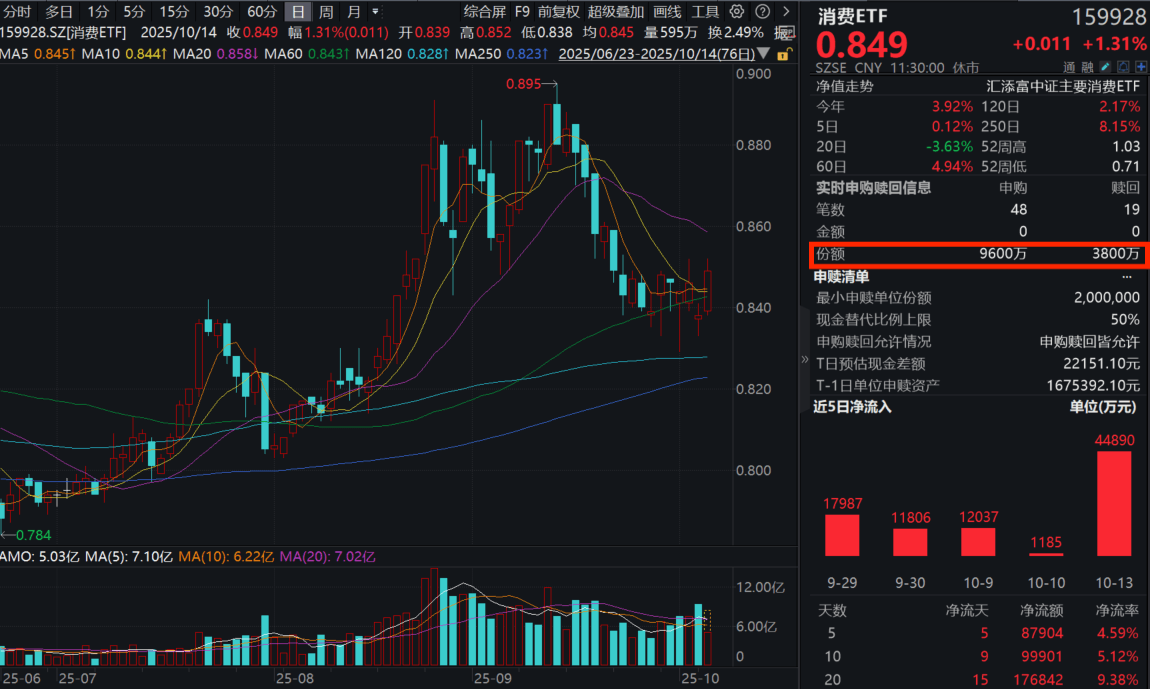
贸易摩擦再起,内需消费机会备受关注!消费ETF(159928)涨超1%,昨日获净流入超4.4亿元!机构:乐观看待消费板块补涨机会!
Xin Lang Cai Jing· 2025-10-14 05:26
Group 1: Market Performance - The consumption ETF (159928) rose over 1.3% today, with a trading volume exceeding 520 million yuan, marking a net inflow of over 440 million yuan yesterday and an additional 60 million yuan today, achieving eight consecutive days of capital inflow [1] - The latest scale of the consumption ETF (159928) has surpassed 19.9 billion yuan, nearing the 20 billion yuan mark, significantly leading its peers [1] Group 2: Hong Kong Market Insights - The Hong Kong consumption 50 ETF (159268) experienced a slight increase of 0.1%, with a trading volume exceeding 30 million yuan, accumulating over 12 million yuan in net inflow over the past 20 days [3] - Key component stocks showed mixed performance, with notable gains in brands like Bling and Pop Mart, while companies like Mixue Group and Anta Sports saw declines [3] Group 3: Consumer Trends and Opportunities - The upcoming Double 11 shopping festival is expected to boost consumer spending, with Alibaba's Taobao implementing significant subsidy measures to enhance sales [6][8] - The retail sector is anticipated to perform in line with expectations during the National Day holiday, driven by customer traffic, although average spending per customer remains under pressure [6] Group 4: Investment Outlook - The current market environment presents a rebound opportunity due to low valuations and a clean slate for companies, with expectations of improved fundamentals in sectors like beer and dairy [8] - Structural growth remains robust, particularly among younger consumers and in emerging markets, with certain stocks showing reasonable valuations and high growth potential over the next three years [8] - Four categories of investment opportunities are highlighted for the next six months, focusing on low absolute valuations, historical valuation comparisons, high growth certainty, and short-term policy-driven sectors [8] Group 5: ETF Composition - The consumption ETF (159928) has a significant concentration in its top ten holdings, with over 68% weight, including leading liquor companies and major consumer goods firms [10] - Notable stocks in the ETF include Wuliangye, Kweichow Moutai, and Yili, each holding substantial weight in the index [11]

农林牧渔行业报告(2025.9.30-2025.10.12):节后猪价宽幅下跌
China Post Securities· 2025-10-14 03:34
Investment Rating - The industry investment rating is "Outperform the Market" and is maintained [2] Core Views - The agricultural sector has shown resilience, with the agricultural index rising by 1.03% recently, ranking 12th among 31 primary industries [5][13] - The pig price has entered a downward trend, reaching a national average of 10.97 yuan/kg, the lowest in recent years, leading to significant industry losses [6][17] - Policies aimed at controlling production capacity and reducing weights in the pig industry are expected to positively impact prices in the second half of next year [7][19] - The white feather chicken sector faces challenges with high chick prices and low meat prices, resulting in losses for farmers [8][28] - The sugar market continues to decline, with prices dropping to 5835 yuan/ton, while soybean prices show slight fluctuations [32][34] Summary by Sections Market Review - The market has experienced significant fluctuations post-holiday, with the agricultural sector outperforming the broader market [5][13] Livestock Industry Tracking - **Pigs**: Prices have sharply declined, with a significant increase in supply post-holiday and a drop in demand from slaughterhouses [6][17] - **White Feather Chicken**: Chick prices remain high at 3.5 yuan/chick, while meat prices are low at 3.37 yuan/jin, leading to losses for farmers [8][28] Planting Industry Tracking - **Sugar**: Prices have decreased by 10 yuan/ton recently [32] - **Soybeans**: Prices have shown minor fluctuations, with Brazilian soybeans at 3900 yuan/ton and American soybeans at 4385 yuan/ton [32][34] - **Corn**: The average price has dropped to 2247 yuan/ton, a decrease of 81 yuan/ton [32][34]
猪价跌至近5年低位,节假日“救市”失效,后市何去何从?
2 1 Shi Ji Jing Ji Bao Dao· 2025-10-14 01:47
Core Viewpoint - The holiday consumption effect on pig prices is weakening, with prices continuing to decline despite the recent holidays [1][2][3] Price Trends - The average national pig price was 12.90 yuan/kg in the first week of October, down 2.8% from the previous week and 29.5% year-on-year [1][2] - Prices have dropped over 22% compared to the beginning of the year, reaching a low point for the year [1] - As of October 13, the average price for external three-yuan pigs was 10.81 yuan/kg, indicating a slight daily decrease [1][2] Supply and Demand Dynamics - The supply of pigs remains abundant, with a significant number of breeding sows still in operation, leading to a challenging market for price recovery [3][6] - Analysts predict that the demand for pigs may improve in November due to cooler weather and seasonal activities, but overall supply is expected to outpace demand [2][7] Industry Response - The Ministry of Agriculture has emphasized the need for strict production capacity controls, aiming to reduce the number of breeding sows by approximately 1 million [6] - Some companies have begun to adjust their production strategies, including reducing the number of breeding sows and managing the weight of pigs being sold [6][7] Profitability Concerns - The ongoing decline in pig prices has significantly impacted the profitability of pig farming, with losses reported for self-breeding and pig fattening operations [5][6] - Smaller farming operations are facing the most pressure due to higher costs, while larger enterprises are better positioned to manage risks [5][6] Future Outlook - Analysts suggest that while there may be short-term price stabilization, the overall supply situation will limit significant price increases in the near future [5][7] - The market is expected to remain under pressure until production capacity adjustments take effect, with a potential for improved demand in the winter months [7]

逆市四连阳!业内首只农牧渔ETF(159275)单日吸金超5200万元
Xin Lang Ji Jin· 2025-10-14 00:47
Core Viewpoint - The agricultural, animal husbandry, and fishery (农牧渔) sector is showing resilience in the A-share market, with the Agricultural and Fishery ETF (159275) experiencing significant net inflows and maintaining a strong performance despite broader market pressures [1][2]. Industry Overview - The agricultural, animal husbandry, and fishery sector has undergone a prolonged correction from February 2021 to September 2024, but has recently rebounded alongside the A-share market, although valuations remain low [2]. - The current price-to-book ratio of the index tracked by the Agricultural and Fishery ETF is 2.64, placing it in the 32.14 percentile over the past decade, indicating a favorable long-term investment opportunity [2]. - The pig farming industry, a core segment of the agricultural sector, is currently at a price low not seen in four years, suggesting limited downside risk. Future trends may include production stabilization and price increases, leading to improved profitability for quality enterprises [2]. Policy and Market Dynamics - Recent government policies have focused on controlling production capacity and optimizing the competitive landscape within the pig farming industry, with expected acceleration in capacity reduction in the fourth quarter [2]. - The seed industry is also receiving significant policy support, with advancements in biotechnology and the potential for accelerated commercialization of genetically modified crops, enhancing the competitive edge of leading companies [3]. - The animal health sector is expected to see increased market share for leading firms, driven by ongoing policy focus [3]. Investment Opportunities - The Agricultural and Fishery ETF (159275) is the first ETF to track the comprehensive agricultural index, covering various segments such as pig farming, aquaculture feed, animal health, and seeds, thus providing broad exposure to the agricultural value chain [4]. - The top ten holdings of the index account for 61.1% of its weight, featuring leading companies in the sector, which enhances the index's representativeness [4]. - Historically, the index has outperformed similar thematic indices and broad market indices, with a cumulative return of 95.45% since December 31, 2013, and a remarkable 145.61% return from January 1, 2019, to March 1, 2021 [4].
为智慧农业注入强劲动能
He Nan Ri Bao· 2025-10-13 23:10
Core Viewpoint - The conference on smart agriculture development between China (Henan) and ASEAN countries highlights the importance of digitalization and intelligence in transforming traditional agriculture into modern agriculture, which is crucial for food security and high-quality agricultural development [1]. Group 1: Smart Agriculture Cooperation - Experts and representatives from various sectors gathered to discuss enhancing smart agriculture cooperation between Henan and ASEAN countries [1]. - The cooperation is driven by complementary needs, with a focus on leveraging Henan's achievements in agricultural IoT and smart machinery to benefit ASEAN nations [1]. Group 2: Achievements and Initiatives - Henan has made significant progress in seed industry revitalization and advanced agricultural machinery development [1]. - The establishment of the China (Henan) - ASEAN Smart Agriculture Demonstration Center aims to facilitate digital cooperation across the entire agricultural value chain, including production, processing, logistics, and sales [3]. Group 3: Future Plans - Future initiatives include building R&D platforms, sharing application results, and cultivating professional talent in areas such as intelligent breeding, digital farmland, and precision irrigation [3]. - The Henan wheat big data center is being developed to enhance price discovery, flow tracking, industry analysis, and information dissemination, with the first phase expected to launch within the year [2].

猪价跌超22%至年内低位
Xin Lang Cai Jing· 2025-10-13 16:12
Core Viewpoint - The holiday consumption effect on pork prices is weakening, with a significant decline in prices observed during the recent National Day and Mid-Autumn Festival period, leading to industry losses and a need for capacity adjustments [3][6][10]. Price Trends - The average price of live pigs in the first week of October was 12.90 yuan/kg, down 2.8% from the previous week and 29.5% year-on-year, marking a decline of over 22% compared to the beginning of the year [3][6]. - As of October 13, the average price further decreased to 10.81 yuan/kg, with regional price differences noted, ranging from 9.94 yuan/kg in Guangxi to 11.49 yuan/kg in Fujian [3][6]. Supply and Demand Dynamics - Analysts indicate that the supply of live pigs remains abundant due to previous production capacity releases and ongoing policies aimed at controlling weight and reducing production, which may lead to continued downward pressure on prices [4][7]. - Demand is expected to improve slightly in November with cooler weather and seasonal activities, but overall supply is projected to outpace demand, leading to further price declines [4][8]. Industry Challenges - The industry is facing significant losses, with self-breeding and piglet fattening operations reporting average losses of 206.91 yuan and 409.19 yuan per head, respectively [10][11]. - Smaller producers are under the most pressure due to higher costs, while larger enterprises are better positioned to manage risks but still face accumulating pressures from sustained low prices [10][12]. Capacity Adjustments - The Ministry of Agriculture has emphasized the need for strict capacity control measures, aiming to reduce the breeding sow population by approximately 1 million heads [10][11]. - Some companies, like Muyuan Foods, have begun to implement capacity reduction strategies, including culling low-yield sows and managing slaughter weights [11][12]. Future Outlook - Analysts predict that while there may be a seasonal increase in demand during the upcoming festive periods, the overall supply situation remains robust, limiting the potential for significant price rebounds [8][12]. - The speed of capacity reduction will be crucial in determining future price movements, with expectations that a surplus may persist into 2026 if current trends continue [12].

猪价跌超22%至年内低位
21世纪经济报道· 2025-10-13 15:33
Core Viewpoint - The holiday consumption effect on pig prices is weakening, with prices continuing to decline despite the recent National Day and Mid-Autumn Festival [2][5][6] Price Trends - The average national pig price was 12.90 yuan/kg in the first week of October, down 2.8% from the previous week and 29.5% year-on-year, marking a decline of over 22% compared to the beginning of the year [2][5] - As of October 13, the average price for external three-yuan pigs dropped to 10.81 yuan/kg, with significant regional price differences [2][3] Supply and Demand Dynamics - The supply of pigs remains abundant due to previous production capacity releases and ongoing policy impacts, leading to a generally high supply [3][6] - Demand is expected to improve in November as cooler weather stimulates pork consumption and southern regions begin their curing activities, potentially providing some support for prices [3][6] Profitability and Industry Impact - The decline in pig prices has severely impacted breeding profits, with self-breeding and piglet fattening operations showing losses of 206.91 yuan and 409.19 yuan per head, respectively [9][10] - Different market pressures are felt across various breeding entities, with smallholders facing the most significant challenges due to higher costs, while larger enterprises have better risk management capabilities [10][11] Production Capacity Adjustments - The Ministry of Agriculture has emphasized the need for strict production capacity controls, aiming to reduce the breeding sow population by about 1 million heads [10][11] - Some companies, like Muyuan Foods, have begun to adjust their production capacity by reducing the number of breeding sows and managing slaughter weights [11][12] Future Outlook - Analysts suggest that while there may be a seasonal increase in demand during the upcoming festive periods, the overall supply remains high, limiting the potential for significant price rebounds [7][11] - The speed of production capacity reduction will be crucial in determining future price trends, with expectations of continued high supply levels into 2026 if current trends persist [11][12]

长江消费周周谈
2026-01-05 15:42
Summary of Key Points from Conference Call Records Industry or Company Involved - **Pork Industry**: Focus on companies like Muyuan, Dekang, Wens, Shennong, and Juxing Agriculture - **Beauty and Personal Care Industry**: Highlighting brands such as Mao Ge Ping and Shangmei - **Gold and Jewelry Industry**: Recommendations for Changhongqi and Caibai - **Retail Industry**: Emphasis on Xiaoshangpin City and Bubu Gao - **Education and Training Sector**: Focus on K12 education leaders and AI applications - **Restaurant and Beverage Sector**: Recommendations for Mixue and Guming - **Automotive Industry**: Focus on Huawei's smart vehicles and Changan Automobile - **Textile Manufacturing Sector**: Recommendations for companies in the ASEAN region and Nike's supply chain - **Innovative Pharmaceutical Industry**: Focus on companies with high R&D investment Core Points and Arguments - **Pork Industry**: The significant impact of pork prices on CPI, with a noted 8.5% decrease in pork prices leading to a 0.12 percentage point drop in CPI in June 2025. The strategy of capacity control to boost pork prices is crucial to mitigate CPI pressure [2][3][4] - **Beauty and Personal Care**: The industry is in a traditional off-season, but high-end brands like Mao Ge Ping and operationally strong brands like Shangmei are recommended due to low base effects from last year [6] - **Gold and Jewelry**: Despite a 20% drop in gold jewelry consumption in Q2, brands with strong same-store performance like Changhongqi and low-valuation, high-dividend companies like Caibai are recommended [6] - **Retail Sector**: Xiaoshangpin City is highlighted for its strong business certainty, while Bubu Gao is noted for potential investment opportunities post-unlock of shares [7] - **Education Sector**: K12 education leaders and AI applications are emphasized, with companies like Dou Shen and Fen Bi showing strong growth [8] - **Restaurant Sector**: The rise of takeaway services is noted, with companies like Guming and Mixue recommended for their growth potential [8][9] - **Automotive Sector**: Huawei's smart vehicles are performing well, with new models like M7 and M8 expected to launch soon, while Changan's S9 model shows stable delivery [10][11][12] - **Textile Manufacturing**: The sector is expected to see performance and stock price turning points, with a focus on companies benefiting from reduced tariffs in the ASEAN region [13][14][15] - **Innovative Pharmaceutical Industry**: A new cycle of R&D investment is anticipated, with a focus on companies sensitive to domestic demand recovery and those specializing in large molecules and oncology [26][27] Other Important but Possibly Overlooked Content - **Pork Industry**: The adjustment in the pork breeding sector is linked to broader economic conditions and CPI management strategies [3][4][5] - **Retail Sector**: The potential for supermarkets and department stores to experience operational turning points is noted [7] - **Automotive Sector**: The upcoming launch of multiple new models indicates a strategic push for market share [10][11][12] - **Textile Manufacturing**: The impact of tariff changes on the competitive landscape and the potential for recovery in the sector is highlighted [14][15] - **Innovative Pharmaceutical Industry**: The increasing trend of funding sources and the focus on early-stage research are critical for future growth [26][27]
中美关税博弈升级,4月冲击再现?A股该如何应对?
2025-10-13 14:56
Summary of Conference Call Records Industry or Company Involved - The records primarily discuss the impact of the escalating US-China trade tensions on various industries, particularly focusing on the electronics, agriculture, and pet healthcare sectors. Core Points and Arguments US-China Trade Tensions - The recent escalation in US-China trade tensions is viewed as a milder version compared to April, with the impact primarily confined to bilateral relations rather than a global scale [1][2][3] - Both parties have a clearer understanding of each other's bottom lines, making extreme measures less likely, leading to more phase-based conflicts [2][3] Market Reactions and Strategies - Short-term market sentiment is leaning towards risk aversion, with gold, US Treasury bonds, and defensive consumer stocks being highlighted as areas of interest [1][4] - In the domestic market, sectors such as rare earths, military industry, and self-sufficient fields are recommended for attention [1][4] Economic Outlook - The most pessimistic period for US economic growth has passed, with a shift towards a relatively stable state in the global capital competition between China and the US [5] - China's economy has stabilized since the fourth quarter of last year, attracting more global funds and experiencing currency appreciation [5] Electronics Industry Insights - New tariffs are seen as a psychological boost for the domestic electronics industry, with real benefits arising from increased demand in manufacturing, IC design, and downstream internet companies [1][8] - The A4 chip market is expected to grow four to five times from 2025 to 2026, with China holding a significant advantage in the PCB supply chain [12] Agriculture and Pet Food Sector - The pig farming sector is facing challenges due to oversupply and declining prices, with predictions of prices dropping to around 5 RMB per kilogram before the Spring Festival [14][15] - The pet food industry is experiencing disruptions due to tariffs, but companies are adapting by utilizing Southeast Asia and New Zealand for production to mitigate impacts [14] Pet Healthcare Market - The Chinese pet healthcare market is valued at approximately 30 billion RMB, with local brands like Ruip and Pulaike gaining market share through B2B and consumer education efforts [16][20] - The market is transitioning from initial development to rapid growth, with expectations of significant increases in revenue for local brands [17][20] Other Important but Possibly Overlooked Content - The overall risk appetite in the market remains low, with no significant changes observed in the past few months [5] - The impact of the US economic outlook on military competition with China could lead to a more aggressive stance from the US, affecting market dynamics [6] - The importance of distinguishing between opportunities driven by underlying demand versus those created by tariff-related fluctuations is emphasized [12][13] Investment Recommendations - Investors are advised to focus on sectors benefiting from tariff countermeasures, such as rare earths and military, as well as self-sufficient areas like semiconductors [4][21] - Specific companies to watch include Ruip and Pulaike in the pet healthcare sector, and pig farming companies like Muyuan, Dekang, and Bangji for their cost control and growth potential [20]