伊利股份

Search documents
现制茶饮,跨界抢了乳企市场
2 1 Shi Ji Jing Ji Bao Dao· 2025-09-03 01:13
Group 1 - The competition in the food delivery market has significantly impacted the dairy industry, with Mengniu's revenue declining by 6.95% to 41.567 billion yuan in the first half of 2025, and liquid milk revenue dropping by 11.2% to 32.19 billion yuan [1] - In contrast, Yili's revenue increased by 3.37% to 61.933 billion yuan during the same period, although its liquid milk revenue fell by 2.1% to 36.13 billion yuan [1] - Nielsen IQ data indicates that the overall sales of dairy products across all channels decreased by 9.6% in June 2025, with offline channel sales down by 12.7% [1] Group 2 - Yili noted that ready-to-drink tea beverages are substituting liquid milk products, particularly affecting packaged liquid milk sales, although the overall demand for liquid milk remains stable [1][2] - The company believes that the pressure from competition is manageable and that the impact of ready-to-drink tea on packaged liquid milk will weaken over time due to the health attributes and gifting properties of dairy products [2] Group 3 - Yili expressed confidence in the long-term growth potential of liquid milk, citing factors such as the aging population's increasing health awareness and the ongoing upgrade potential within the dairy product sector [3] - The current product structure in the dairy industry is still immature, with basic categories accounting for over half of the market, particularly evident in lower-tier cities [3]

现制茶饮,跨界抢了乳企市场丨消费参考
2 1 Shi Ji Jing Ji Bao Dao· 2025-09-03 01:08
Group 1 - The takeaway from the news is that the competition in the food delivery market is impacting the dairy industry, particularly affecting companies like Mengniu and Yili, with Mengniu's revenue declining while Yili's revenue shows growth despite challenges [1][2] - Mengniu's revenue for the first half of 2025 decreased by 6.95% to 41.567 billion yuan, with liquid milk revenue down by 11.2% to 32.19 billion yuan [1] - Yili's revenue increased by 3.37% to 61.933 billion yuan, although its liquid milk revenue fell by 2.1% to 36.13 billion yuan [1] Group 2 - The overall sales of dairy products across all channels dropped by 9.6% in June 2025, with offline sales declining by 12.7% [1] - Yili noted that the demand for liquid milk remains stable, but packaging liquid milk is under pressure due to the rise of ready-to-drink tea beverages [1][2] - Yili expressed confidence in the long-term growth potential of liquid milk, citing factors such as aging population and health awareness driving demand [2] Group 3 - The financial performance of tea beverage companies like Mixue Ice City and Luckin Coffee is strong, with Mixue's revenue growing by 39.3% to 14.87 billion yuan and Luckin's revenue increasing by 47.1% to 12.36 billion yuan in the second quarter [1] - Yili believes that the pressure from ready-to-drink tea beverages is manageable and that the impact of such competition will weaken over time [2]
坚持价值投资,险资私募钟情高股息大市值公司
Zheng Quan Shi Bao· 2025-09-03 00:10
Core Insights - The Honghu Fund, the largest and earliest established insurance private equity fund, has become a major shareholder in at least six listed companies, indicating a strategic investment approach focused on stable, high-dividend blue-chip companies [1][2] Group 1: Fund Overview - The Honghu Fund has established four funds with a total scale of 110 billion yuan, managed by Guofeng Xinghua, a joint venture of Guoshou Asset and Xinhua Asset [1] - The first phase of the Honghu Fund has a scale of 50 billion yuan, with investments fully deployed by March 2023 [2] - The second phase has nearly completed its investment allocation by the end of Q2 2023, while the third phase commenced in early July 2023 [2] Group 2: Investment Characteristics - The investment criteria for the Honghu Fund include companies with good governance, stable operations, relatively stable dividends, good liquidity, and strong returns [1] - The selected companies exhibit characteristics of high dividend yields and large market capitalizations, with companies like Shaanxi Coal and China Shenhua yielding over 5% [1] Group 3: Performance and Impact - The pilot fund's risk indicators are below the benchmark, while its return indicators exceed the benchmark, achieving both functional and profitability success [2] - The pilot fund aims to enhance equity investment and long-term investment capabilities for insurance companies, contributing to market stability and fostering a positive interaction between insurance funds and capital markets [2]
坚持价值投资 险资私募钟情高股息大市值公司
证券时报· 2025-09-02 23:52
Core Insights - The article discusses the recent disclosures of half-year reports from listed companies, highlighting the investments made by the Honghu Fund, which is the largest and earliest established private equity fund backed by insurance capital in China [1][2]. Group 1: Honghu Fund Investments - Honghu Fund has become a top ten shareholder in at least six listed companies, including China Petroleum, China Shenhua, and China Petrochemical [1]. - The investment criteria for Honghu Fund include companies with good governance, stable operations, relatively stable dividends, good liquidity, and strong returns, focusing on large-cap blue-chip companies [1]. - The companies in which Honghu Fund has invested exhibit characteristics of high dividend yields and large market capitalizations, with dividend yields exceeding 5% for companies like Shaanxi Coal and China Shenhua [1]. Group 2: Fund Performance and Strategy - As of the end of the second quarter, the second phase of the Honghu Fund has nearly completed its investment allocation, while the third phase commenced in early July and is progressing smoothly [2]. - The pilot fund has achieved lower risk indicators and higher return indicators compared to benchmarks, indicating a successful balance between functionality and profitability [2]. - The pilot fund's total amount has reached 222 billion yuan, with the first two batches of pilot institutions approved to establish private equity fund companies [2].





光大证券晨会速递-20250903
EBSCN· 2025-09-02 23:32
Group 1: Market Strategy - The report suggests that liquidity remains the most important support for the market in the short term, while profitability will be a focus in the medium term, with mid-year performance potentially being the low point for the year [3] - The market is expected to rotate between growth and balanced styles in September, with recommended sectors for investment including TMT, electric new energy, military industry, automotive, non-ferrous metals, and machinery equipment [3] Group 2: Company Research - Petrochemical - The report indicates a downward adjustment in profit forecasts for Dongfang Shenghong due to falling oil prices and declining aromatics market conditions, with expected net profits for 2025-2027 at 9.65 billion, 14.04 billion, and 20.62 billion respectively, reflecting a 63% and 66% downward adjustment for 2025 and 2026 [4] - Despite the challenges, the company is advancing its new materials projects, maintaining a "buy" rating [4] Group 3: Company Research - Building Materials - The report notes that Kaisheng Technology's application materials business is under pressure, leading to a downward revision of net profit forecasts for 2025-2027 to 1.62 billion, 2.08 billion, and 2.51 billion, with a significant reduction of 38%, 35%, and 31% respectively [5] - The report maintains an "increase" rating for the company [5] Group 4: Company Research - High-end Manufacturing - Jingjin Equipment's revenue decreased by 9.6% to 2.83 billion in the first half of 2025, with net profit down 28.5% to 330 million, attributed to weak demand in the filter press market [7] - The company is actively exploring new markets and is expected to achieve net profits of 730 million, 860 million, and 940 million for 2025-2027, maintaining a "buy" rating [7] Group 5: Company Research - Engineering Machinery - LiuGong reported a 25.1% increase in net profit to 1.23 billion in the first half of 2025, with slight downward adjustments to profit forecasts for 2025-2027 [9] - The company is expected to benefit from the recovery of the domestic engineering machinery industry and trends towards internationalization and electrification [9] Group 6: Company Research - Electric New Energy - Sany Renewable Energy's revenue increased by 62.75% to 8.594 billion in the first half of 2025, but net profit fell by 51.54% to 210 million [13] - The company is expected to achieve net profits of 1.502 billion, 2.514 billion, and 2.915 billion for 2025-2027, maintaining a "buy" rating [13] Group 7: Company Research - Food and Beverage - Yili Group's revenue for the first half of 2025 was 61.933 billion, a year-on-year increase of 3.37%, while net profit decreased by 4.39% to 7.2 billion [18] - The company is projected to have EPS of 1.80, 1.94, and 2.10 for 2025-2027, maintaining a "buy" rating [18]
华创证券食饮2025年中报总结:白酒加速出清 大众呈现亮点
智通财经网· 2025-09-02 22:55
Group 1 - The beverage sector shows better performance, with leading companies demonstrating significant advantages. The sector's revenue and profit increased by 5.4% and 14.4% year-on-year in Q2 2025, respectively [1][3] - The soft drink segment, particularly brands like Nongfu Spring and Dongpeng, is experiencing strong momentum, with bottled water market share recovering and functional beverages continuing to benefit from market trends [1][4] - Traditional leaders in the beer and dairy industries, such as China Resources Beer, Yili, and Angel Yeast, are seeing improvements in return on equity (ROE) as they adapt to market conditions [1][3] Group 2 - The white wine sector is under pressure, with Q2 2025 revenue and net profit declining by 5.0% and 7.5% year-on-year, respectively. Excluding Moutai, the declines are more pronounced at 13.0% and 21.4% [2][3] - High-end and mid-range wines are experiencing a drop in gross margins, with high-end wine margins decreasing by 0.2 percentage points, while base and expansion-type mid-range wines saw declines of 1.7 and 5.4 percentage points, respectively [3] - Cash flow in the white wine sector decreased by 3.2% in Q2 2025, indicating a tightening of liquidity as companies focus on easing channel pressures [3]
坚持价值投资 险资私募钟情高股息大市值公司
Zheng Quan Shi Bao· 2025-09-02 18:00
Core Insights - The Honghu Fund, the largest and earliest established insurance private equity fund, has become a significant shareholder in at least six listed companies, indicating a strategic investment approach focused on stable and high-dividend blue-chip companies [1][2] Group 1: Fund Overview - The Honghu Fund has established four funds with a total scale of 110 billion yuan, managed by Guofeng Xinghua, a joint venture of Guoshou Asset and Xinhua Asset [1] - The first phase of the Honghu Fund has a scale of 50 billion yuan and began investing in March 2024, with all investments completed by March of this year [2] - The second phase of the fund has nearly completed its investment allocation as of the end of the second quarter, while the third phase commenced in early July and is progressing smoothly [2] Group 2: Investment Characteristics - The investment strategy of the Honghu Fund focuses on large listed companies that are well-governed, operate steadily, offer stable dividends, and have good liquidity [1] - The selected companies exhibit characteristics of high dividend yields and large market capitalizations, with companies like Shaanxi Coal and China Shenhua having dividend yields exceeding 5% [1] - The smallest company in the portfolio, Yili Group, has a market capitalization exceeding 100 billion yuan, while China Petroleum's market cap exceeds 1.6 trillion yuan [1] Group 3: Performance and Impact - The pilot fund's risk indicators are below the benchmark, while its return indicators are above the benchmark, achieving both functional and profitability success [2] - The pilot fund aims to enhance equity investment and long-term investment capabilities for insurance companies, contributing to market stability and fostering a positive interaction between insurance funds and the capital market [2] - The total amount of the long-term investment reform pilot for insurance funds has reached 222 billion yuan across three batches, with the first two batches having established private equity fund companies [2]



9/2财经夜宵:得知基金净值排名及选基策略,赶紧告知大家
Sou Hu Cai Jing· 2025-09-02 16:32
Group 1 - The article highlights the top 10 open-end funds with the highest net value growth as of September 2, 2025, including the top fund, Baoying Ruifeng Innovation Mixed A/B, which increased from 2.8290 to 2.9880, a growth of 0.15 [2][3] - The bottom 10 funds in terms of net value growth include Guorong Rongxin Consumer Selected Mixed A, which decreased from 0.9057 to 0.8365, a decline of 0.06 [4][6] - The overall market performance shows a downward trend in the Shanghai Composite Index, with a trading volume of 2.91 trillion, indicating a challenging market environment [6] Group 2 - The top holdings of Baoying Ruifeng Innovation Mixed A/B include Zhengsheng Technology, which saw a daily increase of 6.35%, and Zhongdali De, which increased by 6.64%, contributing to the fund's strong performance [7] - The top holdings of Guorong Rongxin Consumer Selected Mixed A include Wuliangye, which decreased by 0.24%, and Dongfang Caifu, which fell by 2.93%, reflecting the fund's underperformance [7] - The article notes that the fund's style has shifted towards the artificial intelligence sector, indicating a potential change in investment strategy [7]

中国必选消费9月投资策略:资金面影响更大,关注低位股和权重股
Haitong Securities International· 2025-09-02 14:52
Investment Focus - The report emphasizes the importance of fund flows in the market, suggesting a focus on low-position stocks and heavyweight stocks within the consumer staples sector [1][6] - Key stocks recommended for investment include Guizhou Moutai, Wuliangye, and Yili, all rated as "Outperform" [1] Industry Overview - In August 2025, five out of eight tracked essential consumer sectors showed positive growth, while three sectors experienced negative growth. The sectors with single-digit growth included soft drinks (+3.9%), frozen foods (+2.0%), condiments (+1.9%), dining (+0.5%), and dairy products (+0.5%). The declining sectors were mass-market and below baijiu (-3.8%), mid-to-high-end baijiu (-1.9%), and beer (-0.6%) [3][8] - The report notes that the new alcohol ban continues to impact high-ticket dining businesses and related consumer goods, leading to short-term effects on the supply chain [3][8] Price Trends - In August, the wholesale prices of mid-to-high-end baijiu generally declined, with specific price points for various products such as Guizhou Moutai and Wuliangye showing significant year-on-year decreases [4][20][22] - The report indicates that the price index for consumer goods has seen fluctuations, with most categories experiencing increased discount rates compared to the previous month [4] Cost Analysis - The report highlights that the cost index for consumer goods has mostly increased, with specific increases noted in instant noodles (+1.30%), frozen foods (+1.15%), and soft drinks (+0.78%) [4] - The report also mentions that packaging material prices have shown mixed trends, with paper and glass prices increasing while plastic prices have decreased [4] Fund Flow Insights - As of the end of August, net inflows from Hong Kong Stock Connect amounted to 103.23 billion yuan, with the consumer staples sector's market capitalization share rising to 5.22% [5] - The report notes that the valuation of A-share food and beverage companies has increased, with the historical PE ratio rising to 21.6x, indicating a shift in market sentiment [5] Stock Recommendations - The report suggests focusing on heavyweight stocks with solid fundamentals, such as Yili, Shanxi Fenjiu, and Guizhou Moutai, as well as low-position stocks like Qingdao Beer and Mengniu Dairy [6] - The report warns of potential risks in the soft drink sector, predicting a weakening of fundamentals in the coming year [6]





蒙牛销售下滑31亿元:总裁高飞正找第二曲线
2 1 Shi Ji Jing Ji Bao Dao· 2025-09-02 13:40
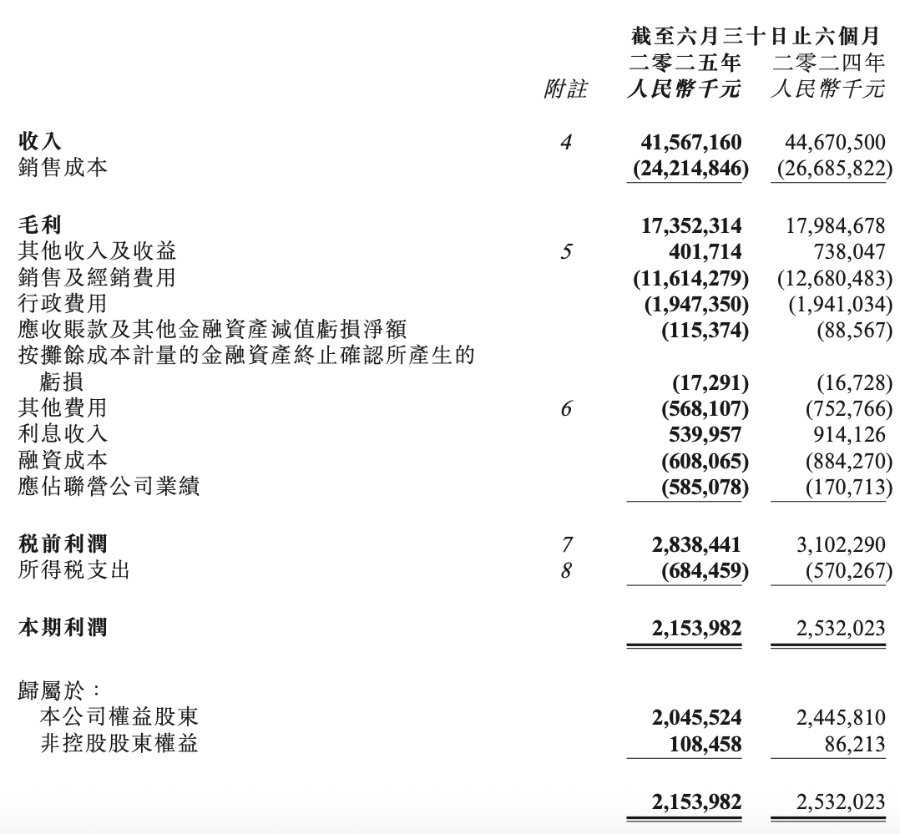
Core Viewpoint - Mengniu's performance continues to decline, with a significant drop in revenue and net profit in the first half of 2025, reflecting ongoing challenges in the dairy industry [1][2]. Financial Performance - Mengniu's revenue decreased by 6.95% year-on-year to 41.567 billion RMB, with a net profit decline of 16.37% to 2.046 billion RMB [1][3]. - Specific revenue breakdown for Mengniu includes liquid milk at 32.19 billion RMB (down 11.2%), ice cream at 3.88 billion RMB (up 15.0%), milk powder at 1.68 billion RMB (up 2.5%), cheese at 2.37 billion RMB (up 12.3%), and other businesses at 1.45 billion RMB (up 16.9%) [1]. - In contrast, Yili's revenue grew by 3.37% to 61.933 billion RMB, with a net profit decline of 4.39% to 7.2 billion RMB [1]. Market Trends - The dairy market is experiencing a contraction, with overall dairy sales down by 9.6% year-on-year as of June 2025, and offline sales down by 12.7% [1][4]. - Yili acknowledged a decline in terminal sales prices and a shift from packaged to non-packaged products, impacting overall sales [4]. Competitive Positioning - Yili has successfully developed a second growth curve through its milk powder business, achieving a 14.3% increase in revenue to 16.578 billion RMB [7]. - Mengniu has not yet established a comparable scale in new business areas, which limits its growth potential [2][8]. Strategic Initiatives - Mengniu is attempting to expand its market presence by enhancing online sales channels and collaborating with major brands in coffee and tea [9][10]. - The company is also focusing on operational efficiency, with a 7.1% reduction in total operating expenses to 13.814 billion RMB [18]. Profitability and Cost Management - Despite revenue declines, Mengniu's gross margin improved to 41.7%, up 1.5 percentage points, driven by lower raw milk prices [6]. - The company is implementing cost-cutting measures, including a reduction in sales and distribution expenses by 8.4% to 11.614 billion RMB [18]. Future Outlook - Mengniu's management emphasizes the need for a faster development of its second growth curve to adapt to market challenges [23]. - The company plans to maintain its dividend payout ratio and continue share buybacks, indicating a focus on stabilizing stock prices [20].