蔚来

Search documents
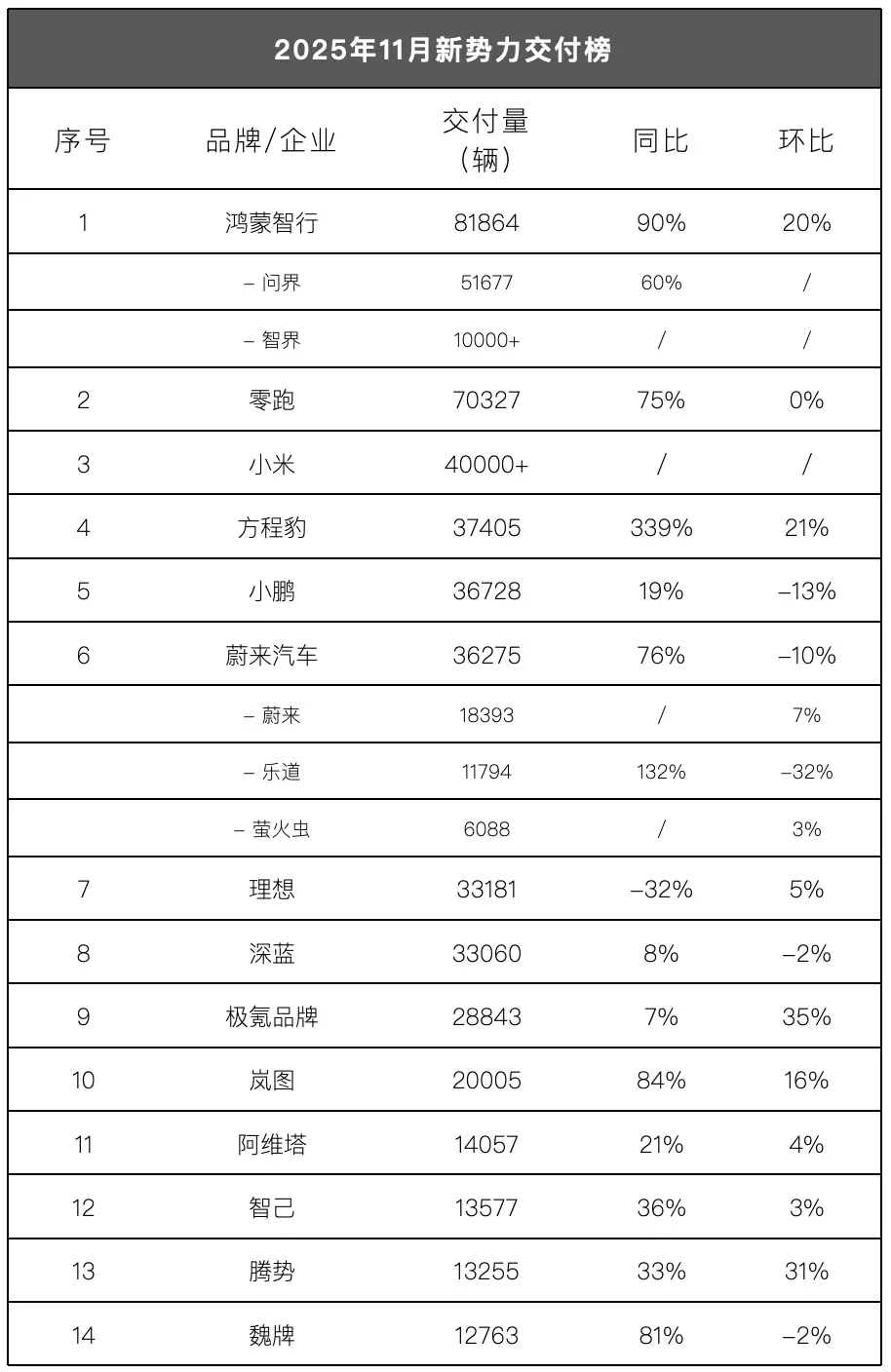
11月新势力榜单:蔚来困于盈利,理想反弹乏力
Feng Huang Wang Cai Jing· 2025-12-07 14:03
Core Insights - The delivery rankings of new car manufacturers have undergone significant changes in November, with a reshuffling of positions following the "golden September and silver October" period [1] Group 1: Delivery Rankings - Hongmeng Zhixing topped the delivery chart with 81,864 units, achieving a year-on-year growth of 90% and a month-on-month increase of 20% [2][3] - Leap Motor maintained its position as the "single brand champion" with 70,327 units delivered, marking its second consecutive month above 70,000 [4] - Xiaomi entered the top three with over 40,000 units, while BYD's Fangchengbao emerged as a dark horse with 37,405 units [5] Group 2: Competitive Landscape - In the second tier, brands like Xiaopeng (36,728 units) and NIO (36,275 units) are in close competition, with Ideal (33,181 units) and Deep Blue (33,060 units) also in the mix [5][21] - Zeekr accelerated its growth with 28,843 units, while Lantu broke the 20,000 mark for the first time [6] Group 3: Financial Performance and Market Challenges - Despite high delivery numbers, companies like Leap Motor face challenges in profitability, with a net profit of 150 million yuan in Q3, down 8% from the previous quarter [12][13] - Xiaomi's automotive division reported a 700 million yuan operating profit in Q3, making it the fastest to achieve profitability among new forces, yet its stock price has been under pressure due to negative publicity [14][15] - NIO's stock fell 20% in November after lowering its Q4 delivery guidance, indicating challenges in meeting profitability targets [24][30] Group 4: Strategic Adjustments - Xiaopeng is transitioning to a dual strategy of pure electric and range-extended vehicles, with plans to launch three new range-extended models in Q1 next year [19][20] - NIO is focusing on high-end models to improve overall gross margins, while also facing pressure to enhance profitability [22][26] - Ideal is adjusting its organizational structure and technology to address ongoing challenges, with a focus on ramping up production of its new electric model [28][30]





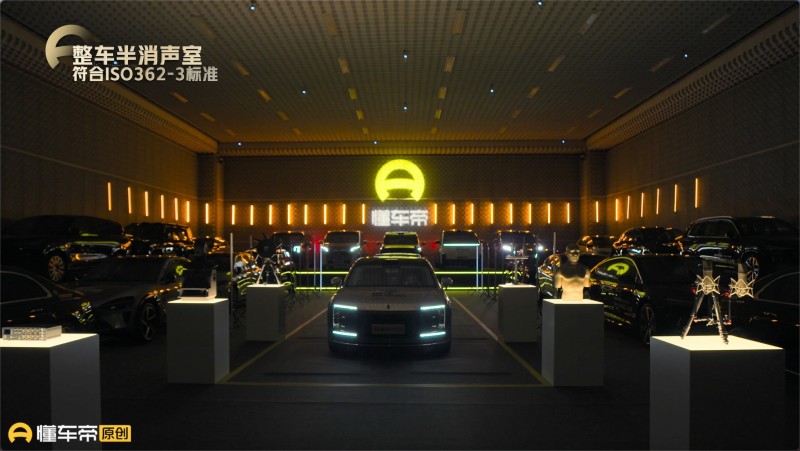
50款顶流车型静谧性对比,国产新能源车隔音全面领先
Sou Hu Wang· 2025-12-07 12:50
Core Insights - The article highlights the increasing importance of cabin quietness and in-car audio systems as core elements defining the comfort of the "mobile third living space" for consumers [1][6] - The launch of the "Dongche Voice Academy" by Dongche Di aims to help consumers better understand vehicle sound insulation levels and audio technology through comprehensive testing of 50 popular models [1][3] Group 1: Testing and Results - The testing involved collaboration with authoritative testing organizations and well-known music producers, focusing on various dimensions such as driving noise, static insulation, and subjective audio quality [1][3] - Results indicate that domestic electric vehicles excel in acoustic performance, with key indicators like driving noise and static insulation matching or surpassing those of foreign brands [1][3] - 80% of the five-star rated models were from domestic brands, and 90% of models with driving noise below 50 dBA were also from domestic brands, showcasing the maturity of domestic automakers in acoustic tuning [3][4] Group 2: Comparative Performance - In cross-brand comparisons, models like the Yangwang U8 and Xiaomi YU7 demonstrated outstanding performance in dynamic and static insulation, respectively, with no significant differences in acoustic experience compared to luxury brands [4][6] - Continuous investment in sound insulation materials, acoustic structure design, and proprietary algorithm development has allowed mainstream domestic brands to reach the acoustic quality of traditional luxury brands [4][7] Group 3: Consumer Insights - The study provides valuable insights for consumers regarding audio quality and quietness when purchasing new vehicles, emphasizing that price is not the sole determinant of audio performance [6][7] - The correlation between vehicle price and audio quality is not absolute, as demonstrated by the Lynk & Co 900, which offers high-quality audio performance at a lower price point [6][7] - The article suggests that the core value of in-car audio systems lies in technical adaptation and meeting consumer needs rather than merely the number of speakers or power ratings [7]


11月新势力榜单:蔚来困于盈利,理想反弹乏力
凤凰网财经· 2025-12-07 12:07
Core Viewpoint - The delivery rankings of new car manufacturers have undergone significant changes in November, with a reshuffling of positions following the "golden September and silver October" period, highlighting the competitive landscape in the electric vehicle market [4][6]. Group 1: Delivery Rankings - Hongmeng Zhixing topped the delivery chart with 81,864 vehicles delivered, a year-on-year increase of 90% and a month-on-month increase of 20%, becoming the "alliance leader" among new forces [5][10]. - Leap Motor maintained its position as the "single brand champion" with 70,327 vehicles delivered, indicating a strong competitive dynamic between the top two players [6][17]. - Xiaomi entered the third position with over 40,000 vehicles delivered, while BYD's Fangchengbao emerged as a dark horse with 37,405 vehicles, intensifying competition in the 30,000 to 40,000 vehicle range [7][19]. Group 2: Market Dynamics - The second tier of manufacturers is characterized by fierce competition, with brands like Xiaopeng and NIO facing challenges in maintaining their delivery volumes amid strategic adjustments and market pressures [24][26]. - NIO delivered 36,275 vehicles in November, a year-on-year increase of 76.3%, but faced stock price declines due to lowered fourth-quarter delivery guidance [28][29]. - Li Auto's deliveries reached 33,181 vehicles, showing signs of recovery, but the company still faces challenges in scaling production and maintaining profitability [32]. Group 3: Financial Performance and Market Sentiment - Xiaomi's automotive division reported a significant operating profit of 700 million yuan in Q3, making it the fastest profitable new force, despite facing negative market sentiment due to various controversies [20][21]. - Leap Motor's stock price fell by 9% in November, raising concerns about its ability to balance scale and profitability, especially in competitive price segments [17][18]. - The overall market sentiment reflects a growing scrutiny on profitability and sustainability, with companies needing to demonstrate not just sales growth but also healthy financial performance to meet investor expectations [36][37].

中国拒绝被收割,全产业链通吃,记者:欧洲只剩最后一条活路
Sou Hu Cai Jing· 2025-12-07 07:44
接着,他又问:那奢侈品呢?比如LV、爱马仕?一些受访者笑了:买是买,但现在年轻人更喜欢'国潮'品牌了,高端品牌的定义已经开始发生转移,盲目崇 拜西方的时代已经过去了。他依旧不死心,继续问:那教育呢?剑桥、牛津、巴黎高师?对方淡淡地回应:论科研硬件和学术严谨性,现如今的清华北大, 甚至华东五校,在很多前沿领域已经不逊色于你们了。镀金?没必要。最终,哈丁听到了一位中国经济学家的一句实话,这句话几乎让他崩溃。那位经济学 家似乎看出哈丁的真诚,便没有隐瞒:其实,现在中国企业最想做的,不是从你们手里买东西,而是去欧洲买地建厂,把我们过剩的产能输出给你们。听到 这话,哈丁心中一沉。这简直就是降维打击!过去是西方将淘汰的产能转移给发展中国家,现在,中国要把自己的高端产能反向输出给欧洲。这不仅意味着 欧洲卖不出去东西,更意味着欧洲本土企业将面临中国企业的激烈竞争,甚至可能被卷死。 在哈丁回到欧洲后,他写了一篇报道,其中指出:除了原材料,中国几乎没有什么特别想从欧洲进口的东西了。这句话成了2025年秋天,悬在欧洲头顶的最 大威胁。 那中国为什么能如此自信,底气到底在哪?这就涉及到一个关键的词——全产业链通吃。近年来,我们经常听 ...

美媒发现可怕事实:能在中国市场胜出的企业,就能在全球“大杀四方”
Xin Lang Cai Jing· 2025-12-07 07:27
来源:军哥漫谈 11月29日,美媒《华尔街日报》的一篇报道揭示了一个引人深思的现象:中国市场已经成为全球竞争最 激烈的练兵场。 能在这里胜出的企业,往往具备了在全球市场脱颖而出的能力。 这一观点的背后,是中国市场角色的根本性变化,以及本土品牌的全面崛起。 《华尔街日报》表示,过去几十年,中国市场曾是外资企业的"摇钱树"。 改革开放后,大批国际品牌进入中国,从家电到汽车,从奢侈品到快消品,几乎每个领域都能看到它们 的身影。 星巴克、耐克、苹果等品牌曾在中国市场轻松赚得盆满钵满。 然而,随着中国经济的快速发展和本土品牌的强势崛起,这种局面已经发生了根本性变化。 如今的中国市场,已成为全球竞争最为激烈的战场。 外资企业不仅要面对本土品牌的强势竞争,还需要适应中国消费者日益挑剔的需求。 能够在这样残酷的环境中生存并胜出的企业,显然拥有极强的竞争力。 中国本土品牌的崛起并非偶然,而是多种因素共同作用的结果。 首先,中国连续多年蝉联世界第一大制造业国家,制造业的综合实力为本土品牌提供了强大的技术和生 产支撑。 以新能源汽车为例,比亚迪、蔚来、小鹏等品牌不仅在国内市场站稳脚跟,还逐步走向国际市场,与特 斯拉等国际巨头展开正 ...
人形机器人重塑公司估值,美的集团股价接连创年内新高
Di Yi Cai Jing· 2025-12-07 06:02
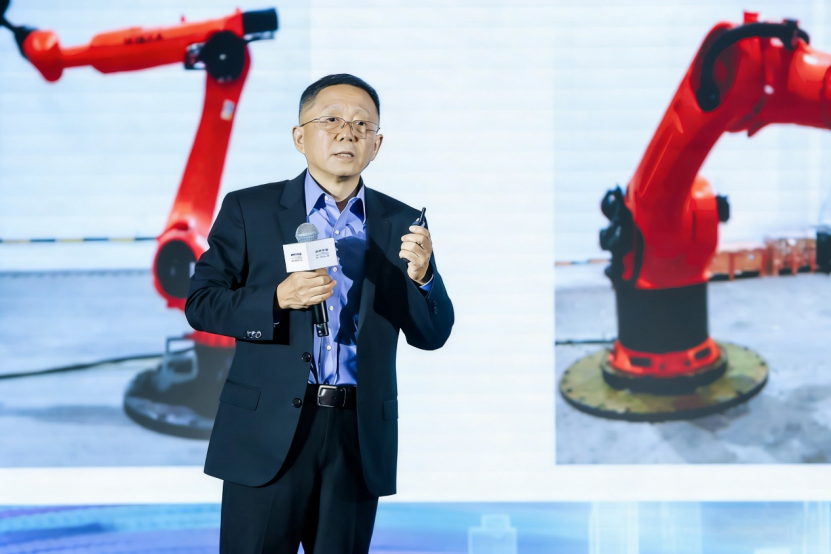
Group 1: Company Developments - Midea Group's Vice President and CTO Wei Chang announced the launch of the humanoid robot "MIRO U," which is the industry's first six-arm wheeled humanoid robot aimed at addressing the practical value of humanoid robot technology [1][3] - Midea's stock price reached a new high of 83.17 yuan per share, with a market capitalization exceeding 630 billion yuan, reflecting the company's growth resilience and potential despite facing demand and cost pressures in the domestic appliance market [1][12] - The company has established a comprehensive R&D capability in the robotics sector, from core component development to complete system integration, following significant milestones such as the acquisition of KUKA Group and the establishment of a national key laboratory for high-end heavy-duty robots [3][4] Group 2: Technological Innovations - The MIRO U robot features a core technology system developed by Midea, enabling stable elevation, 360-degree rotation, and high-precision control with six bionic arms, significantly enhancing operational efficiency in industrial scenarios [3][4] - Midea's humanoid robots are designed to follow a path of "industrial first, commercial follow, family exploration," prioritizing technology value transformation in controllable environments [4][5] - The company aims to solve the "technical landing value" issue in the humanoid robot industry through continuous technological iteration and deep engagement in practical scenarios [5] Group 3: Strategic Partnerships and Market Expansion - Midea has signed a strategic cooperation agreement with BYD Group to deepen the integration of smart home and smart vehicle technologies, expanding the "human-vehicle-home" ecosystem [6][8] - The partnership will focus on collaborative innovation in AI and the standardization of technology interfaces and data protocols, aiming to establish industry standards for smart interconnectivity [8][9] - Midea's overseas market is a significant growth point, with overseas revenue reaching 107.2 billion yuan in the first half of 2025, a 17.7% increase year-on-year, and the company plans to expand its overseas production scale and enhance localized product innovation [11] Group 4: Financial Performance and Investor Relations - Midea has committed to substantial shareholder returns, with a total of approximately 10.975 billion yuan spent on share buybacks this year, representing 1.9383% of the total share capital [12][13] - The company reported a revenue of 363.1 billion yuan and a net profit of 37.883 billion yuan for the first three quarters, reflecting a year-on-year growth of 13.81% and 19.5%, respectively [13] - Midea plans to distribute a dividend of 35 yuan per 10 shares for the 2024 fiscal year and an additional 5 yuan per 10 shares for the mid-2025 fiscal year, which is expected to attract value investors [13]

懂车帝大规模汽车声学评价栏目上线,国产品牌音响效果全面赶超合资
Zhong Guo Qi Che Bao Wang· 2025-12-06 08:25
Core Insights - The article highlights the increasing importance of cabin quietness and in-car audio systems as core elements defining the comfort of the "mobile third living space" for consumers [1][6] - The launch of the "Dongche Voice Academy" by Dongche Di aims to help consumers better understand vehicle sound insulation levels and audio technology [1][6] - Results from tests on 50 popular models indicate that domestic electric vehicles excel in acoustic performance, surpassing or matching international brands in key metrics [1][3] Group 1: Testing and Results - The program evaluated 50 mainstream models, covering joint ventures, luxury overseas brands, and domestic brands, providing a comprehensive assessment of acoustic performance [3][4] - 80% of the five-star rated models were from domestic brands, with 14 out of 15 four-star models also being domestic, showcasing the maturity of domestic manufacturers in acoustic tuning [3][4] - The top eight models for driving noise were all domestic, with over 90% of models maintaining driving noise below 50 dBA, which is considered the optimal range for human hearing comfort [3][4] Group 2: Comparative Performance - The Yangwang U8 demonstrated outstanding dynamic noise insulation, while the Xiaomi YU7 ranked first in static insulation, indicating that domestic models can compete with luxury brands [4][6] - Brands like Xiaomi, Lynk & Co, and BYD have made significant investments in sound insulation materials and acoustic design, achieving sound quality comparable to traditional luxury brands [4][6] Group 3: Consumer Insights - The testing results provide valuable references for consumers when selecting vehicles based on audio quality and quietness [6][7] - The relationship between vehicle price and audio performance is not absolute, as demonstrated by the Lynk & Co 900, which offers high-quality audio at a lower price point [6][7] - The core value of in-car audio systems lies in technical adaptation and meeting consumer needs, rather than just the number of speakers or power ratings [7]

中美俄联手“断奶”,欧洲五百年“吸血”终遭清算,还债时刻来了
Sou Hu Cai Jing· 2025-12-06 08:15
大家好,老半这篇国际评论,主要来分析欧洲好日子到头,美俄中不再"供血",这迟来的清算已无法避 免。 2025年的欧洲,你感受到的,不再是咖啡馆里飘出的悠扬旋律,也不是古老街头艺人的即兴表演。取而 代之的,是弥漫在空气中的一丝不安,一种切切实实的"凉意"。 这股凉意,不是来自窗外的寒风,而是从人们的口袋、从企业的账本里,一点点渗出来的。 曾经的"体面"生活:别人家的钱袋子 想象一下,你是个生活优渥的欧洲人:从小享受免费教育,生病了不用愁天价医药费,工作几年就能休 个把月带薪假,到了退休更是能领上不菲的养老金,周游世界不是梦。 这样的日子,是不是听起来有点像白日梦?但在欧洲,这曾是许多人的日常。 可这些"体面"和"优渥"是从哪儿来的呢?说白了,就像一个长期在家享福,不愁吃穿的"老少爷",他的 钱袋子,可不是自己挣的。 欧洲在战后,巧妙地搭建了一个"借力使力"的生存模式,说好听点叫全球化分工,说直白点,就是有三 根"大腿"在默默支撑着它。 曾几何时,我们谈起欧洲,总会联想到高福利、慢节奏、好山好水好生活,仿佛那是人人向往的"人间 天堂"。可如今,天堂的门缝似乎正在一点点合上,留下了一地鸡毛和一声声叹息。 你可能要问 ...

中国汽车的真正考验,才刚开始
Xin Lang Cai Jing· 2025-12-06 07:04
Core Viewpoint - The Chinese automotive industry is facing a significant downturn, with 2026 expected to be one of the most challenging years in its history due to declining sales and market conditions [5][37]. Group 1: Market Performance - Retail sales of passenger cars in China saw a 15% year-on-year increase earlier this year, but growth has rapidly declined since July, with October experiencing an overall negative growth [7][39]. - In November, daily retail sales averaged 4.6 million units, down 19% year-on-year in the first week, and 6.7 million units, down 9% in the second week [8][39]. - Major automakers are struggling to meet their sales targets, with only a few smaller new players achieving their goals by November [8][40]. Group 2: Industry Challenges - The automotive industry is transitioning from subsidy-driven growth to competition based on real demand and efficiency, indicating a significant shift in market dynamics [40][41]. - The impact of subsidies is diminishing, with over 50% of sales in 2025 attributed to trade-in programs, highlighting a reliance on government incentives [9][41]. - The market is experiencing a "strategic waiting" phase among consumers, leading to a decline in new orders as buyers anticipate better deals [15][48]. Group 3: Future Outlook - The expected decline in new energy vehicle purchase tax incentives in 2026 is anticipated to further exacerbate market challenges [15][47]. - The penetration rate of new energy vehicles is slowing, with a notable drop in total retail volume despite high growth rates in percentage terms [15][47]. - The industry is likely to undergo a significant restructuring, with weaker companies facing exit from the market, marking a shift from scale expansion to value competition [32][65]. Group 4: Technological Developments - The automotive sector is exploring various technological advancements, including smart driving and battery innovations, but progress varies across different areas [51][54]. - The introduction of solid-state batteries and centralized computing is underway, but widespread adoption is not expected until 2026 or later [54][55]. - The smart driving sector is experiencing a technological leap, with new models expected to enhance user trust and influence purchasing decisions in 2026 [57][60].


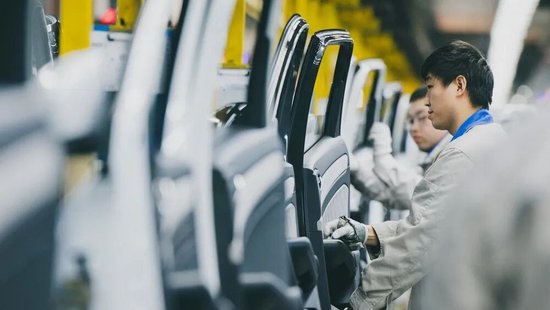
中国汽车的真正考验,才刚开始
虎嗅APP· 2025-12-06 03:32
Core Viewpoint - The article highlights that 2026 is expected to be a challenging year for the Chinese automotive industry, with significant declines in sales and a shift from subsidy-driven growth to competition based on real demand and efficiency [2][9]. Sales Performance - Retail sales of passenger cars in China saw a 15% year-on-year growth at the beginning of the year, but the growth rate has sharply declined since July, with October experiencing an overall negative growth [4][8]. - In November, the average daily retail sales of passenger cars were 46,000 units, down 19% year-on-year in the first week, 9% in the second week, and 7% in the third week [6]. Company Targets and Achievements - BYD aimed for 4.6 million units and achieved 4.18 million units by November, facing challenges to meet its target [7]. - SAIC Group set a target of 4.5 million units, with 4.11 million units sold by November, likely to meet its goal [7]. - Chery and Li Auto are unlikely to meet their targets, while Xiaomi and Leap Motor have already achieved theirs [11]. Market Dynamics - The automotive industry is experiencing its lowest profit margins in five years, with an average profit margin of only 3.8%, leading to significant price reductions [8]. - The market is shifting from a subsidy-driven model to one focused on genuine consumer demand and efficiency, indicating a potential industry "cold wave" in 2026 [8][41]. Subsidy Impact - The impact of subsidies is diminishing, with over 50% of sales in 2025 attributed to trade-in programs, which are now facing adjustments and reductions in many regions [10][13]. - The withdrawal of subsidies is leading to a significant drop in consumer purchasing activity, as many are adopting a "wait-and-see" approach [19][23]. Technological Developments - The article discusses various technological advancements in the automotive sector, including developments in autonomous driving and battery technology, which are seen as potential growth areas for 2026 [26][30]. - The shift towards "software-defined vehicles" and advancements in intelligent driving systems are expected to play a crucial role in the market's future [30][40]. Industry Outlook - The automotive industry is facing a structural adjustment, with weaker companies likely to exit the market as competition intensifies [47]. - The transition from scale expansion to value competition is seen as essential for the long-term health of the industry, with a focus on innovation and efficiency [47][48].