
国联安基金

Search documents
一批投资老将业绩重回巅峰!强势回应“尚能饭否”
Sou Hu Cai Jing· 2026-02-11 13:35
Core Viewpoint - The performance of veteran fund managers has rebounded strongly, challenging the notion that they are outdated and unable to compete with younger managers who focus on high-growth sectors [2][10]. Group 1: Performance Recovery of Veteran Fund Managers - Veteran fund managers have demonstrated a strong recovery in performance, with many achieving record highs in net value in January 2026, despite previous criticisms and market challenges [3][4]. - Notable examples include Wei Dong from Guolian An Fund, whose managed fund's annualized return has returned to over 10%, and Gu Jun from Bosera Fund, who achieved a 71.3% return in the past year [3][4]. - Other veteran managers, such as Qi Fapeng and Xu Lirong, have also seen their funds reach historical net value highs, indicating a broader trend among experienced fund managers [4]. Group 2: Challenges Faced by Veteran Fund Managers - The market has seen a significant divide, with veteran managers facing pressure from new, high-performing managers who focus on high-volatility sectors, leading to doubts about the capabilities of older managers [5][6]. - Some veteran managers have struggled with large fund sizes, which can limit their ability to adapt quickly to market changes, further intensifying scrutiny on their performance [5][6]. Group 3: Trust Restoration Among Investors - As the performance of actively managed equity funds improves, investor confidence is gradually being restored, reversing previous trends of fund redemptions [8][9]. - Investors have expressed mixed feelings about their experiences, with some reporting significant losses followed by recoveries, highlighting the importance of veteran managers in navigating complex market conditions [9]. - The resurgence of veteran fund managers is seen as a critical factor in rebuilding trust within the public fund industry, as they leverage their experience to manage risks and capitalize on opportunities [8][10].
突然大爆发 这只ETF冲涨停
Zhong Guo Ji Jin Bao· 2026-02-10 16:05
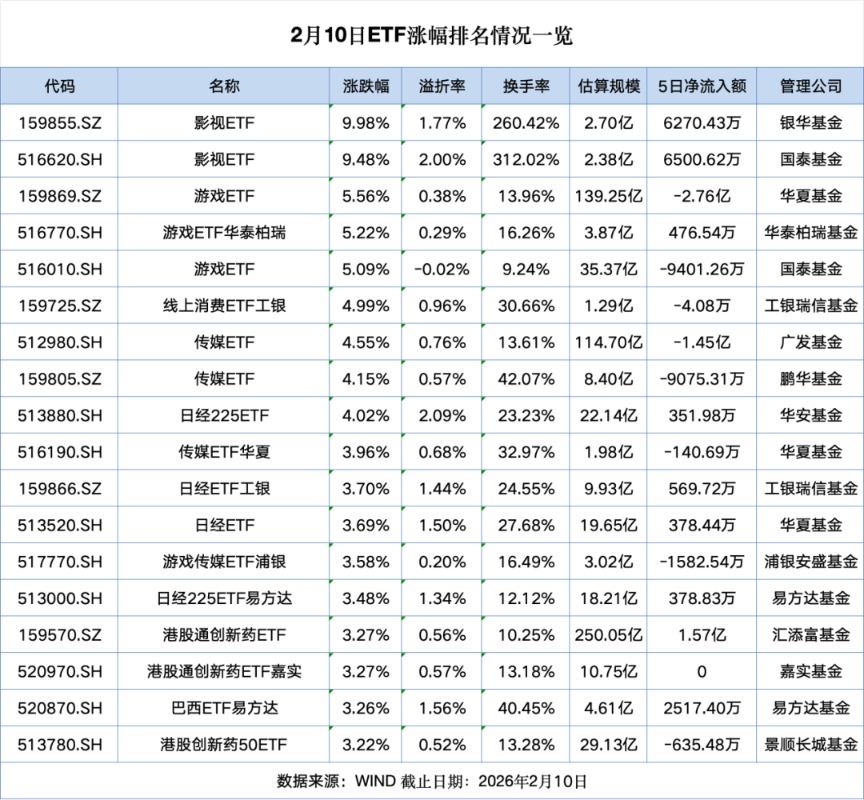
Market Overview - On February 10, 2026, A-shares showed mixed performance with the three major indices fluctuating. The AI application and film sectors experienced a surge, while the photovoltaic, real estate, and consumer sectors weakened [1] - A total of 847 ETFs rose in the market, with the film and gaming ETFs seeing significant increases of 9.98% and 5.56%, respectively [1] ETF Performance - The top-performing ETFs included: - Film ETF (159855.SZ) with a rise of 9.98%, estimated scale of 270 million, and a turnover rate of 260.42% [2] - Gaming ETF (159869.SZ) increased by 5.56%, with an estimated scale of 139.25 billion [2] - Conversely, 468 ETFs declined, with the satellite, real estate, and photovoltaic ETFs leading the losses [2][3] Film Sector Insights - The film sector saw a remarkable rally, with the CSI Film Index (930781) soaring by 9.25%. Major stocks like Jiechuan Co. and Huayi Brothers hit the daily limit [5] - The Silver华 Film ETF (159855) reached its daily limit with a 9.98% increase, while the Guotai Film ETF (516620) rose by 9.48%. Both ETFs experienced significant capital inflows [5][6] Gaming Sector Insights - The gaming sector also performed well, with the Animation and Gaming Index (930901) rising by 5.26%. Key stocks such as Light Media and Aofei Entertainment reached their daily limits [12][13] - The top gaming ETFs included: - 华夏 Gaming ETF (159869) with a 5.56% increase and an estimated scale of 2.93 billion [15] - 华泰柏瑞 Gaming ETF (516770) with a 5.22% increase [14] Fund Flow Analysis - On February 9, the A-share market saw a strong rally, with a net outflow of over 28 billion across all stock ETFs. The top inflow sectors included the CSI 500 Index, which saw a net inflow of 27.3 billion [16] - The CSI 500 ETF was highlighted as a core broad-based index reflecting mid to small-cap stocks in the A-share market [19]

从ETF巨震看中国式市场下一站
Sou Hu Cai Jing· 2026-02-10 12:10
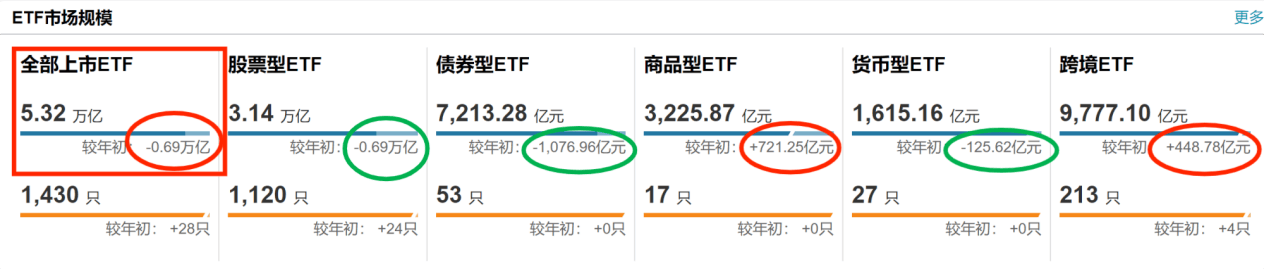
Core Viewpoint - The A-share market has experienced significant fluctuations in early 2026, with a notable reduction of over 690 billion yuan in the overall ETF market, indicating a shift in capital preferences and regulatory intentions [1][2]. Group 1: ETF Market Overview - As of February 6, 2026, the total market size of ETFs has decreased by over 690 billion yuan since the beginning of the year, with stock ETFs accounting for a reduction of 690 billion yuan and bond ETFs decreasing by 107.6 billion yuan [2]. - The issuance of new ETFs has been limited, with only 24 new stock ETFs and 4 cross-border ETFs launched, while no new bond, commodity, or money market ETFs were issued [2]. Group 2: ETF Performance by Theme - The top 25 ETFs with the highest growth rates in terms of share volume include sectors such as oil and gas, general aviation, and semiconductor technology, with some ETFs showing growth rates exceeding 800% [4]. - In terms of absolute value increase, the leading ETFs are in the chemical, communication, and software sectors, indicating strong investor interest in these themes [5]. Group 3: ETF Outflows - The ETFs with the highest reduction rates in share volume include those in financial technology, engineering machinery, and solar energy, reflecting a trend of capital withdrawal from these sectors [6]. - The ETFs with the largest absolute value decrease are also concentrated in financial technology and engineering machinery, suggesting a significant shift in investor sentiment away from these themes [7].
申万金工ETF组合202602
Shenwan Hongyuan Securities· 2026-02-10 09:43
1. Report Industry Investment Rating - Not provided in the given content 2. Core Viewpoints of the Report - The report focuses on constructing multiple ETF portfolios, including macro industry, macro + momentum industry, core - satellite, and trinity style rotation portfolios, aiming to find better investment opportunities by combining macro factors, momentum factors, and style rotation [4][5]. - Different industries have different sensitivities to economic, liquidity, and credit factors. For example, traditional cycle industries are sensitive to the economy, TMT is sensitive to liquidity, and consumption is sensitive to credit [4]. 3. Summary According to Relevant Catalogs 3.1 ETF Portfolio Construction Methods 3.1.1 Based on Macro Method - Calculate macro - sensitivities of broad - based, industry - themed, and Smart Beta ETFs based on economic, liquidity, and credit variables. Combine with momentum indicators for complementary analysis [4]. - Traditional cycle industries are suitable for economic up - periods, TMT for weak - economy but loose - liquidity periods, and consumption for credit - expansion periods. State - owned enterprises and ESG - related themes have low sensitivities to liquidity and credit [4]. - Construct three ETF portfolios (macro industry, macro + momentum industry, and core - satellite) and adjust positions monthly [4]. 3.1.2 Trinity Style Rotation ETF Portfolio Construction - Build a medium - to - long - term style rotation model centered on macro - liquidity, and compare it with the CSI 300 index [5]. - Construct three types of models (growth/value rotation, market - cap, and quality models) by screening macro, fundamental, and market - sentiment factors. The model has 8 style - preference results [5]. - Select ETFs with high exposure to the target style, control industry exposure, and set allocation limits to get the final ETF allocation model [5]. 3.2 Macro Industry Portfolio - Select industry - themed ETFs with over 1 - year establishment and over 200 million current scale. Calculate sensitivity scores of economic, liquidity, and credit factors monthly, adjust scores according to the latest indicators, and sum them up. If liquidity and credit deviate significantly, remove the liquidity score. Select the top 6 industry - themed indices and corresponding largest - scale ETFs for equal - weight allocation [6][7]. - Currently, with falling economic leading indicators, loose liquidity, and tightened credit, the portfolio is biased towards TMT and consumption. The February positions are shown in Table 1 [8]. - The portfolio has large fluctuations and outperformed the benchmark significantly in January [11]. 3.3 Macro + Momentum Industry Portfolio - Combine macro and momentum methods to address the left - side nature of macro - based strategies (low win - rate but high odds). Use clustering to group industry - themed indices and select the highest - rising product in each group in the past 6 months for equal - weight allocation [12]. - The momentum - selected industries still have a high proportion of cyclical industries. The February positions are shown in Table 3 [16]. - The portfolio has performed well this year and outperformed the CSI 300 significantly in January [17]. 3.4 Core - Satellite Portfolio - Design a "core - satellite" portfolio with the CSI 300 as the core to address the high volatility and rapid industry rotation of industry - themed ETFs [19]. - Calculate macro - sensitivities for broad - based, industry - themed, and Smart Beta ETFs, construct three stock portfolios, and weight them at 50%, 30%, and 20% respectively [19]. - The current allocation of broad - based ETFs is biased towards the Sci - tech Innovation Board and the ChiNext. The portfolio has performed stably, outperforming the benchmark in most months except December, and had significant excess returns in January 2026 [23][24]. 3.5 Trinity Style Rotation ETF Portfolio - The model currently favors the small - cap growth - high - quality segment. The factor exposures and historical performance are shown in Table 7 [26]. - The February positions are shown in Table 9 [31]. - The portfolio has achieved certain excess returns, especially in some months such as August 2025 and January 2026 [29].
尚能饭否?基金老将,“高分”回归!
券商中国· 2026-02-10 07:56
Core Viewpoint - The article discusses the resurgence of veteran fund managers in the public fund industry, highlighting their ability to adapt and achieve strong performance despite recent market challenges and skepticism about their relevance [2][10]. Group 1: Performance of Veteran Fund Managers - Veteran fund managers have demonstrated a strong recovery in performance, with many achieving record highs in net value and returns in early 2026, despite facing significant market fluctuations in previous years [3][4]. - Notable examples include Wei Dong from Guolian An Fund, whose fund's annualized return has returned to over 10%, and Gu Jun from Bosera Fund, who achieved a 71.3% return in the past year [3][4]. - Other veteran managers, such as Qi Fapeng from Guotou Ruijin Fund and Zhou Weiwen from China Universal Fund, have also seen their funds reach historical highs, showcasing the effectiveness of their long-term investment strategies [4]. Group 2: Challenges Faced by Veteran Fund Managers - The market has seen a significant style divergence, leading to periods where veteran managers underperformed compared to newer managers who focused on high-growth sectors, resulting in a loss of investor patience and confidence [6]. - Some veteran managers faced criticism for their performance and were perceived as outdated, especially when managing larger funds that limited their flexibility in adjusting portfolios [6][7]. - Despite these challenges, many veteran managers have maintained their investment philosophies and adapted their strategies to align with market changes, demonstrating resilience and a commitment to continuous learning [7]. Group 3: Rebuilding Investor Trust - As the performance of actively managed equity funds improves, investor confidence is gradually being restored, reversing previous trends of fund redemptions and skepticism towards the public fund industry [8][9]. - The article highlights that veteran fund managers, through their stable and predictable performance, are helping to mend the trust gap that had developed among investors due to past volatility [8][9]. - Feedback from investors indicates a renewed faith in veteran managers, as many have seen their investments recover from significant losses, reinforcing the value of experienced fund management [9].

光伏ETF上周领涨,太空光伏新需求获机构看好丨ETF基金周报
2 1 Shi Ji Jing Ji Bao Dao· 2026-02-09 03:21
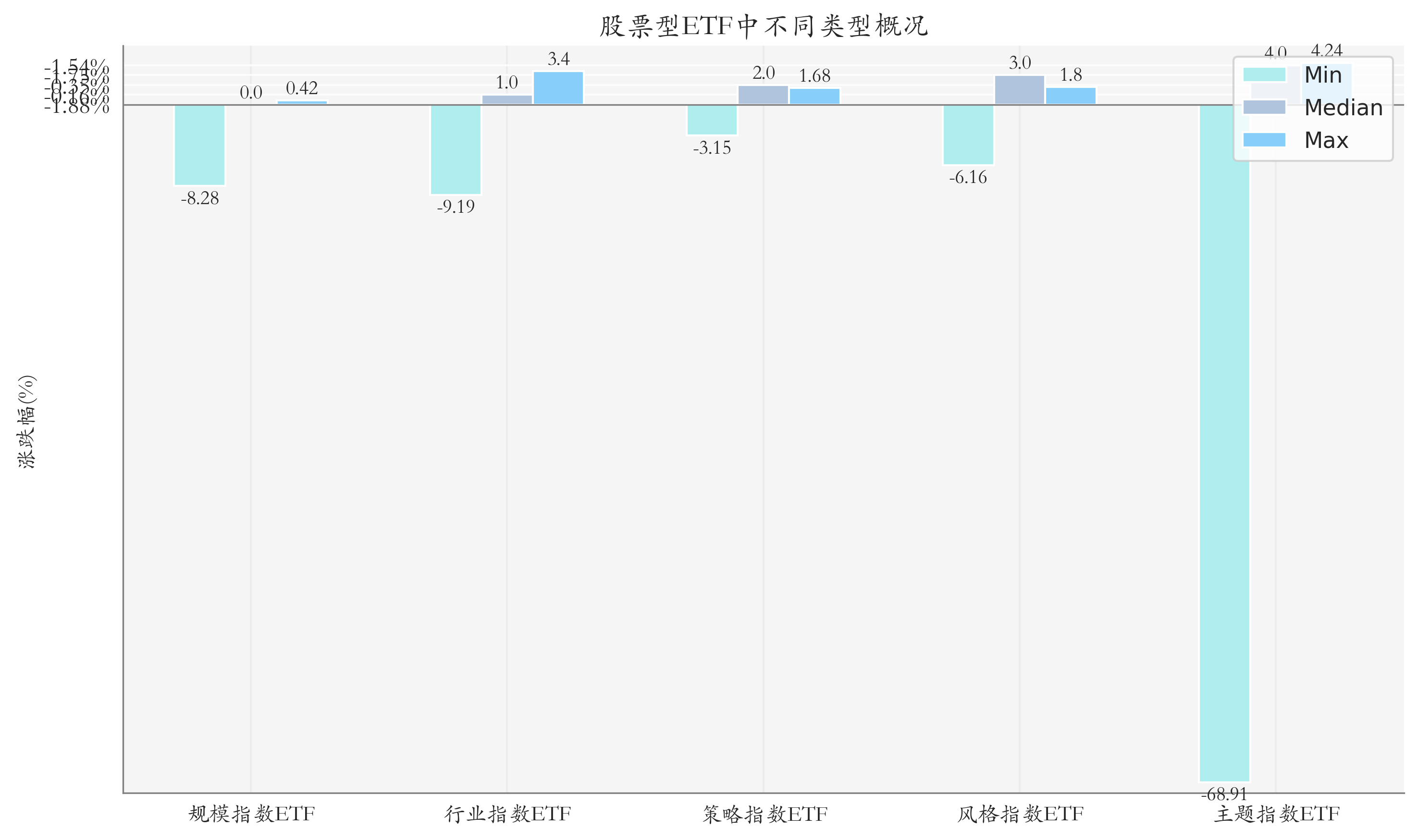
Market Overview - The Shanghai Composite Index fell by 1.27% to 4065.58 points, with a weekly high of 4104.62 points [1] - The Shenzhen Component Index decreased by 2.11% to 13906.73 points, reaching a high of 14213.61 points [1] - The ChiNext Index dropped by 3.28% to 3236.46 points, with a peak of 3390.3 points [1] - In the global market, the Nasdaq Composite Index declined by 1.84%, while the Dow Jones Industrial Average rose by 2.5% [1] ETF Market Performance 1. Stock ETF Overall Performance - The median weekly return for stock ETFs was -1.63% [2] - The highest weekly return among scale index ETFs was 0.42% for the Southern Shenzhen Main Board 50 ETF [2] - The highest weekly return in industry index ETFs was 3.4% for the China Southern Shanghai Composite Main Consumer ETF [2] 2. Stock ETF Gain and Loss Rankings - The top five performing ETFs were: - China Southern Photovoltaic Industry ETF (4.24%) - Fortune Shanghai Stock Exchange Sci-Tech Innovation Board New Energy ETF (4.09%) - E Fund Shanghai Stock Exchange Sci-Tech Innovation Board New Energy ETF (3.93%) - Penghua Shanghai Stock Exchange Sci-Tech Innovation Board New Energy ETF (3.88%) - Tianhong China Southern Photovoltaic Industry ETF (3.42%) [6] - The five ETFs with the largest declines included: - Guotai China Southern All-Index Communication Equipment ETF (-68.91%) - Guolian An Shanghai Stock Exchange Sci-Tech Innovation Board Chip Design Theme ETF (-54.59%) - Huaan China Southern Shanghai-Hong Kong Gold Industry Stock ETF (-13.25%) [6] 3. Stock ETF Liquidity - Average daily trading volume for stock ETFs decreased by 32.4%, while average daily trading volume increased by 20.9% [8] 4. Stock ETF Fund Flows - The top five ETFs with the highest inflows were: - Southern China 500 ETF (inflow of 2.26 billion) - Huatai-PB CSI 300 ETF (inflow of 1.086 billion) - Huaxia CSI 1000 ETF (inflow of 600 million) [11] - The top five ETFs with the largest outflows included: - Huaxia Shanghai 50 ETF (outflow of 331 million) - Huaxia CSI Subdivision Food and Beverage Industry Theme ETF (outflow of 324 million) [12] ETF Financing and Margin Trading - The financing balance for stock ETFs decreased from 53.0598 billion to 52.7352 billion [14] - The highest financing buy amount was for Southern China 500 ETF, totaling 845 million [14] ETF Market Size - The total market size for ETFs reached 5321.655 billion, a decrease of 135.866 billion from the previous week [17] - Stock ETFs accounted for 59.0% of the total ETF market size [19] ETF Issuance and Establishment - No new ETFs were issued last week, but nine new ETFs were established, including: - Huaan CSI Nonferrous Metal Mining Theme ETF - Wanji Guo Zheng New Energy Vehicle Battery ETF [20] Institutional Insights - CITIC Securities predicts exponential growth in space photovoltaic demand, with leading Chinese photovoltaic equipment manufacturers likely to enter the supply chains of companies like Tesla and SpaceX [21] - GF Securities anticipates that the demand for energy from space satellites and data centers will drive global photovoltaic demand, projecting a growth of 18.6% in global photovoltaic demand by 2026 [22]
43只基金2月发行 抢滩布局“春节效应”
Shang Hai Zheng Quan Bao· 2026-02-08 17:31
Group 1 - The core viewpoint of the articles highlights a surge in the issuance of public funds, particularly equity funds, ahead of the Spring Festival, with 43 new funds launched during the period from February 9 to the end of February [1] - Among the new funds, 33 are equity funds, accounting for nearly 80% of the total, with a significant number being actively managed funds [1] - The current market sentiment and continuous funding support are creating a favorable environment for the issuance of equity funds, driven by structural market trends and a shift in investor preferences from traditional savings to equity investments [1] Group 2 - As of February 8, 2023, the issuance momentum for equity funds has been strong, with notable funds like Guangfa Research Smart Mixed Fund raising over 7.2 billion yuan and Huabao Advantage Industry Mixed Fund nearly 5.8 billion yuan [2] - The issuance of configuration products, particularly FOFs, has also increased, with rapid fundraising success attributed to heightened market volatility [2] - Analysts suggest that the Spring Festival effect may enhance market performance, with expectations of a sustained spring rally due to favorable policy outlooks and increased consumer spending [2] Group 3 - Market analysts believe that the short-term fluctuations before the Spring Festival do not alter the positive outlook for the market post-holiday, with many institutions favoring holding positions through the holiday [3] - Three key factors are expected to support corporate profit improvement: expansionary fiscal policies in major economies, easing local government debt pressures, and a potential bottoming out of the real estate market in China [3] - Improved demand conditions are anticipated to enhance profitability in sectors with favorable supply-demand dynamics, particularly in the context of low manufacturing inventory levels [3]
资金加仓!这一方向显著吸金
Zhong Guo Zheng Quan Bao· 2026-02-06 13:16
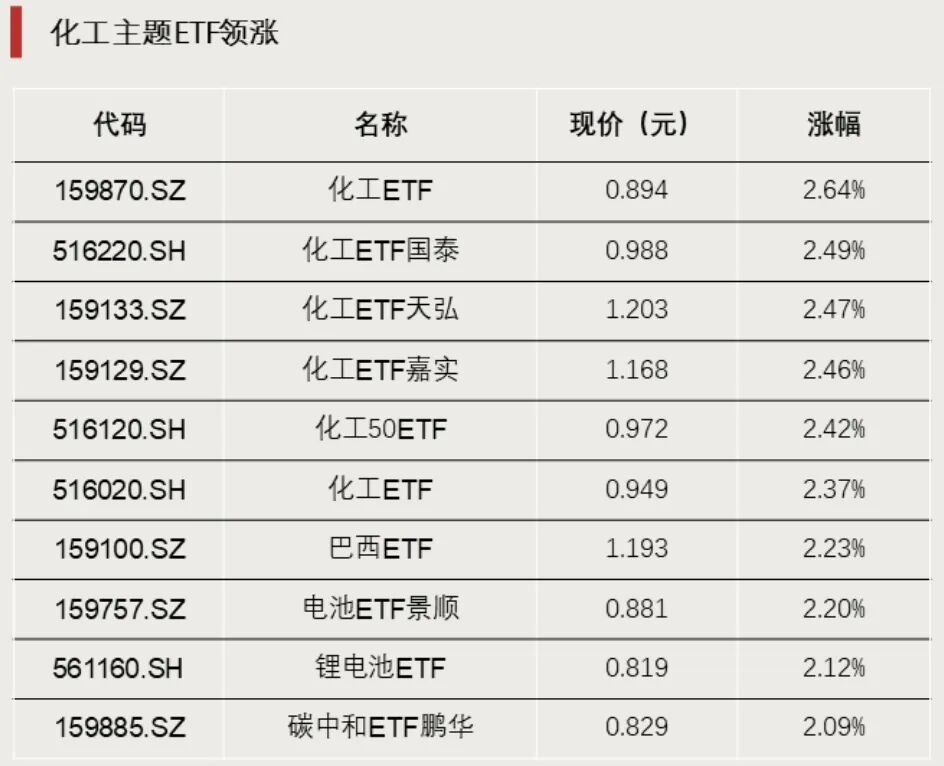
Group 1: Chemical Sector Performance - On February 6, the A-share chemical sector experienced a strong rally, with multiple sub-sectors such as chemical fibers, chemical products, chemical raw materials, and petrochemicals showing significant gains, leading to several chemical-themed ETFs rising over 2% [2][4] - The chemical ETF performance included notable increases: Chemical ETF (159870.SZ) rose by 2.64%, Chemical ETF Guotai (516220.SH) by 2.49%, and Chemical ETF Tianhong (159133.SZ) by 2.47% [3] - Analysts from Zhongyuan Securities noted a significant recovery in chemical prices in January, with liquid chlorine, acetonitrile, and butadiene performing well, suggesting that supply constraints in the chemical industry may strengthen in the future [3] Group 2: New Energy and Battery Sector - The new energy and battery sectors saw strong performance, with several related ETFs actively rising, including the Science and Innovation New Energy ETF and Battery ETF Jiashi, both nearing a 2% increase [4][5] - The Science and Innovation New Energy ETF (588830.SH) increased by 1.99%, while the Battery ETF Jiashi (562880.SH) rose by 1.96% [5] Group 3: ETF Market Trends - The ETF market has seen significant inflows, particularly in technology-themed ETFs, with the top ten products by net inflow mostly being technology-related [8] - The Huatai-PB Hang Seng Technology ETF recorded a net inflow of over 3.1 billion yuan, while other technology ETFs also saw substantial inflows exceeding 2 billion yuan [9] Group 4: A500 Index and Investment Value - The A500 index, represented by the A500 ETF (563800), has shown significant investment value due to its balanced industry distribution and focus on leading companies, making it attractive for long-term investment [10] - Analysts from GF Fund highlighted the index's advantages, including its ability to effectively capture growth opportunities while mitigating risks associated with single industries [10]
有研新材股价涨5.34%,国联安基金旗下1只基金位居十大流通股东,持有404.87万股浮盈赚取445.35万元
Xin Lang Cai Jing· 2026-02-06 03:30
Core Viewpoint - Youyan New Materials Co., Ltd. has shown a significant increase in stock price, reflecting positive market sentiment and investor interest in the company's advanced functional materials business [1]. Group 1: Company Overview - Youyan New Materials Co., Ltd. was established on March 12, 1999, and listed on March 19, 1999. The company is located at 2 D, Youyan Technology Innovation Center, Xinjiekou Outer Street, Xicheng District, Beijing [1]. - The company's main business involves the research, production, and sales of semiconductor materials, rare earth materials, optoelectronic materials, and high-purity/ultra-high-purity metal materials [1]. - The revenue composition of the main business includes: high-purity/ultra-high-purity metal materials (74.75%), rare earth materials (23.52%), infrared optical materials (2.18%), medical device materials (0.73%), and others (0.02%) [1]. Group 2: Shareholder Information - Guolian An Fund has a presence among the top ten circulating shareholders of Youyan New Materials, with its Guolian An Semiconductor ETF (512480) newly entering the top ten in the third quarter, holding 4.0487 million shares, which accounts for 0.48% of the circulating shares [2]. - The estimated floating profit for Guolian An Semiconductor ETF today is approximately 4.4535 million yuan [2]. - Guolian An Semiconductor ETF was established on May 8, 2019, with a latest scale of 20.165 billion yuan. Year-to-date return is 8.66%, ranking 690 out of 5564 in its category; the one-year return is 56.45%, ranking 669 out of 4288; and since inception, the return is 218% [2]. Group 3: Fund Manager Information - The fund managers of Guolian An Semiconductor ETF are Huang Xin and Zhang Zhenyuan. Huang Xin has a cumulative tenure of 15 years and 301 days, with the fund's total asset scale at 36.867 billion yuan and the best return during his tenure at 241.86% [3]. - Zhang Zhenyuan has a cumulative tenure of 12 years and 67 days, with the fund's total asset scale at 36.491 billion yuan and the best return during his tenure at 387.76% [3].
