
建行

Search documents
今天银行股为何大跌?
表舅是养基大户· 2025-06-27 13:14
Group 1: Xiaomi's Performance - Xiaomi's Yu7 model achieved impressive sales, with 200,000 units pre-ordered within 3 minutes and over 240,000 units locked in total, indicating strong market demand [1] - In comparison, Li Auto's expected second-quarter delivery was around 110,000 units, highlighting Xiaomi's significant market share gain [1] - The strong sales of Yu7 are expected to impact other SUV manufacturers negatively, leading to declines in their stock prices, with BYD down 7%, Xpeng down 5.5%, and others down around 3-3.5% [1] Group 2: Market Reactions and Fund Movements - Despite the positive sales news, Xiaomi's stock performance was below expectations, with a closing increase of only 3.6% after an initial 8% rise [2] - There was a significant net sell-off of Xiaomi shares, with southbound funds selling 3.2 billion, indicating a strong profit-taking sentiment among investors [3] - The sell-off is seen as a healthy market correction, preventing potential bubbles from forming [5] Group 3: Banking Sector Analysis - The banking sector experienced a decline of nearly 3%, attributed to specific institutional needs for balance sheet adjustments at the end of the quarter [7] - The Shenwan Banking Index fell by 2.86%, contributing approximately -1.45% to the overall decline of the low-volatility dividend index, indicating that the issue was primarily within the banking sector [8] - Institutional selling was driven by a combination of profit-taking and seasonal adjustments, with significant sell-offs occurring as banks reached historical highs [9][10] Group 4: Divergence in Banking Stocks - A divergence was noted between A-share and Hong Kong banking stocks, with A-shares declining while Hong Kong stocks began to rebound, suggesting continued buying interest from insurance funds [14] - The China Construction Bank in Hong Kong saw net purchases exceeding 1.3 billion, indicating strong demand despite the overall market downturn [17] Group 5: Commodity Market Insights - The metals sector, particularly copper, saw significant gains, with a rise of over 2% driven by tight global supply and increased demand [23] - The surge in copper prices is linked to supply shortages and geopolitical factors, with expectations of continued high performance in the metals sector [28]


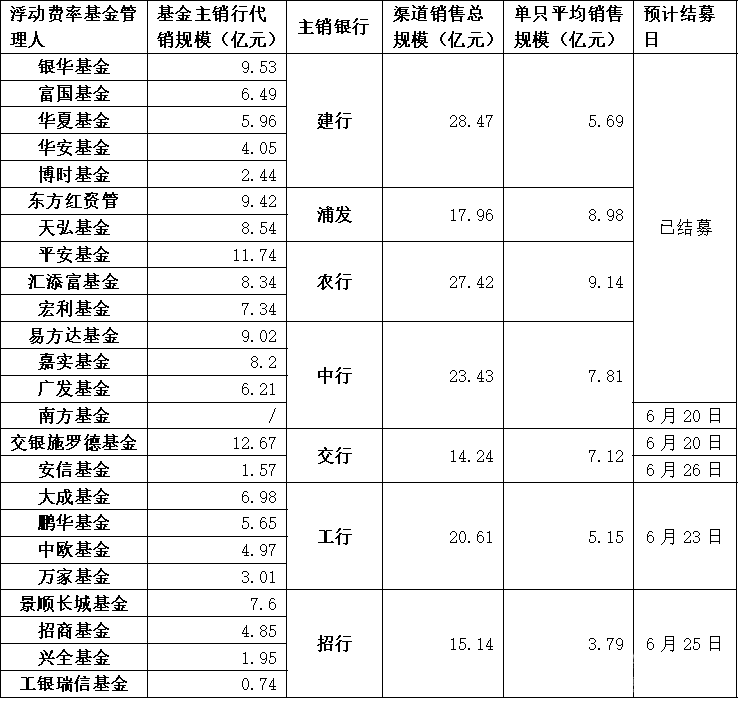
浮动费率基金“代销榜”:建行居首,招行意外落后
Sou Hu Cai Jing· 2025-06-19 13:11
Core Insights - The issuance and sales competition of the first batch of floating rate funds has progressed significantly, with 24 out of 26 approved funds currently in the issuance phase [1] - Major banks have revealed their sales rankings for floating rate funds, with China Construction Bank leading in sales volume [2] - There are concerns regarding the alignment of marketing themes with fund managers' expertise, indicating potential miscommunication in product positioning [6][7] Group 1: Fund Issuance and Sales - As of June 18, 2023, 24 out of 26 approved floating rate funds are in the issuance phase, with several funds from major asset management companies having completed their fundraising [1] - China Construction Bank, Shanghai Pudong Development Bank, and Agricultural Bank of China have all completed fundraising for their floating rate funds, with China Construction Bank leading with a total sales volume of 28.47 billion yuan [2] - The sales performance of floating rate funds varies across banks, with most funds achieving sales between 5 to 10 billion yuan [2][3] Group 2: Marketing and Product Positioning - Floating rate funds are designed to align management fees with fund performance, creating a better investment experience for investors [6] - There are instances where marketing materials for certain funds do not align with the fund managers' actual investment capabilities, raising concerns about the clarity of product positioning [6][7] - The emphasis on specific investment themes in marketing may mislead investors if not accurately represented by the fund manager's historical performance [7]
中泰国际每日晨讯-20250611
ZHONGTAI INTERNATIONAL SECURITIES· 2025-06-11 03:03
Market Overview - On June 10, the Hang Seng Index experienced a slight decline of 19 points or 0.1%, closing at 24,162 points[1] - The Hang Seng Tech Index fell by 0.8%, ending at 5,392 points[1] - Total market turnover reached HKD 250.3 billion, with the top two ETFs, the Tracker Fund and the Hang Seng China Enterprises ETF, recording turnover of HKD 16.5 billion and HKD 14.0 billion respectively[1] - Net inflow through the Stock Connect was HKD 7.59 billion[1] Sector Performance - Sub-sectors such as banking, insurance, power, biomedicine, materials, and transportation showed positive performance[1] - Agricultural Bank, China Construction Bank, and Industrial and Commercial Bank reached new highs since their listings[1] - Biomedicine stocks like Lepu Biopharma, CanSino Biologics, and 3SBio saw increases ranging from 9.8% to 15.5%[1] Valuation Insights - The current AH premium index has dropped to 130.5, indicating a low level within the past three years[2] - After accounting for a 20% dividend tax on H-shares, the adjusted AH premium index is approximately 125, suggesting limited upside for H-shares[2] - The Hang Seng Index's risk premium is nearing two standard deviations below its rolling two-year average, indicating insufficient market risk compensation[2] Economic Context - The economic fundamentals remain in a weak recovery phase, with ongoing downward pressure on prices and unstable corporate profit recovery[2] - If the Hong Kong dollar approaches the weak side of the peg, the Monetary Authority may withdraw liquidity, potentially raising funding costs[2] Real Estate Market Trends - New home transaction volume in 30 major cities fell to 1.42 million square meters, a year-on-year decline of 18.1%[5] - The inventory-to-sales ratio for major cities increased to 85.4, up from 83.6 a year ago[7] - Land transaction volume in 100 major cities dropped by 48.9% year-on-year, indicating a significant contraction in the real estate market[8] Investment Recommendations - Focus on state-owned developers for stability in the real estate sector, given the underperformance of Hong Kong-listed property stocks[11] - Monitor high-growth potential sectors such as consumer electronics and AI, which may benefit from reduced external risks[13]
首批26只浮费基金发行规模突破70亿元
news flash· 2025-06-09 11:08
Core Viewpoint - The first batch of 26 floating fee funds has been fully issued, with a total issuance scale exceeding 7 billion yuan, indicating strong market demand and participation from various financial institutions [1] Fund Issuance Overview - The total issuance scale of the first batch of floating fee funds has surpassed 7 billion yuan, with banks contributing over 6 billion yuan [1] - Major banks such as China Construction Bank, Agricultural Bank of China, and Industrial and Commercial Bank of China have shown significant activity, with daily issuance exceeding 100 million yuan [1] - The leading issuer, Shanghai Pudong Development Bank, has achieved a cumulative issuance of 1.45 billion yuan, while Bank of China has nearly reached 1.3 billion yuan [1] Individual Fund Performance - The fund "Oriental Red Core Value" has reached its fundraising cap of 2 billion yuan and has been established first [1] - Other leading funds in the current issuance phase include "E Fund Growth Progress" and "Harvest Growth Win," with issuance exceeding 500 million yuan and 400 million yuan respectively through Bank of China channels [1] - Other notable funds include "Tianhong Quality Value," "Jiaoyin Schroder Ruian," and "Dacheng Ultimate Return," which are also performing well in terms of issuance [1] Securities Channel Contribution - In the securities channel, Dongfang Securities has contributed nearly 500 million yuan in sales for "Oriental Red Core Value," while CITIC Securities has surpassed 200 million yuan in sales for floating fee funds [1]
【财闻联播】这家公司即将从A股摘牌!国家电网最新发布,解决世界级难题
券商中国· 2025-05-20 11:16
Macro Dynamics - In the first four months of 2025, the national general public budget revenue reached 80,616 billion yuan, a year-on-year decrease of 0.4%, with the decline narrowing by 0.7 percentage points compared to the first quarter [1] - Central government revenue decreased by 3.8%, but in April, it saw a growth of 1.6%, marking the first month of positive growth this year [1] - Local government revenue increased by 2.2%, consistent with the growth rate in the first quarter [1] Automotive Industry - In the first four months of 2025, the top ten car manufacturers sold 2.502 million vehicles, accounting for 68.7% of total car sales [2] - Among these manufacturers, BYD, Geely, SAIC-GM-Wuling, and FAW saw varying degrees of sales growth compared to the same period last year, while other companies experienced declines [2] Financial Institutions - Several banks have lowered the interest rates on large-denomination time deposits, bringing them into the "1" era [5][6] - The recent trend of deposit rate cuts includes major banks like ICBC, BOC, and CCB, affecting various deposit products [6] Market Data - The Shanghai Composite Index rose by 0.38%, with significant activity in the consumer sector, leading to a surge in stock prices for beauty care, food and beverage, and pet economy sectors [8] - The total financing balance in the two markets increased by 35.43 billion yuan, with the Shanghai Stock Exchange reporting a balance of 9,096.57 billion yuan and the Shenzhen Stock Exchange at 8,833.67 billion yuan [9] Company Dynamics - State Grid has released a self-developed large-scale renewable energy grid operation control system, addressing the challenge of integrating large-scale renewable energy into the grid [11][12] - Yulong Co., Ltd. will have its stock delisted on May 27, 2025, without entering a delisting transition period [13] - Zhaoyi Innovation plans to issue H-shares and list on the Hong Kong Stock Exchange [14] - BYD and Shenzhou Car Rental signed a strategic cooperation agreement to promote sustainable development in green travel and car rental markets [15] - Vipshop reported Q1 2025 net revenue of 26.3 billion yuan, a year-on-year decline of approximately 5%, with a Non-GAAP net profit of 2.3 billion yuan [16]
国证国际港股晨报-20250509
Guosen International· 2025-05-09 07:46
Core Viewpoints - The report suggests that the recent US-UK trade agreement may not be replicable with other countries, advising investors to reduce their holdings in US stocks [2][3][4]. Market Performance - The Hong Kong stock market has seen a six-day rise, with the Hang Seng Index opening at 22,589 points and closing at 22,775 points, up 84 points or 0.4%. The trading volume decreased by 22.6% to HKD 185.9 billion [2]. - Northbound trading recorded a net outflow of HKD 2.385 billion, a reduction of 69.7% compared to previous days. The most bought stocks were China Construction Bank, Chifeng Jilong Gold Mining, and Meituan, while Tencent, Pop Mart, and Xiaomi saw the most selling [2]. Industry Performance - Among the 12 Hang Seng Composite Index sectors, six rose and six fell. The leading sectors were Information Technology, Consumer Discretionary, and Healthcare, with increases ranging from 0.52% to 1.08%. The lagging sectors included Materials, Real Estate & Construction, and Industrials, with declines between 0.26% and 1.15% [2]. Company Analysis: Apple Inc. - Apple reported Q2 revenue of USD 95.4 billion, a 5.1% year-on-year increase, surpassing market expectations. Product revenue exceeded expectations by 1.3%, while service revenue fell short by 0.3%. The growth was driven by iPhone, Mac, iPad, and software services, despite a decline in wearables and other hardware [5]. - Operating profit reached USD 29.6 billion, up 6.1% year-on-year, and net profit was USD 24.8 billion, a 4.8% increase [5]. - iPhone revenue was USD 46.8 billion, with a 1.9% year-on-year growth and a 10.1% increase in shipment volume, attributed to the launch of the iPhone 16e and preemptive purchases due to tariff expectations. However, the average selling price dropped by 7.4% to around USD 809 [5]. - The Greater China region saw a revenue decline of 2.3% due to competitive pressures, while the Americas accounted for 42.3% of revenue, growing by 8.2% [5]. Future Outlook - The company anticipates revenue growth of 0-5% for the next quarter, facing challenges from tariff pressures, intensified competition in China, rising hardware costs, and increased AI R&D investments. The demand for wearables remains weak, and software service revenue growth is slowing [6]. - The report highlights potential risks including tariff uncertainties, rising costs from supply chain shifts, and insufficient product growth momentum [6].
中金公司港股晨报-20250429
Xin Da Guo Ji Kong Gu· 2025-04-29 02:52
Core Insights - The report highlights a positive outlook for the Hong Kong stock market, with the Hang Seng Index facing initial resistance at 23,000 points due to potential economic stimulus measures from the Chinese government and a possible reduction in tariffs by the U.S. [2][10] - The report notes that various sectors, including oil and banking, are expected to perform well in the upcoming quarters, with specific companies like CNOOC and China Construction Bank showing promising quarterly results [3][11] Market Overview - The Hang Seng Index closed at 21,972, reflecting a year-to-date increase of 9.53%, while the Hang Seng Tech Index rose by 11.66% [4] - The report indicates that Hong Kong's exports surged by 18.5% in March, exceeding market expectations, while imports increased by 16.6% [11] Company-Specific Insights - Renrui Talent (6919) is gradually recovering from the impact of a major client's reduction in service orders, with expectations for a rebound in operating profit for 2023-24 [6][9] - Sinopec (0386) reported a 25% decline in net profit for the first quarter, attributed to a challenging external environment, but is focusing on integrated operations and regional optimization [12] - Shandong Gold (1787) achieved a net profit of 1.026 billion RMB in the first quarter, marking a 46.6% increase year-on-year, driven by rising gold prices [12] Industry Trends - The report discusses the increasing importance of flexible employment services in China, with a notable shift in revenue sources for companies like Renrui Talent, which is expanding its client base beyond the internet sector [9] - The Chinese government is expected to implement policies aimed at stabilizing employment and promoting consumption, which could positively impact various sectors [10]
