毕马威

Search documents
抢夺百亿上市费,中资保荐四小龙力压大摩、高盛
2 1 Shi Ji Jing Ji Bao Dao· 2026-02-05 07:56
Group 1 - The Hong Kong IPO market in 2025 led the global capital markets with 114 companies raising approximately HKD 121.16 billion in listing fees, a year-on-year increase of HKD 64.62 billion, with listing fees accounting for about 4.24% of the total fundraising amount [1] - The top four IPO sponsors in 2025 were all Chinese firms, with CICC leading by sponsoring 41 companies, followed by CITIC Securities with 32, Huatai International with 22, and China Merchants International tied with Morgan Stanley at fourth place [2][3] - The participation of Chinese brokers in IPO sponsorship was significantly higher than that of foreign institutions, with only Morgan Stanley being the sole foreign firm in the top five [2][3] Group 2 - In 2025, 27 brokers acted as stabilizing agents for IPOs, with CICC leading by stabilizing 30 IPOs, followed by CITIC Securities with 16, and Morgan Stanley with 9 [4] - A total of 140 brokers participated as underwriters in the Hong Kong IPO market, with Futu Securities involved in 54 IPOs, followed closely by Agricultural Bank of China International with 53 [4] - The "Big Four" accounting firms dominated the auditing market for IPOs, collectively participating in 87% of the projects, with Ernst & Young leading by auditing 41 IPOs [5][6] Group 3 - In 2025, 34 mainland law firms provided legal services for Hong Kong IPOs, with Jingtian Gongcheng leading with 47 projects, doubling its participation from the previous year [7] - A total of 122 overseas law firms were involved in providing legal services for IPOs, with the top three being King & Wood Mallesons, DLA Piper, and Clyde & Co [9] - Eight industry consultants participated in 113 IPOs, with Frost & Sullivan being the most active, involved in 82 projects, capturing a market share of 73% [9]

资产证券化年刊(2025年度)
Sou Hu Cai Jing· 2026-02-05 06:32
Core Insights - The asset securitization market in China is experiencing steady growth, with a total issuance of 2,435 products amounting to RMB 23,250.45 billion in 2025, reflecting a 15% increase in the number of issuances and a 14% increase in issuance scale compared to 2024 [4][11] Group 1: Market Overview - In 2025, the credit ABS market saw 238 new products issued, a 24% increase year-on-year, with a total issuance of RMB 2,915 billion, marking an 8% increase in scale [6][11] - The corporate ABS segment led the market with 1,560 new products and an issuance scale of RMB 14,133 billion, showing increases of 18% in quantity and 20% in amount year-on-year [6][11] - The ABN market issued 612 new products, with a 7% increase in quantity and a 9% increase in scale, totaling RMB 5,731 billion [6][11] Group 2: Asset Class Breakdown - The top three asset classes driving the ABS market in 2025 were financing lease receivables (349 products, RMB 3,583.05 billion), bank/internet consumer loans (388 products, RMB 3,138.84 billion), and corporate receivables (337 products, RMB 3,112.43 billion) [8][11] - Consumer loan ABS emerged as a significant growth point, driven by policies supporting consumer finance, leading to the highest issuance quantity among all asset categories [11][12] Group 3: Regulatory Environment - In 2025, various regulatory bodies, including the China Securities Regulatory Commission and the People's Bank of China, issued notifications and guidelines impacting the asset securitization market, indicating a proactive regulatory approach [3][12] Group 4: Key Players and Rankings - In the credit ABS sector, the top issuer was Jianxin Trust with 54 projects totaling RMB 1,043.98 billion, followed by Huaneng Guicheng Trust with 52 projects totaling RMB 324.28 billion [13] - The leading initiator in credit ABS was Ping An Bank, with 23 projects totaling RMB 42.96 billion [14] - KPMG was the top accounting advisor for credit ABS, participating in 105 projects with a total issuance of RMB 1,525.81 billion, accounting for over 52% of the total [15] Group 5: Market Trends and Innovations - The market is transitioning from mere scale expansion to structural optimization and high-quality development, with a focus on innovative financial products that align with national strategies [12][22] - A series of "first-of-its-kind" products emerged in 2025, reflecting the market's adaptability to national strategic directions and the need for financial product innovation [21][22]


一网纳万言 一线听真声 四川邀社会各界共绘“十五五”蓝图
Si Chuan Ri Bao· 2026-01-30 00:32
Core Viewpoint - The "15th Five-Year Plan" period is crucial for achieving socialist modernization in Sichuan, with a focus on transforming public suggestions into actionable policies for high-quality development [1] Group 1: Public Participation and Feedback - The Sichuan provincial government has opened channels for public participation in the "15th Five-Year Plan" through various online platforms, receiving over 11,000 suggestions covering 20 areas including technology innovation and social welfare [2][3] - The feedback process involves categorizing suggestions, assessing their feasibility, and integrating over 300 constructive suggestions into the planning process, while other suggestions are forwarded to relevant departments for consideration [3][4] Group 2: In-depth Research and Field Surveys - The provincial development and reform commission has conducted extensive field surveys and discussions across multiple cities to gather diverse opinions, ensuring that the planning process reflects the real needs of various communities [4][5] - The surveys included input from a wide range of stakeholders, including workers, teachers, and entrepreneurs, focusing on issues such as optimizing the business environment and improving public services [4][5] Group 3: Expert Insights and Strategic Development - The planning process emphasizes the importance of expert opinions from scholars and business leaders, addressing strategic topics like low-altitude economy and platform economy to foster new growth areas [5] - A comprehensive and interactive feedback model ensures that the plan aligns with national strategies while addressing local needs and innovative ideas [5]
刚刚,上市公司“挖”来毕马威合伙人任CFO!
Sou Hu Cai Jing· 2026-01-29 04:01
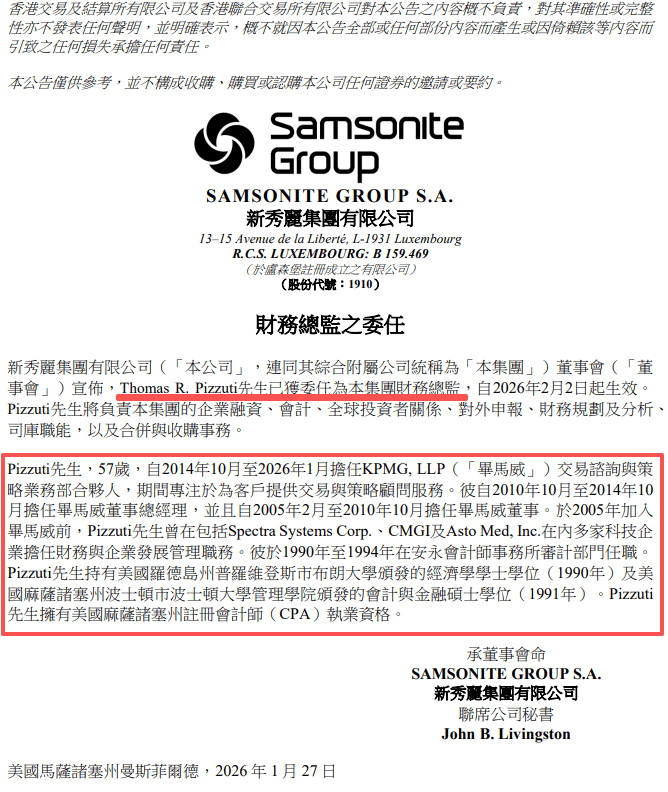
Group 1 - Samsonite has appointed Thomas R. Pizzuti as the new Chief Financial Officer (CFO), effective February 2, 2026, responsible for corporate finance, accounting, global investor relations, external reporting, financial planning and analysis, treasury functions, and mergers and acquisitions [1][2] - Pizzuti has extensive experience, having served as a partner at KPMG, focusing on transaction and strategy advisory services since October 2014, and held various senior roles at KPMG prior to that [2] - The previous CFO, Reza Taleghani, will leave to join Under Armour as CFO, ensuring a smooth transition until January 2026 [5][10] Group 2 - Reza Taleghani has been with Samsonite since November 2018, previously serving as president and CFO at Brightstar Corp., where he managed global financial operations [5][11] - Taleghani's background includes leadership roles at J.P. Morgan, where he oversaw investment banking and commercial banking operations, and he holds degrees from Brown University and Villanova University [7][14] - Under Armour's announcement of Taleghani's appointment indicates a significant leadership change, as he will replace David Bergman, who has been with the company for 21 years [5][10]
新秀丽委任毕马威前高管为财务总监
Xin Lang Cai Jing· 2026-01-28 00:13
Core Viewpoint - Samsonite announced the appointment of Thomas R. Pizzuti as the Group Chief Financial Officer, effective February 2, 2026, highlighting a strategic move in leadership to enhance corporate finance and investor relations [1] Group 1: Appointment Details - Thomas R. Pizzuti, aged 57, will oversee corporate finance, accounting, global investor relations, external reporting, financial planning and analysis, treasury functions, and mergers and acquisitions [1] - Pizzuti has a significant background, having served as a partner in KPMG's Transaction Advisory and Strategy practice from October 2014 to January 2026 [1] - Prior to his role at KPMG, he held positions as a managing director and director at KPMG from October 2010 to October 2014 and February 2005 to October 2010, respectively [1] Group 2: Previous Experience - Before joining KPMG in 2005, Pizzuti worked in financial and corporate development roles at several technology companies, including Spectra Systems Corp., CMGI, and AstoMed, Inc. [1]
G60科创走廊“创赢未来”大赛获奖企业融资路演活动举行
Sou Hu Cai Jing· 2026-01-27 12:23
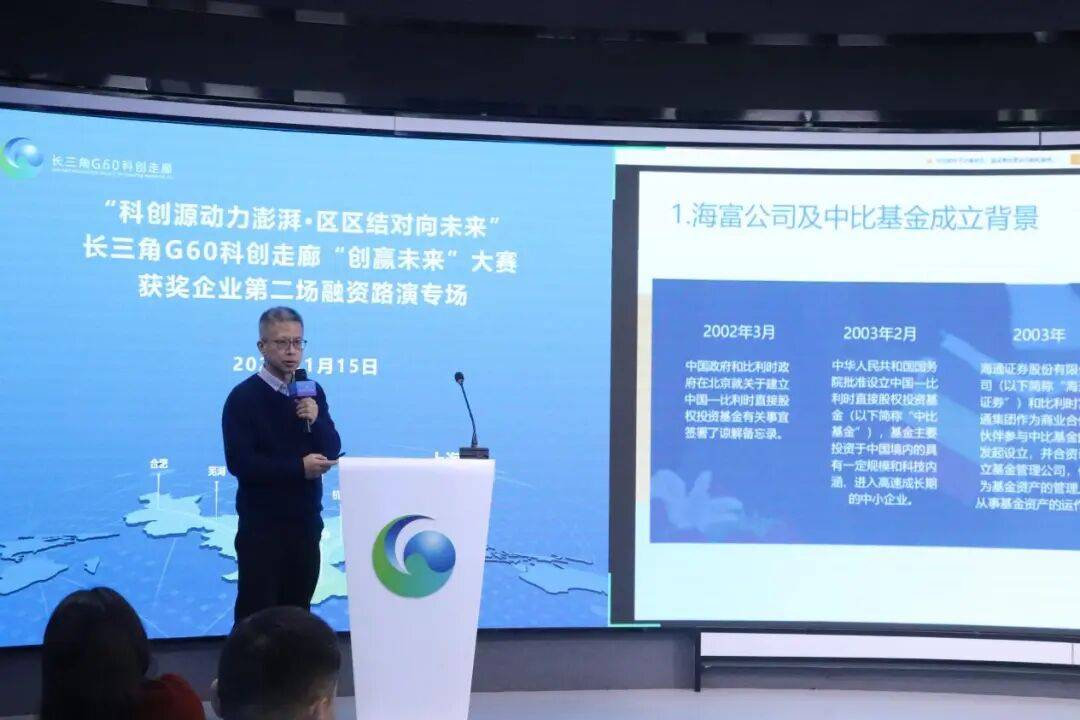
Core Insights - The G60 Science and Technology Corridor is being further developed to enhance the innovation ecosystem in the region, particularly focusing on the Songjiang University Town's innovation source [1] Group 1: Event Overview - The "Winning the Future" competition's second financing roadshow for award-winning companies was held in Shanghai Songjiang [1] - The event aimed to promote the G60 Science and Technology Corridor and support the construction of the Songjiang University Town innovation source [1] Group 2: Financial Products and Presentations - Various financial products were introduced, including the G60 Technology Achievement Transformation Fund and G60 Technology Financial Service Solutions [3] - Nine award-winning companies participated in the roadshow, showcasing their core technological breakthroughs, commercialization efforts, and financing needs [3] Group 3: Investor Engagement - Over 50 professional investors and institutional experts from G60 Financial Service Alliance member organizations attended the event [4] - The event facilitated one-on-one exchanges between investors and company founders, focusing on key dimensions such as application innovation, patent barriers, and market competition [3][4] Group 4: Future Initiatives - The G60 Joint Office plans to continue leveraging the "Financial Empowerment · Building Brands" roadshow platform to establish a regular mechanism for resource, technology, and talent integration [4] - The goal is to create a comprehensive empowerment platform covering all licenses, industry chains, and life cycles [4]
解读2025年全球裁员潮:AI还不是关键因素
经济观察报· 2026-01-27 10:42
Core Viewpoint - AI is transforming the way companies employ labor, but it is not necessarily the main driver behind the current wave of layoffs. Instead, AI serves as a narrative framework for structural adjustments within companies while also being a significant force in productivity transformation [1][6]. Group 1: Layoff Trends - A massive layoff wave is expected globally by 2025, affecting various sectors from tech giants to traditional manufacturing and finance. The true drivers behind these layoffs include economic slowdown and strategic restructuring rather than solely AI [2][4]. - In the U.S., approximately 153,074 layoffs were announced in October 2025, marking one of the worst months in over 20 years. By the end of November 2025, total layoffs reached around 1.17 million, the highest since the COVID-19 pandemic [2]. - AI-related layoffs accounted for only about 4% to 5% of total layoffs in the U.S., indicating that economic pressures and strategic realignments are more significant factors [3][6]. Group 2: Regional Differences - In Europe, layoffs are primarily attributed to cost control, profit pressure, and business restructuring, particularly in the automotive and manufacturing sectors [4]. - In China, layoffs are closely linked to macroeconomic adjustments and structural changes, with youth unemployment rates remaining high. The layoffs are driven by economic slowdown and industry cycles rather than a clear AI factor [5]. Group 3: AI's Role in Employment - AI is reshaping job structures, particularly affecting roles in customer service and support. However, the broader causes of layoffs remain economic conditions and strategic business decisions [6][10]. - AI is expected to create new talent demands, with job postings related to AI increasing by approximately 78% in 2025, while the talent pool only grew by 24% [11]. Group 4: Skills and Training - The future workforce will require a combination of skills, including the ability to learn continuously, understand business deeply, and collaborate effectively. These meta-skills will be crucial in the AI era [14][15]. - Companies that invest in employee reskilling and development tend to perform better in terms of innovation and long-term competitiveness compared to those that focus solely on layoffs [19][20]. Group 5: Organizational Change - Successful companies are not just reducing headcount but are also investing in employee skill upgrades and organizational restructuring to adapt to technological changes [20][21]. - The focus should be on optimizing processes and reallocating talent to higher-value roles rather than merely cutting jobs, as this approach supports long-term growth and productivity [21].

“十五五”为外资提供“机遇清单”
Sou Hu Cai Jing· 2026-01-26 22:37
越来越多跨国公司意识到,在中国市场的成功布局关乎其全球竞争力。正如一些外资企业负责人所言, 中国市场已成为"全球健身中心",在这里经受住考验,才能在全球市场中脱颖而出。这种认知推动外资 企业更加注重在华研发投入和创新布局,从最初的技术转让、代工生产,转向联合研发、共建产业生 态,合作模式的升级折射出中国机遇的变迁。 中国吸引外资的综合优势正在发生深刻变化。完备的产业体系、持续优化的创新环境、丰富的应用场景 以及超大规模市场优势,构成了当前中国吸引外资的核心竞争力。毕马威2025年12月发布的一份报告显 示,大多数行业的跨国企业对未来3年至5年在中国的收入增长前景持更为乐观的态度;94%的受访企业 表示会继续投资中国市场。许多外资企业认为,中国不仅是重要的市场,更是全球创新的源头和驱动增 长的核心引擎。中国在跨国公司全球布局中的定位正在发生质的提升。 面对"十五五"时期的新机遇,秉持长期主义正成为越来越多外资企业把握中国机遇的关键。一方面,诸 多外资企业紧跟中国经济转型步伐,重点关注数字经济、绿色低碳、人工智能、生物医药等新兴领域的 发展动向,这些领域既是中国培育新质生产力的重点,也是"机遇清单"中的核心内容。 ...
eBay禁止AI智能体自动购物丨合规周报(第223期)
2 1 Shi Ji Jing Ji Bao Dao· 2026-01-26 05:31
Group 1: AI Security Discussions - During the Davos World Economic Forum, AI security was highlighted as a core technological risk facing enterprises, with concerns about the rapid proliferation of AI Agents impacting deployment rhythms [2] - EY's Raj Sharma emphasized the need for industrial-grade security systems for AI agents, which currently lack clear identity and tracking mechanisms, contrasting with traditional IT systems [2] - KPMG's Tim Walsh noted that AI has become a central topic in cybersecurity discussions, leading some companies to slow down AI project progress to ensure security systems are robust before data migration [2] Group 2: Meta's AI Role Restrictions - Meta Platforms announced a temporary ban on underage users accessing its AI roles while updating its platform, although they can still use the AI assistant with age-appropriate protections [3] - This decision follows previous measures introduced in October to protect underage users from inappropriate content and sensitive topics [3] Group 3: eBay's Policy on AI Shopping - eBay updated its user agreement to prohibit third-party generative AI from interacting with its platform for automatic shopping without permission, effective February 20, 2026 [4] - This move comes as various AI companies have launched automatic shopping features, highlighting eBay's intent to control AI interactions on its platform [4] Group 4: Douyin's Account Recovery Efforts - Douyin's 2025 governance white paper revealed a 60% increase in the coverage of its "anchor health score" mechanism, with 370,000 accounts being indefinitely recovered for violations [5] - The AI model improved violation handling efficiency by 31%, leading to a 37% reduction in overall violation exposure [5] Group 5: OpenAI's Revenue Growth - OpenAI reported over $1 billion in new annual recurring revenue in the past month, entirely from its API business, marking a significant milestone for the company [6][7] - The growth is attributed to the API team's efforts, indicating a shift from a consumer subscription model to a comprehensive AI service provider [7] Group 6: Apple's Advertising Expansion - Apple confirmed the introduction of more advertising placements in App Store search results starting March 3, 2024, with plans to expand globally by the end of March [8] - This expansion aims to provide advertisers with more opportunities to reach users, as approximately 65% of app downloads occur after a search [8] Group 7: Vivo's AI Glasses Project Cancellation - Vivo has reportedly halted its AI glasses project, which had been in development for six months, due to concerns about differentiation in the current market [9] - Following the cancellation, Vivo will refocus its efforts on mixed reality (MR) technology [9]
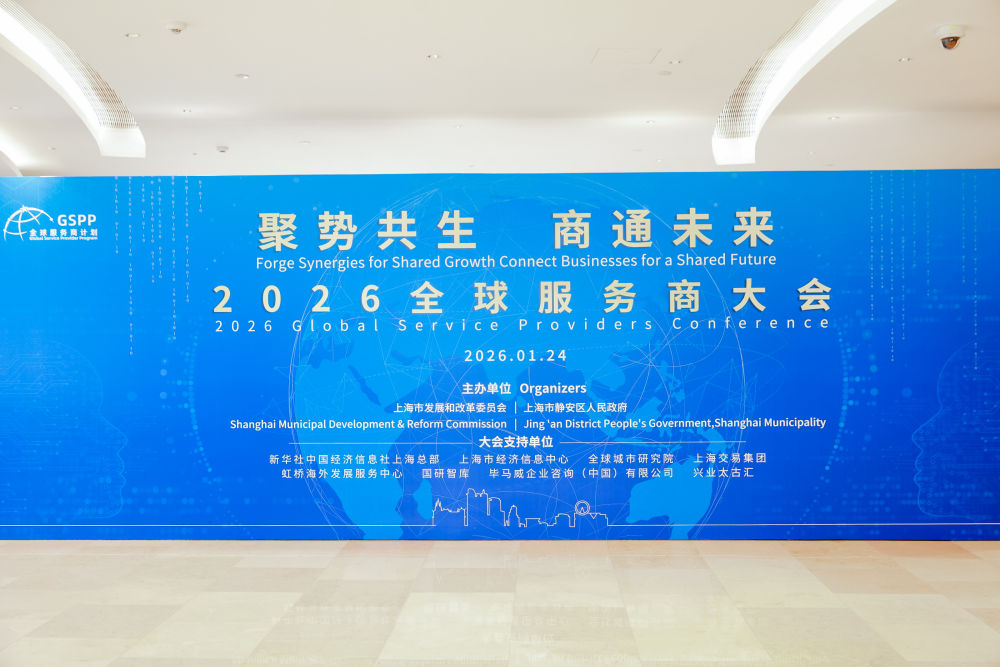
2026全球服务商大会:为中国企业扬帆出海“链接”世界
Xin Lang Cai Jing· 2026-01-25 05:55
Core Insights - The "Global Service Provider Program" in Shanghai's Jing'an District has entered its seventh year, focusing on accelerating the aggregation of high-end professional services to empower Chinese enterprises in their global expansion [1][2] - The 2026 Global Service Provider Conference highlighted the achievements of the program and discussed new trends in high-quality development of professional services and enterprise globalization [1][2] Group 1: Program Achievements - The total number of global service providers in Jing'an has reached 115, with the sixth batch of service provider companies being awarded, covering various fields such as law, consulting, and human resources [2] - A new plan for the construction of high-end professional service clusters was launched, aiming for an annual growth rate of the leasing and business service industry to exceed the average level of the district's economy by 2028 [2][6] - KPMG released the second edition of the "Belt and Road" outbound service white paper, providing practical references for Chinese enterprises expanding into Belt and Road markets [2][5] Group 2: Support for Enterprises - The program offers a comprehensive service platform that includes 60 services across 12 areas such as finance, law, and ESG, supporting enterprises throughout the entire investment cycle [5][6] - Initiatives such as the establishment of the first overseas investment project consultation service point in Shanghai's central urban area and the launch of a "one-stop" outbound service center were introduced to enhance support for enterprises [6][7] - The "Belt and Road" outbound professional service capability list was introduced to showcase outstanding service institutions in fields like law and human resources, reinforcing the soft power of professional services in supporting enterprise globalization [6][7] Group 3: Future Directions - Jing'an aims to build a high-end service ecosystem with a focus on internationalization and innovation, enhancing global resource allocation capabilities and fostering a more open economic structure [9] - The district's leadership emphasized the importance of the "Global Service Provider Program" in supporting national strategies and enhancing the global competitiveness of local enterprises [9]