
中国移动

Search documents
平治信息拟定增10亿!加码算力!
Guo Ji Jin Rong Bao· 2026-02-13 02:15
Core Viewpoint - The company, Pingzhi Information Technology Co., Ltd., is raising up to 1 billion yuan through a private placement to fund the construction of a domestic intelligent computing power center and to supplement working capital [1]. Group 1: Fundraising and Financial Strategy - The company plans to raise a total of no more than 1 billion yuan, with 700 million yuan allocated for the intelligent computing power center project and 300 million yuan for working capital [4]. - The issuance targets up to 35 specific investors, including the controlling shareholder Guo Qing, who intends to subscribe for no less than 50 million yuan and no more than 400 million yuan [3]. Group 2: Business Transformation and Performance Pressure - The company has undergone a significant business transformation from digital reading to communication equipment and computing power services due to market pressures from short video platforms [5][6]. - Financial data indicates a substantial decline in revenue from 3.556 billion yuan in 2022 to 1.443 billion yuan in 2024, with a net loss of 116 million yuan in 2024 [6]. Group 3: Strategic Moves in Computing Power - The company is deepening its computing power transformation by acquiring a 60% stake in Tianxing Electronics to establish a server production base and develop domestic general-purpose computing servers [7]. - In 2023, the company won a 150 million yuan project from China Telecom for computing power services, marking its entry into computing network construction and leasing [7]. Group 4: Expansion into Advanced Technologies - The company is expanding its services from computing power infrastructure to model services and terminal applications, including the development of AI-integrated products like smart blood pressure monitors [8]. - The company has invested in Future Partners Robotics, holding a 40% stake, to enter the robotics sector and leverage telecom channels for product promotion [8].
南向1.41万亿“压舱” 韩国散户“点火”——港股迎来定价权分层时代
Zhi Tong Cai Jing· 2026-02-13 01:53
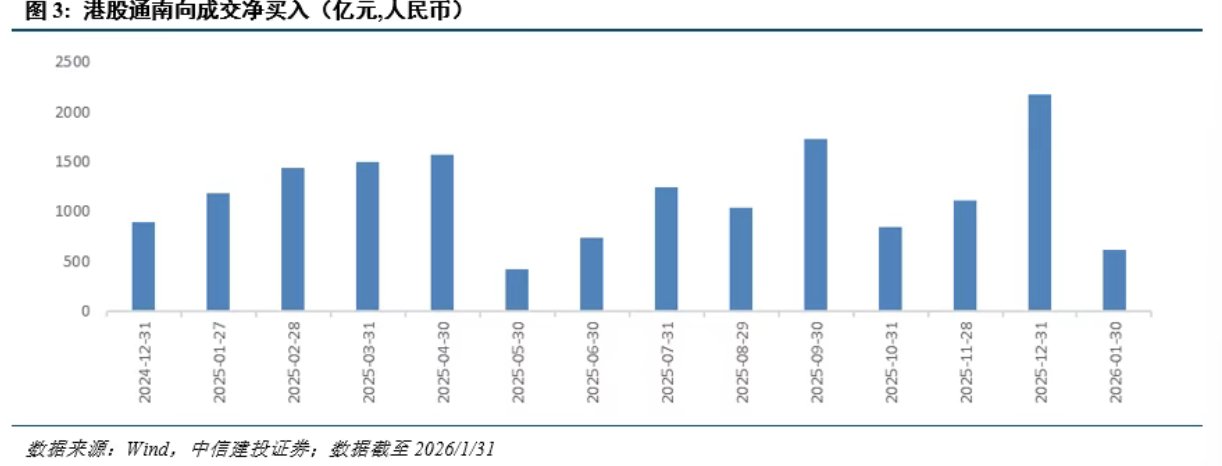
Core Insights - The Hong Kong stock market is experiencing two distinct but resonant waves of incremental capital from mainland China and South Korean retail investors, with mainland southbound funds achieving a record net purchase of 1.41 trillion HKD, establishing themselves as core builders of pricing power in the market [1][10] - Southbound funds are characterized by long-term value investment, while South Korean retail investors engage in high-frequency trading and narrative-driven investments, creating a diversified funding source and a layered pricing logic in the Hong Kong market [1][10] Funding Scale and Structure - Southbound funds have become the core incremental source and valuation system reshaper for the Hong Kong market, with a cumulative net inflow of 5.11 trillion HKD by the end of 2025, and a market value exceeding 6.3 trillion HKD, accounting for 12.7% of the total market [2] - South Korean retail investors, while having a smaller capital scale, exhibit concentrated trading behavior and significant leverage, particularly impacting specific sectors like new economy IPOs and the semiconductor industry [2][5] Industry Preferences - Southbound funds focus on financials and high-dividend utilities, with significant investments in major banks and state-owned enterprises driven by high dividend yields and low valuation levels, while South Korean investors show minimal interest in these sectors [3][5] - South Korean retail investors heavily invested in Xiaomi and MiniMax-WP, demonstrating a high turnover and narrative-driven trading approach, contrasting with the stable, long-term holdings of Southbound funds [5][8] Trading Behavior and Decision-Making - Southbound funds exhibit a decision-making anchor based on dividend yield, ROE stability, and free cash flow generation, characterized by continuous accumulation and stable holdings, as seen with significant net purchases in major banks [8][9] - South Korean retail investors, on the other hand, are driven by industry narrative strength and social media trends, with a high frequency of trading and a tendency to hold stocks for less than three months, reflecting a stark contrast to the long-term holding strategy of Southbound funds [9][10] Market Dynamics - The influx of South Korean retail investors into the Hong Kong market represents a diversification of the investor base, providing liquidity while also potentially increasing volatility during certain periods [9][10] - The interaction between Southbound funds and South Korean retail investors is creating a new normal in the Hong Kong market characterized by layered pricing and concurrent narratives, necessitating both stable investment strategies and agile trading approaches [10]







智通特供|南向1.41万亿“压舱” 韩国散户“点火”——港股迎来定价权分层时代
智通财经网· 2026-02-13 01:49
Core Viewpoint - The Hong Kong stock market is experiencing two distinct but resonant waves of incremental capital from mainland China and South Korean retail investors, leading to a diversification of funding sources and a layered pricing logic in the market [1][14]. Group 1: Scale and Structure - Southbound funds have established themselves as the core incremental source and revaluation force in the Hong Kong stock market, with a cumulative net inflow of 5.11 trillion HKD by the end of 2025, and a record annual net purchase of 1.41 trillion HKD in 2025 [2]. - The market capitalization of southbound funds has surpassed 6.3 trillion HKD, accounting for 12.7% of the total market capitalization of Hong Kong stocks, indicating their evolution into an "endogenous pricing variable" [2]. Group 2: Trading Behavior of South Korean Retail Investors - South Korean retail investors, while having a relatively limited capital size, exhibit highly concentrated and leveraged trading behaviors, particularly impacting specific sectors such as new economy IPOs and the semiconductor industry [5]. - In early 2026, South Korean retail investors made a net purchase of over 2 million USD in MiniMax-WP, contributing significantly to its IPO, which saw an oversubscription of 1837 times [5]. Group 3: Industry Preferences - Southbound funds focus on financials and high-dividend utilities, with significant investments in companies like China Construction Bank and China Mobile, driven by high dividend yields and low valuation levels [6]. - South Korean investors, on the other hand, show a preference for high-growth sectors, with notable investments in Xiaomi and MiniMax-WP, reflecting a narrative-driven trading strategy [8]. Group 4: Investment Strategies - Southbound funds demonstrate a long-term investment strategy characterized by stable holdings and systematic increases in positions, as seen with China Construction Bank, which saw a net purchase of 7.39 billion shares in 2025 [12]. - South Korean retail investors engage in high-frequency trading with a focus on social media trends and community consensus, leading to a rapid turnover of holdings, with an average holding period of less than three months [13]. Group 5: Market Dynamics - The influx of South Korean retail investors into the Hong Kong market represents a diversification of the investor base, contributing to liquidity while also potentially increasing volatility during certain periods [14]. - The interaction between the long-term positioning of southbound funds and the short-term trading strategies of South Korean investors creates a new normal in the Hong Kong stock market characterized by layered pricing and concurrent narratives [14].
“吴江心意”暖了新就业群体
Su Zhou Ri Bao· 2026-02-13 01:49
Group 1 - The core idea of the news is the "New Year New Clothes · Wujiang Heart" charity event aimed at providing support and warmth to new employment groups in Wujiang, showcasing the community's care for workers like delivery riders and drivers [1][2] - The Wujiang District Social Work Department, in collaboration with various organizations, distributed over 300 high-quality new clothes to new employment groups, enhancing their sense of belonging and celebration during the New Year [1] - A dedicated insurance plan was launched to cover 15,000 delivery workers and drivers in Wujiang, providing protection against major illnesses and hospitalization allowances until September 2026, ensuring their safety and well-being [1] Group 2 - Wujiang Power Supply Company distributed 200,000 charging service fee coupons and introduced discount vouchers for battery swap packages to alleviate the charging cost concerns of urban workers [2] - The district planned over 30 themed activities around the Spring Festival to deliver care directly to new employment groups, including community services for children and wellness activities [2] - The "Warm Heart Station" initiative will provide energy-boosting breakfasts and transportation assistance for returning workers, ensuring a supportive environment for those re-entering the workforce [2][3]
中信证券A股2025年报预告全景透视:预喜公司占比达37% 大市值龙头盈利修复显著
Zhi Tong Cai Jing· 2026-02-13 01:17
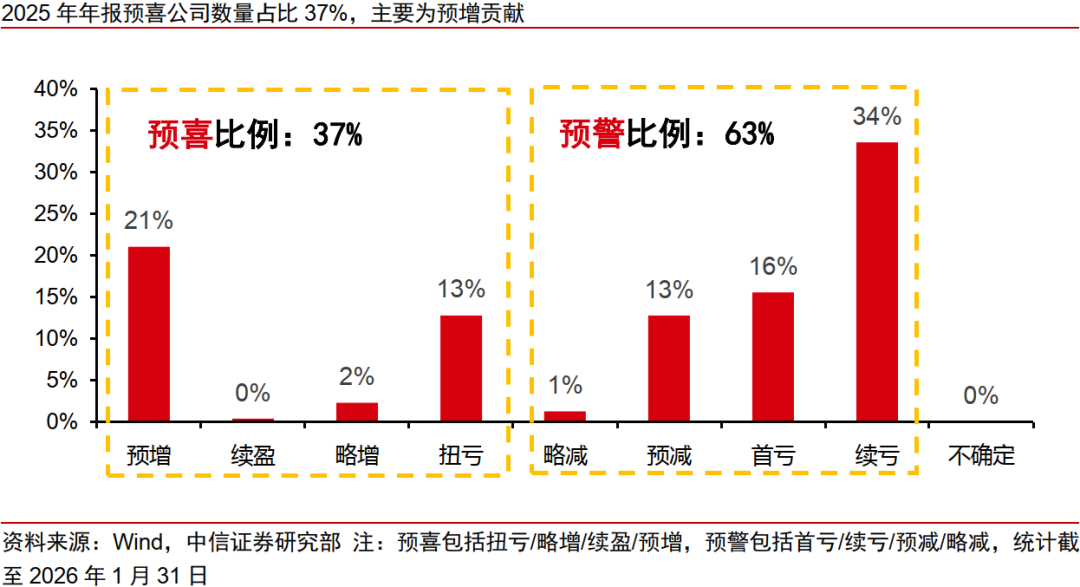
Core Viewpoint - As of January 31, 2026, 2,976 A-share companies have disclosed their 2025 annual performance forecasts, with a total disclosure rate of 54.0%. The proportion of companies with positive forecasts has increased to 37% from 33% in 2024, indicating a structural recovery driven by technology, supported by external demand, while financial sectors face pressure [1][9]. Group 1: Performance Forecast Overview - The number of companies with positive forecasts has expanded, with technology, finance, and cyclical sectors being the highlights. The overall disclosure rate is 54.0%, with 37% of companies forecasting positive results, up from 33% in 2024. Key sectors showing growth include communication, basic chemicals, non-ferrous metals, non-bank finance, electronics, and utilities [1][5]. - The performance forecast reveals significant improvements among large-cap leaders, while small-cap companies continue to face substantial pressure. The positive forecast ratio is highly correlated with market capitalization, with the Shanghai Stock Exchange 50 index showing a 75% positive forecast ratio [9][12]. Group 2: Sector-Specific Insights - The current performance forecasts exhibit structural characteristics of "technology-driven, externally supported, and financial pressure." Notably, 9 companies from the Shanghai Stock Exchange 50 have released forecasts, with 6 showing growth, particularly in machinery, non-ferrous, pharmaceuticals, and electronics [12]. - The technology sector shows high resilience due to global AI infrastructure and semiconductor demand growth, while industries like non-ferrous metals and chemicals are experiencing performance releases due to improved pricing power [12][22]. Group 3: Institutional Investment Strategies - Fund companies focus on clear growth sectors, with the top three heavy investment industries being electronics (20.1%), pharmaceuticals (10.1%), and power equipment & new energy (9.3%). The top 20% of holdings have a forecasted net profit of 3,976.3 billion yuan, reflecting a 46.4% year-on-year growth [16][21]. - Insurance companies prioritize cash flow and defensive attributes, with a significant portion of their holdings in banking and non-bank financial sectors. The top 20% of holdings forecast a net profit of 814.7 billion yuan, with limited growth elasticity [16][20]. Group 4: Analyst Expectations and Market Reactions - Analyst expectations are generally optimistic, with 537 companies forecasting below market consensus and only 160 exceeding expectations, indicating a significant bias towards optimism in earnings predictions [22][27]. - The analysis of market reactions shows that 658 stocks experienced a gap down on the day following their forecasts, while only 230 saw a gap up, suggesting that overall earnings expectations were overly optimistic prior to announcements [27][33].

中原证券晨会聚焦-20260213
Zhongyuan Securities· 2026-02-13 00:45
Core Insights - The report highlights a positive outlook for the semiconductor industry, driven by increased capital expenditure from major cloud companies and a robust demand for AI infrastructure [22][24][25] - The electric power sector is expected to benefit from a significant increase in installed capacity, with a focus on renewable energy sources such as solar and wind [27][28][29] - The food and beverage sector shows mixed performance, with certain sub-sectors like prepared foods and snacks performing well, while others face challenges [19][20] Domestic Market Performance - The Shanghai Composite Index closed at 4,134.02, with a slight increase of 0.05%, while the Shenzhen Component Index rose by 0.86% to 14,283.00 [4] - The A-share market has shown resilience, with average P/E ratios for the Shanghai Composite and ChiNext at 16.91 and 53.15, respectively, indicating a favorable environment for medium to long-term investments [10][11] International Market Performance - Major international indices such as the Dow Jones and S&P 500 experienced declines of 0.67% and 0.45%, respectively, reflecting a cautious global market sentiment [5] Industry Analysis - The semiconductor industry saw a strong performance in January 2026, with a 18.63% increase in the domestic semiconductor index, significantly outperforming the broader market [22][23] - The electric power sector's installed capacity reached 38.9 billion kilowatts by the end of 2025, marking a 16.1% year-on-year increase, with solar and wind energy contributing significantly to this growth [27][28] - The food and beverage sector's sales in January 2026 showed a slight increase of 0.11% year-on-year, with a notable decline in month-on-month sales due to policy changes [19][20] Investment Recommendations - The report suggests a balanced investment strategy focusing on technology sectors, particularly AI and high-end manufacturing, while also considering opportunities in consumer sectors [10][11][15] - In the semiconductor space, investors are encouraged to look at companies benefiting from AI demand and increased capital expenditures from cloud providers [24][25][26] - For the electric power sector, a "barbell strategy" is recommended, focusing on stable, high-dividend companies as well as growth opportunities in renewable energy [27][29]
“为访华,特朗普暂缓多项对华科技限制措施”
Guan Cha Zhe Wang· 2026-02-13 00:45
消息人士称,这是特朗普政府在去年10月底中美元首釜山会晤达成"贸易休战"后,为遏制可能激怒中方 的美国政府行动而采取的最新举措。 报道还称,美国商务部在为其行动辩护时坚称,正积极运用其权限,"应对来自外国技术的'国家安全风 险',并将继续这样做"。 【文/观察者网 熊超然】自中美元首去年10月底的釜山会晤之后,有关美国总统特朗普将于今年4月访 华的消息就不绝于耳。 据路透社当地时间2月12日援引消息人士独家报道,在潜在的访华行程正式成行之前,特朗普政府搁置 了一系列对华关键科技安全措施(禁令),这些措施包括禁止中国电信在美国开展业务,以及限制向美 国数据中心销售中国设备。 四名不愿透露姓名的知情人士称,美方还暂停了对TP-Link路由器的销售禁令、中国联通和中国移动在 美国开展互联网业务的禁令,而另一项禁止中国电动卡车和电动巴士在美国销售的禁令也被搁置。 据报道,中国驻美国大使馆回应表示,中方一贯反对将经贸和科技问题政治化,同时欢迎中美合作,让 2026年成为"两国迈向相互尊重、和平共处、合作共赢的一年"。 2025年10月30日,韩国釜山,中美元首会晤结束后,美国总统特朗普乘"空军一号"专机启程返回美国。 ...

创新创造 推动转型升级 ——因地制宜发展新质生产力一线故事(下)
Ren Min Ri Bao· 2026-02-12 23:07
广东深圳 冲刺"人形机器人第一城" 本报记者程远州 近日,去广东深圳市K11商场看电影的市民惊奇地发现,递上爆米花的居然是一台人形机器人。识别指 令、抓取纸杯、装填爆米花、递给顾客……这台由深圳市越疆科技股份有限公司生产的机器人,单日可 以连续工作14小时,日均完成超1000杯爆米花的制作与售卖,全程零失误。 "最大的难题是'眼、脑、手'协同——机器人既要精准识别环境变化,又要快速决策,还要实现毫米级 的精细操作。"越疆科技创始人兼首席执行官刘培超说,项目启动初期,机器人存在抓取纸杯时用力过 猛捏扁杯身、装填爆米花时撒落等问题,遇到顾客移动杯子、物料撒落等突发情况,更是直接"罢工"。 对于机器人而言,售卖爆米花看似简单实则挑战性极强。越疆科技组建硬件、算法、软件等多部门联合 攻关小组,反复调试机器人指尖压力传感器,让机器人能秒级识别环境变化,反复模拟爆米花撒落、容 器移位等20多种场景,让机器人能自主诊断偏差、重新规划动作,无需人工干预即可续行任务。 钻研技术,换来突破。越疆人形机器人搭载自研的端到端模型,融合视觉感知、语言理解与动作生成, 配合具有高度稳定性和操作精度的硬件,从而在电影院柜台环境中实现了自主 ...
坚定价值深耕 汇聚生态势能 上海智算产业向高质量要生产力
Zhong Guo Zheng Quan Bao· 2026-02-12 20:48
作为我国经济中心、科技创新高地与对外开放前沿,近年来,上海聚力打造全国领先的智能算力高地, 推动智算资源加速集聚、产业生态持续迭代提质。上海市算力网络协会数据显示,上海智算规模在全国 占比约达8%,已成为引领全国智算产业高质量发展、带动生态协同升级的重要增长极。 中国证券报记者调研发现,从智算规模的跨越式突破到优质企业的集群式崛起,从技术架构的根源性创 新到产业发展共识的深度凝聚,从生态要素的零散分布到全链条协同发力,上海正稳步突破传统规模扩 张、资本驱动的发展瓶颈,引领智算产业实现从"规模增速"向"质量引领、效率优先、可持续发展"的高 阶转型,同步推动智算生态开放共享、协同共生,以标杆性的"上海实践"赋能国家智算产业能级跃升。 天数智芯AI与加速计算技术负责人单天逸把未来的高质量算力定义为"高效率、可预期、可持续"。"所 谓高效率,是指能为客户创造最优的TCO(总体拥有成本),实实在在帮客户节省使用成本。而可预期是 能够通过精准的仿真模拟,让客户在拿到芯片、部署算力之前,就能清晰预判最终的性能表现,做到所 见即所得。至于可持续,则是从现在主流的算法再到未来还未诞生的全新算法,算力始终能无缝适配, 今天能用, ...

上海智算产业向高质量要生产力
Zhong Guo Zheng Quan Bao· 2026-02-12 20:27
Core Insights - Shanghai is positioning itself as a leading hub for intelligent computing power, contributing approximately 8% to the national scale of intelligent computing, and driving high-quality development in the industry [1][2] - The average annual compound growth rate of China's intelligent computing scale is projected to reach 46.2% from 2023 to 2028 [1] Industry Development - Shanghai's intelligent computing scale has surpassed 120,000 PetaFLOPS, with nearly 20,000 PetaFLOPS managed by the municipal scheduling platform [2] - The industry is shifting focus from capital-driven growth to quality, efficiency, and sustainability, emphasizing the need for deep value cultivation and innovation [2][3] - The market is transitioning from measuring computing power in FLOPS to evaluating application effectiveness, marking a new phase of high-quality development [3] Innovation and Technology - Innovation is identified as the primary driver for high-quality development in the intelligent computing industry, with local companies like MuXi, BiRan Technology, and TianShu ZhiXin making significant breakthroughs [4][6] - MuXi has launched the X series GPU aimed at enhancing performance in scientific computing, supporting various complex simulations [5][6] - TianShu ZhiXin is focusing on creating a high-quality computing architecture with a three-year roadmap, aiming to deliver high-performance and cost-effective solutions [6] Ecosystem Collaboration - The development of the intelligent computing ecosystem in Shanghai is characterized by collaborative efforts among industry players, creating a network of shared value [7][8] - Companies like UCloud are playing a pivotal role in building a collaborative infrastructure that integrates high-performance computing with local industry needs [7][8] - The "Shanghai Intelligent Computing Industry High-Quality Development Initiative" was launched to promote the construction of new intelligent computing centers and a high-level cloud service system [9][10]