
地平线

Search documents
【大涨解读】无人驾驶板块:L3准入+特斯拉无人测试落地,2026年将进入B端无人车商业模式跑通阶段,商业化拐点催生板块行情
Xuan Gu Bao· 2025-12-16 02:22
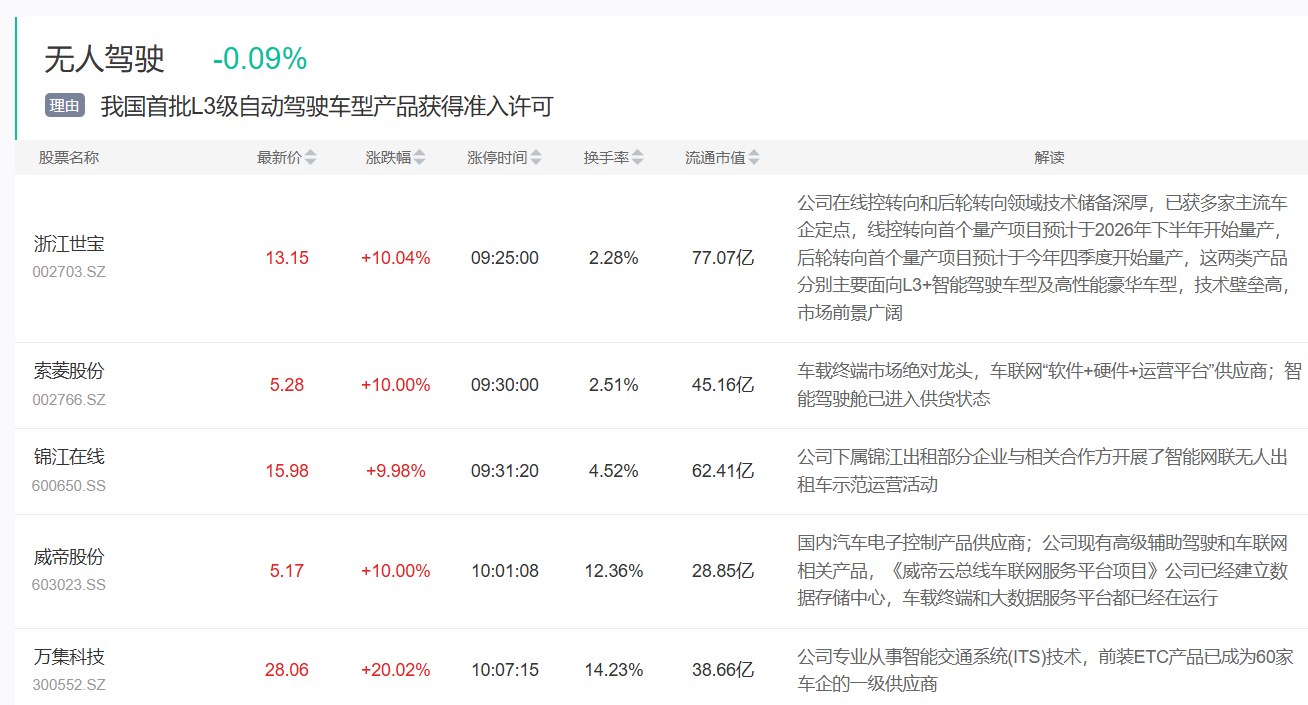
Core Insights - The autonomous driving sector experienced significant gains, with companies like Zhejiang Shibao and Beiqi Blue Valley hitting the upper limit of their stock prices, indicating strong market interest and investor confidence in this industry [1] Event Summary - On December 15, the Ministry of Industry and Information Technology announced the first batch of L3 conditional autonomous driving vehicle permits in China, allowing Changan and Arcfox models to conduct road trials in designated areas of Chongqing and Beijing, marking a shift from testing to commercial application [3] - On the same day, Tesla launched its no-driver Robotaxi testing in Austin, USA, with the Model Y achieving fully autonomous operation, and plans to expand the fleet to 500 vehicles by year-end, currently operating 31 [3] - Multiple cities are accelerating the implementation of smart driving policies, with Beijing, Shenzhen, and Shanghai granting L4 road rights, and the Ministry of Industry and Information Technology expected to release a draft for national standards on L3-L4 by Q4 [3] Institutional Analysis - The approval of L3 vehicles signifies a transition in China's smart driving from "testing and validation" to "compliant mass production and controlled road use," which will accelerate the commercialization process of the industry. The three-pronged management model of "product access + user subject + operational area" provides a clear path for other automakers to follow, with 2026 anticipated as a critical year for L3 mass production [4] - The simultaneous advancement of high-level intelligent driving in China and the US creates a dual catalytic effect. The clear legal responsibilities established by China's L3 approval reduce social risks and regulatory uncertainties, while Tesla's fully autonomous testing validates the feasibility of L4 technology, shifting the industry focus from engineering challenges to commercial viability [4] - By 2026, leading automakers are expected to achieve over 30% growth in revenues related to intelligent driving, benefiting algorithm suppliers and core hardware companies as vehicle production ramps up. Long-term, smart vehicles are projected to reshape the automotive mobility market, establishing a new valuation system based on "intelligent entity revenue capacity = ownership × capability level" [5] - The rollout of L3 technology will create incremental opportunities in the automotive testing and hardware sectors, with increased demand for testing of smart driving vehicle permits. The penetration rates of core components like steer-by-wire and domain controllers are expected to grow rapidly, with the steer-by-wire market projected to increase by over 150% year-on-year by 2026 [5]


智通港股股东权益披露|12月16日


智通财经网· 2025-12-16 00:07
Core Insights - The latest shareholder equity disclosures for China Star Group, Baixin An-B, Horizon Robotics, and Red Star Macalline were conducted on December 16, 2025 [1] Group 1: China Star Group (00326) - Shareholder Heung Wah reduced holdings from 1.64 billion shares to 1.62 billion shares, representing a holding percentage decrease from 67.53% to 66.71% [2] - Shareholder Chen Mingying also reduced holdings from 1.64 billion shares to 1.62 billion shares, with the same percentage change as Heung Wah [2] Group 2: Baixin An-B (02185) - Shareholder Wang Philip Li maintained holdings at 85.11 million shares, with a holding percentage of 36.11% [2] - Shareholder Winning Powerful increased holdings from 45.93 million shares to 45.94 million shares, resulting in a slight increase in holding percentage from 19.48% to 19.49% [2] Group 3: Horizon Robotics (N24028) - Shareholder Liu Qin reduced holdings from 102 million shares to 38.9 million shares, leading to a decrease in holding percentage from 0.82% to 0.31% [2] Group 4: Red Star Macalline (01528) - Taobao Holding Limited reduced holdings from 67.25 million shares to 57.00 million shares, decreasing the holding percentage from 9.07% to 7.69% [2] - New Retail Strategic Opportunities Fund, L.P. reduced holdings from 37.25 million shares to 27.00 million shares, with a decrease in holding percentage from 5.03% to 3.64% [2] - Alibaba Group Holding Limited reduced holdings from 105 million shares to 84.07 million shares, resulting in a decrease in holding percentage from 14.10% to 11.33% [2]
L3级准入破冰 自动驾驶商业化落地驶入快车道
Bei Jing Shang Bao· 2025-12-15 22:56
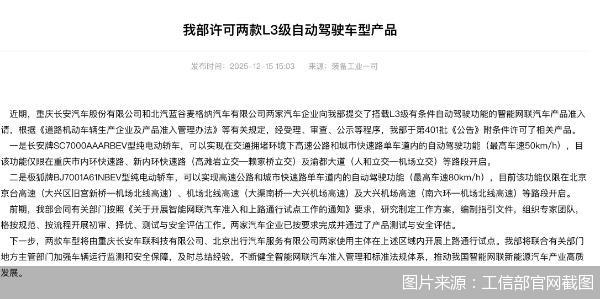
Core Insights - The Ministry of Industry and Information Technology (MIIT) of China has officially announced the first batch of L3 conditional autonomous driving vehicle permits, with Changan Automobile and BAIC Jihe receiving approvals for trial operations in designated areas of Chongqing and Beijing respectively [1][2] Group 1: L3 Autonomous Driving Development - The approval of L3 autonomous driving vehicles is expected to accelerate technological iterations within the industry and drive computing platforms towards automotive-grade standards and scalable applications [1][6] - L3 autonomous driving allows for partial decision-making by the system under specific conditions, enabling drivers to completely disengage from driving tasks [2][6] - Changan's approved model can achieve autonomous driving at speeds up to 50 km/h in congested scenarios on designated highways, while BAIC's Alpha S (L3 version) can reach speeds of 80 km/h on certain routes in Beijing [2] Group 2: Industry Competition and Collaboration - Major automotive companies have entered a competitive mode to commercialize autonomous driving technology, with several firms, including BAIC, GAC, and BYD, being included in the first batch of intelligent connected vehicle trial operations [4][6] - The collaboration between automotive manufacturers and technology companies is crucial for the commercial viability of L3 autonomous driving, with Horizon Robotics and Huawei providing essential technological support [5][6] Group 3: Safety and Regulatory Framework - The shift in driving responsibility due to autonomous driving raises concerns about accident liability, with regulations evolving to clarify responsibilities among users and autonomous systems [3][6] - The MIIT and other departments have emphasized the need for improved regulations and safety standards to support the growth of the autonomous driving sector [5][6] - The market for autonomous driving in China is projected to approach 450 billion yuan by 2025, driven by technological advancements and cost reductions [6]
L3级准入破冰,自动驾驶商业化落地驶入“快车道”
Bei Jing Shang Bao· 2025-12-15 14:07
Core Viewpoint - The Ministry of Industry and Information Technology (MIIT) of China has officially granted the first batch of L3 conditional autonomous driving vehicle permits, allowing Changan Automobile and BAIC's Arcfox models to conduct road trials in designated areas of Chongqing and Beijing, respectively [1][4]. Group 1: Policy and Regulatory Developments - The MIIT has approved L3 autonomous driving vehicles under specific conditions, marking a significant step towards the commercialization of autonomous driving technology in China [4][9]. - The approval process involved thorough assessments and compliance with regulations, ensuring that the vehicles meet safety and operational standards [3][4]. Group 2: Vehicle Specifications and Capabilities - Changan's model can achieve autonomous driving at speeds up to 50 km/h in congested traffic conditions on designated roads in Chongqing [3][4]. - BAIC's Arcfox model can operate at speeds up to 80 km/h on specific highways in Beijing, showcasing the capabilities of L3 autonomous driving technology [3][4]. Group 3: Industry Trends and Competitive Landscape - The autonomous driving industry is entering a competitive phase, with multiple automakers racing to develop and deploy L3 technology [6][9]. - Companies like GAC and BYD are also advancing their L3 capabilities, with GAC's model receiving a license for high-speed testing and BYD integrating L3 systems into urban driving scenarios [7][9]. Group 4: Technological Advancements and Partnerships - The successful deployment of L3 technology relies on advanced sensor systems, with BAIC's Arcfox equipped with 34 high-performance sensors for comprehensive environmental perception [7][8]. - Partnerships with technology firms are crucial, as seen with Horizon Robotics and Huawei, which are providing the necessary technological foundation for L3 commercialization [8][10]. Group 5: Market Outlook and Future Projections - The autonomous driving market in China is projected to approach 450 billion yuan by 2025, driven by technological advancements and increasing adoption rates [9]. - The focus on safety, regulatory compliance, and user experience will shape the competitive landscape, with companies needing to balance innovation with responsible marketing practices [9][10].


新老交替,欧洲汽车工业从“友谊赛”迈入“淘汰赛”
Guan Cha Zhe Wang· 2025-12-15 11:05
【文/观察者网 潘昱辰 编辑/高莘】汽车工业的发源地——欧洲,正处在前所未有的十字路口。 据西班牙《理性报》报道,就在不久前的12月11日,西班牙首相桑切斯致信欧盟委员会主席冯德莱恩,要求维持欧盟自2035年起禁止销售燃油车的规定,这 几乎与大部分欧盟汽车生产国国家和所有欧洲汽车制造商的意见相悖。 《理性报》报道称,桑切斯此举正值欧盟行政机构计划于16日提交放宽先前碳排放政策的提案前夕;与提案主张相反的是,此举有利于中国汽车在欧洲市场 的销售,因为中国在汽车电动化进程上已领先于欧洲产业。 有业内人士认为,作为欧洲新兴的工业国家,西班牙通过与行业领先者展开更长期的产业合作,甚至谋求挑战德国、法国等欧洲传统工业强国的优势地位, 实现"弯道超车"。在此背景下,过去数十年间欧洲车企彼此间保持的"友谊赛"默契或将逐渐瓦解:进入2026年后,属于欧洲汽车行业的"淘汰赛"或将加速到 来。 弯道超车:新玩家的机遇? 就在桑切斯致信欧盟前不久,西班牙政府发布了《西班牙汽车2030计划》,计划在2026年投资4亿欧元(约合人民币33亿元)提供电动汽车购买直接补贴, 并投资3亿欧元(约合人民币25亿元)建设更多充电站。 此外,西班 ...
从破土到成林 本土汽车芯片的“摘果”考验
Zhong Guo Qi Che Bao Wang· 2025-12-15 08:14
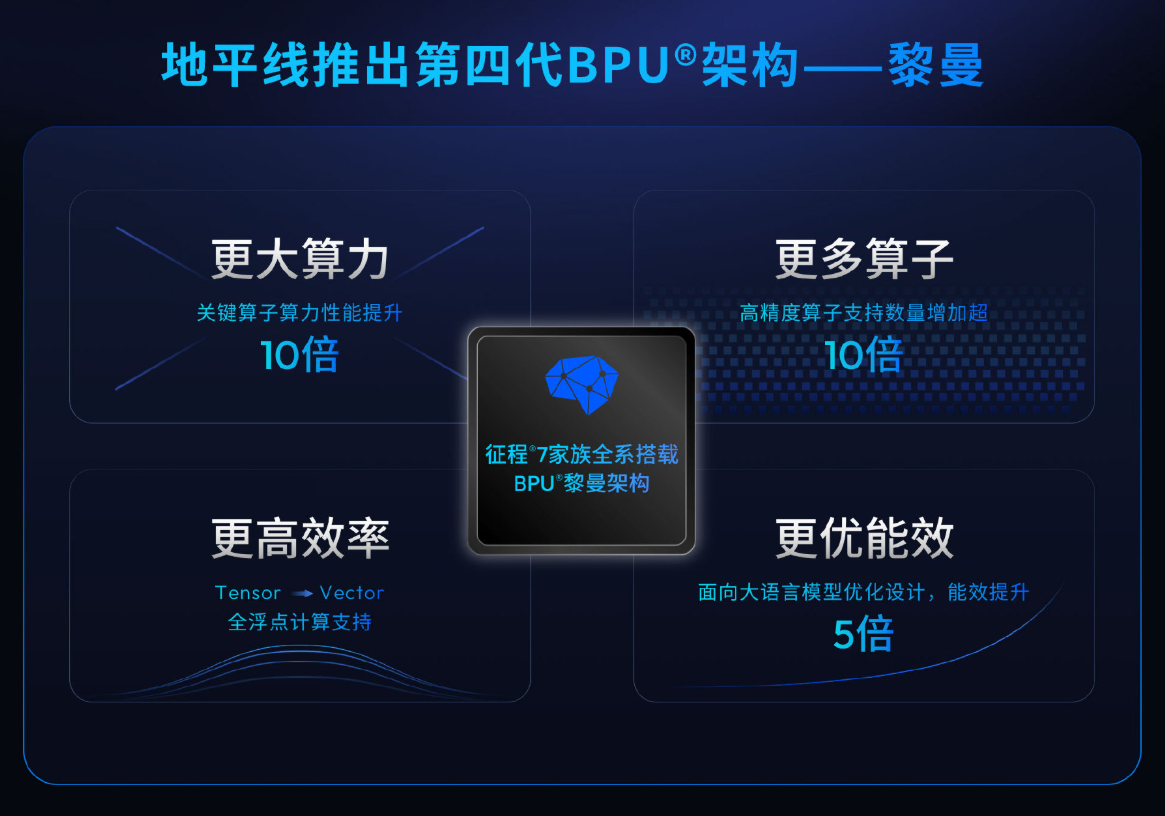
Core Insights - The release of Horizon's fourth-generation BPU architecture "Riemann" and the successful listing of Naxinwei on the Hong Kong stock market highlight the innovative momentum in China's automotive chip industry [2] - The automotive chip industry in China is transitioning from initial development to significant growth, driven by policy standards, core technology advancements, and market applications [2] Industry Developments - The upgraded "Automotive Chip Certification Review Technology System 2.0" was launched, featuring a comprehensive framework with 9 modules and 60 indicators, covering 10 categories of automotive chips for new energy vehicles [2][3] - The implementation of this certification system has improved quality control for chip manufacturers and reduced vehicle manufacturers' selection risks and costs, shortening the onboarding cycle by an average of 3 months [3] Market Performance - Chip manufacturers like Chipone and Horizon are achieving significant milestones, with Chipone's KungFu automotive-grade MCU deliveries surpassing 200 million units and Horizon's HSD system being integrated into more affordable vehicle models [3][9] - The domestic automotive chip industry has seen a rise in the number of companies, with over 1,000 firms involved in the supply chain, and a significant increase in the domestic chip application rate, which is projected to reach 20% by the end of 2024 [5][8] Competitive Landscape - Local companies are rapidly gaining market share in the mid-to-low-end automotive chip market, while high-end markets remain dominated by foreign giants [11] - The collaboration between automotive chip companies and vehicle manufacturers is fostering innovation and enhancing the reliability of domestic chips, which is crucial for market penetration [11][17] Future Opportunities - The automotive chip sector is viewed as a critical growth area, with companies exploring new applications in the robotics industry, which is expected to see significant growth in the coming years [12][14] - The integration of automotive chips with intelligent systems is seen as a pathway for companies to overcome existing growth bottlenecks and explore new market opportunities [14][15] Challenges Ahead - Despite progress, the domestic automotive chip industry still faces challenges, including a reliance on foreign technology for high-end chips and the need for a more robust supply chain [15][16] - The industry must focus on building a comprehensive ecosystem that includes software development capabilities alongside hardware reliability to meet the evolving demands of the automotive market [17]

中国汽车市场一周行业信息快报——2025年12月第3期
Zhong Guo Zhi Liang Xin Wen Wang· 2025-12-15 08:04
2025年12月第二周:中汽协和税务局数据显示,新能源汽车市场亮眼表现,针对新能源汽车电池风险问题,市场监管总局推出"双失控"防控体系,同时还针 对汽车市场销售乱象进行了新规的意见征集。此外还有鸿蒙智行"五界"合作、吉利安全中心亮相等行业动态。 国家税务总局:1至11月新能源乘用车销售收入同比增长19.1% 12月8日,国家税务总局总经济师、新闻发言人荣海楼表示,发票数据显示,今年1至11月,新能源汽车消费持续向好,市场活跃度持续走强,1至11月,新 能源乘用车销售收入同比增长19.1%。 地平线征程7家族将全系搭载BPU黎曼架构 12月8日,地平线创始人兼CEO余凯在2025地平线技术生态大会上透露,正在酝酿中的地平线征程7家族将全系搭载地平线第四代BPU架构——黎曼架构。 该架构具有更大算力、更高算子、更高效率及更高性能等特点,其中关键算子算力性能较上一代BPU架构提升十倍。 市场监管总局组织建设新能源汽车"双失控"风险防控技术体系 12月8日,市场监管总局表示,针对新能源汽车热失控和速度失控构成的"双失控"行业痛点,市场监管总局组织国内优势科研力量,通过"双失控"事故深度 调查与缺陷判定技术研发,结合" ...

地平线与生态伙伴共拓自动驾驶规模化商用之路,勾勒未来发展版图
IPO早知道· 2025-12-15 03:00
Core Viewpoint - The article emphasizes the importance of collaboration and technological breakthroughs in achieving scalable commercialization of autonomous driving, focusing on various applications such as Robotaxi, unmanned logistics, and trunk logistics [1]. Group 1: Event Overview - The "Towards High Collaboration" 2025 Horizon Technology Ecosystem Conference featured a forum on "Scaling Commercialization of Autonomous Driving," discussing sustainable business models and efficient industry ecosystems [1]. - Horizon's founder and CEO, Dr. Yu Kai, highlighted the significance of service providers in the autonomous driving sector, emphasizing the need for scene-based services beyond just vehicle manufacturing [1]. Group 2: Partnerships and Innovations - Horizon collaborates with various partners to provide key technological support for diverse scenarios, including Robotaxi and unmanned logistics, showcasing successful outcomes and industry trends during the forum [3]. - GoGoX and Amigo's founders shared their vision for deploying Robotaxi in Hong Kong, aiming to enhance urban mobility and improve service experiences [3]. - 行深智能 (Xing Shen Intelligent) announced a partnership with Horizon to launch the first L4 urban unmanned logistics solution based on Horizon's 6M chip, achieving a 30% cost reduction compared to similar solutions [3][5]. Group 3: Industry Trends and Developments - 京东物流 (JD Logistics) is advancing unmanned delivery capabilities, aiming to redefine logistics networks through automation across all stages of the supply chain [6]. - 嬴彻科技 (Yingche Technology) has validated its truck autonomous driving system through real operational data, achieving over 400 million kilometers in commercial operation [9]. - 卡尔动力 (Carl Power) introduced the KargoBot Space, a global first in L4 autonomous heavy trucks, which enhances cargo space and profitability while aiming for a commercial breakthrough in 2025 [10]. Group 4: Insights from Industry Leaders - A roundtable discussion led by industry leaders explored the transition from technology-driven to value-driven commercialization of autonomous driving, emphasizing the need for robust technical foundations and ecosystem collaboration [12]. - 佑驾创新 (Youjia Innovation) focuses on creating standardized unmanned vehicle platforms while customizing solutions for different scenarios, maintaining close collaboration with Horizon [14]. - The article concludes with a call for continued collaboration and innovation within the autonomous driving ecosystem, highlighting Horizon's commitment to being a trusted enabler in the industry [20].
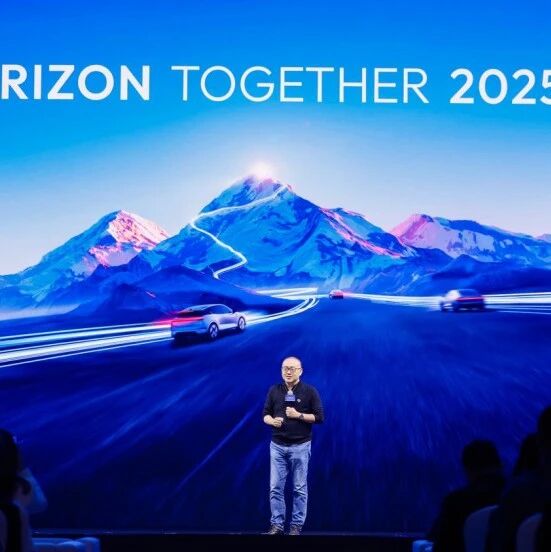
地平线携手伙伴共弄机器人智能进化浪潮,锚定具身产业 “向高同行” 方向
IPO早知道· 2025-12-15 03:00
Core Viewpoint - The article emphasizes the evolution and commercialization of embodied intelligence in robotics, highlighting the collaborative efforts among industry partners to enhance technological capabilities and applications in various sectors [2][24]. Group 1: Event Overview - Horizon held the 2025 Horizon Technology Ecosystem Conference, focusing on the transition from smart vehicles to robotics and the potential of embodied intelligence [2]. - The founder and CEO of Horizon, Yu Kai, stated that the company aims to be the "brain" of robots, emphasizing the vast opportunities in the robotics sector [2]. Group 2: Technological Insights - Tsinghua University researcher Zhao Mingguo discussed the challenges of embodied intelligence, proposing a "VISION-MAPPING-ACTION" strategy model to enhance robots' reactive intelligence [4]. - The article mentions the development of the HoloMotion model for motion control and the FSR-VLN model for visual language navigation, which are crucial for robots to perform tasks effectively [10][11]. Group 3: Industry Collaboration - Fourier's CEO Gu Jie shared insights on creating human-centered AI robots, focusing on emotional interaction and the integration of advanced computing platforms [5][7]. - Vbot's CEO Yu Yinan introduced the world's first smart dog, BoBo, which operates without remote control and is designed to integrate into daily life [8]. Group 4: Market Trends and Future Directions - The article highlights the importance of a universal base and functional modules in robot design, which can accelerate the commercialization of embodied intelligence [21]. - The discussion points towards a diverse and non-monopolistic market for robotics, with various applications across industries, emphasizing the need for robust foundational infrastructure to support innovation [22][24]. Group 5: Development Ecosystem - Horizon's subsidiary, Diguo Robotics, aims to create a comprehensive ecosystem for developers, providing a one-stop development platform that integrates data loops and training environments [13][14]. - The article notes a significant increase in shipment volume and customer base for Diguo Robotics, indicating a growing interest in robotics development [14].
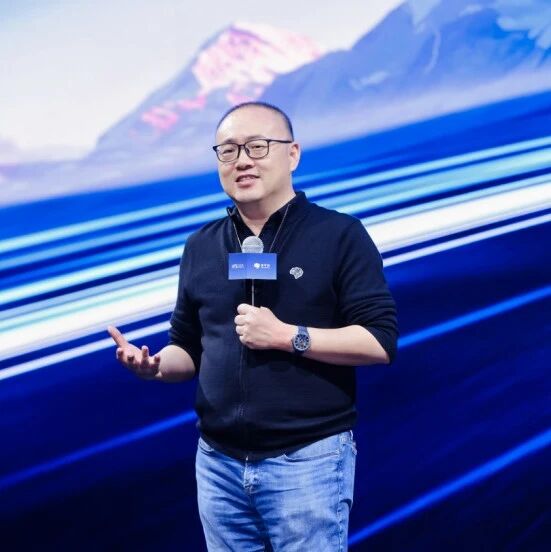
泡沫破裂与生死时速 ——自动驾驶行业进入“务实生存”新阶段
Zhong Guo Qi Che Bao Wang· 2025-12-15 01:32
Core Viewpoint - The autonomous driving industry is experiencing a significant downturn, marked by the collapse of once-prominent unicorn companies, reflecting the harsh realities of the market after a period of excessive capital influx [2][3]. Group 1: Industry Collapse - By the end of 2025, the autonomous driving sector is witnessing the end of its "crazy era," with companies like Maimo Zhixing halting operations due to financial distress and judicial account freezes [2]. - The downfall of Maimo Zhixing and Zongmu Technology serves as a warning for the industry, indicating that the collapse of high-valuation companies is no longer an isolated incident but a reflection of systemic issues within the sector [2]. Group 2: Strategic Pitfalls - Companies that have fallen from grace share similar trajectories, having initially thrived during a booming market by securing substantial funding and high valuations based on promising technology narratives [3]. - Maimo Zhixing's reliance on a single major client, Great Wall Motors, created a dependency that ultimately limited its market expansion and technological autonomy, leading to missed opportunities [4]. Group 3: Market Dynamics - The shift in Great Wall Motors towards more open technological collaborations has destabilized Maimo Zhixing's foundational partnerships, exacerbating its vulnerabilities in a competitive landscape [4]. - The global capital market's increasing caution towards hard technology investments has redirected funds away from the uncertain profitability of autonomous driving towards more immediately rewarding sectors like AI [4]. Group 4: Technological Missteps - Maimo Zhixing's failure to adapt to the industry's shift towards "light mapping" technology has hindered its competitiveness, as it continued to invest heavily in outdated systems [5]. - The choice of technology routes has significant implications for cost structure, data iteration efficiency, and scalability, with companies like Momenta successfully leveraging their capabilities to enter global markets [6]. Group 5: Market Polarization - The collapse of weaker firms has led to a stark division in the industry, with leading companies like Horizon Robotics solidifying their positions through extensive partnerships and market penetration [8]. - The competition has shifted from mere technological prowess to the speed of technological iteration, cost control, and the ability to commercialize effectively [9]. Group 6: Future Outlook - The autonomous driving sector is transitioning from its initial chaotic phase to a more mature stage focused on deepening and consolidating market positions, with capital becoming more selective in its investments [10].
