康方生物

Search documents
KGI凯基:2026年底恒指目标为30000点 潜在升幅约14%
Zhi Tong Cai Jing· 2026-01-13 06:07
KGI凯基对恒生指数前景持乐观态度。预期美联储减息将推动资金回流A、港股。基于预期市盈率上调 至13.5倍预测市盈率及8%盈利增长,该行设定2026年底恒指目标为30000点,潜在升幅约14%。 随着信心恢复,投资风格有望由守转攻。推荐12大选股:小鹏汽车(09868/XPEV.US)、优必选(09880)、 腾讯(00700)、阿里巴巴(09988/BABA.US)、中国宏桥(01378)、友邦保险(01299)、中国平安(601318) (02318)、招商银行(600036)(03968)、康方生物(09926)、泡泡玛特(09992)、腾讯音乐(01698/TME.US) 及信和置业(00083)。 凯基首席投资总监梁启棠表示:2026年是中国经济的关键转折点。新质生产力如人形机器人正接棒成为 新增长引擎。市场最关键的信号是资金正在苏醒一庞大的储蓄正从低息定存流向资本市场寻求回报。随 着风险偏好回归及政策发力,现在是投资策略由防守转向进攻的最佳时机。在估值修复与盈利增长双重 驱动下,看好恒指上望30000点,A、港股的配置价值已全面重现。 ...
脑机接口、小核酸等热点概念带动下创新药表现积极,港股通创新药ETF嘉实(520970)聚焦产业发展机会
Xin Lang Cai Jing· 2026-01-13 06:00
Group 1 - The core viewpoint of the news highlights the strong performance of the innovative pharmaceutical sector, with the CSI Hong Kong Stock Connect Innovative Drug Index rising by 2.08% as of January 13, 2026, driven by significant gains in stocks such as Rongchang Bio (+9.38%), WuXi AppTec (+7.67%), and Tigermed (+7.66) [1] - Eight departments jointly issued the "Implementation Opinions on the Special Action of 'Artificial Intelligence + Manufacturing'," emphasizing AI in drug development, AI-enabled pharmaceutical supply chains, surgical robots, and intelligent diagnostic systems as key development areas, with a goal to cultivate 2-3 ecosystem-leading enterprises by 2027 [1] - The integration of AI and healthcare is seen as a clear trend, with hardware companies represented by brain-computer interfaces and surgical robots expected to benefit from policy support and technological advancements [1] Group 2 - As of December 31, 2025, the top ten weighted stocks in the CSI Hong Kong Stock Connect Innovative Drug Index include WuXi Biologics, BeiGene, Innovent Biologics, and others, accounting for a total of 71.36% of the index [2] - The Hong Kong Stock Connect Innovative Drug ETF managed by Harvest closely tracks the CSI Hong Kong Stock Connect Innovative Drug Index, which includes stocks involved in innovative drug research and development, as well as services for pharmaceutical companies [2] - Investors without stock accounts can access the opportunities in the Hong Kong innovative drug industry through the Hong Kong Stock Connect Innovative Drug ETF linked fund [2]

荣昌生物(688331):RC148授权艾伯维,进入大药postBD阶段
Huaan Securities· 2026-01-13 05:33
Investment Rating - The investment rating for Rongchang Biologics (688331) is "Buy" (maintained) [2] Core Insights - On January 12, 2026, Rongchang Biologics announced an exclusive licensing agreement with AbbVie for its self-developed PD-1/VEGF bispecific antibody drug RC148. AbbVie will receive exclusive rights for development, production, and commercialization outside Greater China, with an upfront payment of $650 million and potential milestone payments up to $4.95 billion, along with double-digit royalties on net sales outside Greater China [5][11] - The deal is seen as a significant entry into the business development (BD) market for 2026, highlighting the growing trend of large licensing transactions in the PD-1/VEGF space, which is crucial for next-generation cancer immunotherapy [6] - AbbVie, a well-established player in oncology, aims to enhance treatment standards for patients with difficult-to-treat cancers, and the acquisition of RC148 will further strengthen its pipeline in immuno-oncology [7] Financial Projections - Revenue projections for Rongchang Biologics are adjusted to 2.25 billion, 7.42 billion, and 3.98 billion yuan for 2025, 2026, and 2027 respectively, reflecting year-on-year growth rates of 31.1%, 229.6%, and -46.3% [11] - The net profit attributable to the parent company is expected to be -763 million, 3.19 billion, and 220 million yuan for the same years, with growth rates of 48.0%, 517.8%, and -93.1% [11] - The gross margin is projected to remain stable, increasing from 80.4% in 2024 to 82.2% in 2027 [13]

医保商保双目录落地,BD 交易与研发齐热,港股通创新药 ETF 嘉实(520970)表现强势
Jin Rong Jie· 2026-01-13 04:07
Group 1 - The core viewpoint of the news highlights the positive performance of the innovative drug sector in the stock market, with significant gains in individual stocks and ETFs [1][3] - The new national medical insurance drug catalog will be implemented on January 1, 2026, adding 114 new drugs, including 50 Class 1 new drugs, marking a record high in both quantity and proportion [2] - The commercial insurance catalog will include 19 high-value innovative drugs, addressing accessibility issues for high-value innovative treatments [2] Group 2 - The collaboration between domestic innovative drug companies and multinational corporations continues, with 49 outbound transactions totaling over $39 billion since October last year [3] - The market is entering a peak season for business development (BD) and data disclosures, coinciding with the JPM conference and the upcoming annual report cycle [3] - The Hong Kong Stock Connect Innovative Drug ETF (520970) tracks the CSI Hong Kong Stock Connect Innovative Drug Index, with the top ten weighted stocks accounting for over 71.95% of the total weight [3]
CXO、消费医疗大崩盘:这三年医疗行业发生了什么?
Sou Hu Cai Jing· 2026-01-13 03:48
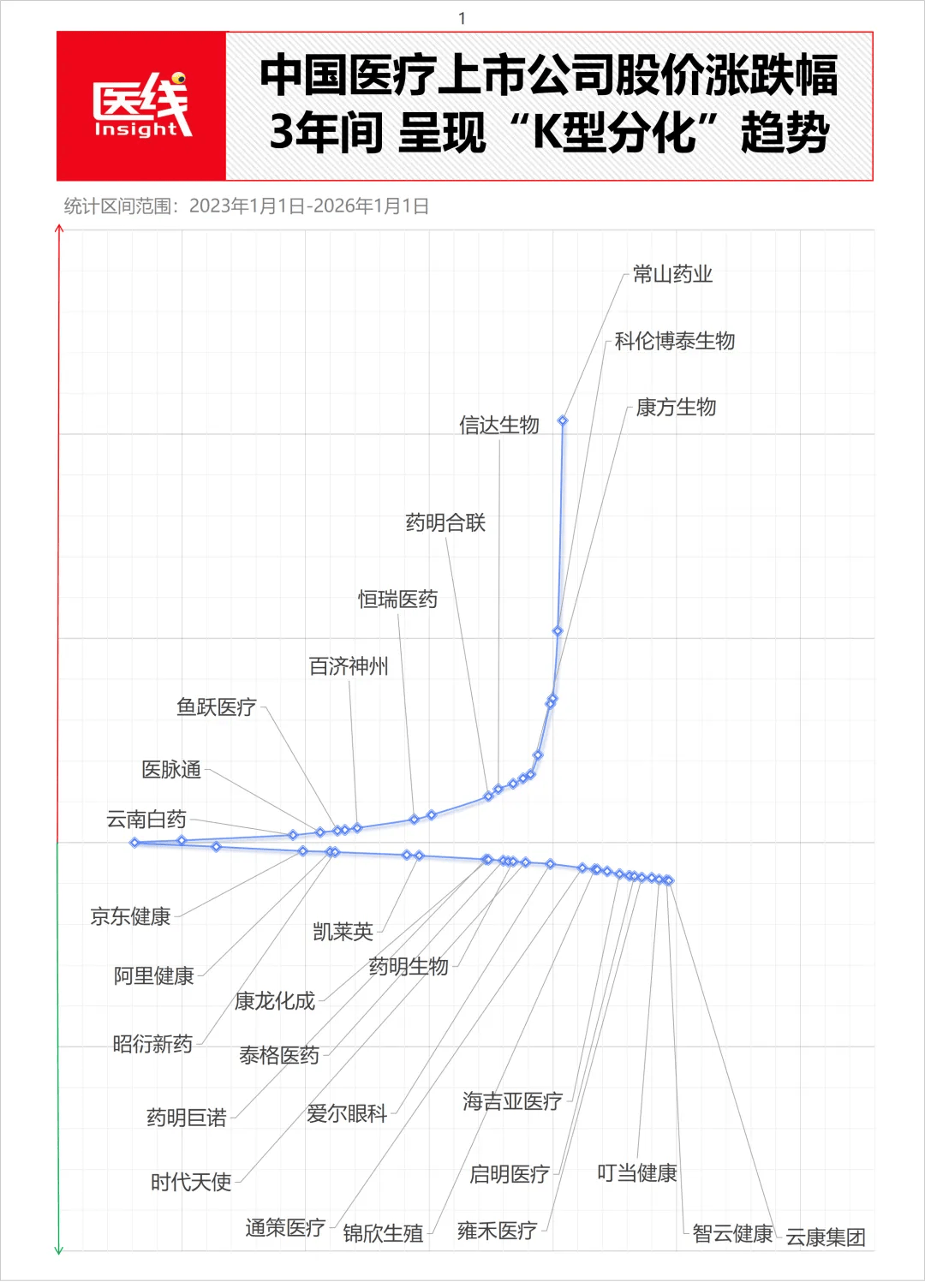
Core Insights - The Chinese healthcare industry has undergone a significant transformation from 2020 to 2025, transitioning from a "golden era" of investment to a "bubble-clearing period" characterized by a K-shaped divergence in market performance [1][2][4]. Group 1: K-shaped Downward Trends - The collapse of previously successful business models, particularly in CXO, consumer healthcare, and internet healthcare, has led to substantial market value losses, with some companies experiencing declines of over 90% [4][7]. - The downturn is attributed to macroeconomic factors such as U.S. interest rate hikes and geopolitical tensions, as well as microeconomic issues like supply-demand imbalances and the disappearance of growth dividends [8][10]. - The CXO sector, once seen as a perpetual growth engine, has faced a 46.68% decline for WuXi Biologics and 44.47% for Tigermed, revealing the fragility of its business model reliant on continuous global financing [12][10]. - Consumer healthcare has suffered a "Davis double whammy," with companies like Yonghe Medical and Aier Eye Hospital seeing declines of 86.19% and 52.69%, respectively, as consumer spending shifts away from discretionary healthcare services [14][15]. - Internet healthcare companies, including Zhiyun Health and Dingdang Health, have also faced severe declines, with drops of 92.44% and 90.67%, as the market realizes that their revenue largely comes from online drug sales rather than innovative healthcare solutions [19][21]. Group 2: K-shaped Upward Trends - In contrast, companies with strong global rights and hard-core technology have thrived, with Keren Biotechnology and Kangfang Biopharma seeing increases of 518.33% and 166.72%, respectively, marking a shift towards biopharma and global market engagement [29][31]. - The rise of these companies signifies a new era where capital is attracted to firms that can demonstrate robust clinical data and global market potential, moving away from mere concepts [30][31]. - Even within struggling sectors, some companies like WuXi AppTec and Yuyue Medical have shown resilience, with increases of 113.36% and 28.75%, respectively, by focusing on high-tech, high-barrier services [34][35]. Group 3: Challenges Ahead - Despite the emergence of new leaders, significant challenges remain, including the risks associated with licensing agreements that may compromise long-term profitability [36][37]. - The ADC sector is experiencing a rush similar to the past PD-1 craze, raising concerns about market saturation and price competition, which could undermine future profitability [39][40]. - The ongoing "ice age" in the primary market poses a threat to innovation, as funding for early-stage companies has become increasingly scarce, potentially leading to a decline in new drug approvals in the coming years [42][43].

医药行业跟踪报告:医药板块迎来开门红,2026年继续看好创新出海和硬科技
Shanghai Aijian Securities· 2026-01-13 03:44
Investment Rating - The report assigns an "Outperform" rating for the pharmaceutical sector, indicating a positive outlook compared to the broader market [2][4]. Core Insights - The pharmaceutical sector has shown strong performance, with the SW Pharmaceutical Biotechnology Index rising by 7.81% in the week of January 5-11, significantly outperforming the CSI 300 Index, which increased by 2.79% [2]. - Key drivers of this growth include advancements in brain-computer interfaces, small nucleic acids, and AI healthcare technologies [2]. - The report emphasizes the potential of innovation in overseas markets and hard technology, particularly in AI healthcare and brain-computer interfaces, as major growth areas for the pharmaceutical industry in 2026 [2]. Summary by Sections Industry Overview - The pharmaceutical sector is expected to continue its positive trajectory into 2026, driven by innovation and technological advancements [1]. - The report highlights the importance of the "AI + Health" investment trend, particularly with the launch of the Ant Group's "Afu" app, which focuses on health management [1][2]. Market Performance - The report notes that various sub-sectors, including hospitals, CXO, and medical devices, have experienced significant gains, with increases of 13.92%, 11.15%, and 10.81% respectively [2]. - The Hong Kong market has also seen a rebound in innovative drugs, with the Hang Seng Biotechnology Index rising by 11.06% [2]. Future Outlook - The report identifies three main sources of growth for the pharmaceutical industry: innovation in overseas markets, structural growth under the medical insurance payment framework, and natural growth from government finance and personal demand [2]. - Investment opportunities are expected to arise from the expansion of innovative drugs, hard technology, and the ongoing development of AI healthcare applications [2].
港股医药走强,港股通创新药ETF南方(159297)强势涨近3%,中国创新药产业长期向好发展趋势持续显现
Xin Lang Cai Jing· 2026-01-13 02:32
Core Viewpoint - The Chinese innovative drug sector is experiencing significant growth, highlighted by the recent clinical advancements and strategic partnerships, indicating a positive long-term trend in the industry. Group 1: Market Performance - The Hong Kong Stock Connect Innovative Drug ETF (南方, 159297) rose by 2.98%, with a turnover of 53.79 million yuan and a turnover rate of 3.2% [1] - Key stocks in the index, such as Rongchang Biopharmaceuticals, Sihuan Pharmaceutical, and Boan Biotechnology, saw substantial increases of 9.38%, 7.38%, and 6.71% respectively [1] Group 2: Clinical Developments - The GLP-1 class drug, Masitide, developed in China, achieved a milestone with two pivotal Phase III clinical studies published in the prestigious journal Nature on December 18, 2025, showcasing China's drug development capabilities [1] Group 3: Strategic Partnerships - Rongchang Biopharmaceuticals announced an exclusive licensing agreement with AbbVie for RC148, receiving an upfront payment of $650 million and potential milestone payments up to $4.95 billion, along with tiered royalties on net sales outside Greater China [1] Group 4: Industry Trends - Guosen Securities noted the explosive growth in business development (BD) transactions within the Chinese innovative drug industry, emphasizing that for many domestic innovative drugs, external licensing is just the starting point for global development [2] - The Hong Kong pharmaceutical sector has shown strong performance, particularly in the biotech field, reflecting heightened market interest in innovative drugs [2] Group 5: AI Integration - Eight departments jointly issued implementation opinions on "AI + Manufacturing," focusing on AI in drug development and medical supply chains, with a goal to cultivate 2-3 leading ecological enterprises by 2027 [2] - Century Securities highlighted the significant potential of AI in enhancing pharmaceutical manufacturing, particularly in drug discovery and intelligent diagnostics, which is expected to receive ongoing policy support and capital attention [2] Group 6: Index Composition - The index tracking the Hong Kong Stock Connect Innovative Drug sector includes major companies such as CSPC Pharmaceutical Group, BeiGene, and Innovent Biologics among its top ten weighted stocks [3]
PD-1/VEGF双抗交易热潮回归?荣昌生物签下56亿美元授权
Di Yi Cai Jing· 2026-01-13 02:03
Group 1 - AbbVie has secured a licensing agreement with Rongchang Biopharma worth up to $5.6 billion, which includes an upfront payment of $650 million and potential milestone payments of up to $4.95 billion [1] - The agreement grants AbbVie exclusive rights to develop, manufacture, and commercialize RC148, a bispecific antibody targeting PD-1 and VEGF, outside of Greater China [1] - RC148 is designed to enhance anti-tumor immune responses while inhibiting tumor-driven angiogenesis, and is currently undergoing clinical trials in China for various advanced malignancies [1] Group 2 - The PD-1/VEGF dual antibody market has seen increased interest, especially after Kangfang Biopharma's dual antibody demonstrated potential superiority over Merck's Keytruda in clinical trials [3] - Major pharmaceutical companies are investing in PD-1/VEGF dual antibodies, with significant licensing deals such as the $6.06 billion agreement between 3SBio and Pfizer, and the $11.1 billion collaboration between Bristol-Myers Squibb and BioNTech [3] - However, following disappointing overall survival data from Kangfang Biopharma's dual antibody, market enthusiasm for PD-1/VEGF dual antibodies has cooled, raising questions about the future potential of this therapeutic class [4] Group 3 - The recent licensing deal between Rongchang Biopharma and AbbVie may indicate a resurgence in interest in the PD-1/VEGF dual antibody space [4] - Kangfang Biopharma's partner, Summit, has submitted a new drug application to the FDA for its PD-1/VEGF dual antibody, targeting specific lung cancer patients, which could further influence market dynamics [4]
依沃西首个海外适应症BLA向FDA提交
Zheng Quan Shi Bao Wang· 2026-01-13 01:45
Core Viewpoint - Kangfang Biopharma's innovative PD-1/VEGF dual antibody, Ivosidenib, has submitted a Biologics License Application (BLA) to the FDA for treating EGFR mutation non-squamous non-small cell lung cancer (NSCLC) [1] Group 1: Company Developments - Ivosidenib's BLA submission is based on the overall results of the global Phase III HARMONi trial [1] - The application was submitted by Summit Therapeutics, the overseas partner of Kangfang Biopharma [1] Group 2: Regulatory Timeline - The FDA is expected to make a review decision on the BLA by the fourth quarter of 2026 [1] - The BLA aims to support the use of Ivosidenib in combination with chemotherapy for patients with EGFR mutation NSCLC who have progressed after third-generation EGFR-TKI treatment [1]

港股开盘:恒生科技指数涨1.93%,恒生指数涨1.32%
Jin Rong Jie· 2026-01-13 01:36
Group 1 - The Hang Seng Technology Index increased by 1.93% and the Hang Seng Index rose by 1.32% [1] - Notable stock performances include: Zhaoyi Innovation up by 45.06%, Dali Group Holdings up by 13.35%, and Rongchang Bio up by 8.84% [1] - Declining stocks include: Times Angel down by 4.96%, Master Kong Holdings down by 4.18%, and CIMC Enric down by 3.72% [1]