拓荆科技

Search documents
芯片股反弹!南方基金旗下科创芯片ETF南方(588890)拉升上扬涨超2%,澜起科技大涨超11%
Xin Lang Cai Jing· 2026-01-30 06:25
Group 1 - The South Fund's Sci-Tech Chip ETF (588890) saw an intraday increase of over 2%, with a trading volume of 1.56 billion yuan and a turnover rate of 7.28% [1] - The index it tracks, the Shanghai Sci-Tech Board Chip Index, includes stocks such as Huafeng Measurement Control, which rose by 12.48%, and Lanke Technology, which increased by 11.54% [1] - Samsung Electronics reported a record annual revenue of 333.6059 trillion won for 2025, a year-on-year increase of 10.9%, with operating profit and net profit rising by 33.2% and 31.2% respectively [1] Group 2 - SK Hynix announced a 2025 revenue of 97.1467 trillion won, a year-on-year increase of 47%, with operating profit doubling to 47.2063 trillion won, marking a significant shift in the global memory industry landscape [1] - Dongfang Securities noted that the price adjustment for MCU and NOR Flash products by Zhongwei Semiconductor ranges from 15% to 50%, indicating a tight supply in the niche storage market driven by AI demand [2] - The Sci-Tech Chip ETF closely tracks the Shanghai Sci-Tech Board Chip Index, which reflects the overall performance of semiconductor-related companies listed on the Sci-Tech Board [2]

阿里真武PPU累计出货量达数十万片,科创芯片ETF(588200)一键布局国产芯片投资机遇
Xin Lang Cai Jing· 2026-01-30 05:11
Group 1 - The semiconductor sector is experiencing fluctuations, with the STAR Market semiconductor index rising by 0.50% as of January 30, 2026, and several component stocks showing significant gains, such as Shijia Optoelectronics up 7.31% and Chipone Technology up 5.38% [1] - Alibaba has clarified its "Cloud + AI + Chip" strategy, with its PPU from Tmall Genie achieving cumulative shipments of several hundred thousand units, positioning it among the leading domestic GPU manufacturers [1] - As of January 29, 2026, nearly 250 STAR Market companies have disclosed their 2025 performance expectations, with about 50% (125 companies) projected to be profitable, and 67 companies expected to show positive year-on-year growth in net profit [1] Group 2 - Donghai Securities forecasts a global server shipment growth rate of 12.8% in 2026, with AI server shipments expected to increase by over 28%, driving up prices for related chips such as storage and CPUs [2] - Samsung Electronics plans to raise NAND flash supply prices by over 100% in Q1 2026, while Intel and AMD are considering a 10-15% increase in average server CPU prices for the same period [2] - The current demand in the electronics industry is recovering, with effective supply clearance leading to rising prices for storage chips, suggesting structural opportunities in AI computing power, AIOT, semiconductor equipment, and key components [2] Group 3 - The STAR Market Chip ETF (588200) tracks the STAR Market semiconductor index, serving as a convenient tool for investing in the semiconductor sector [3] - Investors without stock accounts can access investment opportunities in domestic chips through the STAR Market Chip ETF linked fund (017470) [4]
这个世界怎么又开始为缺芯买单了?
Xin Lang Cai Jing· 2026-01-29 08:24
春节前夕,黄仁勋如期开始他的一轮中国行。 炒股就看金麒麟分析师研报,权威,专业,及时,全面,助您挖掘潜力主题机会! 从上海小笼包到北京云南菜再到深圳牛肉火锅,老黄一边与民同乐搞起美食之旅,一边对员工们盛赞 DeepSeek 等中国开源大模型,最后成功喜提"首批40万颗H200芯片进口获批"的头条,开启了自己的下 一段行程。 要知道,此时此刻距离DeepSeek上一次震撼发布已经过去了一年,而大模型的魔法,也在过去一年 SOTA模型35天一换的迭代中,似乎失去了万众瞩目的光环。 Scaling law 的魔法与 FOMO 情绪的催涨不会消失,只是从模型参数,转移到了硬件与资本市场。 继英伟达GPU与存储的一路暴涨,2026年开年,反复在神狗二象性蹦极的国产半导体,也用一场史诗级 上涨宣告了自己的回归。 不仅台积电、三星赚的盆满钵满,中芯国际、华虹一众国产晶圆厂机台稼动率久违的重回100%,转到 冒烟,也赚到手软。 资本开支随之水涨船高,半导体设备与材料企业自然率先吃到红利。 高景气度的地方,投资者都怕落人之后。截至1月26日,中证半导体材料设备指数开年涨幅达23%,而 跟踪这个指数的半导体设备ETF易方达(15 ...

这个世界怎么又开始为缺芯买单了?
远川投资评论· 2026-01-29 08:17
Core Viewpoint - The semiconductor industry is experiencing a significant cycle of growth driven by AI demand, leading to a resurgence in semiconductor equipment and materials, with a focus on capital expenditure and production capacity expansion [6][19][20]. Group 1: Semiconductor Market Dynamics - The semiconductor market faced a major crisis starting in 2021 due to pandemic-related disruptions, leading to a global chip shortage that affected various sectors, particularly automotive [6][7]. - The panic buying of chips created a closed-loop of high demand and low supply, resulting in extreme price inflation for certain components, such as automotive chips [8][11]. - In 2023, the global semiconductor market is projected to decline by 11% to $533 billion, with memory markets experiencing a nearly 40% contraction [11][12]. Group 2: Capital Expenditure Trends - Semiconductor capital expenditure surged by 35% in 2021 and an additional 15% in 2022, driven by capacity expansion plans from major players like TSMC and Samsung [11][12]. - In 2023, global semiconductor capital expenditure is expected to total $169 billion, reflecting a 7% decline, with memory sectors facing a 21% drop [12][13]. Group 3: AI and Semiconductor Demand - The demand for AI servers is significantly higher than traditional servers, with AI servers requiring 8 times the DRAM and 3 times the NAND capacity [13][14]. - The anticipated growth in AI applications is expected to lead to another chip shortage by the end of 2024, as supply struggles to keep pace with surging demand [14][15]. Group 4: Semiconductor Equipment Market - The semiconductor equipment market is projected to grow significantly, with Morgan Stanley raising its forecast for the global semiconductor capital equipment market growth rate to 16% by 2026, reaching $136 billion [19][20]. - The demand for semiconductor equipment is driven by the need for expanded production capacity in response to the AI-driven demand surge [16][19]. Group 5: Investment Strategies - Investing in semiconductor equipment and materials is crucial for capturing industry growth, with ETFs providing a practical approach for investors to gain exposure to leading companies in the sector [24][25]. - The semiconductor equipment ETF, E Fund (159558), has shown strong performance, reflecting the high demand and growth potential in the semiconductor equipment market [21][25].




半导体设备ETF易方达(159558)成交额超3亿元,近5个交易日合计“吸金”3.04亿元
Xin Lang Cai Jing· 2026-01-29 07:02
Core Viewpoint - The semiconductor materials and equipment sector is experiencing volatility, with the index showing a decline while certain stocks demonstrate mixed performance [1][2] Group 1: Index Performance - As of January 29, 2026, the CSI Semiconductor Materials and Equipment Theme Index (931743) decreased by 4.21% [1] - Over the past two weeks, the semiconductor equipment ETF from E Fund (159558) has increased by 7.04%, ranking 1 out of 5 among comparable funds [1] Group 2: Stock Performance - Leading stocks include Fuchuang Precision, which rose by 2.94%, and Jinhaitong, which increased by 0.98% [1] - Declining stocks include Jingyi Equipment, which fell by 8.91%, and Shenkong Co., which dropped by 8.69% [1] Group 3: ETF Trading Activity - The E Fund semiconductor equipment ETF had a turnover rate of 6.7% and a trading volume of 310 million yuan [1] - The average daily trading volume over the past week was 321 million yuan, placing it in the top 2 among comparable funds [1] Group 4: Fund Size and Inflows - The latest size of the E Fund semiconductor equipment ETF reached 4.758 billion yuan, marking a one-year high and ranking 2 out of 5 among comparable funds [1] - Recent net outflow was 2.2458 million yuan, but over the last five trading days, there were net inflows on four days, totaling 304 million yuan [1] Group 5: Index Composition - The top ten weighted stocks in the CSI Semiconductor Materials and Equipment Theme Index account for 65.08% of the index [2] - Key companies in the top ten include Northern Huachuang, Zhongwei Company, and Tuo Jing Technology [2]
美联储暂缓降息,科创半导体ETF、半导体设备ETF华夏回调,存储基本面仍扎实
Sou Hu Cai Jing· 2026-01-29 03:44
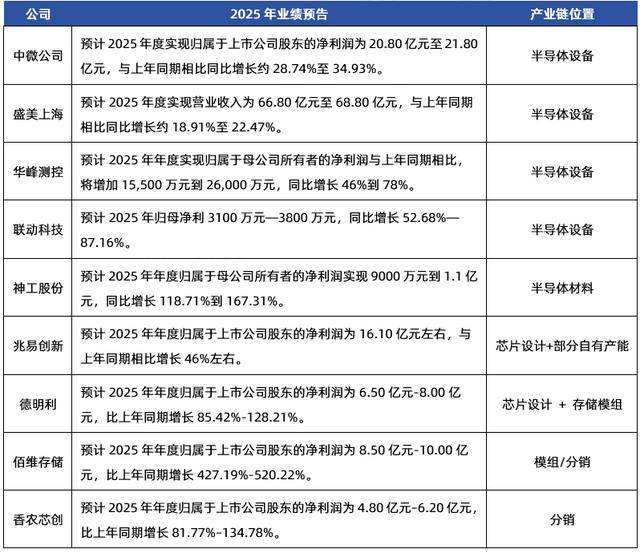
Group 1 - The core viewpoint of the articles highlights the impact of the Federal Reserve's interest rate decisions on the semiconductor industry, indicating that high rates lead to cautious capital expenditure among companies, while lower rates stimulate investment in technology and equipment [2][3] - The semiconductor sector is experiencing a mixed performance, with some stocks rising while others fall, but the trend of domestic substitution remains a key trading logic in the market [1] - Historical data shows that during past interest rate cuts, global semiconductor sales have significantly increased, suggesting a strong correlation between monetary policy and semiconductor demand [3] Group 2 - The fundamentals of the memory chip market remain solid, with companies like SK Hynix and Samsung reporting record revenues and profits in the fourth quarter, indicating robust performance in the sector [4][5] - Several companies in the semiconductor supply chain are expected to achieve substantial profit growth in 2025, with projections indicating increases in net profits ranging from approximately 28.74% to over 520% for various firms [6] - For investors, a strategy of index-based investment in semiconductor ETFs is recommended to mitigate risks associated with individual stocks, with several ETFs available that cover the entire semiconductor industry chain [7]

投资芯片选哪只?全市场半导体芯片主题指数大盘点
Xin Lang Cai Jing· 2026-01-29 02:11
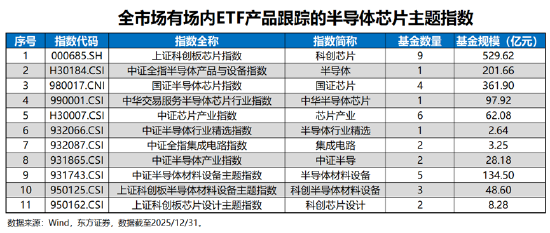
Core Viewpoint - The semiconductor chip sector, particularly the domestic computing power segment, is expected to perform well in 2026, with a notable shift from manufacturing dominance to design prominence since 2023 [1]. Group 1: Market Trends - By the end of 2021, there were only 8 ETFs tracking semiconductor-related indices, but by the end of 2025, this number surged to 36, tracking 11 different indices [1]. - The "semiconductor content" in all related indices is high, with most exceeding 90%, and some even surpassing 95% [13][44]. Group 2: Industry Structure - The semiconductor industry encompasses a complete supply chain from upstream materials and equipment to midstream design, manufacturing, and testing, down to downstream applications [4][35]. - The relationship between semiconductors, chips, and integrated circuits is clarified, with chips being the physical products made from semiconductor materials [5][35]. Group 3: Investment Insights - The investment landscape is categorized into two main segments: the design end (including chip design and discrete devices) and the manufacturing/support end (including semiconductor materials, equipment, and manufacturing processes) [10][42]. - The "Science and Technology Innovation Chip Index" (code: 000685.CSI) is highlighted for its strong performance, with a significant portion of its constituents being large and mid-cap stocks, ensuring liquidity [17][52]. Group 4: Performance Metrics - The expected net profits for the constituents of the Science and Technology Innovation Chip Index are projected to be 313.57 billion, 477.71 billion, and 654.26 billion for 2025, 2026, and 2027, respectively, with growth rates of 97.93%, 53.34%, and 36.96% [28][59]. - The index's top ten holdings account for 58.82% of its weight, indicating a high concentration of leading companies in the sector [25][56].
众赢财富通:境内首只500亿芯片ETF诞生 产业配置升温
Cai Fu Zai Xian· 2026-01-29 01:58
Core Insights - The launch of the first domestic chip ETF exceeding 50 billion yuan signifies strong market recognition of the investment value in the semiconductor sector, reflecting ongoing enthusiasm for core technology assets amid supportive policies and accelerated domestic substitution [1][3] Group 1: ETF Performance and Market Dynamics - The Jiashi Fund's Sci-Tech Chip ETF (588200) has reached a scale of 50.343 billion yuan, marking a new high since its listing and becoming the first chip ETF in China to surpass the 50 billion yuan threshold [1] - The ETF tracks the Shanghai Stock Exchange Sci-Tech Board Chip Index, covering high-quality companies across the semiconductor industry chain, including leaders like Zhongwei Company and Tuojing Technology, which helps capture overall industry growth while mitigating individual stock volatility [3] - Other chip ETFs, such as E Fund's Sci-Tech Chip ETF (589130) and Guolian An's Sci-Tech Chip Design ETF (588780), have also seen significant inflows, indicating a consensus on the long-term value of the chip industry [3] Group 2: Policy Support and Industry Growth - Continuous policy support is identified as a key driver for the explosive growth of chip ETFs, with the semiconductor industry policy support intensifying since the beginning of 2026, including the establishment of the third phase of the semiconductor fund with a total scale exceeding 350 billion yuan [4] - The Ministry of Industry and Information Technology has introduced special subsidy policies, allowing domestic wafer fabs to receive up to 15% subsidies for purchasing domestic semiconductor equipment, thereby accelerating the domestic substitution process [4] - Major domestic wafer fabs are actively expanding production, with significant investments announced, such as 7.6 billion USD by SMIC and 6.7 billion USD by Huahong Wuxi, which are expected to drive performance expectations for industry chain companies [4] Group 3: Domestic Substitution and Market Recovery - The acceleration of domestic substitution in the semiconductor industry and signs of cyclical recovery provide solid fundamental support for ETF growth, with the domestic semiconductor equipment localization rate rising from 25% in 2025 to 35% by early 2026 [5] - Key equipment replacement rates have exceeded 40%, and the proportion of domestic equipment in new wafer production lines has reached 55%, surpassing market expectations [5] - The semiconductor industry is showing clear signs of recovery, with DRAM contract prices increasing by over 50% and flash memory prices rising by over 30%, further driving equipment procurement by domestic manufacturers [5]
利基存储紧缺持续,AI需求打开增量空间
Orient Securities· 2026-01-29 01:45
Investment Rating - The report maintains a "Positive" investment rating for the electronic industry [5] Core Insights - The ongoing shortage of niche storage is expected to continue, with AI demand opening up incremental growth opportunities [2][8] - AI demand is anticipated to drive the need for niche storage, particularly in applications such as automotive, industrial, and security [7] - Domestic manufacturers are positioned competitively in the niche storage market and are likely to benefit from the supply constraints caused by international suppliers exiting this segment [7] Summary by Sections Investment Recommendations and Targets - Key investment targets include domestic storage chip design companies such as Zhaoyi Innovation, Puran, Jucheng, Dongxin, Beijing Junzheng, and Hengshuo [3][8] - Other relevant companies include domestic storage module manufacturers like Jiangbolong, Demingli, and Baiwei Storage, as well as semiconductor equipment firms such as Zhongwei, Jingzhida, and Beifang Huachuang [3][8] - Companies benefiting from storage technology iterations include Lanke Technology, Lianyun Technology, and Aojie Technology [3][8] Market Dynamics - The supply of niche storage products is being significantly reduced as major international suppliers focus on mainstream storage products, leading to a substantial contraction in supply [7] - For instance, the global MLC NAND Flash capacity is projected to decrease by 41.7% in 2026 due to supply shrinkage, which is expected to drive prices significantly higher [7] - Domestic firms are gaining market share in niche storage, with Zhaoyi Innovation holding approximately 18.5% of the NOR Flash market in 2024, ranking second globally [7]


2026年度投资策略:把握AI创新,找寻价值扩张方向
Guolian Minsheng Securities· 2026-01-28 15:40
Core Insights - The report emphasizes the importance of "speed + power" as the core contradiction in the future development of the AI industry, highlighting significant market movements in both speed and power sectors over the past year [1][9] - For 2026, the focus should be on observing the commercial closure rhythms of CSPs and large model vendors to grasp the overall industry beta, while actively seeking value expansion and capital expenditure shifts in specific segments [1][10] - The report suggests that capital expenditure (Capex) and return on investment (ROI) are critical variables in understanding computing power demand, which is primarily driven by token counts and Capex [1][10] Investment Strategy - The computing power industry is viewed as the foundation of technology, with a long-term positive outlook. The report recommends actively seeking value expansion and capital expenditure shifts in specific segments, maintaining the focus on "speed + power" [3][12] - Key areas of investment include domestic computing power, semiconductor equipment, storage, and AI terminals [3][12] Capital Expenditure Analysis - Major cloud service providers (CSPs) have significantly increased their capital expenditures, with the top five CSPs' combined Capex reaching $308.1 billion in Q3 2025, a 75% year-on-year increase [24][27] - Google, Microsoft, Amazon, Meta, and Oracle are leading this trend, with Google and Microsoft showing particularly aggressive Capex growth to support AI infrastructure [27][28] - The report highlights that Google’s Capex for 2024 is projected to be $52.5 billion, a 63% increase year-on-year, while Microsoft’s Capex is expected to reach $75.6 billion, an 84% increase [27][28] AI Model and Chip Development - The report discusses the rapid iteration of Google's Gemini model family, which has introduced significant advancements in AI capabilities, including multi-modal understanding and enhanced reasoning abilities [36][41] - NVIDIA is identified as a key player in the computing power landscape, with its customer base including CSPs, large model vendors, and government clients, driving substantial revenue growth [24][30] - The report notes that the demand for AI chips is expected to grow, with companies like OpenAI forming strategic partnerships with major chip manufacturers to enhance their infrastructure [62][63] Domestic Computing Power Growth - The report anticipates a breakthrough year for domestic computing power in 2026, driven by the acceleration of domestic large models and positive capital expenditure outlook from cloud vendors [2][6] - The supply side is expected to transition from single-point breakthroughs to multi-point developments, indicating a robust growth trajectory for domestic computing power vendors [2][6] Semiconductor and Storage Opportunities - The semiconductor sector is highlighted as benefiting from an AI-driven storage supercycle, with equipment manufacturers poised to gain from original factory expansions [2][8] - The report emphasizes the importance of AI in driving growth in the storage industry, predicting rapid expansion in this sector [2][8]