上海瀚讯

Search documents
“制造强国”实干系列周报(12、14期)-20251217
Shenwan Hongyuan Securities· 2025-12-17 01:46
Group 1: Aluminum vs. Copper in Air Conditioning - The shift from copper to aluminum in air conditioning systems is driven by the copper-aluminum price gap, energy efficiency standards upgrades, and refrigerant replacements, with microchannel technology becoming increasingly prevalent[3] - The competitive landscape for microchannel heat exchangers is dominated by three players: Sanhua, Mahler/Delphi, and Danfoss[3] - Sanhua's revenue growth has slowed, indicating a need for innovation and adaptation in the market[14] Group 2: Nuclear Fusion Developments - The nuclear fusion sector is expected to accelerate due to continuous technological breakthroughs and policy support, with significant project milestones achieved in 2025[19] - The global nuclear fusion market is projected to reach approximately $479.5 billion by 2029, with a total of 196 fusion devices expected by 2035[40][42] - Key investment opportunities in nuclear fusion include core supporting entities and high-value segments within the supply chain, such as superconducting magnets and power systems[46] Group 3: Commercial Aerospace - The commercial aerospace sector is witnessing stable or potentially increasing core players due to cost reduction trends, with a focus on satellite manufacturing and launch services[3] - The domestic satellite constellation projects, such as G60 and GW, are set to significantly increase satellite launches, with G60 planning to deploy 1,296 satellites by the end of 2027 and 15,000 by 2030[60] - The market for satellite services and ground equipment is expected to dominate, accounting for over 90% of the commercial aerospace value chain[52]
AI沦为暗线?从商业航天入手“十五五”投资机会!
Ge Long Hui A P P· 2025-12-16 10:24
Core Viewpoint - The article discusses the ongoing AI bubble concerns and the impact of various negative news on the AI technology sector, while emphasizing that the fundamental logic and trends of the global AI industry remain unchanged in the long term [2][5]. Group 1: Investment Opportunities in Key Technology Directions - Commercial Space: The "strong nation in space" goal in the 14th Five-Year Plan, along with policies, demand, and technology, creates a robust investment opportunity in commercial space [2][3]. - Demand for low-orbit satellite resources is urgent, with China's GW and Qianfan constellations planning over 10,000 satellites, of which less than 1% are currently in orbit [3]. - The successful launch of the Zhuque-3 and the upcoming Long March 12 rocket are expected to significantly reduce launch costs, which is crucial for satellite networking [3]. Group 2: Specific Technology Areas - Autonomous Driving: The recent approval of L3 autonomous vehicle licenses marks a critical transition from testing to commercialization, with a projected market size of 270 billion for Robotaxi by 2030 [5]. - Nuclear Fusion: While still in the experimental phase, nuclear fusion is recognized as a future key industry, with significant investment opportunities tied to technological breakthroughs [6]. - Artificial Intelligence: The focus has shifted from speculative investments to practical applications, with the 14th Five-Year Plan promoting AI integration across various industries [6][7]. Group 3: Market Dynamics and Trends - The commercial space sector has shown resilience despite recent launch delays, indicating strong market recognition and investment potential [9][11]. - The core logic of commercial space revolves around the urgent need for satellite networking and decreasing costs, with various companies positioned to benefit from this trend [11]. - The article highlights the importance of selecting the right sectors and companies for sustained investment, particularly in the context of the 14th Five-Year Plan's long-term technological focus [15].





AI沦为暗线?从商业航天入手“十五五”投资机会!
格隆汇APP· 2025-12-16 09:44
Core Viewpoint - The article discusses the ongoing trends in various technology sectors, particularly focusing on the AI industry, commercial aerospace, autonomous driving, nuclear fusion, and quantum technology, emphasizing the long-term potential despite short-term market fluctuations [5][6][10][13][16]. Group 1: Commercial Aerospace - The Chinese government has prioritized commercial aerospace in its strategic goals, establishing a dedicated department and action plans, indicating strong policy support [8]. - The demand for low-orbit satellite resources is urgent, with plans for thousands of satellites, and recent technological advancements in reusable rockets are expected to significantly reduce launch costs [8][20]. - Key players in the commercial aerospace sector include China Satellite, which leads in satellite manufacturing, and various companies involved in rocket manufacturing and satellite components [20][22]. Group 2: Autonomous Driving - The autonomous driving sector is entering a critical commercialization phase, supported by government policies and technological advancements, with a projected market size of 2.7 trillion by 2030 for Robotaxi services [10]. - The recent approval of L3 autonomous vehicle models marks a significant step towards commercial deployment [10]. Group 3: Nuclear Fusion - Nuclear fusion is recognized as a future clean energy source, but it remains in the experimental stage, with significant breakthroughs needed before commercialization [11][12]. - Current investments are focused on technological milestones, making it a long-term investment opportunity [12]. Group 4: Artificial Intelligence - The AI sector is transitioning from speculative investments to practical applications, with a focus on real-world implementations that enhance efficiency and reduce costs [13]. - The emphasis is on AI applications across various industries, including manufacturing and healthcare, rather than on speculative infrastructure investments [13]. Group 5: Robotics - The development of embodied intelligence and humanoid robots is a key focus area, with increasing demand in manufacturing due to labor shortages and rising costs [14]. - Companies like Tesla are advancing humanoid robot production, while domestic firms are achieving significant progress in core components [14]. Group 6: Semiconductor Industry - The semiconductor sector is a priority for domestic self-sufficiency, with a focus on overcoming key technological challenges [15]. - Domestic wafer manufacturers are expanding production, and there is a growing demand for domestic semiconductor components [15]. Group 7: Quantum Technology - Quantum communication is positioned as a strategic priority for national security, with ongoing efforts in standardization and pilot projects in financial and governmental applications [16]. - Companies in the quantum sector are beginning to secure significant contracts, indicating a move towards commercialization [16][24]. Group 8: Market Trends and Investment Strategy - The article suggests that commercial aerospace is currently the most promising sector for investment, driven by policy, demand, and technological advancements [26]. - It also highlights the importance of focusing on sectors with clear policy support and performance validation, such as AI applications and robotics, while recognizing the long-term potential of quantum technology and semiconductor advancements [26].

商业航天概念震荡调整
Di Yi Cai Jing· 2025-12-16 03:44
龙洲股份跌停,科强股份跌超10%,飞沃科技、佳缘科技、航天智装、上海瀚讯等跌幅靠前。 (本文来自第一财经) 龙洲股份跌停,科强股份跌超10%,飞沃科技、佳缘科技、航天智装、上海瀚讯等跌幅靠前。 (本文来自第一财经) ...




商业航天深度报告:星辰为路,领航新纪元
2025-12-16 03:26
Summary of Commercial Aerospace Conference Call Industry Overview - The commercial aerospace sector faces core challenges related to capacity and cost, with breakthroughs in reusable rocket technology being crucial [1] - SpaceX has launched nearly 10,000 satellites, validating the commercial potential of the industry [1][2] - China is actively advancing reusable rocket testing and has entered a period of intensive launches by private companies, which will accelerate commercialization [1][3] Key Points and Arguments - The information technology segment is vital for commercial aerospace, encompassing remote sensing, measurement and control, CAE simulation, and data transmission, all requiring software service support [1][4] - Space computing is emerging as a solution to address power consumption and land resource constraints, offering long-term economic viability [1][4] - The U.S. has incentivized private sector participation in aerospace through policy simplifications, while China has supported private enterprises since 2020, forming four major industrial belts to reduce operational costs [5] - The Shanghai Aerospace Bureau has been established with a high-quality development plan, indicating increased support during the 14th and 15th Five-Year Plans [6] Market Dynamics - The commercial aerospace sector is not new, having gained attention since 2022, with steady development in China's aerospace industry transitioning from specialized to civilian applications [2] - The core issues in commercial aerospace remain cost reduction and economic feasibility, with significant advancements in technology observed globally [2][3] - The market is witnessing a surge in low Earth orbit satellite projects from various entities in China, which could enhance satellite commercialization once capacity constraints are overcome [3] Technological Developments - Intelligent measurement and control technologies are critical for satellite operational safety, with automation and standardization processes being essential [2][8] - Satellite testing technologies ensure successful missions by simulating space environments and verifying stability and reliability through various testing phases [10] - CAE simulation technology enhances research and development efficiency and product safety, significantly shortening design cycles [11][12] Future Prospects - Space computing is a burgeoning area with immense potential, addressing the data transmission pressures from increasing satellite numbers [13] - The U.S. leads in space computing, with companies like NASA and SpaceX making significant advancements, including the Starlink network [15][16] - China is also making strides, with the Tianzhi series satellites and the launch of the world's first space computing constellation [17] Challenges and Solutions - The development of space computing faces challenges such as heat management and maintenance costs, which can be mitigated through advancements in rocket reusability and lightweight materials [19] - The advantages of space computing include reduced land resource competition and the ability to utilize solar energy, making it a viable alternative to ground-based data centers [18] Investment Opportunities - Recommended focus on state-owned enterprises and leading private aerospace companies, such as Electric Science, Aerospace Systems, and related supporting companies, which are integral to the industry chain and poised to benefit from future trends [20]
谁是商业航天金矿中的“卖铲人”?丨每日研选
Shang Hai Zheng Quan Bao· 2025-12-16 02:23
Core Insights - The commercial aerospace sector is experiencing increasing momentum, with a notable rotation within the industry as national satellite constellations like StarNet (GW) and Qianfan (G60) enter a phase of intensive networking [1] - The investment logic is shifting towards satellite manufacturing, particularly focusing on high-barrier, high-value core component suppliers, as the technology for reusable rockets matures and costs decrease [1] Demand Certainty - The demand for satellite launches is expected to grow significantly, with an estimated average of 499 launches per year in China from 2026 to 2029, and potentially reaching thousands annually after 2030, compared to the current average of approximately 171 launches [1] - StarNet has recently achieved a rapid launch pace of "three times a week," indicating an acceleration in deployment [1] Transition to Mass Production - The satellite manufacturing sector is transitioning from "custom" to "mass production," benefiting companies that can provide standardized, reliable core components [2] - The most certain returns in the industry are expected to come from high-value, high-barrier satellite core components and payloads, with suppliers of standardized power, communication, and attitude control systems positioned as key players [2] Technological Breakthroughs and Policy Support - There is strong anticipation for technological breakthroughs in reusable rocket technology, despite it not being fully matured [2] - Commercial aerospace has been recognized as a strategic emerging industry, with numerous supportive policies being introduced at both central and local levels [2] Investment Focus - Investors are encouraged to focus on "high-barrier component suppliers," particularly core suppliers for satellite platforms and payloads, including: - Communication payloads and chips, which are essential for satellite operations, with relevant companies including Guobo Electronics, Zhenlei Technology, and Shanghai Hanyun [3] - Ground terminals and core network components, covering critical parts, chips, and testing instruments, with notable companies such as Huali Chuantong and Haige Communication [3]
阶段新高后大幅回调,国防军工ETF(512810)挫逾2%!航天智装、中国卫星等商业航天热门股领跌
Xin Lang Cai Jing· 2025-12-16 01:59
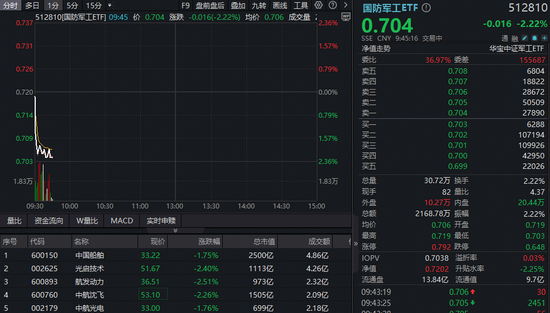
Core Viewpoint - The defense and military sector experienced a significant pullback, with the popular defense military ETF (512810) dropping over 2% after reaching a two-month high the previous day [1][6]. Group 1: Market Performance - On December 16, the defense military ETF (512810) saw a decline of 2.22%, closing at 0.704, with a trading volume of 18,300 [2][5]. - Key stocks within the sector, such as Aerospace Intelligence, Shanghai Hanhua, and China Satellite, showed weak performance with declines of 8.04%, 5.77%, and 5.52% respectively [5][6]. - Major weighted stocks like China Shipbuilding, Guangqi Technology, and Aero Engine Corporation also experienced losses [5][6]. Group 2: Industry Outlook - The long-term investment value of the military sector is highlighted, with the recent pullback potentially opening up new investment opportunities [3][5]. - The Ministry of Finance's budget draft for 2025 indicates a national defense expenditure of 1.78 trillion yuan, with 40% allocated for equipment costs, and over 30% of that focused on aviation equipment [3][5]. - The State Council's recent guidelines emphasize the importance of "military intelligence and unmanned equipment" and "satellite internet" as key development areas, aiming for significant results by year-end [3][5]. - Analysts from Guotai Junan point out that the increasingly complex international environment and rising defense spending in the U.S. underscore the intensifying great power competition, which will drive demand for advanced military equipment [3][5]. - Zhongtai Securities notes that the commercial aerospace sector is seeing increased activity, with new rocket launches accelerating the development of satellite internet, and a robust demand for aerospace equipment expected in the next five years [3][6].
A股商业航天股集体回调,航宇科技跌超7%,航天宏图跌超6%
Ge Long Hui· 2025-12-16 01:51
格隆汇12月16日|A股市场商业航天股今日集体回调,其中,飞沃科技跌超12%,航天智装、佳缘科 技、邵阳液压跌超8%,陕西华达、霍莱沃、航宇科技、招标股份跌超7%,富瑞特装、航天宏图、亚光 科技、上海瀚讯、中国卫星跌超6%,中天火箭、航天晨光、天箭科技、九丰能源跌超5%。 ...

两融资金,新动向!
Zheng Quan Shi Bao Wang· 2025-12-15 11:57
Group 1 - The A-share market's margin trading remains active, with the margin balance maintaining around 2.5 trillion yuan, reaching a historical high of 25,143 billion yuan on December 10 [2][3] - In December, the overall margin balance in the A-share market has shown a slight increase, with most sectors receiving favorable financing [2] - The hardware equipment sector led with a net financing inflow exceeding 10 billion yuan, followed by the non-ferrous metals sector with over 600 million yuan [2] Group 2 - Nearly 200 stocks in the A-share market had a net financing inflow exceeding 100 million yuan from December 1 to December 12, with 18 stocks surpassing 500 million yuan [3] - Leading stocks in the technology sector, such as Xinyi Technology and Shenghong Technology, received significant financing, with net inflows of nearly 3 billion yuan and 1.9 billion yuan respectively [3] - Some technology stocks, including Cambrian and ZTE Precision, experienced higher financing repayments than inflows during the same period [4] Group 3 - As of December 12, 17 stocks had a margin balance exceeding 10 billion yuan, with Dongfang Fortune leading at 27.4 billion yuan [4] - Other notable stocks with high margin balances include China Ping An at 24.9 billion yuan and CATL at 21.8 billion yuan [4] - Several leading technology stocks also had margin balances exceeding 10 billion yuan, indicating strong investor interest in the tech sector [4]





主力爆买,多股涨超10%创新高,512810放量再突破!机构:维持国防军工行业 “超配”评级
Xin Lang Cai Jing· 2025-12-15 11:48
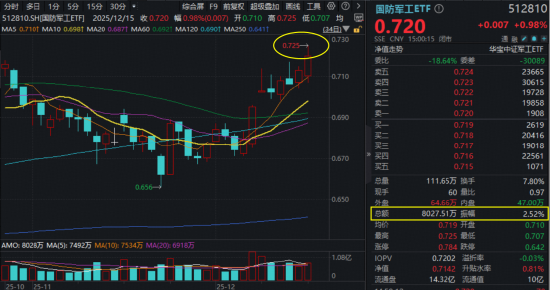
Core Viewpoint - The defense and military industry remains active despite market adjustments, with significant interest in commercial aerospace, satellite internet, and military modernization themes, as evidenced by the performance of the defense military ETF (512810) reaching a two-month high [1][9]. Group 1: Market Performance - The defense military ETF (512810) saw an intraday increase of 1.54%, closing up 0.98% with a trading volume of 80.28 million yuan, indicating a strong upward trend since December [1][9]. - The defense military sector attracted a net inflow of 6.181 billion yuan, leading among 31 first-tier industries, with a total of 19.778 billion yuan accumulated over the past five days [3][11]. Group 2: Key Stocks and Index Changes - Notable stocks within the defense military ETF include Zhenlei Technology, which surged 12.07% to a historical high, and Aerospace Electronics, which hit the daily limit, alongside other stocks like Fushun Special Steel and Shanghai Hanyun reaching historical highs [3][11]. - The index for the defense military ETF underwent a rebalancing on December 15, 2025, adding five new stocks and removing four, resulting in a total of 80 constituent stocks. The new additions have a combined market capitalization exceeding 72.4 billion yuan, enhancing the index's leading attributes [5][14]. Group 3: Industry Trends and Future Outlook - Analysts highlight the spillover of advanced military technology into civilian sectors, fostering new industries such as commercial aerospace and low-altitude economy, which could drive the development of new materials and technologies, creating a positive feedback loop for the defense industry [5][13]. - The Ministry of Industry and Information Technology emphasized accelerating the development of satellite internet, while SpaceX is reportedly preparing for a potential IPO in 2026 with an estimated valuation of 800 billion dollars [4][12].