建发股份

Search documents
2025楼市前高后低,业内预计调整四年后已逐步企稳
Di Yi Cai Jing· 2026-01-01 06:00
Core Viewpoint - The real estate industry has shown signs of stabilization and recovery in 2025 after a prolonged adjustment period since the second half of 2021, with policies shifting from "support and relief" to boosting confidence and activating housing demand [1] Group 1: Market Performance - In 2025, the total sales area of commercial housing is expected to be approximately 890 million square meters, with a sales amount of 8.4 trillion yuan, reflecting a narrowing decline compared to the previous year [1] - The fourth quarter saw a quarter-on-quarter increase of 4% in new housing transaction area across 100 cities, with December experiencing a significant 18% increase [1][5] - The second-hand housing market has become a major battleground, with a total transaction area of approximately 214 million square meters in 30 key cities, surpassing new housing transactions by 1.85 times, marking a slight year-on-year increase of 0.2% [7] Group 2: Policy Changes - The main policy direction in 2025 focused on clearing restrictive measures and promoting housing demand, with over 560 policy measures introduced across more than 210 provinces and cities [2] - Key measures included optimizing public housing fund loans, increasing home purchase subsidies, and reducing housing transaction taxes to lower costs and stimulate demand [2] - Beijing's new policies further relaxed restrictions on home purchases and loans, setting a precedent for other cities to follow suit in removing unreasonable limitations [2] Group 3: Market Dynamics - The new housing market has seen a significant decline in overall transaction volume, dropping nearly 50% from the peak in 2021, with only ten companies achieving sales exceeding 100 billion yuan by the end of 2025 [6] - The demand for larger homes has increased, with over 30% of new home transactions in 2025 being for units larger than 120 square meters [5] - The second-hand housing market has shown a clear recovery trend, with major cities like Beijing and Shanghai seeing significant increases in high-value transactions [8] Group 4: Future Outlook - The real estate market is expected to enter a phase of "weak recovery, gradual balance, and deep differentiation" in 2026, with ongoing efforts to address structural inventory issues and stabilize market confidence [12] - The government is likely to continue implementing targeted policies to stimulate demand, particularly in areas such as urban village renovations and support for low-income homebuyers [11] - The overall housing demand in urban areas is projected to be around 4.98 billion square meters during the "14th Five-Year Plan" period, indicating potential for future growth in the real estate sector [11]
A股2025市值增长九强省盘点:福建省新能源产业链市值领跑 紫金矿业、宁德时代贡献50%市值增量
Xin Lang Cai Jing· 2025-12-31 09:49
2025年,福建省A股上市公司市值增量为20048亿元,较年初市值增长54.10%。 其中,紫金矿业、宁德时代、华电新能为市值增长的核心驱动,其年内贡献的市值增量分别为5147亿 元、5047亿元、2624亿元,占全省市值增量的25.67%、25.18%、13.09%。而TOP5的其余两家企业,即 兴业银行、航天发展,市值增量均未超过500亿元,全省市值增长贡献率未超过3%。 福建省市值缩量最为严重的企业为片仔癀、永辉超市、星宸科技、建发股份、亿联网络,但其市值降幅 均未超过300亿元。 新浪合作大平台期货开户 安全快捷有保障 2025年,福建省A股上市公司市值增量为20048亿元,较年初市值增长54.10%。 其中,紫金矿业、宁德时代、华电新能为市值增长的核心驱动,其年内贡献的市值增量分别为5147亿 元、5047亿元、2624亿元,占全省市值增量的25.67%、25.18%、13.09%。而TOP5的其余两家企业,即 兴业银行、航天发展,市值增量均未超过500亿元,全省市值增长贡献率未超过3%。 福建省市值缩量最为严重的企业为片仔癀、永辉超市、星宸科技、建发股份、亿联网络,但其市值降幅 均未超过300亿元 ...



北京卖地,费尽心思
Sou Hu Cai Jing· 2025-12-31 07:11
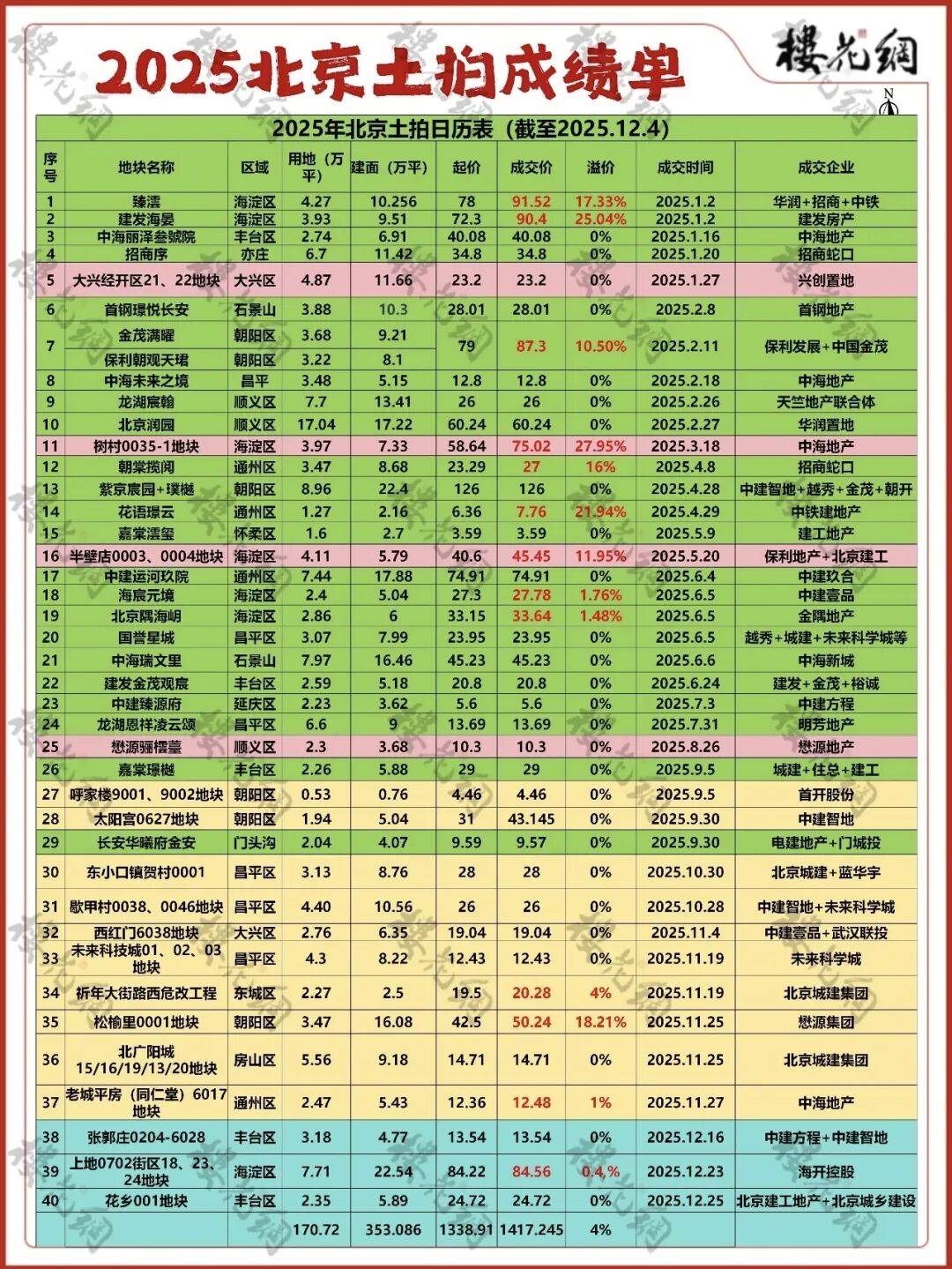
Core Insights - The Beijing land auction market in 2025 experienced significant changes, including land type adjustments, last-minute modifications, and various strategies to attract bidders, resulting in a total of 40 residential land transactions generating 142.7 billion yuan, a year-on-year decline of 8.17% [44][47]. Group 1: Land Auction Dynamics - The land auction market in Beijing is characterized by a variety of strategies, including "fat and thin" combinations to facilitate the sale of commercial land alongside residential plots [9][10]. - The introduction of new land parcels often involves last-minute changes, such as the replacement of residential plots with commercial ones, which can impact the bidding process [4][11]. - The trend of combining residential and commercial land parcels has been noted, with examples from various districts, indicating a shift in land use strategy [18][22]. Group 2: Land Characteristics and Changes - Specific land parcels have undergone significant changes in their characteristics, such as adjustments in land area, building height limits, and usage types, which can affect their marketability [6][29]. - The total area for a new land parcel in Shunyi New National Exhibition is 59,700 square meters, with a planned above-ground construction area of 128,600 square meters, where residential use accounts for 64% and commercial use for 36% [6][7]. - The practice of adjusting land use types has been prevalent, with some parcels transitioning from industrial to residential use, reflecting a strategic response to market demands [37][40]. Group 3: Market Trends and Future Outlook - The 2025 land auction market has shown a tendency towards uncertainty, with various methods employed to sell land, including adjustments in regulations and land types [44][45]. - The overall performance of the land auction market in 2025 was less favorable compared to 2024, indicating potential challenges ahead for developers and investors [47]. - The hope for 2026 is to see a reduction in the complexity of land auction strategies, which could restore confidence in the market [47].

房地产行业点评报告:增值税税率下调,二手房交易税负成本下降
KAIYUAN SECURITIES· 2025-12-31 03:45
Investment Rating - The industry investment rating is "Overweight" (maintained) [1] Core Insights - The report highlights a recent policy change where the value-added tax (VAT) rate for housing sold within two years has been reduced from 5% to 3%, effective January 1, 2026. This aims to lower transaction costs and stimulate the second-hand housing market [5][6] - The report notes a significant decline in second-hand housing transaction volumes in major cities during the fourth quarter of 2025, with year-on-year decreases of 24.9% in Beijing, 19.4% in Shanghai, and 30.8% in Shenzhen for October-November [7][11][14] - The adjustment in VAT is expected to stabilize market expectations and promote overall recovery in the real estate sector, with specific recommendations for companies that are well-positioned to benefit from these changes [8] Summary by Sections Policy Changes - The VAT rate for housing sold within two years is reduced to 3%, while sales of properties held for two years or more remain exempt from VAT. This change is projected to save approximately 9.25 million yuan in VAT for a property priced at 5 million yuan [5][6] Market Trends - The report indicates a notable drop in second-hand housing transactions in major cities, with cumulative year-on-year increases of 11.0%, 18.5%, and 28.7% for the first nine months of 2025, followed by significant declines in October and November [7][11][14] Investment Recommendations - The report recommends focusing on companies with strong fundamentals and the ability to cater to improving customer demands, such as Greentown China, China Overseas Land & Investment, and China Resources Land. It also suggests companies that benefit from both residential and commercial real estate recovery, as well as high-quality property management firms [8]


三亚中央商务区积极探索、主动作为,推动园区党建工作走深走实
Hai Nan Ri Bao· 2025-12-31 02:08
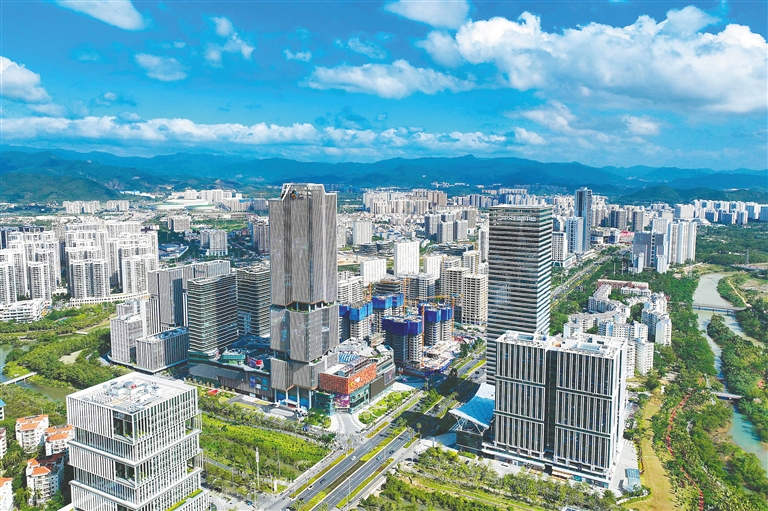
Core Viewpoint - The Sanya Central Business District (CBD) is actively exploring and implementing high-quality party building to drive high-quality development in the park [2][3][7]. Group 1: Development and Achievements - The Sanya CBD has established itself as a modern financial industry cluster, with 31 Fortune Global 500 companies, 51 Chinese Fortune 500 companies, and 242 foreign enterprises registered [2][3]. - In the first week of the Hainan Free Trade Port's closure, the park saw a 24.4% year-on-year increase in newly registered enterprises [2]. - The park has successfully launched various initiatives, including the first international cruise voyages and the establishment of the first foreign art gallery and auction house in Sanya [2][3]. Group 2: Party Building Initiatives - The Sanya CBD management has initiated a brand-building campaign for party building, creating a system that includes five major actions: organizational strengthening, industry enhancement, enterprise service, talent development, and work style construction [3][7]. - A total of 16 sub-brands have been developed under the party building initiative, aimed at enhancing project construction and investment attraction [3][7]. - The party organization has expanded from 2 to 26, covering various types of institutions and enterprises, thus enhancing its role in the Hainan Free Trade Port construction [8]. Group 3: Economic Growth Projections - By 2025, the park anticipates a 12% increase in revenue, a 27% increase in tax revenue, an 18% increase in investment, a 57% increase in service trade, and a 38% increase in goods trade [12]. Group 4: Talent Development and Support - The Sanya CBD is focusing on talent recruitment and development, establishing a three-pronged approach that includes policy-driven talent attraction, platform-based talent gathering, and internal talent development [17][19]. - The park has created a supportive environment for talent, including the establishment of innovation and entrepreneurship incubation bases and streamlined services for foreign talent [19]. Group 5: Service Optimization - The management has launched initiatives like "Warm-hearted Enterprises, Service to Home" to address business challenges and improve the overall business environment [13][16]. - A comprehensive service system has been established, including a service window for enterprises and a detailed service checklist, resulting in the efficient handling of over 720 business-related tasks this year [14][16].
个人销售住房增值税新政点评:下调增值税率盘活交易链,期待后续需求端政策发力
Shenwan Hongyuan Securities· 2025-12-31 01:43
Investment Rating - The report maintains an "Overweight" rating for the real estate and property management sectors, indicating a positive outlook for the industry [4]. Core Insights - The recent policy change on the value-added tax (VAT) for personal housing sales, reducing the rate from 5% to 3% for properties sold within two years, aims to lower seller transaction costs and help restore the transaction chain [2][4]. - The real estate industry has undergone significant adjustments since 2021, with front-end indicators (sales, land acquisition, and construction) declining by 50-70%, and back-end indicators (completion and investment) dropping by 30-40% [4]. - The cumulative decline in second-hand housing prices from July 2021 to September 2025 is 37%, surpassing the average decline of 34% across 42 countries [4]. - The report emphasizes the need for policies to support demand-side recovery to stabilize the market, particularly in core cities [4]. Summary by Sections Policy Changes - The new VAT policy effective from January 1, 2026, will exempt individuals from paying VAT on properties sold after two years of purchase, while those selling within two years will pay a reduced rate of 3% [5]. Market Analysis - The report highlights the critical need for repairing household balance sheets to address the ongoing challenges in the real estate market, with expectations for further supportive policies to stabilize the market [4]. - Anticipated policy measures include reductions in mortgage rates, optimization of purchase restrictions and taxes in first-tier cities, accelerated land acquisition, and support for real estate financing [4]. Investment Opportunities - The report identifies two key investment opportunities: the revaluation of quality commercial real estate and the emergence of strong product capabilities in core cities [4]. - Recommended companies for investment include: 1. Commercial real estate: China Resources Land, New World Development, Kerry Properties, Hang Lung Properties, Longfor Group, with a focus on Swire Properties and New World Development. 2. Quality housing companies: Jianfa International, Binjiang Group, Greentown China, and China Jinmao. 3. Undervalued recovery companies: Jianfa Shares, China Merchants Shekou, Yuexiu Property, China Overseas Development, and Poly Developments. 4. Property management: China Resources Vientiane, Greentown Services, China Merchants Jinling, Poly Property, and China Overseas Property. 5. Second-hand housing intermediaries: Beike-W [4].


申万宏源证券晨会报告-20251231
Shenwan Hongyuan Securities· 2025-12-31 00:45
Group 1: China Ping An (601318) - The insurance sector is expected to undergo a value reassessment, with China Ping An demonstrating significant advantages in managing liability costs and outperforming peers in interest spread performance. The stabilization of long-term interest rates and the ongoing entry of insurance funds into the market indicate a clear trend of asset improvement, suggesting that the insurance sector will benefit from this reassessment [3][13]. - Investment analysis suggests an upward revision of profit forecasts, maintaining a "buy" rating. The projected net profit for 2025-2027 is adjusted to 146.8 billion, 161.2 billion, and 188 billion RMB, respectively, with a target price of 93.8 RMB per share, corresponding to a P/EV of 0.99x for 2026 [3][13]. - The company has a high dividend yield, with a focus on shareholder returns, and is expected to see a recovery in OPAT growth in 2026. The public fund's holding in China Ping An is below the weight of the CSI 300, indicating potential for increased capital inflow [3][13]. Group 2: 37 Interactive Entertainment (002555) - The company has demonstrated strong operational capabilities through strategic transformations over the years, maintaining a stable management team and timely adjustments to its systems. The gaming pipeline is expected to validate its product offerings in 2025 [12][15]. - The revenue forecast for 2025-2027 is adjusted to 16.2 billion, 18.6 billion, and 20.9 billion RMB, with net profit estimates of 3.22 billion, 3.54 billion, and 3.81 billion RMB, respectively. The current price corresponds to a PE of 15/14x for 2026-2027 [12][15]. - The company is actively integrating AI into its production and content innovation, with a focus on expanding its product pipeline in the gaming sector, particularly in the SLG and casual gaming markets [12][15]. Group 3: Baidu Group (09888) - Baidu is advancing its AI stack, with significant growth in its intelligent cloud business. The company has released new AI chips and models, positioning itself as a leader in the AI large model solution market [14][15]. - Revenue projections for Baidu from 2025 to 2027 are set at 128.5 billion, 133.1 billion, and 141 billion RMB, with corresponding growth rates of -3%, 4%, and 6%. The target valuation for the group is 430.2 billion RMB, with a target price of 172.54 HKD per share [14][15]. - The company is also seeing substantial growth in its autonomous driving segment, with a significant increase in order volume and profitability, indicating a strong market position in the next-generation mobility space [14][15]. Group 4: Real Estate Industry - The real estate sector has experienced significant adjustments, with a focus on repairing household balance sheets as a key to recovery. The government is expected to introduce further supportive policies to stabilize the market [18][22]. - The recent reduction in the value-added tax for housing sales is aimed at lowering transaction costs for sellers, which may help restore the transaction chain, although the overall impact on demand remains limited [18][20]. - Investment recommendations include focusing on commercial real estate and high-quality housing companies, with expectations of value reassessment in the sector as supportive policies are anticipated [18][22]. Group 5: Electric Vehicle Industry - The continuation of subsidies for electric vehicles in 2026 is expected to enhance the penetration rate of electric vehicles, with specific measures aimed at promoting the replacement of old vehicles and supporting the electrification of public transport [24][25]. - The policy changes reflect a commitment to boosting consumer demand for electric vehicles, with expectations of strong sales growth in the coming year [24][25]. - Investment opportunities are highlighted in battery manufacturers and material suppliers, with a focus on the long-term growth potential of the electric vehicle market [24][25].



中国房地产月度跟踪报告_11 月数据进一步恶化;2026 年或仍面临挑战-China Property-Monthly Tracker November Data Deteriorated Further; 2026 may Stay Challenging
2025-12-30 14:41
December 29, 2025 08:33 AM GMT China Property | Asia Pacific Monthly Tracker: November Data Deteriorated Further; 2026 may Stay Challenging Home sales saw deeper declines in November with faster price drops. We expect the physical market to stay challenging in 2026 given fast-worsening residential sentiment, higher inventory, reactive policy and a high base. We reiterate our suggestion to stick with quality SOEs with high alpha visibility. Seize the alpha: We expect further share-price divergence between th ...
交通运输行业2026年投资策略:周期拐点渐显
Dongguan Securities· 2025-12-30 09:08
Investment Strategy Overview - The transportation industry is closely linked to the macroeconomic environment, with a weak overall performance in 2025, underperforming the CSI 300 index. Key segments like railways and highways have weakened due to style shifts, while logistics, aviation, and shipping have seen some support in the second half of the year from anti-involution and external demand factors, but still lag behind the market index. Looking ahead to 2026, domestic demand is expected to improve driven by anti-involution and major infrastructure projects, with recommendations to focus on (1) improved domestic express delivery competition and benefiting bulk supply chains from upstream price recovery, (2) growth in business and leisure demand potentially returning aviation airports to profitability, and (3) the high prosperity cycle of oil transportation [5][72]. 2025 Review - The transportation industry index showed a stable performance, with a cumulative increase of 1.55% as of December 29, 2025, but underperformed the CSI 300 index. The performance of sub-sectors varied, with aviation airports, shipping ports, railways, and logistics showing cumulative changes of 9.74%, 6.56%, -12.86%, and 6.34% respectively, all underperforming the CSI 300 index [13][14]. Aviation Sector - The aviation supply-demand landscape continues to improve, with aircraft utilization recovering to high levels. Domestic civil aviation demand has been steadily increasing, with passenger volume reaching new highs in the second half of 2025. The average daily utilization of aircraft in China was 8.7 hours as of November 2025, nearing pre-pandemic levels [18][21]. - The average ticket price has stabilized, with a peak passenger load factor of 87.5% in August 2025. The market supply-demand situation is tight, and further tightening could boost ticket prices [23][24]. - The supply side faces challenges with aircraft manufacturers struggling to restore production capacity, with Boeing and Airbus delivering significantly fewer aircraft than pre-pandemic levels. As of 2024, Boeing delivered 348 commercial aircraft, while Airbus delivered 766, both below their respective 2019 levels [25][26]. - The demand side is supported by policy initiatives that have revitalized business activities, with business line passenger volume increasing year-on-year in the first eight months of 2025 [34][36]. - Cost pressures are alleviated by declining oil prices, with WTI futures at $56.74 per barrel as of December 26, 2025, down 54.13% from peak levels. The strengthening of the RMB also reduces dollar-denominated debt burdens for airlines [40][43]. Oil Transportation Sector - The oil transportation industry is currently in a high prosperity cycle, with oil prices influenced by demand fluctuations and unexpected events. The BDTI index has seen an uptick, indicating potential for improved industry conditions [46][47]. - Short-term demand is driven by significant U.S. strategic petroleum reserve replenishment needs, while long-term demand is expected to stabilize globally. The IEA forecasts a growth of 2.5 million barrels per day in global oil demand from 2024 to 2030 [49][51]. - The supply side is characterized by tight compliance capacity, with sanctions on shadow fleets leading to a reduction in compliant shipping capacity. This is expected to gradually elevate oil transportation rates [56][57]. Bulk Supply Chain Sector - The bulk supply chain sector is transitioning from traditional trading and logistics models to integrated service provider models, enhancing resource control and operational efficiency. Leading companies are learning from international experiences to improve their market positions [60][63]. - The sector is currently fragmented, with a low market share for leading firms (CR5 at around 5%). As domestic companies consolidate, there is potential for increased market share and profitability [63][64]. - The anti-involution trend is expected to stabilize the PPI, benefiting bulk supply chains as they recover from price declines. The sector is poised to benefit from price rebounds and improved demand conditions [65][66]. Investment Recommendations - Maintain a market-weight rating for the transportation industry, with a focus on improving domestic demand and sector recovery in 2026. Recommended stocks include China National Aviation (601111), Southern Airlines (600029), and Xiamen Xiangyu (600057) [72][74].





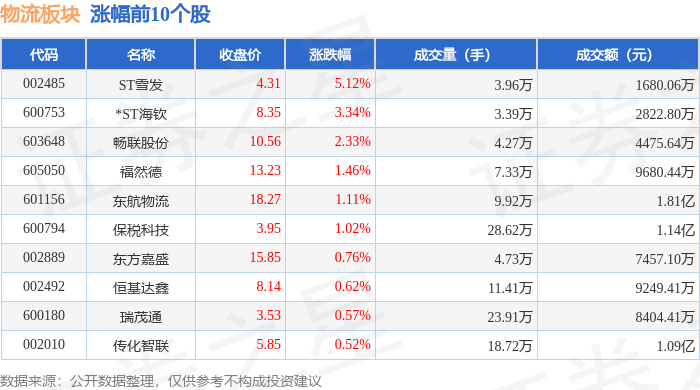
物流板块12月30日涨0.04%,ST雪发领涨,主力资金净流出5.31亿元
Zheng Xing Xing Ye Ri Bao· 2025-12-30 09:00
Core Viewpoint - The logistics sector experienced a slight increase of 0.04% on December 30, with ST Xuefa leading the gains, while the overall market showed mixed results with the Shanghai Composite Index closing at 3965.12, down 0.0% [1]. Group 1: Market Performance - The logistics sector's performance was highlighted by ST Xuefa, which closed at 4.31 with a gain of 5.12% [1]. - Other notable gainers included *ST Haijin, which rose by 3.34% to 8.35, and Changlian Co., which increased by 2.33% to 10.56 [1]. - The Shenzhen Component Index closed at 13604.07, reflecting an increase of 0.49% [1]. Group 2: Trading Volume and Value - ST Xuefa had a trading volume of 39,600 shares and a transaction value of approximately 16.80 million [1]. - The highest transaction value in the logistics sector was recorded by Donghang Logistics, with a closing price of 18.27 and a transaction value of 181 million [1]. - The overall trading volume and value for the logistics sector showed varied performance across different stocks, with some stocks like Baoshui Technology and Donghang Logistics achieving significant transaction values [1]. Group 3: Capital Flow - The logistics sector saw a net outflow of 531 million from institutional investors, while retail investors contributed a net inflow of 507 million [2]. - The data indicates that retail investors were more active in the logistics sector, contrasting with the outflow from institutional investors [2]. - Specific stocks like YTO Express and Baoshui Technology experienced varying levels of net inflow and outflow from different investor categories [3].