东方财富

Search documents
东方财富策略陈果团队:产业主题与涨价链共舞下的春季行情
Xin Lang Cai Jing· 2026-01-25 12:06
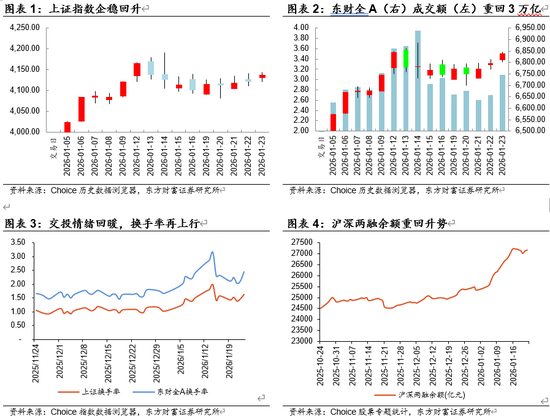
Core Viewpoint - The A-share market has shown a rebound in trading activity, with transaction volume exceeding 3 trillion yuan, indicating strong internal confidence and capital inflow amidst domestic asset scarcity and expectations of RMB appreciation [1][29]. Market Structure and Trends - The market structure has shifted compared to late last year and early this year, with increased activity in the real estate chain, resource products, and price increase chains, reflecting the inflow of medium to low-risk preference capital [1][6][39]. - Recent signals of expanding domestic demand policies have emerged, with expectations of policy enhancements, particularly in real estate prices, infrastructure investment, and service consumption, which are key areas of focus for medium to low-risk preference capital [1][39]. - The expansion of cyclical stocks indicates rising market confidence in re-inflation, with performance spreading from non-ferrous metals to chemicals, building materials, and coal, suggesting strong confidence in the PPI recovery trend this year [1][11][42]. Sector Performance - The small-cap stocks have outperformed large-cap stocks, with indices like the CSI 500 and CSI 1000 showing significant gains of 4.34% and 4.04% respectively, indicating increased participation and liquidity support for small-cap stocks [5][35]. - The real estate chain and cyclical resource products have benefited from warming policy expectations and re-inflation, with recent policy announcements aimed at reversing funding dilemmas in the real estate sector [39][42]. - The communication sector has faced declines, raising concerns about the sustainability of previously favored stocks, as institutional holdings in this sector have not consistently yielded excess returns [19][44]. Investment Focus - Key sectors to watch include semiconductors, non-ferrous metals, computing, media, chemicals, and military industries, with themes such as commercial aerospace, AI applications, robotics, controllable nuclear fusion, intelligent driving, and innovative pharmaceuticals being highlighted [31][37]. - The price increase chain remains a significant investment focus, particularly in areas experiencing supply-demand mismatches, such as AI hardware and upstream raw materials like lithium carbonate and PTA [20][21][23].


4倍大牛股,停牌核查!
Zhong Guo Ji Jin Bao· 2026-01-25 10:36
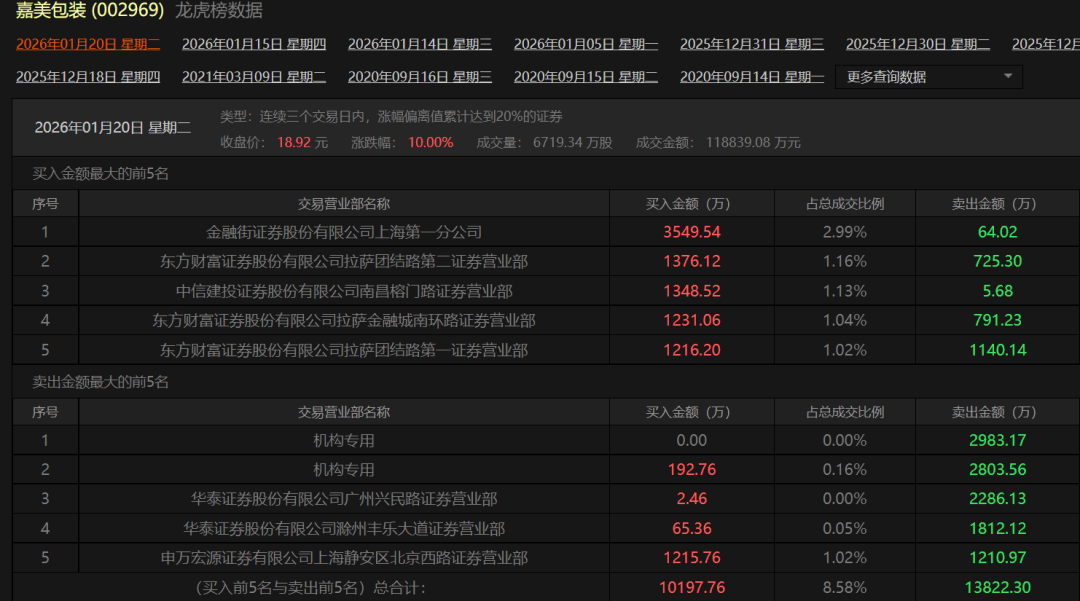
Core Viewpoint - Jia Mei Packaging plans to suspend trading for verification starting January 26, 2026, after its stock price surged over 4 times, indicating a significant deviation from its fundamentals [1][2]. Group 1: Stock Performance and Market Reaction - From December 17, 2025, to January 23, 2026, Jia Mei Packaging's stock price increased by 408.11%, while its industry sector rose by 18.11% and the overall market increased by 11.81% [3]. - As of January 23, 2026, the stock price closed at 23.17 CNY per share, with a market capitalization of 24.3 billion CNY [1]. - The company's static price-to-earnings (P/E) ratio was 132.58, significantly higher than the industry average of 44.61, indicating potential irrational market speculation [2]. Group 2: Ownership Change and Future Outlook - The controlling shareholder of Jia Mei Packaging will change to Suzhou Zhuyue Hongzhi Technology Development Partnership, with Yu Hao, the founder and CEO of Chasing Technology, becoming the actual controller [1][5]. - The acquisition process is currently in the public notice period, with no substantial progress reported, and there are risks associated with the approval of acquisition loans [5][6]. - The company expects no significant changes in its main business over the next 12 months, focusing on the research, design, production, and sales of food and beverage packaging containers [6]. Group 3: Financial Performance - Jia Mei Packaging anticipates a net profit attributable to shareholders of 85.44 million to 104 million CNY for 2025, representing a year-on-year decline of 53.38% to 43.02% [6][9]. - The net profit after deducting non-recurring gains and losses is projected to decrease by 58.10% compared to the previous year [9].

金融行业周报(2026、01、25):业绩比较基准新规正式落地,坚定保险中长期向好逻辑-20260125
Western Securities· 2026-01-25 10:30
Investment Rating - The report maintains a positive long-term outlook for the insurance sector, indicating a strong continuity in market performance despite recent fluctuations [2][12][16]. Core Insights - The financial sector experienced a mixed performance this week, with the non-bank financial index down by 1.45%, underperforming the CSI 300 index by 0.83 percentage points. The insurance sector saw a decline of 4.02%, while the brokerage sector decreased by 0.61% [1][10]. - The insurance sector's performance is driven by two main factors: policy support leading to economic recovery and liquidity easing combined with a strong stock market. The report suggests a shift from liquidity-driven growth to a focus on macro policy support and economic recovery expectations [2][13][16]. - The brokerage sector is expected to benefit from new regulations that enhance investment management quality, with a recommendation to focus on larger, undervalued firms and those involved in mergers and acquisitions [3][18]. - The banking sector is facing a slight decline, but there are signs of recovery in profitability for leading banks, with recommendations to focus on banks with high dividend yields and those expected to benefit from market conditions [19][21]. Summary by Sections Insurance Sector - The insurance sector's recent decline is attributed to short-term market sentiment and liquidity changes, but the long-term outlook remains positive due to strong support from both the liability and asset sides [2][12][16]. - Key recommendations include focusing on companies like China Pacific Insurance, China Ping An, China Life (H), and China Taiping, with a specific recommendation for New China Life [4][16]. Brokerage Sector - The brokerage sector's performance is slightly better than the overall market, with a focus on the new guidelines from the regulatory body that aim to improve fund management quality [3][17]. - Recommended firms include Guotai Junan, Huatai Securities, and others, particularly those with strong merger and acquisition prospects [4][18]. Banking Sector - The banking sector has shown a decline but is expected to stabilize, with recommendations to focus on banks with high earnings elasticity and strong dividend yields [19][21]. - Specific banks to watch include Hangzhou Bank, Ningbo Bank, and others, with a focus on those that have previously been undervalued [4][21].




券商App涌现“保险专区”,一线员工已被下派保险销售任务
Nan Fang Du Shi Bao· 2026-01-25 04:49
Core Viewpoint - The recent launch of dedicated insurance sections in the apps of major securities firms marks a significant shift in wealth management strategies, indicating a new phase in the competition among brokerages [2][3][10]. Group 1: Launch of Insurance Sections - Major securities firms such as CITIC Securities, Ping An Securities, and China Merchants Securities have introduced "insurance sections" in their official apps, reflecting a growing focus on insurance products [3][5]. - CITIC Securities' app now features 20 insurance products, including health insurance, life insurance, and annuities, while Ping An Securities offers a wide range of products including health, accident, and pet insurance [3][5]. - The insurance sections are designed to enhance the user experience and provide a comprehensive suite of financial products [2][3]. Group 2: Sales Performance and KPIs - Several brokerage branches in Shenzhen have been assigned specific sales KPIs for insurance products, indicating a push for performance in this new area [9][10]. - Sales targets for individual employees range from 100,000 to 500,000 yuan, but many employees report difficulties in meeting these targets [9][10]. Group 3: Market Context and Expert Insights - The push for insurance product sales by brokerages is seen as a response to the cyclical nature of their traditional revenue streams, with insurance providing a more stable income source [10][12]. - Experts suggest that the integration of insurance products can enhance customer loyalty and lifetime value, positioning brokerages as comprehensive wealth managers rather than just investment advisors [12][14]. - The recent regulatory environment has facilitated this shift, allowing brokerages to expand their offerings and better meet diverse investor needs [11][12]. Group 4: Competitive Landscape - Traditionally, banks have dominated the insurance agency space, but brokerages are leveraging their unique client base, which is more familiar with capital markets, to sell investment-linked insurance products [13][14]. - While brokerages face challenges such as a lack of insurance expertise and service infrastructure, their entry into the insurance market is expected to stimulate innovation and competition within the industry [13][14].


长江红利回报混合型发起式A:2025年第四季度利润162.16万元 净值增长率2%
Sou Hu Cai Jing· 2026-01-24 08:32
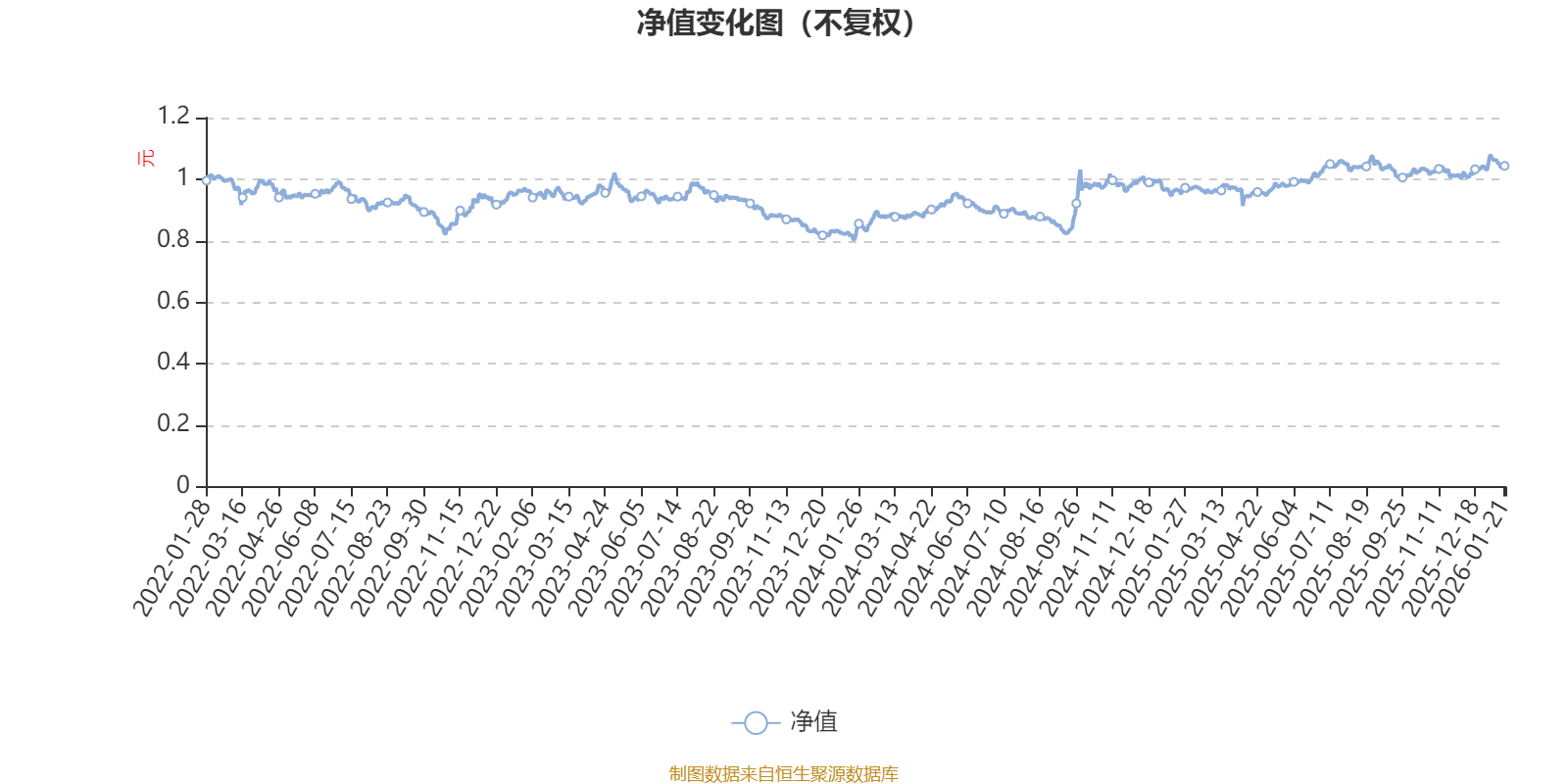
AI基金长江红利回报混合型发起式A(013934)披露2025年四季报,第四季度基金利润162.16万元,加权平均基金份额本期利润0.0212元。报告期内,基金 净值增长率为2%,截至四季度末,基金规模为7130.96万元。 该基金属于偏股混合型基金。截至1月21日,单位净值为1.043元。基金经理是徐婕,目前管理的3只基金近一年均为正收益。其中,截至1月21日,长江均衡 成长混合A近一年复权单位净值增长率最高,达29.31%;长江添利混合A最低,为3.34%。 基金管理人在四季报中表示,本基金在四季度坚守红利策略,继续持有现金流充沛、分红稳定且估值处于低位的优质个股,取得了一定超额收益。展望 2026 年,市场有望从"估值修复"转向"业绩驱动",红利资产的高股息率优势依然显著,是资产配置中不可或缺的"压舱石"。下一阶段本基金将继续在保持较 高仓位的同时,深入挖掘红利资产的新机会,以期在复杂的市场环境中实现中长期平稳回报。 截至1月21日,长江红利回报混合型发起式A近三个月复权单位净值增长率为1.81%,位于同类可比基金535/621;近半年复权单位净值增长率为-0.67%,位于 同类可比基金608/621; ...
AI应用的“妖风”还能吹多久?
投中网· 2026-01-24 07:36
Core Viewpoint - The article discusses the volatility and potential of AI application stocks, highlighting the recent surge and subsequent decline in their prices, emphasizing the need for logical investment rather than speculative trading [4][5][7]. Group 1: AI Application Market Dynamics - The AI application market experienced a significant surge starting January 9, driven by the IPO of MiniMax, which saw a price increase of over 90%, boosting market confidence in AI commercialization [5]. - Following the initial excitement, many AI application companies issued announcements clarifying their limited revenue from AI, leading to a sharp price correction in the sector [7]. - The article suggests that while the AI application sector is currently volatile, it has the potential to create long-term value if investors can identify companies with genuine business models and revenue streams [9]. Group 2: GEO Model in Advertising - The article introduces the GEO (Generative Engine Optimization) model, which allows users to input specific demands and receive optimized product recommendations directly from AI, streamlining the purchasing process [11]. - The GEO market is projected to grow significantly, with estimates of $2.9 billion in China and $11.2 billion globally by 2025, and reaching $24 billion and $100.7 billion by 2030 respectively [13]. - GEO is seen as a transformative force in marketing, shifting the power dynamics towards platforms that can leverage AI models effectively, similar to how Google and Baidu dominated the SEO era [16][17]. Group 3: AI in Healthcare - The AI healthcare sector has shown strong performance, with companies like Hongbo Medicine and Dian Diagnostics seeing stock increases of over 50% year-to-date [28]. - Government policies are increasingly supportive of AI in healthcare, with initiatives aimed at integrating AI into high-end medical equipment and remote healthcare applications [30]. - The article notes that AI healthcare applications are moving from concept to clinical use, with companies like Tempus AI reporting an 83% revenue growth, indicating a positive trend for domestic firms in the sector [31]. Group 4: AI in Financial Technology - The financial technology sector has also seen a rise, with the Financial Technology ETF increasing by over 14% since the beginning of 2026 [46]. - AI is expected to enhance the capabilities of internet financial companies by improving customer engagement and operational efficiency through advanced tools [48]. - However, the article cautions that while AI can improve operational efficiency, it may not fundamentally change the poor business models of many financial IT companies, which face challenges such as high customization costs and fragmented market share [49].

非银行业月报:金融行业:多项监管法规首次出台,夯实非银行业长期业绩根基
金融街证券· 2026-01-23 13:30
Investment Rating - The report provides a positive outlook on the non-banking financial sector, indicating a strong performance and potential for continued growth in the coming years [1][2]. Core Insights - The report highlights the introduction of multiple regulatory frameworks aimed at strengthening the long-term performance of the non-banking sector, which is expected to enhance the overall stability and growth prospects of the industry [1][39]. - The insurance market is expanding steadily, with significant growth in premium income and investment returns, indicating a robust recovery and potential for further development [7][58]. - The report emphasizes the performance of various non-banking sectors, with insurance leading the growth, followed by diversified finance and securities [22][58]. Summary by Sections Regulatory Dynamics - The China Banking and Insurance Regulatory Commission (CBIRC) has introduced several new regulations, including adjustments to risk factors for insurance companies and management guidelines for financial leasing companies, aimed at enhancing regulatory efficiency and promoting high-quality development in the non-banking sector [3][39]. - New regulations also include the asset-liability management guidelines for insurance companies and the information disclosure management for asset management products, which are expected to improve transparency and investor protection [40][43]. Industry Dynamics - The non-banking sector has shown varied performance, with the insurance sector achieving a premium income of CNY 5.76 trillion, a year-on-year increase of 7.56% [58]. - The report notes that the A-share market's average daily trading volume reached CNY 10,768 billion, reflecting a year-on-year growth of 53.24%, although there was a slight decline in trading activity towards the end of the year [10][64]. Market Performance - In December 2025, the non-banking index rose by 6.31%, outperforming major indices, with insurance stocks showing the highest gains at 14.59% [19][22]. - The report identifies key ETFs in the non-banking sector, highlighting strong performance in the securities insurance ETFs and financial technology ETFs, which saw significant inflows [13][38]. Investment Opportunities - The report recommends focusing on the valuation recovery logic in the non-banking sector, particularly in ETFs such as the Hong Kong Stock Connect Non-Banking ETF and the Financial Technology ETF, which are expected to benefit from the positive market dynamics [13][38]. - The insurance sector's dividend yields are becoming increasingly attractive, with several companies offering yields above 3.5%, indicating a potential investment opportunity for income-focused investors [12].


重仓榜首之争:宁德仍居全市场榜首,中际旭创成主动基金第一持仓
Xin Lang Cai Jing· 2026-01-23 10:49
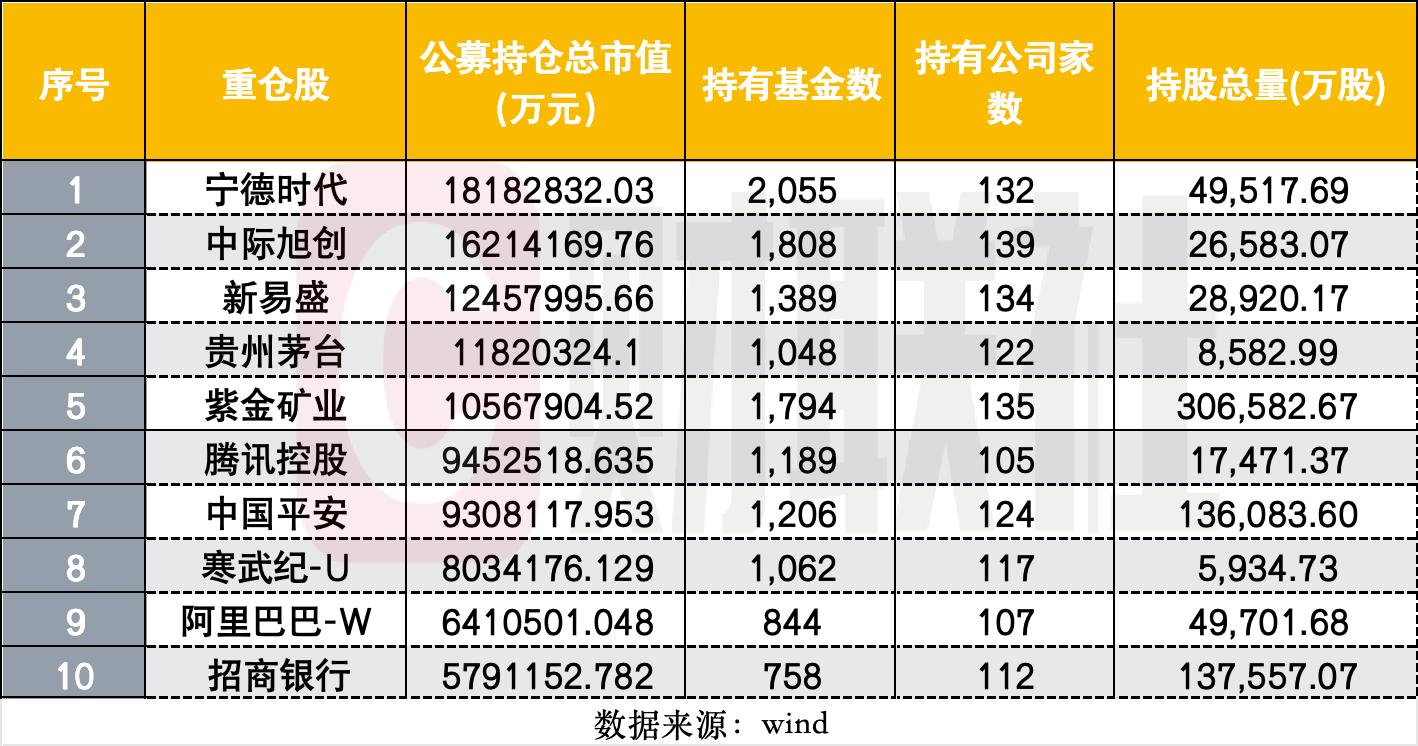
Group 1 - The core viewpoint of the article highlights the changing landscape of public fund heavyweights, with CATL maintaining its top position while Zhongji Xuchuang rapidly closes the gap [1][6] - As of the end of 2025, CATL holds a total market value of 181.83 billion yuan, while Zhongji Xuchuang has reached 162.14 billion yuan, significantly narrowing the gap from 96.01 billion yuan in the previous quarter [6][8] - The top ten heavyweights in public funds include CATL, Zhongji Xuchuang, Xinyi Semiconductor, Kweichow Moutai, Zijin Mining, Tencent Holdings, China Ping An, Cambricon Technologies, Alibaba-W, and China Merchants Bank, with total market values ranging from 57.91 billion yuan to 181.83 billion yuan [6][10] Group 2 - In the active fund category, Zhongji Xuchuang has overtaken CATL to become the top heavyweight, with a total market value of 82.54 billion yuan, while CATL's value is 69.18 billion yuan [3][10] - The active funds show a preference for technology and cyclical stocks, with significant increases in rankings for Xinyi Semiconductor and Zijin Mining, while Tencent Holdings and Alibaba-W have seen declines [3][12] - The top ten heavyweights in active funds include Zhongji Xuchuang, CATL, Xinyi Semiconductor, Tencent Holdings, Zijin Mining, Alibaba-W, Cambricon Technologies, Luxshare Precision, Kweichow Moutai, and Dongshan Precision, with market values ranging from 25.61 billion yuan to 82.54 billion yuan [10][11] Group 3 - The public fund's top ten increased holdings are dominated by "Chinese-character" stocks, focusing on the financial and energy sectors, with notable increases in Industrial Bank, China Cinda, and Industrial and Commercial Bank of China [4][15] - The financial sector saw significant increases in holdings, primarily driven by broad-based ETFs, while the energy sector also experienced collective increases from dividend ETFs [4][15] - The top ten stocks with the largest reductions in holdings are concentrated in the financial, media technology, and traditional cyclical sectors, with Oriental Fortune and Focus Media being the most significantly reduced [5][16] Group 4 - In the fourth quarter, Oriental Fortune and Focus Media were the only two stocks that saw reductions exceeding 60,000 shares, indicating a consensus among institutions to withdraw from these stocks [5][16] - The reduction in Oriental Fortune was primarily driven by multiple broad-based ETFs, while Focus Media faced significant reductions from several well-known active fund managers [5][16] - The reduction list also includes Agricultural Bank of China, Nanjing Steel, and China CITIC Bank, which were primarily affected by dividend-themed ETFs [17]


AI应用的“妖风”还能吹多久?
虎嗅APP· 2026-01-23 10:16
Core Viewpoint - The article discusses the volatility and potential of AI application stocks, highlighting the recent surge and subsequent decline in their prices, emphasizing the need for logical investment rather than speculative trading [3][4][6]. Group 1: AI Application Market Dynamics - The AI application market saw a significant surge starting January 9, driven by the IPO of MiniMax, which rose over 90%, boosting market confidence in AI commercialization [3][4]. - Following the initial excitement, many AI companies issued announcements clarifying their limited revenue from AI, leading to a sharp price correction in the sector [4][5]. - The article suggests that while the current market may present opportunities, investors should focus on companies with genuine value and sustainable business models [4][7]. Group 2: GEO Model in Advertising - The article introduces the GEO (Generative Engine Optimization) model as a transformative approach in advertising, allowing users to input specific demands and receive optimized product recommendations directly from AI [9][11]. - The GEO market is projected to grow significantly, with estimates of $2.9 billion in China and $11.2 billion globally by 2025, indicating a shift from traditional SEO to AI-driven marketing strategies [11][12]. - Companies that own AI models and user behavior data are expected to be the primary beneficiaries of the GEO model, similar to how Google and Baidu benefited during the SEO era [12][13]. Group 3: AI in Healthcare - The AI healthcare sector has shown strong performance, with companies like 泓博医药 and 迪安诊断 seeing over 50% gains year-to-date, driven by increasing market interest [22][24]. - Government policies are increasingly supportive of AI in healthcare, with initiatives aimed at integrating AI into medical services and diagnostics [24][25]. - The article notes that advancements in AI healthcare applications, such as OpenAI's ChatGPT Health, are enhancing market sentiment and could lead to further growth in the sector [26][29]. Group 4: AI in Financial Technology - The financial technology sector has also experienced growth, with a 14% increase in the financial technology ETF as of January 14, 2026 [37]. - AI is expected to enhance the capabilities of both internet finance companies and financial IT firms, improving customer engagement and operational efficiency [38][39]. - However, the article cautions that while AI can improve operational efficiencies, it may not fundamentally change the poor business models prevalent in financial IT companies [40].

数据复盘丨钙钛矿电池、商业航天等概念走强 191股获主力资金净流入超1亿元




Zheng Quan Shi Bao Wang· 2026-01-23 09:56
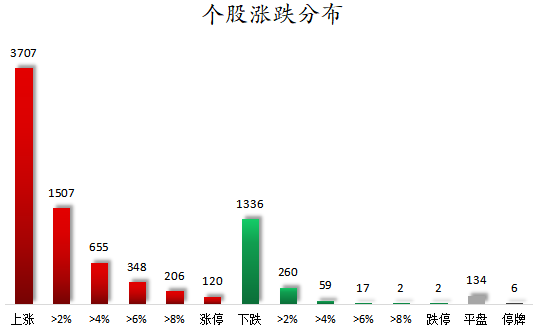
Market Overview - The Shanghai Composite Index closed at 4136.16 points, up 0.33%, with a trading volume of 1.3369 trillion yuan. The Shenzhen Component Index rose 0.79% to 14439.66 points, with a trading volume of 1.7484 trillion yuan. The ChiNext Index increased by 0.63% to 3349.50 points, with a trading volume of 822.63 billion yuan. The STAR Market 50 Index closed at 1553.71 points, up 0.78%, with a trading volume of 110.8 billion yuan. The total trading volume of both markets was 3.0853 trillion yuan, an increase of 393.5 billion yuan compared to the previous trading day [1]. Sector Performance - The market saw more sectors gaining than losing, with notable increases in power equipment, non-ferrous metals, precious metals, defense and military, steel, media, computer, environmental protection, and textile and apparel sectors. Concepts such as perovskite batteries, commercial aerospace, satellite internet, sapphire, lithium mining, cultivated diamonds, small metals, gold, and interactive short dramas were particularly active. In contrast, sectors like communication, insurance, banking, coal, and home appliances experienced declines [1]. Individual Stock Performance - A total of 3707 stocks rose, while 1336 stocks fell, with 134 stocks remaining flat and 6 stocks suspended. Excluding newly listed stocks, there were 120 stocks hitting the daily limit up and 2 stocks hitting the limit down [2]. - Among the stocks that hit the daily limit up, 23 stocks had consecutive limit-up days of 2 or more, with Fenglong Co., Ltd. leading with 18 consecutive limit-ups [3]. Capital Flow - The net capital outflow from the two markets was 4.167 billion yuan, with the ChiNext seeing a net inflow of 1.515 billion yuan. The CSI 300 index experienced a net outflow of 1.005 billion yuan, while the STAR Market saw a net outflow of 3.171 billion yuan. Out of 31 sectors, 13 sectors had net capital inflows, with the power equipment sector leading with a net inflow of 8.977 billion yuan [4][6]. - The top sectors with net inflows included non-ferrous metals (4.552 billion yuan), media (2.173 billion yuan), and defense and military (2.157 billion yuan). Conversely, the communication sector had the highest net outflow of 7.992 billion yuan, followed by electronics (6.350 billion yuan) and machinery (5.077 billion yuan) [4][6]. Notable Stocks - 191 stocks had net capital inflows exceeding 1 billion yuan, with Jin Feng Technology receiving the highest net inflow of 1.861 billion yuan. Other notable stocks included Lens Technology (1.594 billion yuan), Qian Zhao Optoelectronics (1.267 billion yuan), and Xian Dao Intelligent (1.217 billion yuan) [7][8]. - Conversely, 116 stocks experienced net capital outflows exceeding 1 billion yuan, with Xin Yi Sheng leading with a net outflow of 3.471 billion yuan, followed by Zhong Ji Xu Chuang (3.103 billion yuan) and Li Ou Shares (2.604 billion yuan) [10][11]. Institutional Activity - Institutional investors had a net selling of approximately 1.02 billion yuan, with 22 stocks seeing net purchases and 14 stocks net sales. Jin Feng Technology was the most purchased stock by institutions, with a net purchase amount of approximately 266 million yuan [13][14].