
娃哈哈

Search documents
2025年第41周:食品饮料行业周度市场观察
艾瑞咨询· 2025-10-18 00:05
Group 1: Market Trends - The trend of "light health" among young consumers reflects a shift towards flexible and fragmented health integration into daily life, with a focus on self-made health drinks and portable wellness products [2] - The pre-prepared food market in Japan emphasizes strict control over additives and a well-defined regulatory framework, which serves as a model for China to build consumer trust [3] - The mooncake market is experiencing a "healthification" trend, with low-sugar and medicinal mooncakes gaining popularity among young consumers, indicating a growing interest in traditional Chinese medicine [4] Group 2: Industry Insights - Japan's pre-prepared food industry has evolved since the 1960s, with a focus on convenience and safety, highlighting the need for clear definitions and regulations in China's pre-prepared food market [5] - The bottled water market is shifting from a "price war" to a "value war," with companies like Nongfu Spring and China Resources Beverage adapting their strategies to maintain competitiveness [6] - The bagged beverage market is rapidly growing, with various brands competing through innovative products and extensive channel distribution, indicating a significant potential for future development [7] Group 3: Company Developments - San Yuan is focusing on low-temperature fresh milk and has optimized its product structure to enhance high-end product offerings, despite a decline in revenue [12] - TATA's collaboration with the popular IP "Butter Bear" has resulted in significant online sales growth and increased brand engagement among younger consumers [14] - The success of traditional sweet soups in Lanzhou demonstrates how traditional products can resonate with modern health trends, attracting a diverse consumer base [15] Group 4: Consumer Behavior - The rise of health-conscious products, such as those targeting the elderly, indicates a growing market for affordable and health-oriented beverages [16] - The popularity of blind box products, like the "Starry People" series from Pop Mart, showcases the demand for collectible items and the potential for high resale value [17] - The convenience of KFC's "drive-thru" service in Suzhou aligns with local consumer preferences, enhancing the dining experience for car owners [18] Group 5: Future Outlook - The instant noodle industry is facing challenges from rising costs and competition, prompting brands to innovate and adapt to changing consumer preferences [10] - The protein beverage market in China is projected to grow significantly, with a focus on health and nutrition, indicating a shift towards high-quality, functional products [8] - The emergence of Chinese herbal health drinks is expected to create a billion-dollar market, driven by the demand for natural and health-oriented beverages [22][24]


1个农夫山泉≈23个华润饮料 怡宝“水战”输在哪?解开市值悬殊之谜
Mei Ri Jing Ji Xin Wen· 2025-10-17 13:47
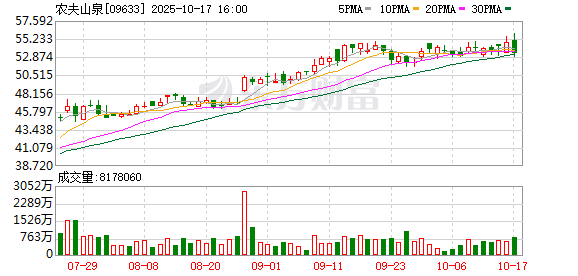
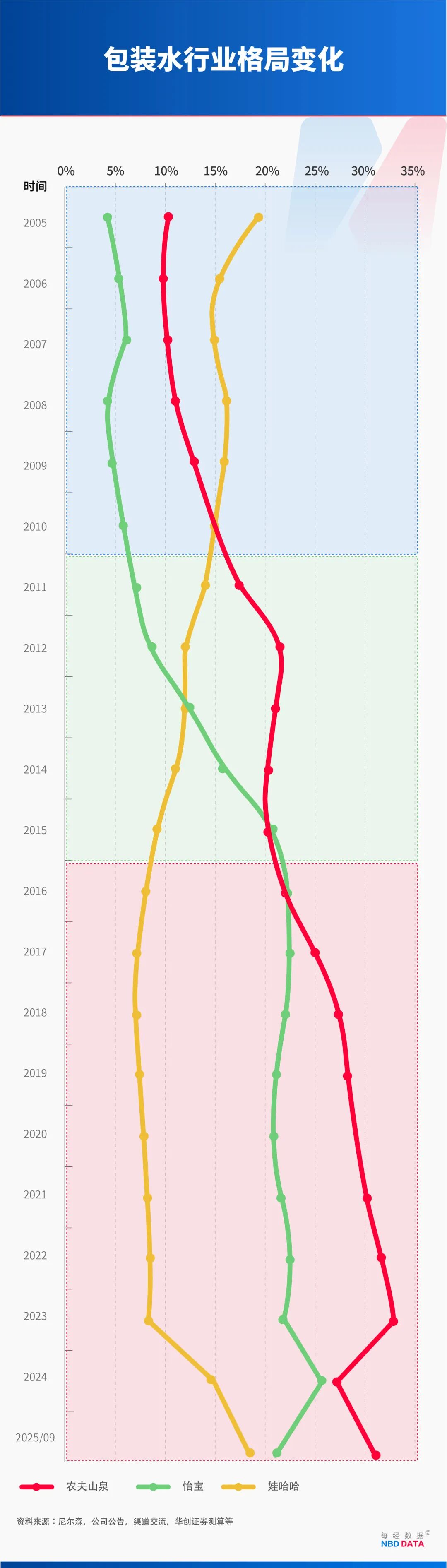
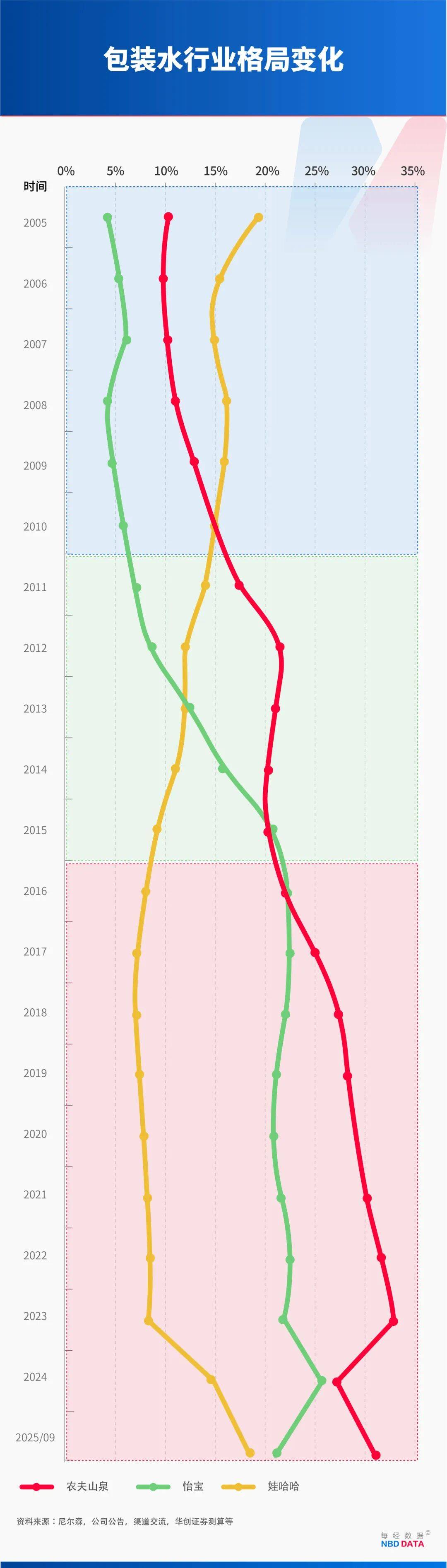
Core Viewpoint - The stark valuation difference between Nongfu Spring and China Resources Beverage, despite similar product pricing, highlights the underlying value dynamics in the bottled water industry, with Nongfu Spring commanding a market capitalization of 599.4 billion HKD compared to China Resources Beverage's 26.4 billion HKD [2][7]. Group 1: Market Performance - As of October 17, 2023, Nongfu Spring's market capitalization increased by 217.6 billion HKD, while China Resources Beverage's decreased by 1.7 billion HKD, illustrating a significant valuation gap where one Nongfu Spring is equivalent to approximately 23 China Resources Beverages [7]. - In the first half of 2025, Nongfu Spring reported revenue of 25.622 billion CNY and a net profit of 7.622 billion CNY, with bottled water revenue accounting for 36.9% of total revenue. In contrast, China Resources Beverage had revenue of 6.206 billion CNY and a net profit of only 0.805 billion CNY, with bottled water revenue making up 84.6% of its total [7][9]. Group 2: Profitability Metrics - Nongfu Spring's gross margin reached 60.3% in the first half of 2025, while China Resources Beverage's was 46.7%, indicating a 13.6 percentage point advantage for Nongfu Spring [9][19]. - The gross margins for Nongfu Spring have consistently been higher than those of China Resources Beverage, with a notable difference of 10.8 percentage points in 2024 [9]. Group 3: Competitive Landscape - The bottled water market has seen intense competition, with Nongfu Spring emerging as a leader, while China Resources Beverage has struggled to maintain its market position, leading to a decline in market share for the latter [9][10]. - Nongfu Spring has diversified its product offerings beyond bottled water, with tea beverages contributing significantly to its revenue, while China Resources Beverage is still in the process of expanding its beverage portfolio [9][10]. Group 4: Supply Chain and Production Models - Nongfu Spring operates a fully self-sufficient production model, controlling its supply chain from water source to bottling, which enhances its cost efficiency and profitability [19][22]. - In contrast, China Resources Beverage relies heavily on a contract manufacturing model, which incurs additional costs and risks associated with outsourcing production [19][22][27]. Group 5: Future Strategies - China Resources Beverage is actively working to increase its self-production capacity, aiming for 60% of its bottled water production to come from its own facilities by 2025, as part of its strategic expansion plan [28][29]. - The industry is witnessing a trend towards self-built production facilities, as companies recognize the importance of supply chain control in maintaining competitive advantage [30][31].
一个农夫山泉≈23个华润饮料,怡宝“水战”输在哪?揭开市值悬殊之谜
3 6 Ke· 2025-10-17 12:50
Core Viewpoint - The stark valuation difference between Nongfu Spring and China Resources Beverage, despite similar product offerings, highlights the underlying value dynamics in the bottled water industry, with Nongfu Spring commanding a market capitalization of HKD 599.4 billion compared to China Resources Beverage's HKD 26.4 billion [1][6]. Group 1: Financial Performance - As of October 17, 2023, Nongfu Spring's market capitalization increased by HKD 217.6 billion to HKD 599.4 billion, while China Resources Beverage's market cap decreased by HKD 1.7 billion to HKD 26.4 billion, indicating a valuation ratio of approximately 23:1 [6]. - In the first half of 2025, Nongfu Spring reported revenue of CNY 25.622 billion and a net profit of CNY 7.622 billion, with bottled water revenue accounting for 36.9% of total revenue. In contrast, China Resources Beverage had revenue of CNY 6.206 billion and a net profit of only CNY 0.805 billion, with bottled water revenue making up 84.6% of its total [6][8]. Group 2: Profit Margins - In the first half of 2025, Nongfu Spring achieved an overall gross margin of 60.3%, while China Resources Beverage's gross margin was 46.7%, reflecting a significant competitive advantage [8][17]. - Nongfu Spring's gross margins have consistently been higher than those of China Resources Beverage, with a margin of 58.1% in 2024 compared to 47.3% for China Resources Beverage [8][17]. Group 3: Market Strategy and Product Diversification - Nongfu Spring has successfully diversified its product offerings beyond bottled water, with tea beverages generating over CNY 10 billion in revenue, accounting for 39.4% of total revenue in the first half of 2025 [8][9]. - China Resources Beverage is still in the process of expanding its beverage product line, with only CNY 0.955 billion in beverage revenue, representing 15.4% of its total revenue in the first half of 2025 [9][10]. Group 4: Supply Chain and Production Models - Nongfu Spring operates a fully self-sufficient production model, controlling its supply chain from water source to bottling, which contributes to its higher gross margins [14][17]. - China Resources Beverage relies heavily on a contract manufacturing model, with approximately 69% of its bottled water produced by third-party manufacturers, leading to increased cost pressures [20][25]. Group 5: Competitive Landscape - The bottled water market is characterized by intense competition, with Nongfu Spring's strategic focus on product diversification and supply chain control giving it a competitive edge over China Resources Beverage, which is still developing its product range and production capabilities [35][36]. - The industry is witnessing a trend towards self-built production facilities, with major players like China Resources Beverage planning to increase its self-produced capacity to 60% by 2025, reflecting a shift in strategy to enhance supply chain control [29][33].
一个农夫山泉≈23个华润饮料,怡宝“水战”输在哪?
Hu Xiu· 2025-10-17 12:28
Core Insights - The article discusses the stark valuation differences between two leading bottled water companies in China: Nongfu Spring and China Resources Beverage (Yibao), despite their similar product offerings and pricing [3][4][11]. Group 1: Market Valuation and Performance - Nongfu Spring has a market capitalization of HKD 599.4 billion, while China Resources Beverage is valued at only HKD 26.4 billion, indicating a significant disparity in market perception [3][11]. - From January to October 2023, Nongfu Spring's market value increased by HKD 217.6 billion, while China Resources Beverage's market value decreased by HKD 1.7 billion, highlighting the contrasting trajectories of the two companies [11]. - In the first half of 2025, Nongfu Spring reported revenue of CNY 25.622 billion and a net profit of CNY 7.622 billion, with bottled water contributing CNY 9.443 billion, accounting for 36.9% of total revenue. In contrast, China Resources Beverage had revenue of CNY 6.206 billion and a net profit of only CNY 0.805 billion, with bottled water making up 84.6% of its revenue [12]. Group 2: Profitability and Margins - Nongfu Spring's gross margin has consistently been higher than that of China Resources Beverage, with a gross margin of 60.3% in the first half of 2025 compared to 46.7% for China Resources Beverage [15][32]. - The article emphasizes that higher gross margins provide companies with the financial strength to engage in price wars, which is crucial in a competitive market [16][14]. - The profitability gap is attributed to the operational efficiencies and cost management strategies employed by Nongfu Spring, which has a more robust supply chain and production model [32][29]. Group 3: Product Diversification and Market Strategy - Nongfu Spring has successfully diversified its product offerings beyond bottled water, with tea beverages contributing significantly to its revenue, accounting for 39.4% in the first half of 2025 [19]. - In contrast, China Resources Beverage is still in the process of expanding its beverage portfolio, with only CNY 0.955 billion in beverage revenue, representing 15.4% of its total revenue [20]. - The competition for shelf space in retail outlets is critical, with companies needing to provide a diverse product range to secure prime display locations, which Nongfu Spring has managed effectively [24][27]. Group 4: Supply Chain and Production Models - Nongfu Spring operates a fully self-sufficient production model, controlling its supply chain from water source to bottling, which enhances its cost efficiency and product quality [29][32]. - China Resources Beverage, on the other hand, relies heavily on third-party manufacturers, which adds to its cost structure and reduces its profit margins [35][32]. - The article notes that the trend in the industry is shifting towards self-built production facilities, as companies recognize the importance of controlling their supply chains to improve profitability [54][56].

食品饮料行业周度市场观察-20251016
Ai Rui Zi Xun· 2025-10-16 06:25
Investment Rating - The report does not explicitly provide an investment rating for the food and beverage industry Core Insights - The food and beverage industry is witnessing a shift towards health-conscious consumption among young people, with trends like "light health" and the popularity of traditional Chinese medicine (TCM) products [1][4] - Japan's experience in the prepared food sector offers valuable lessons for China, emphasizing the importance of clear definitions, strict regulations on additives, and consumer trust [1][4] - The bottled water market is undergoing a transformation from price competition to value competition, with companies diversifying their product offerings to adapt to changing consumer preferences [1][5] - The protein beverage market in China is growing rapidly, with a market size of 158.6 billion yuan in 2023, and is expected to continue expanding towards high-end and functional products [1][8] - The instant noodle industry is facing challenges due to increased competition from substitutes and rising raw material costs, necessitating product upgrades and innovation [1][8] Industry Trends - Young consumers are increasingly adopting "light health" lifestyles, integrating health into daily routines through self-made health drinks and portable wellness products [1] - The Japanese prepared food market has established a clear definition and regulatory framework, focusing on food safety and consumer confidence, which can serve as a model for China's market [1][4] - The mooncake market is trending towards health-oriented products, with low-sugar and medicinal mooncakes gaining popularity among younger consumers [1][4] - The protein beverage sector is projected to grow significantly, driven by health trends and the demand for diverse protein sources [1][8] - The instant noodle market is experiencing a decline in sales due to competition and rising costs, prompting brands to innovate and explore new market segments [1][8] Top Brand News - Sanyuan is focusing on low-temperature fresh milk and has optimized its product structure to enhance its market position in Beijing [1][10] - TATA's collaboration with the popular IP "Butter Bear" has resulted in significant online sales growth and increased brand engagement among younger consumers [1][11] - The success of traditional sweet soup brands in Lanzhou highlights the demand for health-oriented products and transparent production processes [1][11] - Footwear brand TATA has effectively utilized IP collaborations to enhance brand visibility and connect with younger audiences [1][11] - The instant noodle brand Kang Shifu is innovating its product offerings to redefine the category and meet evolving consumer demands [1][14]
“娃哈哈”千人集体诉讼:宗馥莉这把火,为何烧到了自己?
Xin Lang Cai Jing· 2025-10-15 17:24
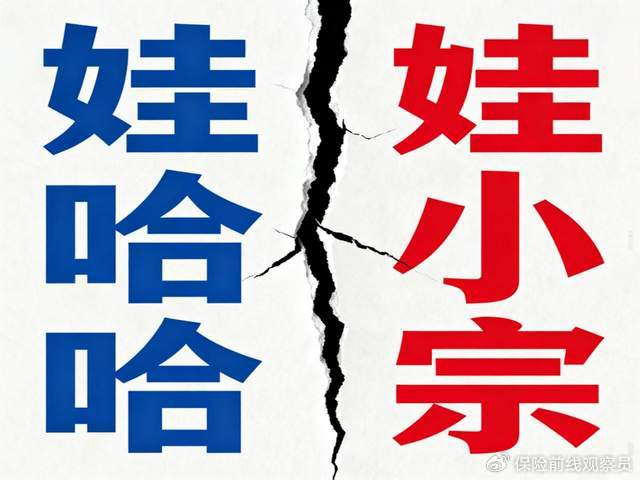
Core Viewpoint - The collective lawsuit by over a thousand Wahaha employees against current leader Zong Fuli highlights the tensions arising from her controversial "de-Wahaha" strategy, which is seen as a catalyst for a broader revolution in the company's business model [1][3]. Group 1: Employee and Distributor Reactions - Zong Fuli's first major action upon taking over in 2018 was to dismantle the "family factory integration" model established by her father, resulting in the closure of 12 factories with an average employee tenure of 25 years, leading to significant employee layoffs and dissatisfaction [3][5]. - The new distribution model has caused confusion among distributors, as payments are made to the Hongsheng group while goods are shipped from Wahaha, complicating tax deductions and leading to widespread frustration among 3,000 distributors [5][6]. Group 2: Business Strategy and Performance - Zong Fuli's reforms, while controversial, align with the "Made in China 2025" initiative, focusing on automation and efficiency, as evidenced by Hongsheng's 7,000 employees with an average age of 28 and a 68% automation rate [8]. - Despite a net profit increase of 11% in the first half of 2024, Wahaha's revenue fell by 7.3% year-on-year to 46.8 billion, indicating a strategy that sacrifices market share for profit margins in a declining consumer environment [9]. Group 3: Future Prospects and Challenges - Zong Fuli has three potential advantages: government support, a limited time window before the critical Chinese New Year sales period, and the enduring brand value of Wahaha, despite recent challenges [10]. - The ongoing transformation reflects broader issues faced by private enterprises in China, as they transition from family-run businesses to modern corporate structures, often encountering significant resistance and challenges [13]. Group 4: Brand and Public Perception - The spread of rumors, including unfounded claims about Zong Fuli's legal troubles, has damaged the brand's reputation, illustrating the rapid dissemination of misinformation in the digital age [14]. - Wahaha is not just a family business; it represents a collective memory for many Chinese consumers, emphasizing the need for a resolution that honors its legacy while navigating current challenges [15][16].
京东11月9日发布新车;娃哈哈核心高管严学峰疑似离职;蜜雪冰城卖啤酒5.9元起;26年国考应届硕博年龄放宽到43周岁以下丨邦早报
创业邦· 2025-10-15 00:09
Group 1 - Wahaha's core executive Yan Xuefeng is reportedly on leave, while Zhu Lidan remains in position, with no official response from the company [3] - JD.com announced a collaboration with GAC and CATL to launch a new vehicle, emphasizing that JD will not be involved in manufacturing but will provide consumer insights and exclusive sales [4][6] - The new vehicle, a battery-swappable version of GAC's Aion UT, will be officially released on November 9, with test drives starting in late October [4][6] Group 2 - DJI has filed an appeal against the U.S. Department of Defense after being placed on a list of "Chinese military companies," asserting that it does not accept the designation [8] - Mixue Ice Cream has expanded its business into alcoholic beverages by acquiring a 53% stake in Fresh Beer for approximately 297 million yuan, with prices for beer starting at 5.9 yuan [8] - Apple confirmed that the iPhone Air sold in China will be unlocked, allowing users to choose their network provider without being tied to a contract [10] Group 3 - Walmart is collaborating with OpenAI to enable shopping directly through ChatGPT, with a launch expected this fall [16] - Google plans to invest $15 billion in building AI infrastructure in India over the next five years, marking a significant commitment to the region [16] - PayPay is preparing for an IPO in the U.S. with an estimated valuation exceeding $20 billion, as SoftBank engages with institutional investors [15] Group 4 - General Motors will incur a $1.6 billion charge due to adjustments in its electric vehicle production plans, influenced by recent policy changes [15] - The global smartphone market saw a 2.6% increase in shipments in Q3, with Samsung maintaining the top position with 61.4 million units shipped [24] - The wearable wristband market is projected to exceed $40 billion by the end of 2024, driven by strong demand for entry-level devices [25]



【钛晨报】李强主持召开经济形势专家和企业家座谈会;入局造车?京东:联合宁德时代、广汽,新车将于11.11期间发布;沃尔玛与OpenAI合作,将在Chat...
Tai Mei Ti A P P· 2025-10-14 23:35
Group 1 - The meeting chaired by Premier Li Qiang highlighted the resilience and vitality of China's economy amidst challenges, with experts suggesting that favorable factors are accumulating despite existing difficulties [2][3] - Li emphasized the importance of implementing counter-cyclical adjustments and enhancing policy effectiveness to support economic recovery and high-quality development [3] - The focus will be on expanding domestic demand, strengthening the domestic circulation, and fostering a favorable industrial ecosystem to stimulate market vitality and increase quality supply [3] Group 2 - JD.com announced a collaboration with CATL and GAC to launch a new vehicle, aiming to integrate resources for enhanced safety, battery technology, and a comprehensive car ownership experience [6] - The departure of key executives from Wahaha raises concerns about leadership stability within the company, although official responses remain pending [8] - DJI is appealing a decision by the U.S. Department of Defense that classified it as a "Chinese military enterprise," asserting its commitment to preventing military misuse of its products [10][11] Group 3 - The Abu Dhabi Investment Authority signed a strategic cooperation agreement with Stellantis to develop an integrated automotive ecosystem in the UAE [11] - Ansem Semiconductor appointed its CFO as interim CEO following export control measures imposed by the Chinese Ministry of Commerce, indicating ongoing communication efforts to mitigate impacts [12] - Salesforce and OpenAI announced a partnership to enhance enterprise experiences through AI, integrating OpenAI's models with Salesforce's platform [13] Group 4 - Johnson & Johnson plans to spin off its orthopedic business to enhance strategic focus and create shareholder value, establishing a new independent company [14] - Walmart is collaborating with OpenAI to enable direct shopping through ChatGPT, expanding its digital presence and customer engagement [14] Group 5 - The Shanghai Municipal Economic and Information Commission released an action plan to enhance the scale of intelligent computing terminals, promoting the application of core components like GPUs [15] - The National Development and Reform Commission issued guidelines to support energy-saving and carbon reduction projects in key industries, including power and steel [17] - The Market Supervision Administration approved China's first national standard for livable cities, aiming to improve urban planning and management [18] Group 6 - The Shanghai Stock Exchange and China Securities Index Co. will launch the Shanghai Stock Exchange Sci-Tech Innovation Board Growth Strategy Index, reflecting the performance of innovative companies [20] - Pony.ai received approval for its Hong Kong IPO, marking a significant step in its dual listing strategy after its initial public offering in the U.S. [20] - Mindray Medical announced plans to issue H-shares and list on the Hong Kong Stock Exchange, pending shareholder and regulatory approvals [21] Group 7 - Sunac China Holdings' offshore debt restructuring plan received overwhelming support from creditors, paving the way for court approval [21] - The International Monetary Fund projected a global economic growth rate of 3.2% for 2025, highlighting the impact of rising tariffs on global uncertainty [22]
数据首发:2025Q3线下零售速报
3 6 Ke· 2025-10-14 23:26
Core Insights - The offline retail market in Q3 2025 is under significant growth pressure, with sales down 12.26% year-on-year, indicating a return to double-digit declines. This is primarily driven by reduced consumer budgets and declining prices, leading to a shift towards lower-tier products [3][4]. Overall Quarterly Overview - The analysis covers four major categories: food, beverages, alcohol, and daily chemicals, using a continuous store model to assess performance [2]. Sales Performance - In Q3 2025, the overall sales performance shows a significant decline, with order numbers down 4.45% and average order spending down 8.18%. The decline in average spending is nearly double that of order numbers, suggesting heightened consumer sensitivity to price [3][4]. Price Levels - The WPI (Winning Price Index) indicates that the price levels for food, beverages, and daily chemicals remain under pressure, with all three categories maintaining a price index below 100, reflecting a year-on-year decline [5][7]. Key Category Insights - In the food category, the top three increasing segments are ice cream, soy sauce, and hot pot balls, while the top three declining segments are pure milk, puffed snacks, and jerky [10]. - For beverages, the notable decline in the dairy beverage segment is attributed to a high base from the previous year, while packaged water shows the largest year-on-year increase [14][18]. Consumer Behavior Trends - The trend towards convenience and health is evident, with increased demand for ready-to-eat and frozen foods, reflecting a shift in consumer preferences towards time-saving and healthier options [17][23]. - The snack category is experiencing a decline, driven by a growing health consciousness among consumers, leading to reduced demand for traditional high-sugar and high-fat snacks [17][23]. SKU and New Product Dynamics - The analysis of top SKUs reveals significant shifts in market share, with new entrants and established brands competing aggressively in the convenience food and beverage segments [45][46].

