
宝钢股份

Search documents
建信期货钢材日评-20260121
Jian Xin Qi Huo· 2026-01-21 02:32
021-60635736 zhaihepan@ccb.ccbfutures.com 期货从业资格号:F3033782 交易咨询证书号:Z0014484 021-60635735 niejiayi@ccb.ccbfutures.com 期货从业资格号:F03124070 交易咨询证书号: Z0023472 021-60635727 fengzeren@ccb.ccbfutures.com 期货从业资格号:F03134307 报告类型 钢材日评 日期 2025 年 1 月 21 日 黑色金属研究团队 研究员:翟贺攀 研究员:聂嘉怡 研究员:冯泽仁 请阅读正文后的声明 数据来源:上期所网站,建信期货研究发展部 1 月 20 日,螺纹钢、热卷期货主力合约 2605 连续第 2 个交易日震荡下滑。 | | 表2:1月20日黑色系期货持仓情况(单位:手、%) | | | | | | | --- | --- | --- | --- | --- | --- | --- | | 合约 | 前 20 多头 持仓 | 前 20 空头 持仓 | 前 20 多头 持仓变化 | 前 20 空头 持仓变化 | 多空 对比 | 偏离度 | ...
铁矿日报:发运、到港量均回落,市场情绪有所降温-20260120
Guan Tong Qi Huo· 2026-01-20 11:44
Report Summary 1. Industry Investment Rating - Not provided in the report 2. Core View - The iron ore market is currently in a state of slight weakness in the short - term, but the overall downside space is limited. The supply side of new shipments is gradually decreasing, the demand side is slightly recovering, and the inventory in ports is gradually shifting to downstream steel mills. The futures contract shows a back structure + positive basis with futures at a discount [5]. 3. Summary of Each Section Market行情态势回顾 - Futures price: The main contract of iron ore futures continued to decline weakly, closing at 789.5 yuan/ton, down 4.5 yuan/ton or 0.57% from the previous trading day. The trading volume was 363,000 lots, the open interest was 587,000 lots, and the settled funds were 10.187 billion yuan. The futures market is expected to test the support around 780 in the short - term [1]. - Spot price: The mainstream spot varieties at Qingdao Port, PB powder, dropped 10 yuan to 794 yuan, and Super Special powder dropped 10 yuan to 670 yuan. The swap main contract was 104.2 US dollars/ton (- 0.75 US dollars). The spot and swap prices declined again [1]. - Basis and spread: The price of PB powder at Qingdao Port converted to the futures price was 823.7 yuan/ton, and the basis was 34.2 yuan/ton, with a significant contraction. The spread between iron ore contracts 2 - 5 was 17.5 yuan, and the spread between 5 - 9 was 18 yuan. The iron ore futures contracts showed a back structure + positive basis. Although it showed a weak shock in the short - term, the overall downside space might be limited [1]. Fundamental Analysis - Supply: Overseas mine shipments decreased month - on - month, with a significant decline in Australia and Brazil and an increase in non - mainstream countries. The current arrival volume decreased month - on - month, and there were expectations of supply disturbances due to weather. The arrival of the first batch of iron ore from Mangu increased the expected supply pressure [2]. - Demand: The molten iron output decreased month - on - month, the profitability rate of steel mills recovered, and the rigid demand was still supported. Steel mills were in the process of replenishing inventory, but the enthusiasm was still weak, and the game between upstream and downstream was strong. Attention should be paid to the recovery height of molten iron and the release rhythm of replenishment demand before the Spring Festival [2]. - Inventory: Ports continued to accumulate inventory, the inventory under pressure increased slightly, and the inventory pressure was still accumulating. The inventory of steel mills was still significantly lower than the historical average [2]. Macro - level Analysis - Overseas: The US economy maintained a "light to moderate" expansion, inflation continued to cool down, the CPI in December decreased to 2.7% year - on - year, and the core CPI increased by 0.2% month - on - month, lower than expected. Consumption showed a "K - shaped" characteristic, and industrial production rebounded unexpectedly. The Fed maintained a cautious wait - and - see attitude, and the interest - rate cut expectation was postponed to June [4]. - Domestic: Policies focused on new fields, such as a 25 - basis - point reduction in the interest rate of structural monetary policy tools and investment plans for the new power system of the power grid. Exports were more resilient than expected, with a year - on - year growth rate of 6.6% in December. Social financing data showed that corporate loans and bond financing were stronger than seasonal, but the real estate and infrastructure were seasonally weak. The improvement of inflation was clear, and PP was expected to continue to recover [4].
钢材出口高增长韧性几何?
Bao Cheng Qi Huo· 2026-01-20 09:42
1. Report Industry Investment Rating No relevant content provided. 2. Core Views of the Report - Since achieving a net steel export in 2006, China's steel product export volume as a proportion of the global total has been on an upward trend. In recent years, due to tariff disturbances, the domestic steel export market has been expanding, with the export scale increasing year by year. The export volume exceeded 100 million tons in 2024 and reached a new high in 2025 [5][9]. - In 2025, steel exports showed several characteristics: a shift in the export variety structure with the increase coming from long - products, diversification of export countries with an increasing share of emerging markets, and a situation of increasing volume but decreasing price, indicating that the strong steel export was mainly supported by low - price advantages [5][12][16]. - Currently, the domestic price advantage remains, and there is an increase in overseas demand, so the resilience of steel exports still exists. However, there are also more challenges in the future, such as intensified trade frictions, domestic policy adjustments, the EU carbon tariff policy, the recovery of overseas supply, and the pressure of RMB appreciation [5][23][26]. - In summary, weak domestic demand forced steel mills to increase exports, and with good price advantages, steel exports in 2025 were strong, alleviating domestic pressure. However, with the increase of challenges, the resilience of steel exports will be impacted, and the direct export volume may decline from its peak [5][44][47]. 3. Summary by Directory 3.1 2025 Steel Exports Reached a New High - China is the world's largest steel producer, and its steel export pattern affects the global steel product trade pattern. In 2025, despite trade barriers, the steel export volume continued to grow. The cumulative export volume of steel products in 2025 was 119.02 million tons, a year - on - year increase of 830,000 tons or 7.50%. Meanwhile, steel imports remained sluggish, with an import volume of only 6.06 million tons in 2025, a year - on - year decrease of 75,000 tons or 11%. The export of steel billets also performed well in 2025, with the cumulative export volume from January to November reaching 1.33801 million tons, a year - on - year increase of 782,000 tons or 140.64%. The combined export increase of steel and steel billets was 1.7 million tons, effectively alleviating the weak domestic demand pressure [9]. - In 2025, steel exports had the following characteristics: - **Shift in export variety structure**: The export increase came from long - products. Due to the downturn in the real estate market, the surplus of domestic construction steel (long - products) increased, and exports became an important factor in adjusting domestic supply - demand balance. From January to November, the cumulative export volumes of bars, sections, and wire rods increased by 527,000 tons, 183,000 tons, and 29,000 tons respectively, with year - on - year growth rates of 43.95%, 34.33%, and 12.13%. In contrast, the export growth rate of plates slowed down, and the export of ordinary plates such as hot - rolled coils and cold - rolled coils was directly affected by anti - dumping measures [12]. - **Diversification of export countries**: Traditional markets were under pressure due to anti - dumping policies, but emerging markets were rising. Southeast Asian countries, the Middle East, Africa, and South America all showed an increase in steel imports from China [16]. - **Increasing volume but decreasing price**: In 2025, the total steel export volume was 119 million tons, a year - on - year increase of 7.50%, while the export value was 82.578 billion US dollars, a year - on - year decrease of 1.26%, indicating that the strong steel export was mainly supported by low - price advantages [19]. 3.2 Steel Exports Face More Challenges - **Reasons for the high - growth of steel exports in 2025**: On the one hand, the intensification of domestic supply - demand contradictions forced steel mills to increase exports. On the other hand, there was a significant cost advantage, and the price difference between domestic and overseas markets was the core driving force for steel exports. Currently, the resilience of steel exports still exists because the domestic price advantage remains, and there is an increase in overseas steel demand. The World Steel Association estimates that global steel demand will rebound moderately by 1.3% in 2026, reaching 1.773 billion tons [23]. - **Challenges in 2026**: - **Intensified trade frictions**: In recent years, the EU, South Korea, Vietnam and other countries have frequently launched "double - anti" investigations and imposed high tariffs on Chinese steel products, resulting in a decline in China's export share in these markets. In 2024, there were 33 original investigations on trade remedies for Chinese steel products, and in 2025, there were more than 150 investigations or arbitrations. In 2026, as the anti - dumping cases from 2024 - 2025 enter the final ruling stage, China's steel exports will face more extensive trade resistance [26]. - **Domestic export policy adjustment**: On December 12, 2025, the Ministry of Commerce and the General Administration of Customs decided to adjust the "Catalogue of Goods Subject to Export License Administration (2025)", including some steel products with 300 customs commodity codes in the catalogue. It is difficult to assess the actual impact of this policy on exports for now. If strictly implemented, large steel enterprises may be less affected, while small and medium - sized enterprises may face restrictions [29]. - **EU carbon tariff policy**: The EU carbon tariff (CBAM) officially started to be levied on January 1, 2026. Once the free quota is completely removed, the CBAM cost of exporting one ton of steel to the EU will increase by 140 - 160 euros, eroding the profit space of enterprises. The implementation of CBAM will significantly weaken China's price advantage in steel exports, and Chinese steel products will face a competitive situation of "being attacked from both inside and outside" in the EU market. In addition, the compliance threshold has been greatly increased, and the short - term export process will be blocked [31]. - **Recovery of overseas supply**: From January to November 2025, the crude steel output of overseas countries (excluding China) was 766.888 million tons, a year - on - year increase of 1.798 million tons or 0.24%. The emerging markets of India and Southeast Asia maintained high - growth, and the production capacities of Turkey and Iran were recovering. In addition, the weakening of the US dollar credit and the pressure of RMB appreciation will also suppress domestic steel exports [35]. 3.3 Conclusion - China's steel exports have been increasing year by year. In 2025, steel exports reached a new high, showing characteristics such as a shift in the export variety structure, diversification of export countries, and increasing volume but decreasing price. Currently, the resilience of steel exports still exists, but in the future, there will be more challenges, and the direct export volume may decline from its peak [45][47].
钢矿央企掌门人年薪最高差一倍
第一财经· 2026-01-20 09:28
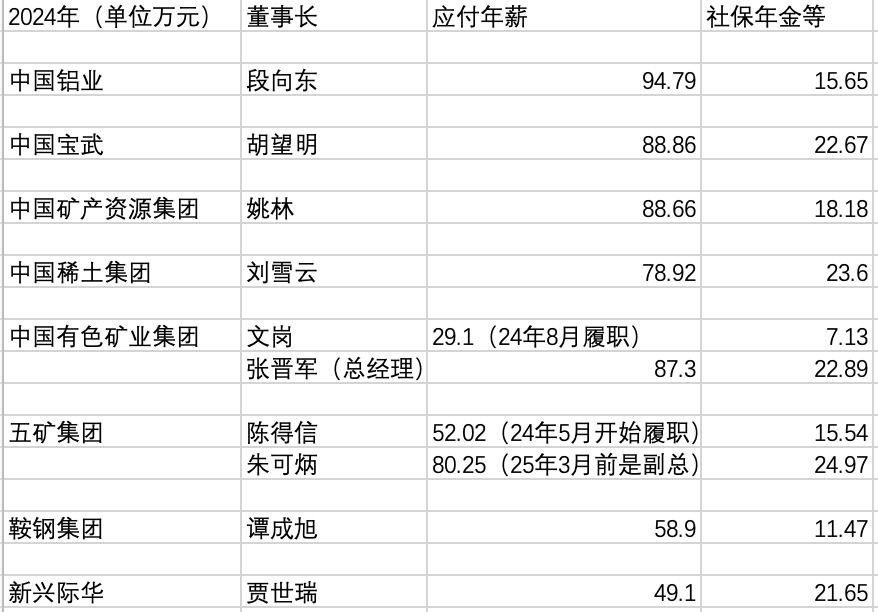
Core Viewpoint - The article discusses the salary information of 87 central enterprise leaders for 2024, highlighting the differences in compensation between steel and non-ferrous metal mining enterprises, with a general decline in steel enterprise salaries and an increase in non-ferrous metal mining salaries [3][9]. Salary Overview - The pre-tax salary of central enterprise leaders consists of three parts: base salary, social insurance, enterprise annuity, supplementary medical insurance, and housing fund contributions, along with other monetary income [3]. - For 2024, the highest pre-tax salary among the eight steel and mining central enterprises is approximately 1.1 million yuan, including additional contributions [4]. - The highest base salary is for Duan Xiangdong, Chairman of China Aluminum Group, at 947,900 yuan, followed by Hu Wangming, Chairman of China Baowu Steel Group, at 888,600 yuan [5]. Year-on-Year Salary Changes - Compared to 2023, the salaries of steel enterprise leaders generally decreased, while those of non-ferrous metal mining leaders mostly increased [9]. - The lowest salary among the eight enterprises is for the Chairman of Xinxing Jihua Group at 491,000 yuan, which is about half of the highest salary in the non-ferrous sector [9]. Performance Impact on Salaries - The decline in steel enterprise salaries correlates with poor performance, as seen in Xinxing Jihua Group, which reported a loss of 4.228 billion yuan in 2024, a significant drop from a profit of 182 million yuan in 2023 [9]. - An analysis of Ansteel Group shows that its three listed companies experienced a decline in performance, with losses exceeding 100% compared to 2023 [10]. Non-Ferrous Metal Sector Performance - In contrast, the non-ferrous metal sector saw significant profit increases, with China Aluminum Group reporting a net profit of 12.4 billion yuan in 2024, a year-on-year increase of 85.38% [12]. - The overall profit for the non-ferrous metal industry is projected to reach around 420 billion yuan in 2024, reflecting a growth of over 10% [12]. Future Outlook - The steel industry is expected to improve in 2025, with profits projected to reach the best economic performance since 2022, driven by a recovery in production and pricing [10]. - The non-ferrous metal industry continues to thrive, with record profits reported in 2025, indicating a robust growth trajectory [13].

瑞达期货铁矿石产业链日报-20260120
Rui Da Qi Huo· 2026-01-20 09:23
Report Summary 1. Report Industry Investment Rating - Not provided in the content 2. Report Core View - The I2605 contract's center of gravity moved down on Tuesday. With the current decline in Australian and Brazilian iron ore shipments and arrivals, a slight reduction in the blast furnace operating rate of steel mills, molten iron production remaining below 2.3 million tons, and the iron ore port inventory reaching a new high, the port continues the inventory accumulation trend, and the spot resources are relatively abundant. Additionally, the first shipment of 200,000 tons of iron ore from Simandou arrived at China Baowu Magang, putting short - term pressure on ore prices. The technical analysis of the I2605 contract shows that the 1 - hour MACD indicator has DIFF and DEA running below the 0 - axis. The reference view is oscillating and bearish, and risk control should be noted. [2] 3. Summary by Relevant Catalogs 3.1. Futures Market - The closing price of the I main contract is 789.50 yuan/ton, down 4.50 yuan; the position volume of the I main contract is 586,412 lots, down 29,929 lots. The I 5 - 9 contract spread is 18 yuan/ton, up 0.50 yuan; the net position of the top 20 in the I contract is - 6,122 lots, up 5,773 lots. The Dalian Commodity Exchange's I warehouse receipts are 1,500 lots, up 700 lots. The Singapore iron ore main contract's quote as of 15:00 is 104 US dollars/ton, down 0.66 US dollars. [2] 3.2. Spot Market - The price of 61.5% PB fines at Qingdao Port is 845 yuan/dry ton, down 9 yuan; the price of 60.5% Mac fines at Qingdao Port is 837 yuan/dry ton, down 10 yuan. The price of 56.5% Super Special fines at Jingtang Port is 755 yuan/dry ton, down 11 yuan. The basis of the I main contract (Mac fines dry ton - main contract) is 48 yuan, down 5 yuan. The 62% Platts iron ore index (previous day) is 104.45 US dollars/ton, down 1.70 US dollars. The ratio of Jiangsu scrap steel to 60.5% Mac fines at Qingdao Port is 3.11, up 0.07. The estimated import cost is 841 yuan/ton, down 14 yuan. [2] 3.3. Industry Situation - The global iron ore shipment volume (weekly) is 2,929.80 tons, down 251.10 tons; the arrival volume at 47 ports in China (weekly) is 2,897.70 tons, down 117.30 tons. The iron ore inventory at 47 ports (weekly) is 17,288.70 tons, up 244.26 tons; the iron ore inventory of sample steel mills (weekly) is 9,262.22 tons, up 272.63 tons. The iron ore import volume (monthly) is 11,965.00 tons, up 911.00 tons; the available days of iron ore (weekly) are 22 days, up 5 days. The daily output of 266 mines (weekly) is 39.95 tons, up 0.81 tons; the operating rate of 266 mines (weekly) is 63.02%, up 1.30%. The iron concentrate inventory of 266 mines (weekly) is 43.44 tons, down 0.49 tons. The BDI index is 1,650, up 83. The iron ore freight rate from Tubarao, Brazil to Qingdao is 20.28 US dollars/ton, up 0.72 US dollars; the iron ore freight rate from Western Australia to Qingdao is 8.11 US dollars/ton, up 0.66 US dollars. [2] 3.4. Downstream Situation - The blast furnace operating rate of 247 steel mills (weekly) is 78.82%, down 0.51%; the blast furnace capacity utilization rate of 247 steel mills (weekly) is 85.46%, down 0.60%. The domestic crude steel output (monthly) is 6,818 tons, down 169 tons. [2] 3.5. Option Market - The 20 - day historical volatility of the underlying (daily) is 18.63%, up 0.12%; the 40 - day historical volatility of the underlying (daily) is 16.03%, up 0.04%. The implied volatility of at - the - money call options (daily) is 22.15%, up 0.14%; the implied volatility of at - the - money put options (daily) is 25.20%, up 0.79%. [2] 3.6. Industry News - From January 12th to January 18th, 2026, the global iron ore shipment volume was 2,929.8 million tons, a week - on - week decrease of 251.1 million tons. The total iron ore shipment volume from Australia and Brazil was 2,246.6 million tons, a week - on - week decrease of 359.8 million tons. The arrival volume at 47 ports in China was 2,897.7 million tons, a week - on - week decrease of 117.3 million tons; the arrival volume at 45 ports in China was 2,659.7 million tons, a week - on - week decrease of 260.7 million tons; the arrival volume at the six northern ports was 1,442.9 million tons, a week - on - week decrease of 26.3 million tons. [2]

铁矿石:补库需求进入后半段,盘面高位风险积累
Hua Bao Qi Huo· 2026-01-20 08:17
1. Report Industry Investment Rating - Not provided in the given content 2. Report's Core View - Short - term iron ore supply - demand contradictions still need to accumulate. The restocking demand supports the spot price, and supply enters the off - season. However, the price increase is limited by industrial chain profits, and the restocking demand drive has entered the realization period. It is expected to fluctuate at a high level in the short term [1] - The recommended strategy is range operation and covered call options [1] 3. Summary by Relevant Catalogs Supply - Current overseas ore shipments have entered the off - season, with weekly shipments declining for three consecutive weeks. According to seasonal patterns, before mid - February, overseas ore shipments will continue to weaken month - on - month but be higher than last year due to the low base caused by the hurricane in Australia last year. Domestic ore supply is also in the off - season. Overall, the supply side is in a seasonally shrinking phase, but a more significant supply - side support requires an unexpected decline. As of January 19, Mysteel's global iron ore shipments totaled 29.298 million tons, a month - on - month decrease of 2.511 million tons and a year - on - year increase of 7.004 million tons. The total iron ore shipments from 19 ports in Australia and Brazil were 21.64 million tons, a month - on - month decrease of 3.692 million tons and a year - on - year increase of 4.28 million tons [1] Demand - Domestic demand has slightly declined but remains at the highest level in the same period of the past five years. The profitability of steel mills has stabilized after the decline in carbon element prices, and steel inventories have not shown an over - seasonal accumulation. Overall, domestic steel mill demand remains stable in the short term, the restocking demand is in the middle stage, and its marginal support is weakening [1] Inventory - Steel mill's imported ore inventory has increased for four consecutive weeks, and the pre - Spring Festival seasonal restocking by steel mills is in the second half, with the restocking support weakening. Port inventories continue to accumulate mainly due to the relatively high arrival volume. It is expected that as the arrival volume declines and restocking demand increases, the pressure on port inventory accumulation will ease [1]
钢矿央企掌门人年薪最高差一倍,背后是业绩的加速分化
Di Yi Cai Jing· 2026-01-20 07:52
Group 1: Salary Trends - In 2024, the salaries of leaders in steel central enterprises generally decreased, while those in the non-ferrous metal mining sector mostly increased [1][4] - The highest salary among the eight central enterprises is held by the chairman of China Aluminum Corporation, Duan Xiangdong, at 947,900 yuan, followed by the chairman of China Baowu Steel Group, Hu Wangming, at 888,600 yuan [2][5] - The average salary for the eight steel and mining central enterprises' leaders did not exceed 1 million yuan, with the highest total salary including social insurance and other benefits being around 1.1 million yuan [1][2] Group 2: Performance and Salary Correlation - The salary of central enterprise leaders is closely linked to their performance, which explains the general increase in salaries for leaders in the non-ferrous metal mining sector [7] - China Aluminum Corporation reported a net profit of 12.4 billion yuan in 2024, a year-on-year increase of 85.38%, contributing to the rise in its leadership salaries [8] - The non-ferrous metal industry is projected to achieve a total profit of around 420 billion yuan in 2024, with a year-on-year growth of over 10% [9] Group 3: Industry Challenges - The steel industry faced a challenging operating environment in 2024, with major steel companies reporting a total profit of 45.7 billion yuan, a decline of 47.2% year-on-year [6] - The crude steel production in 2024 was 1.01 billion tons, down 1.7% year-on-year, and the domestic steel price index fell by 8.4% [6] - Despite the difficulties in 2024, the steel industry's performance is expected to improve in 2025, with a projected profit increase of 1.9 times in the first three quarters [6]




成交额超3亿元,自由现金流ETF(159201)近5个交易日净流入2.07亿元
Sou Hu Cai Jing· 2026-01-20 06:15
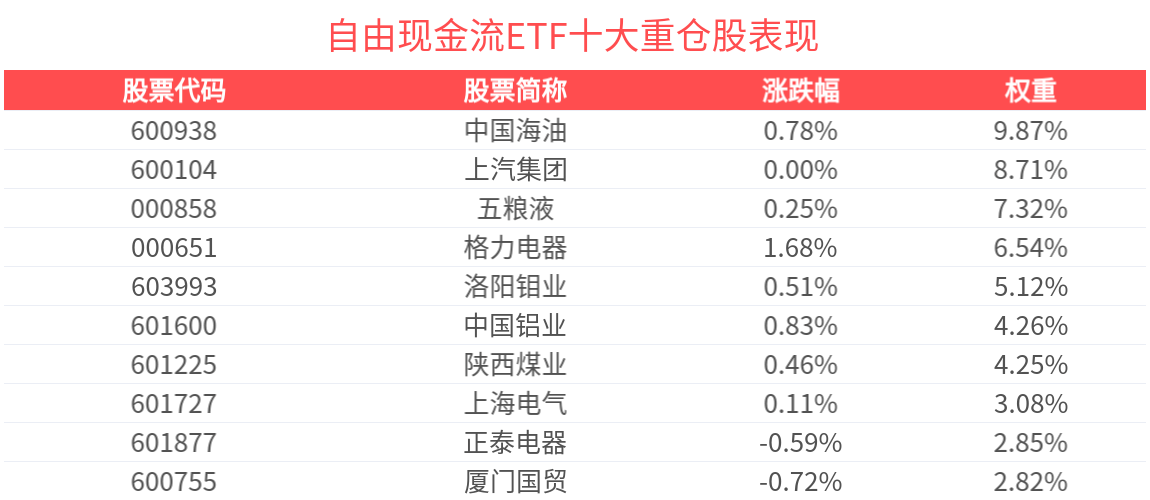
Core Viewpoint - The National Index of Free Cash Flow has shown a positive trend, with significant increases in both the index and its constituent stocks, indicating strong market performance and investor interest in companies with high and stable free cash flow [1][2]. Group 1: Index Performance - As of January 20, 2026, the National Index of Free Cash Flow rose by 0.60%, with constituent stocks such as Nanshan Aluminum and Satellite Chemical experiencing notable gains of 7.65% and 6.05%, respectively [1]. - The Free Cash Flow ETF (159201) increased by 0.55%, reaching a latest price of 1.28 yuan, with a trading volume of 3.69 billion yuan [1]. - Over the past week, the Free Cash Flow ETF has averaged a daily trading volume of 4.77 billion yuan [1]. Group 2: Fund Inflows and Performance - In the last five trading days, the Free Cash Flow ETF attracted a total of 207 million yuan, bringing its total shares to 7.75 billion and total assets to 9.834 billion yuan, marking a record high since its inception [1]. - The ETF has seen a net inflow of 2.4535 million yuan in financing this month, with a current financing balance of 116 million yuan [1]. - The net value of the Free Cash Flow ETF has increased by 21.74% over the past six months, with a maximum monthly return of 7% and a historical holding period profit probability of 100% over six months [1]. Group 3: Top Constituent Stocks - As of December 31, 2025, the top ten weighted stocks in the National Index of Free Cash Flow include China National Offshore Oil Corporation, SAIC Motor, and Gree Electric Appliances, collectively accounting for 51.95% of the index [2]. - The top weighted stocks and their respective weights are: China National Offshore Oil (9.87%), SAIC Motor (8.71%), and Gree Electric Appliances (6.54%) [4]. Group 4: ETF Management and Fees - The Free Cash Flow ETF has a management fee of 0.15% and a custody fee of 0.05%, which are among the lowest in comparable funds [4].
宝钢取得高强度抗非均匀载荷石油套管专利
Sou Hu Cai Jing· 2026-01-20 05:35
来源:市场资讯 天眼查资料显示,宝山钢铁股份有限公司,成立于2000年,位于上海市,是一家以从事黑色金属冶炼和 压延加工业为主的企业。企业注册资本2226220.0234万人民币。通过天眼查大数据分析,宝山钢铁股份 有限公司共对外投资了30家企业,参与招投标项目5000次,财产线索方面有商标信息254条,专利信息 5000条,此外企业还拥有行政许可9284个。 声明:市场有风险,投资需谨慎。本文为AI基于第三方数据生成,仅供参考,不构成个人投资建议。 国家知识产权局信息显示,宝山钢铁股份有限公司取得一项名为"一种高强度抗非均匀载荷石油套管及 其制造方法"的专利,授权公告号CN119663108B,申请日期为2023年9月。 ...
黑色金属投资价值分析-人间正道是沧桑
2026-01-20 01:50
Summary of Key Points from Conference Call Records Industry Overview - The analysis focuses on the **steel industry** and its investment value within the context of China's economic transition and industrialization phases [1][25]. Core Insights and Arguments - **Economic Transition**: China is transitioning from an industrialization maturity phase to a mass consumption phase, with economic growth increasingly reliant on consumer spending and government consumption rather than investment [2][26]. - **Capital Market Dynamics**: The current bull market is characterized by an oversupply of capital in society, with funds flowing into the stock market through various channels, including household savings, institutional asset allocation, corporate buybacks, and overseas hot money [14][9]. - **Investment Opportunities**: In a low-interest-rate environment, value investment opportunities arise, particularly in mature industries like steel, where companies are increasing dividends and buybacks, injecting new capital into the stock market [12][4]. - **Global Capital Flows**: The disarray in the U.S. monetary credit system may lead to a reallocation of global capital, potentially benefiting emerging markets like China if the Federal Reserve implements quantitative easing [13][14]. - **Valuation Methods**: Different stages of the industry lifecycle require different valuation methods. In mature phases, focus should be on the reset cost method rather than relying solely on PE or PB ratios [19][15]. Important but Overlooked Content - **Household Savings Impact**: The shift in household savings from real estate to stable income products like savings and dividend insurance has significantly impacted the capital market, leading to increased asset allocation in equities [10][11]. - **Insurance Sector Growth**: The insurance sector in China has substantial growth potential, with a projected increase in equity asset allocation as bond yields fail to match liabilities [11]. - **Steel Industry Competitiveness**: Evaluating steel companies' competitiveness involves analyzing metrics such as labor costs, production efficiency, and product pricing, which reflect their market positioning [17][18]. - **Investment Strategy**: A bottom-buying strategy for cyclical stocks should focus on reset costs rather than traditional valuation metrics, especially in volatile industries like steel [19][20]. Future Outlook - **Economic Growth Projections**: The overall economic growth rate is expected to stabilize around 3.5% in the coming years, with government consumption playing a crucial role in supporting demand-side reforms [2][41]. - **Steel Demand Trends**: Despite a decline in real estate demand, China's steel production remains robust due to upgrades in machinery and manufacturing, indicating resilience in the sector [27][54]. - **Investment Value in Steel Stocks**: Steel stocks are currently undervalued, with potential for significant returns if supply-side reforms are effectively implemented [56]. This summary encapsulates the key insights and arguments presented in the conference call records, highlighting the steel industry's dynamics and investment potential within the broader context of China's economic landscape.