永辉超市

Search documents
中国消费行业:2026 年 GCC 会议要点 -估值仍具吸引力,消费复苏迹象显现-China Consumer Sector_ 2026 GCC takeaways_ Sector valuation remains attractive with signs of consumption recovery
2026-01-26 02:50
Summary of Key Points from the Conference Call Industry Overview - **Sector**: China Consumer Sector - **Key Insights**: The sector shows signs of consumption recovery despite a near-term property market downturn. Valuation remains attractive, approximately 1 standard deviation below 10-year averages, indicating that a consumption recovery is not yet priced in [2][21]. Consumer Staples - **Baijiu**: Anticipated demand support for mid-end baijiu due to easing alcohol bans and private consumption growth. Companies are expected to accelerate channel transformations for sustainable EPS growth [3][8]. - **Beer**: Premiumization continues through product diversification and in-home channel expansion, despite on-trade softness. CR Beer expects low-single-digit volume growth in 2025, with Heineken volumes projected to grow by 20% YoY [3][8]. - **Dairy**: Liquid milk sales are expected to recover modestly in 2026, driven by marketing and innovation, despite a weak 2025. Fresh milk shows resilience with double-digit growth [3][8]. - **Freshly-Made Beverages (FMB)**: Guming is expected to maintain steady SSSG in 2026 through category expansion and dine-in growth, despite the phase-out of delivery subsidies [3][8][19]. - **Condiments**: Sequentially improving demand is expected, with Haitian focusing on multi-product categories and Jonjee anticipating a cleaner 2026 after a weak 4Q25 [3][8]. Consumer Discretionary - **Home Appliances**: Companies like Midea and Haier expect higher overseas growth compared to domestic markets in 2026. Strategies include price hikes and operational efficiencies [4][10]. - **Jewelry**: Brands with unique designs may consolidate post-VAT reform. Laopu is expected to achieve strong sales growth due to increased focus on value-added services [4][10]. - **Restaurants**: Intense competition leads to divergent strategies, with some companies lowering prices while others upgrade offerings. DPC Dash is on track for expansion despite market uncertainties [4][10]. Stock Implications - **Most Preferred Stocks**: CR Beer, Guming, MIXUE, China Foods, YUM China, among others, are highlighted as preferred investments due to their growth potential [5]. - **Least Preferred Stocks**: Companies like Swellfun, Nongfu, and Gree are noted as less favorable due to various challenges [5]. Key Risks - Risks include demand recovery uncertainties, cost inflation or deflation, and changes in the competitive landscape. These factors could significantly impact the consumer sector's performance [21]. Additional Insights - **Pet Food**: The industry is shifting towards online sales, with over 85% of sales occurring digitally. Competition is intensifying, pushing brands towards innovation and product differentiation [13]. - **Snack Sector**: Rapid category diversification and channel restructuring are creating growth opportunities, particularly through snack discounters [9][12]. This summary encapsulates the essential insights and projections from the conference call, providing a comprehensive overview of the current state and future outlook of the China consumer sector.





闯入全国前十,广东兄妹年入百亿、开店近3000家,冲刺IPO
Sou Hu Cai Jing· 2026-01-26 02:44
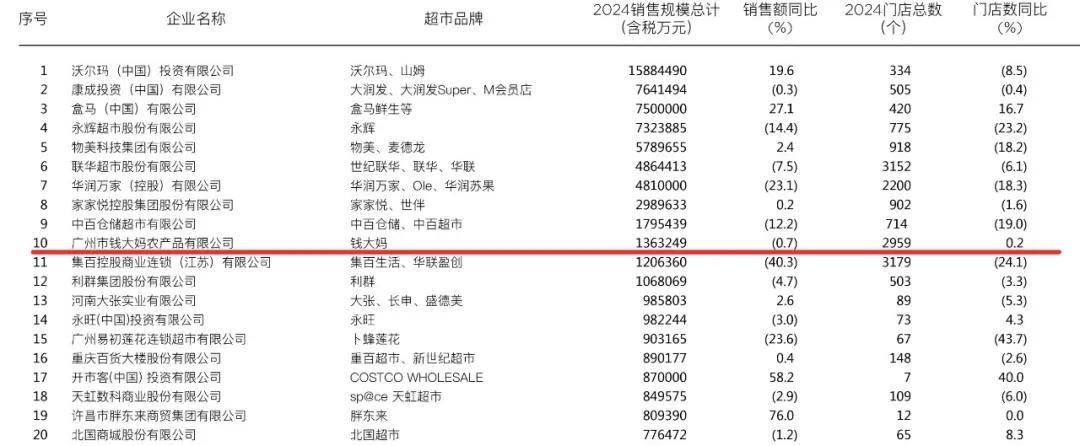
关系到千家万户一日三餐的生鲜零售行业,规模庞大却一直是一块难啃的骨头。 从垂直电商模式、前置仓、O2O到社区店等纷繁多样的创新经营模式,几年来,这一赛道从烈火烹油的扩张到走向稳健理性,无数明星项目折戟沉沙,却也 留存下了一个规模百亿级的实体店巨头——钱大妈。 2025年,中国连锁协会(CCFA)曾发布2024年中国商超排名,钱大妈以136.32亿元的年销售额排到了第10位,超过了永旺、开市客、胖东来等众多耳熟能 详的知名商超,排在钱大妈前面的则是沃尔玛、大润发、盒马、物美、世纪联华、华润万家等老牌商超品牌,虽然其主阵地在华南,却已在全国商超零售界 跻身前十。 | 序号 | 企业名称 | 超市品牌 | 2024销售规模总计 | 销售额同比 | 2024门店总数 | 门店数同比 | | --- | --- | --- | --- | --- | --- | --- | | | | | (含税力元) | (%) | (1) | (%) | | 1 | 沃尔玛(中国) 投资有限公司 | 沃尔玛、山姆 | 15884490 | 19.6 | 334 | (8.5) | | 2 | 康成投资(中国)有限公司 | 大润发、 ...

永辉超市:折价出售云金科技股权致投资亏损近9100万元 收监管工作函
2 1 Shi Ji Jing Ji Bao Dao· 2026-01-26 02:32
Core Viewpoint - Yonghui Supermarket (601933.SH) has decided to terminate the public transfer of its 28.095% stake in Yonghui Yunjin Technology Co., Ltd. due to prolonged timelines and unsuccessful attempts to find qualified buyers, opting instead for a private transfer to existing shareholder Shanghai Paihui Technology Co., Ltd. for a total price of 80 million RMB [1] Group 1: Transaction Details - The decision to terminate the public transfer was influenced by the lengthy process of soliciting potential buyers and the failure to attract suitable offers despite two price reductions [1] - The final agreement price of 80 million RMB is significantly lower than the book net asset value of approximately 171 million RMB, resulting in an expected investment loss of about 90.88 million RMB [1] Group 2: Market Feedback and Pricing - The transaction price was determined based on market feedback received during the earlier public listing process, which included price adjustments to 153 million RMB and 120 million RMB [1] - The company will no longer hold any equity in Yunjin Technology following the completion of this transaction [1]

双融日报-20260126
Huaxin Securities· 2026-01-26 01:28
2026 年 01 月 26 日 双融日报 --鑫融讯 分析师:万蓉 S1050511020001 wanrong@cfsc.com.cn 市场情绪:73 分(较热) 最近一年大盘走势 资料来源:Wind,华鑫证券研究 -10 -5 0 5 10 15 20 25 30 (%) 沪深300 相关研究 ▌ 华鑫市场情绪温度指标:(较热) 华鑫市场情绪温度指标显示,昨日市场情绪综合评分为 73 分,市场情绪处于"较热"。历史市场情绪趋势变化可参 考图表 1 ▌ 热点主题追踪 今日热点主题:商业航天、银行、消费 1、商业航天主题:埃隆·马斯克正积极推进 SpaceX 的 IPO 计划,目标在今年 7 月前完成。作为行业标杆,其上市预期 极大地提振了全球市场对整个商业航天赛道的关注与信心。 另外,低轨轨道和频谱资源遵循"先占先得"的国际规则。 数据显示,可用轨位空间已十分紧张,中国已申请超 20 万颗 卫星的轨道频率,这直接倒逼各国加快卫星制造与发射节奏 以抢占资源,是行情核心驱动力。相关标的:中国卫星 (600118)、航天电子(600879) 2、银行主题:银行股具有高股息特性,如中证银行指数的股 息率高达 6. ...
研判2026!中国药食同源行业政策汇总、销售额、销量、竞争格局及发展趋势分析:市场需求爆发,新兴成分表现出强劲增长势头[图]
Chan Ye Xin Xi Wang· 2026-01-26 01:21
Core Insights - The health-conscious consumer trend is driving demand for food products that offer health benefits, leading to increased interest in "food-medicine" products like goji berries, yam, and red dates [1][3][4] Industry Overview - The "food-medicine" concept is rooted in traditional Chinese medicine, emphasizing the dual role of certain foods as both nutrition and medicine [3] - The market for "food-medicine" products in China is projected to reach 56.78 billion yuan in 2024, with a year-on-year growth of 3% [1][6] Market Dynamics - The nutritional health food market in China is expected to grow to 678 billion yuan in 2024, reflecting a 7.3% increase year-on-year, providing a solid foundation for the "food-medicine" industry [6][7] - Sales of traditional ingredients like bird's nest and goji berries remain strong, while new ingredients like poria and astragalus are gaining traction, with astragalus seeing a 75.2% increase in sales [7][8] Competitive Landscape - The "food-medicine" industry features diverse competition from traditional pharmaceutical companies, food enterprises, new retail businesses, and internet health companies [9][10] - Major players include Tongrentang, Yunnan Baiyao, and Kang En Bei, which leverage their traditional medicine expertise to develop health-oriented food products [10][11] Development Trends - Future product development will focus on functional and scenario-specific offerings, catering to various consumer needs, such as liver health for night owls and digestive health for the elderly [12][15] - Cross-industry collaborations will become common, integrating "food-medicine" with baked goods, beverages, and other food categories to enhance flavor and health benefits [14][15] - Young consumers are emerging as a new growth segment, with increased interest in health products and innovative formats appealing to their preferences [15][16] - Stricter regulatory policies are expected to drive the industry towards higher quality standards, with ongoing support for traditional health culture and product innovation [16]


8点1氪:永辉学习胖东来后仍每天亏600万,亏损幅度进一步扩大;苹果客服回应iPhone Air降价2000元;贾国龙称将回归一线,不再打造个人IP
36氪· 2026-01-26 00:10
Core Viewpoint - Yonghui Supermarket has reported continuous losses for five consecutive years, with a total loss exceeding 11.6 billion yuan from 2021 to 2025, indicating a significant decline in its financial health and operational efficiency [4][5]. Financial Performance - In 2025, Yonghui is expected to report a net loss of 2.14 billion yuan, compared to a loss of 1.47 billion yuan in the previous year, reflecting an increase in daily losses to approximately 6 million yuan [4]. - Cumulative losses from 2021 to 2025 are as follows: 3.944 billion yuan in 2021, 2.763 billion yuan in 2022, 1.329 billion yuan in 2023, 1.465 billion yuan in 2024, and 2.14 billion yuan in 2025, totaling over 11.6 billion yuan [4]. Strategic Adjustments - Yonghui has attempted various strategies to reverse its declining performance, including launching "Super Species" for fresh food and dining, establishing Yonghui MINI community stores, and exploring warehouse stores and digital transformation, but these efforts have not yielded positive results [4]. - The company has faced increased costs due to store adjustments, supply chain reforms, and asset impairments, which have contributed to the widening losses [5]. Market Reaction - Following the announcement of a support plan from the management of "Fat Donglai," Yonghui's stock price rose over 20% in three consecutive trading days, indicating market optimism regarding the company's transformation efforts [5].

8点1氪丨永辉学习胖东来后仍每天亏600万,亏损幅度进一步扩大;苹果客服回应iPhone Air降价2000元;贾国龙称将回归一线,不再打造个人IP
3 6 Ke· 2026-01-26 00:04
Group 1: Yonghui Supermarket - Yonghui Supermarket (601933.SH) forecasts a net loss of 2.14 billion yuan for 2025, compared to a loss of 1.47 billion yuan in the previous year, indicating a daily loss of nearly 6 million yuan [2][3] - This marks Yonghui's fifth consecutive year of losses, with cumulative losses exceeding 11.6 billion yuan from 2021 to 2025 [2] - The company has attempted various strategies for recovery, including launching "Super Species" and exploring community stores, but these efforts have not reversed the downward trend [2][3] Group 2: Apple - Apple has initiated a promotional campaign for the iPhone Air, reducing its price by 2,000 yuan, with potential total discounts reaching 2,500 yuan [3] - The promotion is limited to approximately 13,000 units available through direct sales channels [3] Group 3: Xiaomi - Xiaomi's founder Lei Jun announced that the new generation SU7 model is expected to have some sample cars available in stores before the Spring Festival [6] Group 4: BYD - BYD plans to export 1.3 million vehicles by 2026, aiming for a nearly 25% increase in deliveries to markets outside China [7] Group 5: NIO - NIO's subsidiary, Leidao, has achieved 91.36% progress towards its goal of doubling the number of battery swap stations, with over 7,309 new batteries invested as of January 24 [7] Group 6: Wuliangye - Wuliangye anticipates that the industry will gradually enter a recovery phase, supported by improving macroeconomic conditions and consumer demand [9] Group 7: Tesla - Tesla has introduced an 8,000 yuan subsidy for certain Model 3 variants, alongside financing options such as a 7-year low-interest plan [16] - The Model 3 rear-wheel drive version starts at 235,500 yuan, with various financing options available [16] Group 8: Leica Camera - Blackstone Group is considering selling its controlling stake in Leica Camera, with an estimated valuation of around 1 billion euros (approximately 8.21 billion yuan) [11] Group 9: Semiconductor Market - Samsung Electronics has raised NAND flash memory prices by over 100% in the first quarter, reflecting severe supply-demand imbalances in the semiconductor market [13]
“抄答案都抄不明白”,想学胖东来的超市怎么一家接一家倒下
Sou Hu Cai Jing· 2026-01-25 20:55
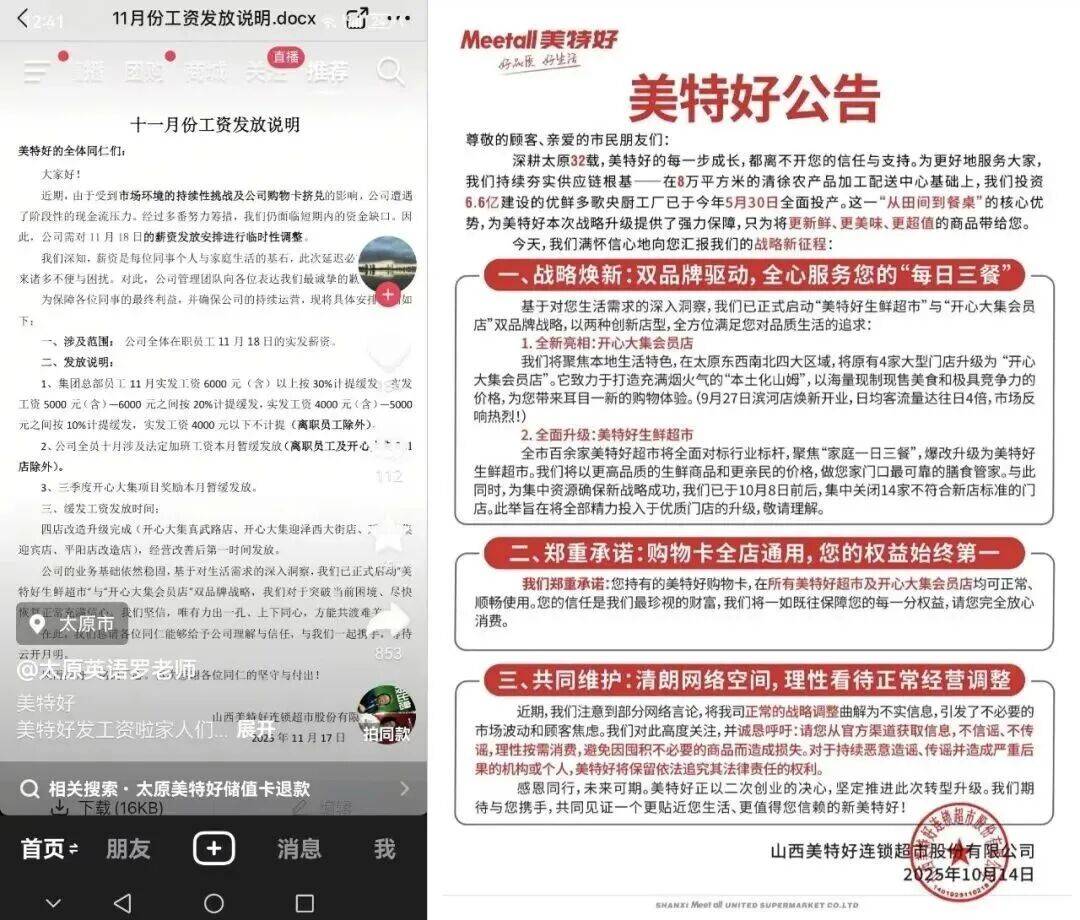
Core Viewpoint - The article discusses the challenges faced by companies attempting to emulate the successful business model of Pang Donglai, highlighting that many have struggled to achieve similar results despite extensive efforts to learn from his approach. Group 1: Challenges in Learning from Pang Donglai - Many companies, including Meitoh and Yonghui Supermarket, have attempted to adopt the "Pang Donglai model" but have encountered significant difficulties, with some even failing to graduate from training programs [1][3]. - Yonghui Supermarket has reported a projected annual loss, while other competitors like Zhongbai have seen revenue decline by nearly 20% year-on-year [3]. - Despite these struggles, Pang Donglai has achieved remarkable success, completing a sales target of 20 billion yuan ahead of schedule, which is 25% more than the previous year's total [3]. Group 2: Key Characteristics of the Pang Donglai Model - The essence of the "Pang Donglai model" lies in fundamentally changing the survival strategies of traditional retail stores, moving away from the reliance on key account (KA) sales [5][6]. - Traditional supermarkets often charge suppliers various fees to place products on shelves, which can significantly reduce profit margins [7][10]. - Pang Donglai, along with Costco and Sam's Club, has adopted a model that emphasizes direct profit from consumers rather than relying on supplier fees, allowing for better product selection and control over inventory [9][10]. Group 3: Management and Operational Insights - The article emphasizes the importance of effective management and organizational structure in successfully implementing the Pang Donglai model, noting that traditional procurement systems can hinder progress [11][25]. - High employee compensation and generous benefits at Pang Donglai are designed to reduce unethical behavior and improve overall management efficiency [14][20]. - The complexity of managing a large organization can dilute the effectiveness of detailed management practices, making it challenging for companies to replicate Pang Donglai's success [25][26].
新老零售如何破局“人心争夺战”?
Xin Lang Cai Jing· 2026-01-25 20:20
Core Insights - The retail industry is experiencing a significant transformation characterized by the emergence of new retail brands and the struggles of traditional retail giants, highlighting a divide in the market [1][5][7] Group 1: New Retail Trends - New retail brands like "悦活里" and ALDI are rapidly expanding, focusing on local consumer preferences and offering unique products to attract customers [1][2] - ALDI's strategy includes a limited but high-quality product selection, catering to essential household needs, which has resulted in a 30% increase in customer traffic on opening day [1][2] - "悦活里" emphasizes low prices and customer satisfaction guarantees, such as refunds for unsatisfactory products, enhancing customer loyalty [2] Group 2: Traditional Retail Challenges - Traditional retailers like IKEA and Carrefour are facing significant challenges due to changing consumer habits and increased competition from online platforms and discount stores [5][6] - IKEA's closure of stores reflects the difficulties of maintaining large retail spaces in a market that increasingly favors smaller, more flexible formats [5] - Carrefour's exit from the Chinese market illustrates the struggle of traditional supermarkets to compete with e-commerce and community group buying models [6] Group 3: Consumer-Centric Strategies - New retail companies are shifting their focus from price to value, emphasizing emotional connections and quality in their offerings [2][8] - Companies like 盒马 are building localized supply chains to ensure freshness and cater to regional tastes, enhancing their competitive edge [2] - The transformation of retail spaces into community hubs, as seen with 永辉 and 苏果, aims to meet diverse consumer needs beyond mere shopping [4] Group 4: Market Dynamics - The retail landscape is moving towards a model where multiple formats coexist, each catering to different consumer segments and preferences [9] - The rise of new retail brands is a response to the evolving consumer demand for personalized experiences and quality products [9] - The ongoing changes in the retail sector reflect a broader trend of consumer empowerment, where businesses must adapt to meet the specific needs of their customers [9]
春节将至,智利车厘子掀起消费热潮成抢手年货
Sou Hu Cai Jing· 2026-01-25 14:55
Core Insights - The "Chilean Cherry Ice Festival" will commence at various retail channels across China starting from December 2025, aiming to promote Chilean cherries as a seasonal winter fruit [1][3]. Group 1: Event Overview - The festival is initiated by the Chilean Fruit Exporters Association's Cherry Committee, combining modern consumption with traditional festive gifting and family gatherings to highlight the unique value of Chilean cherries in winter [3]. - Major national and regional retailers have begun terminal launch activities, including stores in Kunshan, Changsha, Shenzhen, Guangzhou, Zhengzhou, and Chengdu [1]. Group 2: Consumer Behavior - There has been a significant increase in the offline sales of cherries, with some stores experiencing stock shortages during weekends, indicating strong consumer demand [6]. - Consumers are starting to purchase New Year goods earlier this year, contributing to the increased sales of cherries [6]. Group 3: Market Positioning - Charif Christian Carvajal, the Eurasian Market Director of the Chilean Fruit Exporters Association, noted that the peak supply of Chilean cherries to China has passed, and supply will be limited during the Spring Festival due to the late timing of the holiday [8]. - Claudia Soler, Executive Director of the Chilean Cherry Committee, emphasized that Chilean cherries are an ideal winter fruit for Chinese families, highlighting their quality control and nutritional benefits [10]. Group 4: E-commerce Trends - An e-commerce platform manager reported a rapid increase in search keywords related to Chilean cherries, with sales achieving double-digit growth driven by online mechanisms such as live streaming [12]. Group 5: Supply Chain Dynamics - Due to adverse weather conditions in Chile and an earlier harvest period, the supply of Chilean cherries for the 2025/26 season is expected to be concentrated in a shorter timeframe in January, with reduced supply anticipated in February [15].