迎驾贡酒

Search documents
白酒业交出近十年“最差季报” 至暗时刻或许正是光明到来的前奏
Mei Ri Jing Ji Xin Wen· 2025-11-02 12:58
Core Viewpoint - The Chinese liquor industry is currently experiencing a significant downturn, referred to as its "darkest hour," with many companies reporting substantial declines in profits, including a 92.55% drop in net profit for Kuozi Jiao [1][2] Group 1: Industry Performance - The recent quarterly reports from the liquor industry are described as the "worst in a decade," with most companies showing accelerated profit declines [2] - Even leading companies like Kweichow Moutai reported a revenue of over 130 billion yuan with a 6.25% year-on-year growth in net profit, marking the lowest growth rate in nearly ten years [1][2] - The industry is transitioning from a phase of rapid growth to a more stable and mature development cycle, indicating a shift in investment logic [2][3] Group 2: Market Reactions - The market response to the poor performance reports has been mixed, with some investors remaining optimistic about a potential recovery, while others express concern [2][5] - Despite the negative reports, certain stocks like Gujing Gongjiu saw price increases, suggesting a potential market rebound and a shift towards rational investment considerations [5] Group 3: Long-term Outlook - The current downturn is seen as a necessary phase for the industry, allowing stronger companies to emerge and adapt, ultimately leading to a more resilient market [3] - High-end liquor and collectible old liquor maintain stable demand, providing a solid foundation for the industry despite overall demand slowing [4] - The high gross margins of leading companies, such as Kweichow Moutai at 91.29%, indicate that the long-term value of the liquor industry remains intact despite short-term adjustments [4]




迎驾酒业销售公司举办2025年度苏沪区域经销商培训
Sou Hu Cai Jing· 2025-11-02 08:51
Core Insights - The training event titled "Exploring Business Strategies Together for Development" was organized by Yingjia Liquor Sales Co., Ltd. to enhance collaboration with distributors and promote long-term growth [1] - The current Chinese liquor industry is undergoing significant transformation, presenting both opportunities and challenges, necessitating deeper cooperation between manufacturers and distributors [3] Group 1: Brand Development - The invited lecturer, Xiao Yue, provided a comprehensive overview of the Yingjia brand's development history and elaborated on the "Six Ecological" brewing system, emphasizing the unique quality of Yingjia Tribute Liquor [5] - The brand philosophy highlighted the importance of natural ingredients and consumer perceptions of health and taste, reinforcing Yingjia's positioning as a leading ecological liquor brand in China [5] Group 2: Financial Management - Jin Beibei, Deputy Director of Financial Management Center, discussed enhancing financial management and risk prevention capabilities through tax management and real case studies, aiding distributors in navigating financial management challenges [6] Group 3: Market Analysis - Zhou Peng delivered a forward-looking and practical course on the current state and future trends of the liquor industry, analyzing changes in consumption scenarios, channel operations, industry regulations, and manufacturer-distributor relationships [8] Group 4: Training Outcomes - The training was recognized by participating distributors for significantly improving their business management, financial control, and operational capabilities, thereby strengthening mutual trust and collaboration with the manufacturer [10] - Yingjia Liquor Sales Co., Ltd. aims to continue implementing the "Manufacturer-Distributor Unity for Mutual Benefit" philosophy and establish a long-term training mechanism for distributors [10]


白酒:绝对收益正当时
GOLDEN SUN SECURITIES· 2025-11-02 06:48
Investment Rating - The report maintains an "Accumulate" rating for the industry, indicating a favorable outlook for investment in the sector [5]. Core Insights - The report suggests that the absolute value of investment in the liquor sector is becoming increasingly evident, with a recommendation to allocate resources based on short-term marginal changes and long-term operational quality of leading companies [1][7]. - The report highlights that the sales pressure in the liquor market has peaked, with expectations for demand recovery in the future [2][7]. Summary by Sections Sales Dynamics - The report notes that the sales environment for liquor has improved since Q3 2025, following a period of significant decline in Q2 2025 due to regulatory pressures on public consumption and business banquets [2]. - Major brands like Moutai have shown signs of stabilization and recovery in sales, benefiting from rigid demand in wedding and family banquet scenarios [2]. Financial Performance - In Q3 2025, the liquor sector reported revenues of 78.69 billion yuan, a year-on-year decline of 18.4%, with net profits down 22.0%, marking the largest quarterly adjustments since 2013 [3]. - The cumulative revenue for the first three quarters of 2025 was 320.11 billion yuan, down 5.8% year-on-year, while net profit decreased by 6.9% [3]. Historical Context - The report draws parallels with previous downturns in the liquor industry, noting that stock prices often recover before fundamental performance improves, as seen in the 2013-2015 adjustment period [4][7]. - It emphasizes that during past recovery phases, stock prices increased before a rebound in sales and financial reports [7]. Valuation and Market Sentiment - The report indicates that the current valuation of the liquor sector is at historical lows, with leading companies like Moutai and Wuliangye setting benchmarks for dividends, suggesting a strong support for high-quality stocks [7]. - The overall sentiment in the market is shifting towards optimism as supply-side adjustments and demand stabilization are anticipated [7].
A股一哥急了?茅台砸60亿回购还不够,大股东再掏最高33亿增持!
Sou Hu Cai Jing· 2025-11-02 05:03
Core Viewpoint - Kweichow Moutai's recent stock buyback and share repurchase actions indicate a response to declining stock prices and market confidence, raising questions about the company's long-term performance and market strategy [1][3][5]. Group 1: Buyback and Shareholding Actions - Kweichow Moutai announced its first-ever stock buyback, investing 6 billion yuan to repurchase shares, which were subsequently canceled, reducing the total share capital and increasing the value of remaining shares [1][3]. - The major shareholder, Moutai Group, plans to increase its stake by 3 to 3.3 billion yuan, signaling confidence in the company's future despite recent stock price declines from 2600 yuan to around 1200 yuan [3][5]. - The timing of the buyback coincided with a significant drop in stock price, raising suspicions about whether this move reflects genuine confidence or a desperate attempt to stabilize the market [5][7]. Group 2: Financial Performance and Concerns - For the first three quarters of 2025, Kweichow Moutai reported revenue of 130.9 billion yuan, a growth of 6.32%, and a net profit of 64.6 billion yuan, up 6.25%, but the growth rate has significantly slowed, with Q3 revenue growth at only 0.35% [9][11]. - The company's product line shows uneven performance, with Moutai liquor revenue increasing by 7.26%, while series liquor sales plummeted by 34%, indicating a failure to establish a second growth curve [11][13]. - The wholesale channel saw a 14.39% increase, but direct sales dropped by 14.87%, with the once-promising "i Moutai" revenue halving, suggesting reliance on distributors for performance rather than direct sales [11][15]. Group 3: Industry Context and Challenges - The challenges faced by Kweichow Moutai reflect broader issues within the Chinese liquor industry, which is experiencing a downturn characterized by reduced consumption and high inventory levels [13][15]. - High-end liquor prices are under pressure, with competitors like Wuliangye and Luzhou Laojiao seeing significant price drops, indicating a tough market environment [15][17]. - Despite a 38% market share for top brands, the sustainability of Kweichow Moutai's premium pricing and brand reputation is in question if high-end consumption does not recover [15][17].
白酒业新观察:“马太效应”愈发显著
Shang Hai Zheng Quan Bao· 2025-11-01 12:57
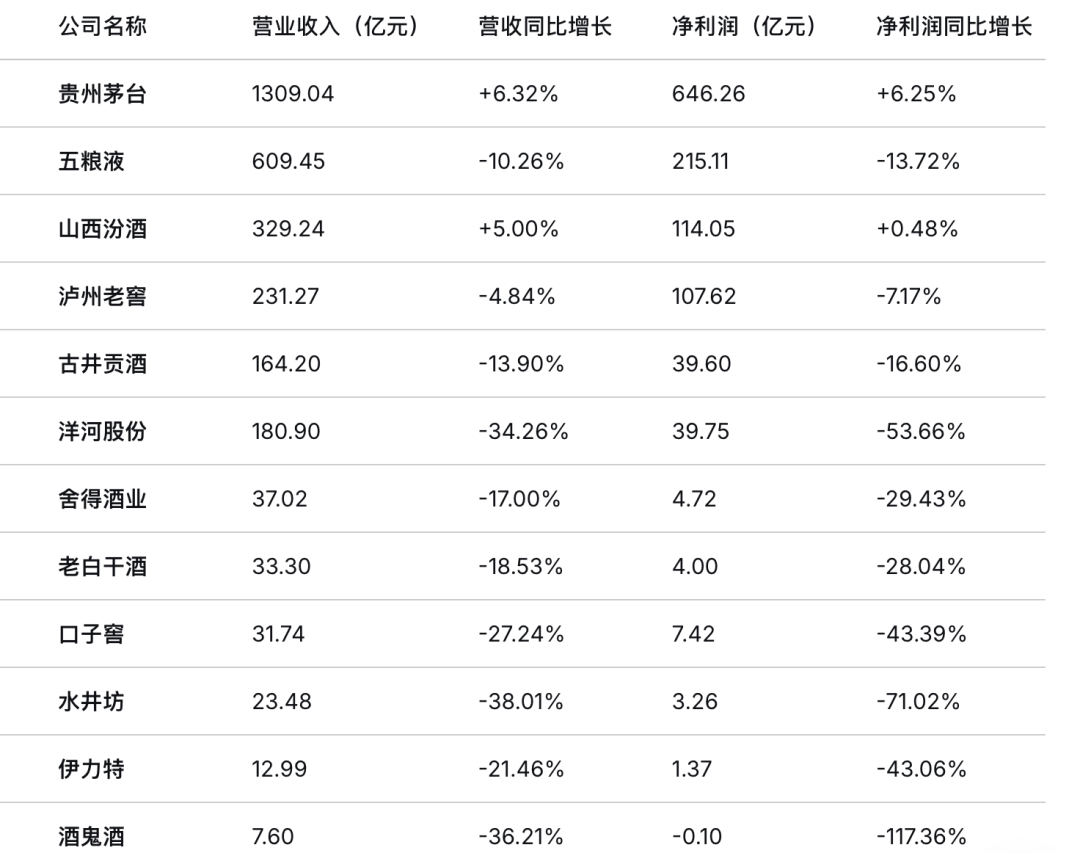
Core Viewpoint - The high-end liquor industry is struggling with growth, while mid-range and regional liquor companies are experiencing significant declines in performance, as evidenced by the third-quarter reports of 20 A-share liquor companies, highlighting challenges such as weak consumption, high channel inventory, and falling prices [1][8]. Company Performance Summary - Guizhou Moutai reported revenue of 130.9 billion yuan, a year-on-year increase of 6.32%, and a net profit of 64.6 billion yuan, up 6.25% [2][9]. - Wuliangye's revenue was 60.9 billion yuan, down 10.26%, with a net profit of 21.5 billion yuan, a decline of 13.72% [2][11]. - Shanxi Fenjiu achieved revenue of 32.9 billion yuan, a 5.00% increase, but its net profit fell by 1.4% to 39.7 billion yuan [2][10]. - Luzhou Laojiao's revenue decreased by 4.84% to 23.1 billion yuan, with a net profit of 10.8 billion yuan, down 7.17% [2][12]. - The performance of regional liquor companies like Kuaijie and Yingjia Gongjiu showed significant declines, with Kuaijie reporting a 46.23% drop in revenue and a 92.6% decrease in net profit [4][6]. Industry Trends - The third quarter showed a clear downward trend, with many regional liquor companies experiencing accelerated declines, and some even reporting losses [3][8]. - The "Matthew Effect" is becoming more pronounced, with only Guizhou Moutai and Shanxi Fenjiu achieving positive growth in both revenue and net profit among the 20 companies [8][13]. - The overall industry is undergoing a profound supply-side adjustment, with strong brand power and national distribution allowing leading companies to withstand cyclical fluctuations, while smaller companies face greater challenges [13]. Market Outlook - Expectations for the upcoming Mid-Autumn Festival and National Day indicate a potential 20%-30% decline in overall liquor demand, with inventory expected to increase by 10%-20% [13]. - The current high channel inventory and weak consumption scenarios suggest that the liquor industry will continue to face significant pressure into the 2026 Spring Festival [13].



白酒业“最差季报”,是至暗时刻也是价值投资的光明前奏
Mei Ri Jing Ji Xin Wen· 2025-11-01 11:01
Core Viewpoint - The Chinese liquor industry is currently experiencing its "darkest moment," with significant declines in performance across many companies, highlighting a growing industry divide [2][3]. Industry Performance - Most liquor companies reported accelerated declines in their Q3 2025 performance, with some regional firms experiencing nearly triple-digit declines in net profit, such as Kuaizi Liquor, which saw a 92.6% drop in net profit [2]. - Even industry leader Kweichow Moutai managed to achieve 130 billion yuan in revenue with a 6.32% year-on-year growth, but this growth rate is the lowest in nearly a decade [2]. Market Sentiment - The market reaction to the poor performance has been mixed, with various stakeholders expressing skepticism, indifference, pessimism, and optimism about the industry's future [3]. - The current situation is viewed as an opportunity for investors to reassess the investment logic in the liquor industry, focusing on the transparency and courage shown by companies in reporting their true performance [3]. Industry Cycle - The liquor industry is transitioning from a phase of rapid growth to a period of stable, high-quality development, indicating that the era of high-speed growth is over [4]. - Historical context shows that the industry has faced similar challenges in the past, suggesting that the current downturn may lead to a stronger, more resilient market in the long run [4]. Competitive Landscape - The differentiation within the liquor industry is intensifying, with leading companies leveraging strong brand power and channel control to capture market share from smaller firms, resulting in increased industry concentration [5]. - The core value of the liquor industry is shifting from explosive growth to resilience and stable returns, prompting investors to recalibrate their investment strategies [5]. Consumer Trends - Despite a slowdown in overall demand growth, high-end liquor and collectible aged liquor maintain solid demand, with business consumption gradually recovering, providing a stable foundation for the industry [5]. Business Model Strengths - Leading liquor companies possess strong competitive advantages, including addictive consumption patterns, scarcity, and cultural premiums, which contribute to high profit margins, such as Moutai's 91.29% and Luzhou Laojiao's 87.11% [6]. - The industry's cash flow remains relatively stable during the downturn due to a "pay first, deliver later" model and the appreciation of aged liquor, ensuring long-term value is not diminished by short-term adjustments [6]. Market Reaction - The market's initial shock to the poor performance reports has shifted towards a more rational assessment, with some stocks, like Gujing Gongjiu, rising nearly 7% following the announcements, indicating a potential recovery and value reallocation in the industry [6].
暴跌92%,白酒三季报的第一颗“雷”炸了
商业洞察· 2025-11-01 09:24
Core Viewpoint - The article discusses the significant decline in the performance of Kuozi Jiao, highlighting a 46.23% drop in quarterly revenue and a 92.55% decrease in net profit, indicating a troubling trend for the company and the broader challenges facing the liquor industry in China [4][9][11]. Financial Performance - Kuozi Jiao's Q3 2025 report shows a total revenue of 6.43 billion yuan, down 46.23% year-on-year, and a net profit of 269.65 million yuan, down 92.55% [11]. - For the first three quarters of 2025, the company reported a total revenue of 31.74 billion yuan, a decrease of 27.24%, and a net profit of 7.42 billion yuan, down 43.39% [9][11]. - The sales of high-end liquor fell by 28%, while mid-range liquor dropped by 15%, although low-end liquor saw a 25% increase, which contributed minimally to overall profits due to its low revenue share [9][12]. Market Dynamics - The overall liquor market in China is under pressure, particularly affecting mid to high-end products that rely on business banquets and gift-giving, leading to a contraction in consumption scenarios [12][23]. - Despite an increase in the number of distributors, the revenue from both provincial and out-of-province markets declined, indicating that the expansion did not translate into actual sales growth [12][11]. Competitive Landscape - Kuozi Jiao has fallen from being the second-largest liquor brand in Anhui to third, overtaken by Yingjia Gongjiu, which has seen significant growth [14][15]. - The company initially aimed for a "100 billion" revenue target but has struggled to penetrate the mid to high-end market effectively, missing out on opportunities as competitors have solidified their positions [14][15]. Management Actions - The founder, Liu Ansheng, has been reducing his stake in the company since 2018, cashing out over 1 billion yuan, which raises concerns about the management's confidence in the company's future [16][19]. - High-level executives have also engaged in significant stock pledges, indicating potential financial strain within the management team [19][20]. Industry Context - The broader liquor sector has faced challenges, with major brands like Kweichow Moutai and Wuliangye also reporting stagnant growth, reflecting a general downturn in the industry [23][24]. - In contrast to Kuozi Jiao, other companies have initiated buyback and stabilization measures to support their stock prices, highlighting a lack of similar proactive strategies from Kuozi Jiao [24].

10月制造业PMI回落,白酒交出最惨三季报 | 财经日日评
吴晓波频道· 2025-11-01 00:30
Group 1: Manufacturing and Economic Indicators - The official manufacturing PMI for October dropped to 49%, a decrease of 0.8% from the previous month, indicating a contraction in the manufacturing sector [2] - Key indices such as production, new orders, and employment are all below the critical point of 50%, reflecting ongoing challenges in demand recovery and production rationalization [2] - The non-manufacturing business activity index slightly increased to 50.1%, but the recovery in service consumption during the holiday period was limited, suggesting that internal demand remains a key constraint on economic recovery [3] Group 2: Local Government Debt and Fiscal Policy - Local governments are allowed to issue an additional 500 billion yuan in bonds to increase spending, on top of the previously arranged 5.2 trillion yuan for the year [4] - The majority of the new debt is aimed at repaying old debts rather than expanding fiscal capacity, indicating a cautious approach to fiscal management amid declining land revenue [4][5] - Infrastructure investment growth remains low at 1.1% year-on-year, highlighting the challenges faced by local governments in stimulating economic activity [4] Group 3: Household Savings and Wealth Distribution - As of the end of 2024, 34 cities have household savings exceeding 1 trillion yuan, with Beijing and Shanghai leading the rankings [6] - The increase in household savings reflects the economic development's impact on overall wealth, particularly in first and second-tier cities [6][7] - However, the strong savings growth also indicates a heightened savings willingness among residents, which could hinder future consumption and investment [7] Group 4: Financial Regulation and Illegal Activities - A meeting was held to address the crackdown on illegal financial activities conducted through apps, emphasizing the need for robust measures to protect citizens' financial security [8][9] - The shift of illegal financial activities from offline to online platforms poses significant challenges for regulatory oversight, necessitating cross-departmental collaboration [9] Group 5: Alcohol Industry Performance - The white liquor industry reported significant declines in performance, with some companies experiencing nearly 100% drops in net profit year-on-year [10] - The overall decline in the industry reflects broader consumer market challenges, with reduced demand for business banquets and gift-giving impacting sales [10][11] - Despite the struggles, leading brands like Kweichow Moutai managed to maintain stable revenue and profit growth, indicating a potential for recovery in the future [11] Group 6: Banking Sector Developments - Agricultural Bank of China surpassed Bank of America to become the second-largest bank globally by market capitalization, with a total market value of approximately 2.74 trillion yuan [12] - The bank's strong performance is attributed to its systemic importance and the recent supportive policies aimed at stabilizing the real estate market [12][13] - However, the bank's growth primarily reflects its domestic focus, suggesting that while the Chinese banking sector is growing, its international influence still has room for improvement [13] Group 7: Apple Inc. Financial Results - Apple reported a 7.9% increase in net sales for the third quarter, reaching $102.47 billion, with net profit soaring by 86.4% to $27.47 billion [14] - The strong performance was driven by solid sales across various product lines, particularly the iPhone, which saw a 6.1% increase in sales [14] - Despite the positive results, concerns remain about the long-term sustainability of iPhone sales growth, particularly in light of competitive pressures and the need for innovative product features [15] Group 8: Stock Market Overview - The stock market experienced fluctuations, with the Shanghai Composite Index falling by 0.81% amid a mixed performance from individual stocks [16] - Despite the overall decline, many stocks saw gains, particularly in the consumer sector, as the market reacted to the completion of third-quarter earnings reports [16] - The market's behavior reflects a tendency to interpret earnings results through a lens of speculation, highlighting the ongoing challenges in achieving value-based investment strategies [16]

293股今日获机构买入评级 7股上涨空间超50%
Zheng Quan Shi Bao Wang· 2025-10-31 15:11
Summary of Key Points Core Viewpoint - A total of 293 stocks received buy ratings from institutions today, with 5 stocks having their ratings upgraded and 4 stocks receiving initial coverage from institutions [1]. Institutional Ratings - 358 buy rating records were published today, covering 293 stocks, with Yingjia Gongjiu receiving the highest attention with 5 buy ratings [1]. - Among the rated stocks, 110 records provided future target prices, with 7 stocks showing an upside potential exceeding 50%. Gujing Gongjiu has the highest upside potential at 86.34%, with a target price of 300.00 yuan set by Huachuang Securities on October 31 [1]. - Other stocks with significant upside potential include Wuliangye and Minsheng Bank, with upside potentials of 80.69% and 63.68%, respectively [1]. - There were 4 initial coverage ratings today, involving stocks such as Dameng Data and Goldwind Technology [1]. - 5 stocks had their ratings upgraded, including Kingsoft Office and Kangnong Agriculture [1]. Market Performance - Stocks with buy ratings averaged a slight increase of 0.01%, outperforming the Shanghai Composite Index. A total of 159 stocks saw price increases, with stocks like Yaxiang Integration, Youyou Food, and Enjie Co., Ltd. hitting the daily limit [1]. - Stocks with significant declines included Stone Technology, Lankai Technology, and Shenzhen South Circuit, with declines of 12.04%, 10.33%, and 8.12%, respectively [1]. Earnings Performance - Among the rated stocks, 293 have reported third-quarter earnings, with Te Yi Pharmaceutical showing the highest year-on-year net profit growth of 985.18%, achieving a net profit of 65.2171 million yuan [2]. - Other notable performers in terms of net profit growth include Changying Tong and Godewei, with year-on-year increases of 933.24% and 837.57%, respectively [2]. Industry Focus - The electronics industry is the most favored, with 27 stocks such as Zhongwei Company and Xingsen Technology listed among the buy-rated stocks. The power equipment and pharmaceutical biology sectors also received attention, with 26 and 22 stocks, respectively, on the buy rating list [2].

吃喝板块反攻号角吹响!食品ETF(515710)盘中涨超1%,近5日吸金1.55亿元!低位布局正当时?
Xin Lang Ji Jin· 2025-10-31 11:48
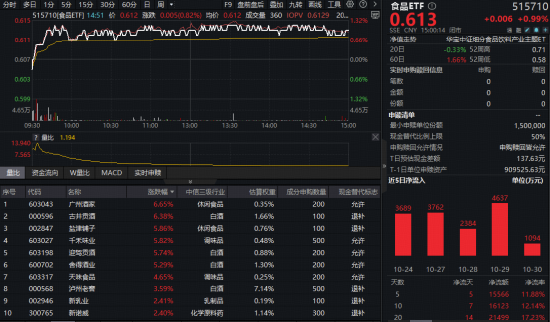
Core Viewpoint - The food and beverage sector is experiencing a significant upward trend, with the Food ETF (515710) showing a notable increase in value and attracting substantial investment in recent trading days [1][3][4]. Group 1: Market Performance - The Food ETF (515710) opened with a rapid increase, reaching a maximum intraday gain of 1.32% and closing with a gain of 0.99% [1]. - Key stocks in the sector, such as Guangzhou Restaurant and Gujing Gongjiu, saw increases exceeding 6%, while several others, including Yanjinpuzi and Qianhe Flavor, rose over 5% [1]. - The Food ETF has attracted over 155 million yuan in the last five trading days and 214 million yuan over the past 20 trading days [1]. Group 2: Industry Outlook - The food and beverage industry is characterized as a typical cyclical sector, with its performance closely tied to the external economic environment. Improved fiscal and monetary policies are expected to enhance consumer sentiment [3]. - Leading companies in the sector are demonstrating strong recovery capabilities despite a weak domestic demand environment, indicating a trend where the strong continue to thrive [3]. - The valuation of the food and beverage sector remains low, with the price-to-earnings ratio of the Food ETF's underlying index at 19.89, placing it in the lower range historically [3]. Group 3: Investment Recommendations - Analysts suggest focusing on high-quality white wine leaders and consumer goods leaders that are positioned at the bottom of the industry cycle [3][4]. - The white wine sector is showing signs of bottoming out, indicating a potential phase for investment [4]. - The Food ETF is recommended as a core asset for investors looking to gain exposure to the food and beverage sector, with a significant portion of its holdings in high-end and mid-range liquor stocks [5].