隆基绿能

Search documents
光伏行业观点更新
2026-01-30 03:11
光伏行业观点更新 20260129 摘要 光伏行业反内卷工作虽受阻,但工信部等部门正推动调整方案,重心在 于防止低于成本销售,同时推进产能整合,市场反应平淡,期待更明确 的目标。 光伏基本面偏弱,头部企业业绩预亏,硅料成交低迷,价格短期稳定。 春节后需求恢复情况是关键,国内 2026 年装机规模预期下调至 200GW 或更低,年中或对 2027 年需求有更清晰判断。 光伏板块筹码低配,基本面和资金面均处底部,存在投资机会。关注今 年年底前后需求恢复情况,或是周期拐点。推荐隆基、通威、福斯特等 各环节龙头。 马斯克计划建设 200GW 光伏产能,一半用于地面,一半用于太空,北 美公司开始审厂,太空光伏与地面光伏产能规划正在推进,太空光伏发 展潜力巨大。 预计 2026 年太空光伏行业将有实际订单,年底前或有设备交付,北美 客户态度积极,价格不敏感,存在超预期可能性。 Q&A 请介绍一下光伏行业近期在反内卷方面的最新进展和市场反馈。 近期光伏行业在反内卷方面有一些重要进展。去年(2025 年)成立了收购硅 料的合资平台公司,带动了产业链价格。然而,由于各部委诉求不同,落实细 节工作时遇到了一些阻碍。前两周,市场监 ...
中银证券:国内反内卷+马斯克太空光伏扩产共振 关键仍在设备、材料
智通财经网· 2026-01-30 02:56
Group 1 - The core viewpoint is that Musk plans to build 100GW of photovoltaic capacity, which may extend upstream to silicon materials and wafers, benefiting core equipment in silicon materials, wafers, batteries, and modules, with long-term market expansion potential for material companies [1][4] - The Ministry of Industry and Information Technology (MIIT) of China has reiterated the "anti-involution" theme in the photovoltaic industry, indicating a high probability of self-imposed production limits, which will optimize the battery and module landscape [1][4] - The meeting held by MIIT on January 28, 2026, emphasized the need for market-based and legal measures to promote healthy competition and rational development in the photovoltaic industry, aiming to prevent monopolistic risks and ensure price rationalization across the industry chain [1][3] Group 2 - Musk's announcement of expanding photovoltaic capacity is not limited to batteries and modules but may also include upstream silicon materials and wafers, which could lead to increased orders for domestic photovoltaic equipment manufacturers [2][4] - China's space photovoltaic industry is accelerating its commercialization, with various technological routes such as gallium arsenide, crystalline silicon, and perovskite being explored, indicating a diverse development landscape [3] - The report recommends several companies, including Foster, JinkoSolar, and LONGi Green Energy, as potential beneficiaries of the expanding photovoltaic market, while also suggesting to pay attention to other companies like Aotaiwei and Shuangliang Energy [4]


光伏概念股走低,相关ETF跌超4%
Sou Hu Cai Jing· 2026-01-30 02:52
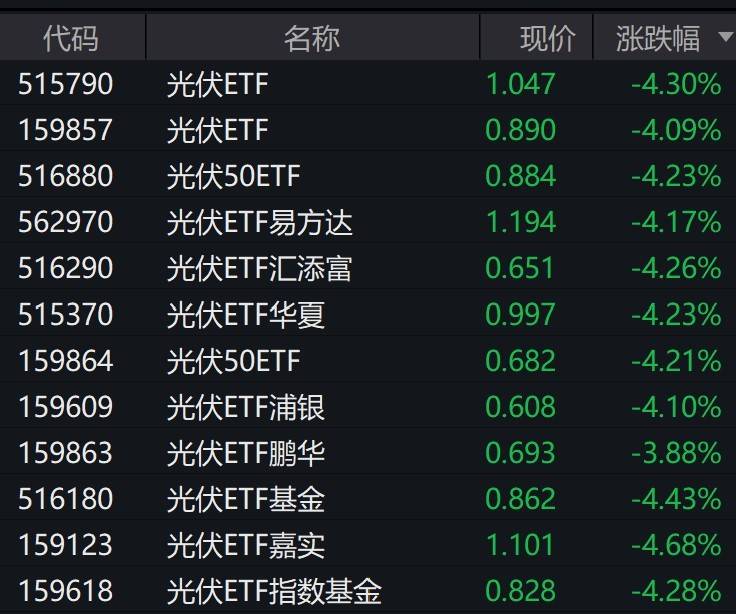
Group 1 - The photovoltaic concept stocks have declined, with TCL Zhonghuan falling over 6%, Maiwei Shares and Jiejia Weichuang dropping over 5%, and Longi Green Energy, TCL Technology, and Tongwei Shares decreasing over 4% [1] - Affected by the market, photovoltaic-related ETFs have dropped over 4% [1] Group 2 - Various photovoltaic ETFs have reported significant declines, with the following notable changes: - Photovoltaic ETF 515790 at 1.047, down 4.30% - Photovoltaic ETF 159857 at 0.890, down 4.09% - Photovoltaic 50 ETF 516880 at 0.884, down 4.23% - Photovoltaic ETF E Fund 562970 at 1.194, down 4.17% - Photovoltaic ETF Huatai-PineBridge 516290 at 0.651, down 4.26% [2] - Some brokerages indicate that the current valuation of the photovoltaic industry remains historically low. Looking ahead, measures regarding product sales price to combat internal competition, mergers and acquisitions among companies, increased industry entry barriers, and improved product quality standards are expected to be implemented [2] - The competitive landscape and industrial chain ecology of the photovoltaic industry are anticipated to optimize, presenting opportunities for valuation recovery [2]

AI这趟车,不上怕掉队,上了怕翻车
吴晓波频道· 2026-01-30 00:30
Core Viewpoint - China has been the most aggressive testing ground for industrial intelligence over the past decade and is set to build the world's most advanced artificial intelligence factory clusters in the next decade [2][43]. Group 1: AI in the Workplace - Employees have mixed feelings about AI, hoping it will reduce their workload while fearing job displacement, with 75% of decision-makers more concerned about missing AI opportunities than wasting money [3][4]. - Many manufacturing enterprises are hesitant to adopt AI due to uncertainty about implementation and fear of ineffective investments [4][6]. Group 2: Challenges in AI Adoption - The primary challenges faced by manufacturing companies in adopting AI include: - **Data Utilization**: Many factories invest heavily in data collection but end up with "dead" data that is outdated or inconsistent, making it difficult to train AI effectively [6][7]. - **Overwhelming Technology Choices**: The vast array of AI applications in manufacturing creates confusion, leading companies to either follow trends blindly or remain inactive [8]. - **High Cost of Trial and Error**: The unique nature of industrial applications means that the costs associated with failed AI implementations can be prohibitively high [9][10]. Group 3: Successful AI Implementation Strategies - Successful companies often start by addressing a specific, pressing issue rather than attempting to create a comprehensive smart factory from the outset [12][14]. - AI serves as a "super assistant" to human workers, solving problems that were previously difficult or costly to address [15]. Group 4: Case Studies - In the Hai Tian factory, AI has transformed traditional processes, such as selecting soybeans, by using advanced scanning technology to improve efficiency and accuracy [17][18]. - The Haier factory employs a VR welding training system that enhances safety and reduces training time by 30% [20]. - At the Zeekr factory, AI systems optimize collaboration between robots and workers, resulting in a 30% increase in assembly efficiency and a 25% reduction in defect rates [23]. Group 5: AI+Manufacturing Practical Training Camp - The "AI+Manufacturing" practical training camp aims to help enterprises understand and implement AI effectively by providing real-world case studies and expert guidance [28][30]. - Participants will engage in deep discussions with factory leaders and AI engineers to understand the rationale behind their AI implementations and the challenges faced [32]. - The camp emphasizes output, with each participant leaving with a personalized action plan tailored to their company's specific needs and constraints [34][35].

中银晨会聚焦-20260130
Bank of China Securities· 2026-01-29 23:34
证券研究报告——晨会聚焦 2026 年 1 月 30 日 | 市场指数 | | | | --- | --- | --- | | 指数名称 | 收盘价 | 涨跌% | | 上证综指 | 4157.98 | 0.16 | | 深证成指 | 14300.08 | (0.30) | | 沪深 300 | 4753.87 | 0.76 | | 中小 100 | 8663.51 | (0.91) | | 创业板指 | 3304.51 | (0.57) | 资料来源:同花顺,中银证券 中银晨会聚焦-20260130 ■重点关注 【电力设备】光伏行业动态点评—国内反内卷+马斯克太空光伏扩产共振, 关键仍在设备、材料*武佳雄 顾真 产品组 证券分析师:王军 (8621)20328310 jun.wang_sh@bocichina.com 证券投资咨询业务证书编号:S1300511070001 重点关注 【电力设备】光伏行业动态点评—国内反内卷+马斯克太空光伏扩产共振,关键仍在设备、材料 武佳雄 顾真 马斯克再次表示将建设 100GW 光伏产能,其产能规划可能往上游硅料、硅片延伸,硅料、硅片、电池、组件核心设 备受益,长期看材料 ...
隆基绿能:截至2026年1月20日公司股东人数854838户
Zheng Quan Ri Bao Wang· 2026-01-29 13:41
Core Viewpoint - Longi Green Energy (601012) reported that as of January 20, 2026, the number of shareholders reached 854,838 [1] Group 1 - The company is actively engaging with investors through an interactive platform [1] - The increase in shareholder numbers indicates growing interest and confidence in the company [1]

隆基绿能:目前替代银浆技术中试已经完成
Zheng Quan Ri Bao Wang· 2026-01-29 13:41
Group 1 - The core viewpoint of the article is that Longi Green Energy is actively advancing the commercialization of alternative silver paste technology, with pilot tests completed and large-scale production capacity construction underway [1] Group 2 - The company has successfully completed the pilot testing phase for the alternative silver paste technology [1] - Large-scale production capacity construction has already begun for the alternative silver paste technology [1]
工信部召开座谈会,强调以产能调控等手段破除光伏“内卷”
第一财经· 2026-01-29 12:42
Core Viewpoint - The article discusses the ongoing efforts by regulatory authorities to address the "involution" issues within the photovoltaic (PV) industry, emphasizing the need for a return to rational competition and sustainable development [2][5]. Group 1: Industry Overview - The Chinese photovoltaic industry has been a global leader in scale, industrial chain layout, technology, and application, with manufacturing output increasing from 750 billion yuan in 2021 to 1.75 trillion yuan in 2023, and expected to remain above 1 trillion yuan in 2024 [2]. - By 2025, the installed capacity of wind and solar power in China is projected to exceed 1.8 billion kilowatts, with solar power capacity reaching 1.2 billion kilowatts, marking a year-on-year growth of 35.4% [2]. Group 2: Challenges Faced - The rapid expansion of the domestic PV industry has led to significant supply-demand mismatches and chaotic low-price competition, resulting in severe "involution" issues [3]. - From 2022 to 2025, the price of domestic PV modules has dropped from 2 yuan per watt to around 0.6 yuan, while silicon material prices have plummeted from a peak of 300,000 yuan per ton to about 55,000 yuan, causing many companies to sell products below mainstream cash cost lines [4]. - As a result, the industry has faced widespread losses since the fourth quarter of 2023, with major companies like Longi Green Energy, JinkoSolar, and Tongwei expected to report losses ranging from 60 billion to 100 billion yuan in 2025 [4]. Group 3: Regulatory Actions - In response to the chaotic situation, regulatory authorities have initiated multiple measures to promote "anti-involution" governance in the PV industry, including capacity regulation, curbing low-price competition, and supporting industry self-discipline [5]. - The Ministry of Finance and the State Taxation Administration announced the cancellation of VAT export rebates for PV products starting April 1, which is seen as a move to end the "rebate subsidy era" and promote rational pricing in foreign markets, ultimately enhancing the industry's international competitiveness [5]. Group 4: Industry Recovery Signs - Benefiting from the ongoing "anti-involution" efforts, the PV industry is reportedly approaching a cyclical bottom, with profitability gradually improving in the main industry chain [6]. - In the first three quarters of 2025, 31 companies reported a total loss of 31.04 billion yuan, with the third quarter loss narrowing by approximately 46.7% to 6.42 billion yuan, and the gross margin for the main industry chain reaching 5.61%, up from 3.64% in the previous quarters [6]. - As of November 2025, the average prices of polysilicon, silicon wafers, battery cells, and modules have increased by 38.9%, 2.2%, 0.4%, and 2.3% respectively compared to the beginning of the year [6].


银浆价格突然暴涨光伏企业承压,高盛研判:行业短期成本压力陡增
Zhi Tong Cai Jing· 2026-01-29 12:28
Core Viewpoint - The silver price surge is significantly impacting the production costs of the photovoltaic (PV) industry, leading to a restructured cost structure and increased pressure on profitability, with a consensus emerging around the need for silver alternatives in the industry [1]. Group 1: Price Dynamics - The price of silver paste has become the largest variable, with significant increases in January, leading to a rise in the unit production cost of battery cells and modules by 0.03 yuan per watt [2]. - The cost of silver now accounts for 20% of the total production cost of modules, a substantial increase from 7% in Q3 2025 and 11% in Q4 2025, making it the core cost component [2]. Group 2: Impact of Silver Price Surge - The rise in silver prices has redefined the cost structure of the PV industry, with silver paste now constituting over 20% of component costs, compared to less than 10% previously, leading to severe profit compression for companies [3]. - Major companies are expected to report significant losses in 2025, with Tongwei Co. projected to lose 9-10 billion yuan and Trina Solar expected to lose 6.5-7.5 billion yuan, resulting in an overall industry gross margin drop from 15% in 2024 to below 5% [3]. Group 3: Challenges in Price Transmission - Companies are attempting to raise prices in response to cost pressures, but face limitations due to market conditions, with only short-term relief available through export tax rebates [4]. - The market for PV components is characterized by oversupply, limiting the ability of companies to pass on costs to downstream project developers, which may lead to loss of market share if prices are raised individually [6]. Group 4: Technological Evolution and Industry Outlook - The surge in silver prices is accelerating technological innovation in the PV industry, with a focus on reducing silver dependency, which is expected to lead to a market reshuffle [7]. - By 2026, the PV industry is anticipated to operate under increased antitrust regulations and efforts to combat internal competition, with pricing closely following the cost reduction progress of leading companies [7]. Group 5: Investment Strategies - Investment focus is shifting towards companies with high efficiency and low costs, emphasizing the importance of capacity utilization rates and cost reduction progress in improving profitability [7]. - Specific investment directions include short-term solutions like silver-coated copper paste, mid-term solutions such as copper plating, and long-term exploration of pure copper paste [9].
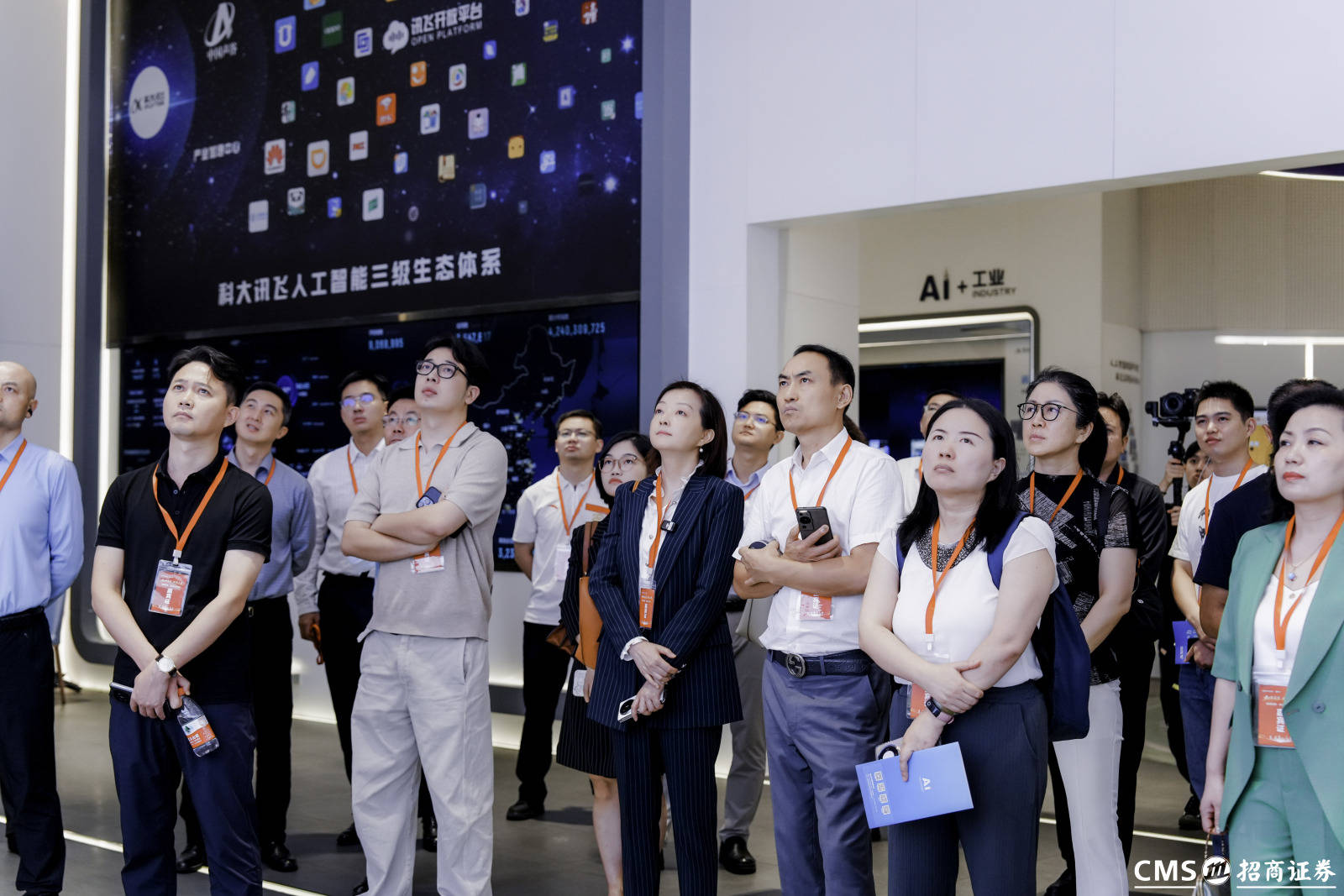
锚定金融强国 洞察产业价值:招商证券《投资中国——走进上市公司》赋能客户投资决策
Sou Hu Cai Jing· 2026-01-29 12:21
Core Insights - The Chinese capital market is transitioning from scale expansion to quality enhancement, with the "financial power" goal and new "National Nine Articles" providing direction for high-quality development in the industry [1] - Investor wealth management needs have evolved from traditional short-term returns to a focus on deep industry analysis and long-term value, emphasizing risk-controlled certainty and comprehensive service [1] - China Merchants Securities is launching the "Investing in China - Entering Listed Companies" service brand in 2025 to address information barriers through in-depth industry research, embodying the "buy-side advisory" concept and serving the real economy [1] Group 1 - The service brand will conduct nine in-depth industry research events to help investors understand the real pulse of Chinese industries based on data logic [1] - The focus areas include semiconductor sensors, pharmaceutical CDMO services, green energy in photovoltaics, AI, healthcare, optical communication, rare earth permanent magnets, and new materials [1] - The initiative aims to provide investors with insights into "Chinese manufacturing" and deliver investment guidance that combines depth and foresight [1] Group 2 - The series of activities features "on-site visits + industry decoding" to create a direct communication bridge between investors and quality listed companies [3] - Activities include senior analysts leading tours, in-depth dialogues with company executives, and on-site exploration of production operations, meeting clients' needs for industry insights [3] - This approach enhances the professional depth of client services and conveys the warmth of wealth management [3] Group 3 - The nine industry visits serve as an upgrade in investment understanding and an expansion of industry perspectives for investors [5] - Investors reported that engaging with production lines and management teams transformed their understanding from financial data to a comprehensive grasp of industry logic and application scenarios [5] - This experience strengthens their recognition of the value and structure of the industry chain, turning abstract trends into concrete frameworks [5] Group 4 - Each visit allows investors to combine data support with on-site insights, deepening their understanding of corporate long-term value and responsibility [9] - The initiative exemplifies the mission of connecting capital with real value and aligns with the brand's commitment to customer value and serving the real economy [9] - The "Investing in China - Entering Listed Companies" initiative will continue to develop in the coming year, enhancing wealth and high-net-worth client services while supporting the high-quality development of the real economy [9]