
TCL电子

Search documents
深圳眼镜新锐,10亿现金进账
2 1 Shi Ji Jing Ji Bao Dao· 2026-01-06 00:49
Core Viewpoint - The financing round for Thunderbird Innovation, led by major telecom operators, signifies a pivotal moment for the AR smart glasses industry, indicating a shift towards mainstream adoption and integration into national communication infrastructure strategies [1][3][2]. Group 1: Financing and Investment - Thunderbird Innovation secured over 1 billion yuan in a new financing round, with participation from China Mobile Chain Fund, CITIC Jinshi, and China Unicom's Lianchuang Innovation Fund [1]. - This financing marks the first joint investment by major domestic telecom operators in the smart glasses sector [2]. Group 2: Industry Implications - The investment reflects operators' belief that the AR industry is at a tipping point for explosive growth [3]. - The collaboration with telecom operators aims to establish standards and dominate the ecosystem by binding with leading hardware companies [3]. Group 3: Strategic Partnerships - A long-term strategic cooperation agreement was signed between the telecom operators and Thunderbird, covering eSIM technology, promotional offers, channel development, and cloud services [3]. - The operators' extensive offline service networks and large user bases are expected to broaden the reach of Thunderbird's AR smart glasses [3]. Group 4: Product Development - Thunderbird plans to showcase its first eSIM-enabled AR glasses, the X3 Pro Project eSIM, at the CES exhibition, featuring dual full-color display and independent functionality from smartphones [5][6]. - The financing will primarily be allocated to R&D, aiming to enhance product experience standards by 2026 and expand technological advantages in optics, spatial computing, and AI [7]. Group 5: Market Position - Thunderbird, established in 2021 and incubated by TCL Electronics, is recognized as the only company globally to achieve mass production of full-color Micro LED AR glasses [4]. - The best-selling Thunderbird V3 smart glasses are priced around 1,700 yuan, with over 7,000 units sold, ranking among the top-selling XR devices on Tmall [4].
国泰海通每日报告精选-20260105
国泰海通· 2026-01-05 08:29
| | 国泰海通证券 | | --- | --- | | 2 | GUOTAI HAITONG SECURITIES | 目 录 | | 每日报告精选(2025-12-31 09:00——2026-01-05 15:00) 3 | | | --- | --- | --- | | | 宏观周报:《地缘风险再起,国际油价或迎剧烈波动》2026-01-04 | 3 | | | 宏观周报:《元旦"微度假"热度高》2026-01-04 | 3 | | | 宏观快报点评:《PMI 逆季节性回升,预期改善》2025-12-31 | 4 | | | 策略专题报告:《1 月金股策略:决胜"开门红"》2026-01-05 | 5 | | | 资产配置周报:《地缘政治突变,建议超配黄金》2026-01-05 | 6 | | | 策略专题报告:《AI 应用与机器人主题有望接力》2026-01-04 | 6 | | | 海外策略研究:《长线外资积极增配港股软件服务》2026-01-04 | 7 | | | 策略周报:《一年之计在于春》2026-01-04 | 8 | | | 行业月报:房地产《TOP ...
招商证券家电行业2026年度策略:内需国补续期 出海科技成长
智通财经网· 2026-01-05 07:47
Group 1 - The core viewpoint is that the home appliance industry is expected to underperform the market in 2025 due to multiple factors including a preference for growth styles, a decline in domestic subsidies, and disruptions from overseas tariffs [1] - The home appliance sector achieved a positive return of 9% in 2025, ranking 22nd among all industries, influenced by the increasing share of TMT transactions and the reduction of domestic subsidies post-618 [1] Group 2 - For domestic sales in 2026, the government will continue to support the "trade-in" subsidy program, with an estimated total subsidy fund of 250-300 billion yuan, including 80 billion for home appliances [2] - The six major categories of home appliances will continue to receive subsidies, with new AI products being added to the 3C category [2] Group 3 - The company sees opportunities in technology exports, supply chain advantages, and hardware innovation in sectors like 3C consumption, consumer robotics, and 3D printing [3] - The transition to new national standards for power banks and the expected growth in the European balcony solar storage market are anticipated to drive hardware innovation in AI applications [3] Group 4 - Investment recommendations include focusing on high-dividend value leaders like Midea Group and Haier Smart Home, and paying attention to Gree Electric and other brands in the white goods sector [4] - For technology exports, companies like Anfu Technology and Anker Innovations are highlighted, along with opportunities in 3D printing and consumer robotics [4] - The tool export chain is recommended, with companies like Juxing Technology and Quanfeng Holdings being favored due to expected demand growth in North America [4]

华西证券:国补政策收紧推动行业产品升级 品类补贴范围更加聚焦
智通财经网· 2026-01-05 03:00
Core Viewpoint - The current round of national subsidies is more focused compared to 2025, with stricter energy efficiency standards, which will help promote product structure upgrades in the industry, benefiting leading companies with a more complete layout of mid-to-high-end products [1]. Group 1: Policy Announcement - On December 29, 2025, the National Development and Reform Commission (NDRC) announced the implementation of a large-scale equipment update and consumer goods replacement policy for 2026, explicitly supporting the replacement of old home appliances [2]. - On December 30, 2025, the NDRC announced that the first batch of 625 billion yuan in ultra-long-term special government bonds to support consumer goods replacement has been allocated in advance [2]. Group 2: Funding and Subsidy Details - The first batch of 625 billion yuan in support funds for the replacement program has been allocated, with the subsidy categories being more focused compared to 2025. The scale is slightly reduced from the 810 billion yuan allocated in the first batch for 2025 [3]. - The total scale of special government bonds for consumer goods replacement in 2025 was 3000 billion yuan, distributed in four batches, with the first batch accounting for approximately 27%. The estimated total subsidy scale for 2026 is around 2300 billion yuan [3]. Group 3: Subsidy Categories and Standards - The subsidy categories for 2026 have been narrowed from 12 categories in 2025 to 6 categories, focusing on essential appliances such as refrigerators, washing machines, televisions, air conditioners, computers, and water heaters [3]. - The subsidy for 2026 is limited to first-level energy efficiency products, with a uniform subsidy rate of 15%. Each consumer can receive a subsidy for one unit of each product category, with a maximum subsidy of 1500 yuan per unit [4]. - In comparison, the 2025 subsidy standards allowed for second-level energy efficiency products with a subsidy of 15% of the sales price, and first-level products with a 20% subsidy, capped at 2000 yuan per unit [4]. Group 4: Investment Recommendations - Recommendations include leading white goods companies such as Midea Group, Hisense Home Appliances, and Haier Smart Home; and leading black goods companies such as Hisense Home Appliances and TCL Electronics [4].



2026年国补落地,关注政策接续效果:家用电器
Huafu Securities· 2026-01-04 06:05
Group 1 - The core viewpoint of the report emphasizes the implementation of the 2026 national subsidy policy for large-scale equipment updates and the trade-in of consumer goods, which is expected to stabilize the domestic consumption market and stimulate demand, particularly in offline channels and rural areas [2][3][5][14]. - The 2026 subsidy policy introduces changes compared to 2025, including a more concentrated subsidy range, with the number of household appliance categories reduced from 12 to 6, retaining only core categories such as refrigerators, washing machines, televisions, air conditioners, computers, and water heaters [4][15]. - The subsidy standards have been optimized, with a 15% subsidy on the sales price for energy-efficient or water-efficient products, and a maximum subsidy of 1,500 yuan per item for household appliances [4][15]. Group 2 - The report indicates that the 2026 policy aims to enhance the efficiency of fund utilization by focusing on core categories and avoiding imbalances in funding distribution, which is expected to positively impact leading companies in the household appliance sector such as Midea Group, Haier Smart Home, Hisense, and TCL Electronics [5][14]. - The report highlights the recent performance of the home appliance sector, noting a weekly increase of 0.7%, while specific segments like white goods and small appliances experienced declines [6][17]. - The report provides insights into raw material prices, indicating a week-on-week increase in LME copper and aluminum prices by 2.05% and 1.23%, respectively, which may impact the cost structure of household appliance manufacturers [6][17].
2025年谁流落亏损榜?“亏损王”爱调仓折腾,多位知名老将在列
Feng Huang Wang· 2026-01-03 23:21
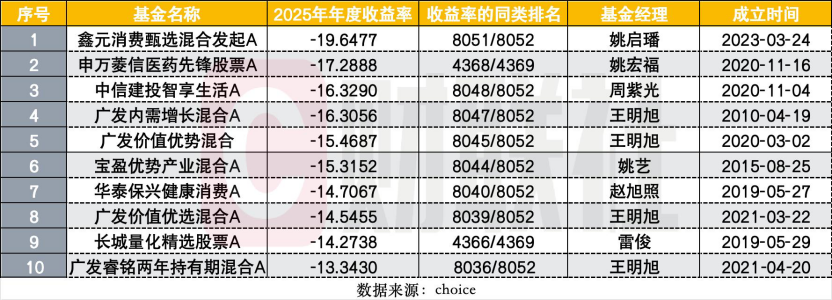
Core Viewpoint - The A-share market in 2025 exhibited a clear structural bull market, with significant performance disparities among active equity funds, highlighted by the top-performing fund achieving a record annual return of 233.29% while others faced substantial losses, including the worst performer with a -19.65% return [1][4]. Group 1: Market Performance - The Shanghai Composite Index, Shenzhen Component Index, ChiNext Index, and Sci-Tech Innovation 50 Index rose by 18.41%, 29.87%, 49.57%, and 35.92% respectively in 2025 [1]. - A total of 4888 active equity products from 160 public fund institutions reported positive returns, while 144 products from 68 institutions experienced losses [1][9]. Group 2: Fund Performance Disparities - The top-performing fund, Yongying Technology Smart Selection, achieved a record annual return of 233.29%, surpassing the previous record set by Wang Yawei in 2007 [1]. - The worst-performing fund, Xinyuan Consumption Selection, recorded a -19.65% return, marking a significant gap of 252.94% from the top performer [2][4]. Group 3: Xinyuan Consumption Selection Analysis - Xinyuan Consumption Selection's poor performance is attributed to aggressive trading strategies, frequent personnel changes, and scale challenges, leading to a lack of coherent investment logic [3][5]. - The fund's industry allocation showed erratic shifts, moving from heavy investments in pharmaceuticals to technology and later to media, missing key market trends [5][6]. Group 4: Fund Manager Insights - Notable fund managers, including Wang Mingxu and Han Weijun, saw their products listed among the worst performers, with their total managed assets shrinking by over 70% compared to previous peaks [3][9][12]. - Xinyuan Consumption Selection faced a critical challenge to meet its scale assessment, needing to grow from 0.29 billion to 2 billion within three months [7][8]. Group 5: Institutional Investment Trends - Institutional ownership in Xinyuan Consumption Selection dropped from over 95% to 42.94% by mid-2025, indicating a significant withdrawal of institutional funds [7]. - The trend of multiple products from the same fund manager appearing on the loss list highlights a broader issue within the industry, affecting even previously successful managers [9][10].

2026年家电以旧换新政策出台 家电消费景气有望提振(附概念股)
Zhi Tong Cai Jing· 2026-01-02 00:45
Group 1 - The 2026 appliance replacement policy will provide subsidies for consumers purchasing energy-efficient home appliances, with a subsidy of 15% of the product price, capped at 1,500 yuan per item [1] - The first batch of subsidies for the 2026 policy amounts to 62.5 billion yuan, which is lower than the 2025 plan, and the eligible appliance categories are fewer [1] - Citigroup believes the new policy will boost consumer sentiment despite the limited overall impact on e-commerce platforms due to high baseline effects and smaller subsidy scale [1] Group 2 - The 2026 policy is expected to stimulate domestic appliance sales and improve product structure, benefiting companies with R&D, channel, and brand advantages in the white and black goods sectors [2] - The easing of US-China trade tensions may reduce tariff pressures, allowing home appliance companies to gradually release global production capacity and gain incremental contributions from emerging markets [2] - The new policy is anticipated to drive the home appliance industry towards high-end, intelligent, and green upgrades, favoring large appliance companies with competitive advantages [2] Group 3 - Related Hong Kong-listed companies in the home appliance industry include Midea Group, Haier Smart Home, Hisense Home Appliances, TCL Electronics, Skyworth Group, and Xiaomi Group [3]
港股概念追踪|2026年家电以旧换新政策出台 家电消费景气有望提振(附概念股)
智通财经网· 2026-01-02 00:43
Group 1 - The Chinese government has announced a new policy for 2026 to support the replacement of old appliances and consumer goods, providing a subsidy of 15% of the product price for eligible energy-efficient appliances, with a maximum subsidy of 1,500 yuan per item [1][2] - The first batch of funding for this policy amounts to 62.5 billion yuan, aimed at stimulating consumer sentiment despite a smaller subsidy scale compared to 2025 [1][2] - The policy is expected to benefit e-commerce platforms, although the overall impact may be limited due to high baseline effects and reduced subsidy amounts [1][2] Group 2 - The 2026 policy focuses on high-efficiency products, with a narrower scope and lower subsidy rates compared to 2025, which aligns with market expectations and is anticipated to improve domestic appliance sales [2] - Companies with advantages in research, distribution, and branding in the white and black goods sectors are expected to benefit more from the new policy [2] - The policy is likely to drive the home appliance industry towards higher-end, smart, and green upgrades, optimizing product structures [2] Group 3 - Relevant Hong Kong-listed companies in the home appliance supply chain include Midea Group, Haier Smart Home, Hisense Home Appliances, TCL Electronics, Skyworth Group, and Xiaomi Group [3]

家电行业2026年度投资策略
2025-12-31 16:02
Summary of Key Points from the Conference Call on the Home Appliance Industry Industry Overview - The home appliance industry is expected to have a clear demand space in 2026, but growth momentum is limited, with marginal prosperity and structural changes being key influencing factors [1][3] - Categories with strong demand resilience or improved structures are likely to have higher performance certainty, particularly in the white goods and two-wheeler sectors [1] Core Insights and Arguments White Goods - The white goods sector is primarily driven by replacement demand, with structural growth opportunities in overseas markets. Leading companies are expected to achieve revenue growth of 5-10% [1][5] - Xiaomi's growth has slowed, and its high-end strategy has alleviated price competition, leading to an improved industry structure and increased performance certainty [1][5] - The overall valuation of the white goods sector is relatively low, with leading companies maintaining an upward trend, indicating potential for a strong rebound [3][12] Two-Wheeler Market - The two-wheeler market has essential demand characteristics, supported by inventory updates and structural growth opportunities in the mid-to-high-end market due to new national standards [1][9] - If domestic demand remains strong, the market could achieve single-digit growth [1][9] Black Goods - The black goods sector is experiencing a shrinking demand center but shows a trend of structural upgrades. However, external uncertainties and intense domestic competition may limit profit margin improvements [1][6] Kitchen Appliances and Lighting - Kitchen appliances and lighting are influenced by the real estate sector's post-cycle effects, with short-term demand potentially declining. However, the industry structure is improving, which could benefit leading companies in the medium term [1][7] Small Appliances and Cleaning Equipment - The small appliance sector is diverse and somewhat discretionary, with cleaning equipment being a focal point. Overseas demand is strong, but domestic risks exist due to subsidy factors [1][8] Additional Important Insights - The overall demand for the home appliance industry in 2025 was clear, but significant growth stories were lacking. Key factors include changes in marginal prosperity and industry structure [3] - Leading white goods companies are cash-rich and committed to increasing dividend payouts, with expectations of exceeding 70% [3][18] - The two-wheeler industry is expected to face a demand decline of 5-10% in 2026, but structural growth opportunities remain due to new standards and market dynamics [19][20] - The overseas market, particularly in Southeast Asia, presents significant potential for the two-wheeler industry, supported by favorable policies [21] - Brand expansion into international markets is crucial for future growth, with low penetration rates in emerging categories providing opportunities for Chinese brands [22] Investment Recommendations - Investment strategies for 2026 should focus on two main areas: dividend opportunities in white goods and two-wheelers, and overseas expansion potential in companies with reasonable valuations and strong brand/channel capabilities [29]

双节消费亮点前瞻
2025-12-31 16:02
Summary of Key Points from Conference Call Records Industry or Company Involved - **Moutai**: Focus on stable supply and market demand - **Angel Yeast**: Benefiting from cost reductions and market improvements - **Yili**: Anticipating price recovery in dairy products - **Li Ning**: Strategies for inventory and product innovation - **Electric Bicycle Industry**: Focus on leading companies like Yadea and Aima - **Home Appliances**: Impact of subsidy policies - **Pork Farming Industry**: Current market conditions and investment opportunities - **Smart Glasses Market**: Growth expectations and product developments Core Points and Arguments - **Moutai's Strategy**: In 2026, Moutai will maintain stable total supply while reducing high-value product investments and increasing supply of Feitian Moutai to tap into mass market demand, which is expected to stabilize prices in the long term [1][3] - **Angel Yeast's Performance**: Expected to outperform the sector in 2026 due to lower sugar molasses procurement costs and improvements in the domestic restaurant chain [1][4][5] - **Yili's Growth**: Anticipated turning point in milk prices in Q2 and Q3 of 2026, with a focus on product innovation and high-end branding to achieve quality growth [1][5] - **Li Ning's Strategy**: Effective inventory management and product innovation, including new running shoes, are expected to drive revenue recovery, with a projected profit of 2.7 billion yuan in 2026 [1][6][7] - **Electric Bicycle Industry Outlook**: Leading companies like Yadea and Aima are currently undervalued, with a focus on spring sales data to assess market recovery [1][8][9] - **Home Appliance Subsidy Policy**: The renewal of the subsidy policy, totaling 250 billion yuan, is expected to positively impact related sectors, including smart glasses, with projected sales growth of 78% in 2025 [1][11][12] - **Pork Farming Industry**: Continuous reduction in breeding sow capacity presents a window for investment in quality pork stocks, despite recent price recoveries not changing the fundamental supply-demand dynamics [2][31][32] Other Important but Possibly Overlooked Content - **Smart Glasses Market**: Expected domestic shipment of 4.5 million units in 2025, indicating significant growth potential [1][12] - **Investment Recommendations**: Companies like Jimi Technology, TCL Electronics, and Anke Innovation are highlighted for their low valuations and growth potential in the context of new product lines and market recovery [1][14] - **Pork Industry Valuation**: Current valuations in the pork sector are considered severely undervalued, making it a prime area for investment [2][32] - **Poultry Industry Insights**: The yellow feather chicken market shows promising investment opportunities, while the white feather chicken market faces challenges due to seasonal factors [2][33] This summary encapsulates the essential insights and projections from the conference call records, providing a comprehensive overview of the discussed industries and companies.