锦江酒店

Search documents
政策红利与消费共振!详解海南离岛免税升级下的旅游ETF投资机遇
市值风云· 2025-12-19 10:08
Core Insights - The article highlights the significant launch of the Hainan Free Trade Port's full island closure operation, marking a new phase in its development [3][4] - The synergy between the closure operation and the new duty-free policies is expected to enhance market demand and supply, leading to cost savings for businesses [5] - The initial impact of the new policies is evident, with a notable increase in duty-free shopping amounts in Hainan [6] Policy and Market Dynamics - The implementation of the closure operation allows for duty-free imports of production equipment, potentially saving businesses around 20% in costs [5] - In November 2025, duty-free shopping in Hainan reached 2.38 billion yuan, a year-on-year increase of 27.1%, indicating strong market growth [6] - Sanya's sales figures for November also showed a significant increase, with sales reaching 1.63 billion yuan, up 24.3% year-on-year, marking a record monthly growth rate [6] Investment Opportunities - The tourism ETF (562510.SH) is presented as an ideal investment tool to capture the benefits of the new policies, offering transparency and diversification [8] - On the day of the closure operation, the tourism ETF saw a 2.4% increase, reflecting positive market sentiment [9] - The ETF tracks a comprehensive tourism theme index, including key players in the industry such as China Duty Free Group, which constitutes 16.6% of the fund's net value [10][13] Company Focus - China Duty Free Group is identified as a major beneficiary of the Hainan duty-free policies, with its performance closely tied to the development of the Hainan Free Trade Port [13][16] - The company's sales in Hainan showed a positive trend, with a 3.4% year-on-year increase in September 2025, indicating a recovery in the market [14][16] - Overall, China Duty Free Group is seen as a critical player in the Hainan duty-free industry, making it a focal point for investors looking to capitalize on the long-term prospects of the free trade port and duty-free consumption [17]


消费者服务行业双周报(2025/12/5-2025/12/18):商务部等提出将加大金融协同,加大服务消费支持力度-20251219
Dongguan Securities· 2025-12-19 07:59
Investment Rating - The report maintains an "Overweight" investment rating for the consumer services industry, expecting the industry index to outperform the market index by over 10% in the next six months [29]. Core Insights - The macroeconomic environment is experiencing fluctuations, and increasing domestic demand to boost consumption has become a crucial driver for economic growth. Recent policies have significantly enhanced support for service consumption, including a notice from the Ministry of Commerce to strengthen financial collaboration and support for service consumption [29][19]. - The consumer services industry index experienced a slight decline of 0.52% from December 5 to December 18, 2025, underperforming the CSI 300 index by approximately 0.66 percentage points [7]. - The report highlights a divergence in the performance of sub-sectors within the consumer services industry, with the education sector showing strength while the tourism and leisure sector faced challenges due to risks associated with major stakeholders [8][11]. - The overall price-to-earnings (PE) ratio for the consumer services industry is approximately 37.57 times, remaining stable compared to the previous period but below the average valuation of 43.42 times since 2016 [14]. Summary by Sections Market Review - The consumer services industry index showed a slight decline, ranking sixteenth among all CITIC first-level industry indices [7]. - Sub-sector performance varied, with comprehensive services and tourism leisure declining by 3.42% and 2.86%, respectively, while the education sector increased by 4.22% [8]. - A total of 31 listed companies in the industry achieved positive returns, with the top five performers being China High-Tech, Zhonggong Education, Tianmu Lake, Qujiang Cultural Tourism, and Doushen Education, with increases ranging from 10.11% to 17.76% [11]. - The industry’s overall PE ratio is approximately 37.57 times, which is lower than the historical average [14]. Industry News - The Ministry of Commerce issued a notice to enhance support for service consumption, focusing on various sectors including hospitality, education, and tourism [19]. - Hunan Province is promoting strategic mergers and acquisitions in the cultural tourism sector to support quality enterprises [18]. Company Announcements - China Duty Free Group won bids for two duty-free segments at Shanghai Airport, marking a significant expansion in its operations [23]. - Xiangyuan Cultural Tourism's major shareholder faces judicial freezes on shares, which may impact the company's stability [24]. Weekly Outlook - The report suggests focusing on themes such as ice and snow tourism and duty-free shopping as potential catalysts for growth in the consumer services sector. Recommended stocks include Jinjiang Hotels, Changbai Mountain, Emei Mountain A, and China Duty Free [29][30][32].




国企差旅黄金时代,结束了
虎嗅APP· 2025-12-18 13:57
Core Viewpoint - The article discusses the tightening of travel policies within state-owned enterprises (SOEs) in China, highlighting the shift from luxury to more modest accommodations and the impact on the business travel market [26][52]. Group 1: Changes in Travel Policies - SOEs are increasingly restricting travel budgets and expenditures in response to government mandates for cost-cutting and compliance [28][36]. - The emphasis on compliance has led to a defensive administrative approach, where employees avoid any appearance of extravagance, even when choosing budget-friendly options [41][46]. - The internal audit processes have become more stringent, with a focus on the names of hotels rather than their actual pricing or service levels [12][40]. Group 2: Impact on Hotel Choices - High-end international hotel brands like Hilton and Marriott are now viewed as risky choices for SOE employees due to their association with luxury [54][57]. - There is a noticeable shift towards domestic mid-range hotel brands that are perceived as safer and more compliant with current regulations [58][59]. - The demand for local hotel brands such as Atour and Vienna is increasing as they align with the low-profile and practical approach required by SOEs [58][59]. Group 3: Business Travel Management - The priorities of travel management companies (TMCs) are evolving, with a greater focus on safety and compliance rather than just cost reduction [61][63]. - SOEs now require TMCs to provide systems that can automatically filter out non-compliant options and flag sensitive destinations [64]. - The era of business travel characterized by leisure and luxury is ending, giving way to a more pragmatic and utilitarian approach to travel [65][67].
“犒赏经济”火了!情绪消费成A股新主线?
Jin Rong Jie· 2025-12-18 10:49
Group 1: Core Concept of "Reward Economy" - The "Reward Economy" is a new consumption model where consumers purchase non-essential goods or services to gain immediate pleasure and emotional satisfaction in response to work and life pressures [1] - This concept has gained traction on social media and is linked to popular IP consumption trends, with films like "Zootopia 2" generating over 3.6 billion yuan in box office revenue, leading to collaborations with over 70 brands across various sectors [1] - The upcoming release of "Avatar 3" further highlights the potential of IP consumption in driving market activity [1] Group 2: Investment Insights from Securities Firms - Dongxing Securities predicts that continued policy support by 2026 will boost consumer confidence, shifting investment focus in new consumption sectors from short-term narratives to business models and profitability barriers [2] - The report identifies three major trends in the new consumption industry: health-oriented, new pragmatism, and emotional consumption, along with developments in smart technology and overseas consumption [2] - Zhongtai Securities emphasizes that new consumption is fundamentally supply-driven, marking a "new consumption upgrade," with categories like tech sleep products and ergonomic chairs gaining momentum [2] Group 3: A-Share Related Themes - Beauty and personal care sectors reflect "self-reward" consumption, with companies like Betaini focusing on sensitive skin care, aligning with emotional value in the reward economy [3] - Proya, known for its anti-aging products, meets consumer demands for self-investment in appearance, while Huaxi Biological's functional skincare products cater to quality upgrades in skincare [3] Group 4: Tourism, Hospitality, and Dining - Dining and travel are classic forms of self-reward, with companies like China Duty Free benefiting from luxury purchases during travel, directly boosting their performance [4] - Tongqinglou targets celebratory consumption scenarios, while Jinjiang Hotels offers mid-to-high-end accommodations that align with current leisure spending trends [4] Group 5: Trendy Toys and Entertainment - Companies like Pop Mart cater to emotional consumption among younger demographics through collectible blind boxes, which serve as popular self-reward items [5] - Tom Cat is developing AI companion toys, aligning with emotional consumption needs, while Aofei Entertainment is engaging in the IP economy with AI toys and card game services [6] Group 6: Retail and Lifestyle Services - Retail companies like Baida Group are experiencing significant market performance driven by the reward economy, while Nanjing Shunyi reflects strong consumer recovery trends [7] - Meituan provides a platform for various self-reward consumption experiences, including high-end dining and hotel stays [7] Group 7: Other Niche Areas - Langsha, a leader in intimate apparel, aligns with consumer desires for quality and comfort, reflecting small-scale self-reward trends [8] - Zhongchong focuses on high-end pet food, catering to pet owners' emotional needs for rewarding their pets [8] - Deyi Cultural Innovation emphasizes IP operations and collectible products, appealing to young consumers' preferences for self-reward through trendy toys [8]

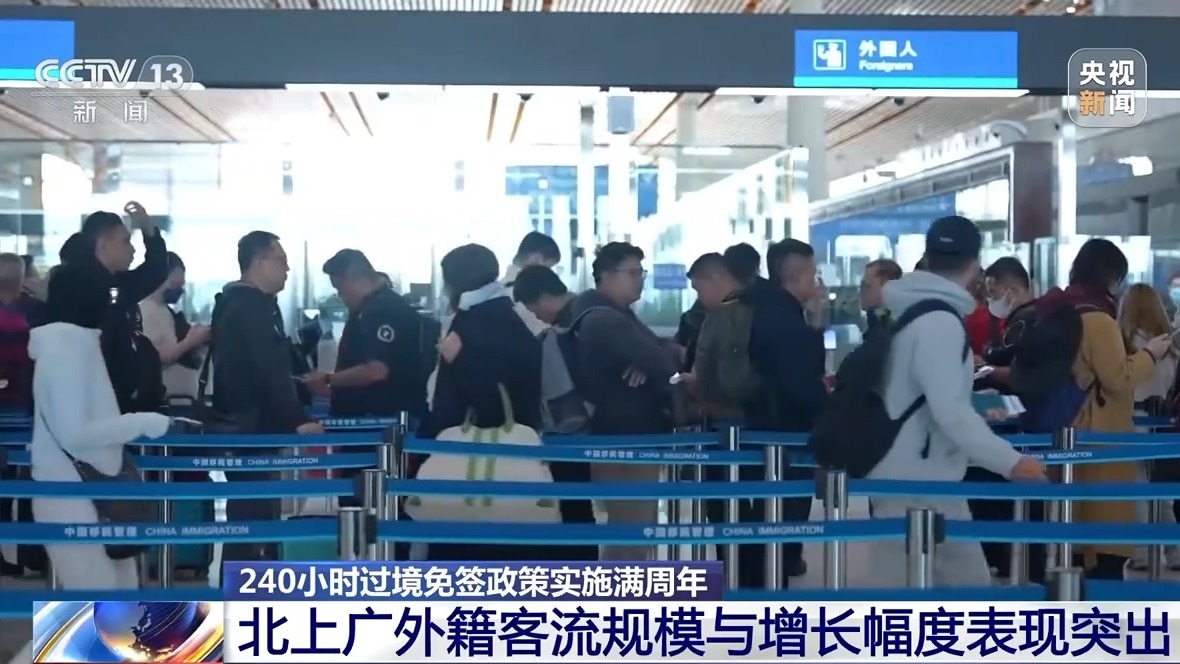
畅游240小时 外国游客深度解锁“宝藏中国”
Yang Shi Xin Wen Ke Hu Duan· 2025-12-18 01:50
Core Viewpoint - The implementation of the 240-hour visa-free transit policy has significantly enhanced the entry of foreign travelers into China, marking a successful year since its launch, and has created new opportunities for tourism and economic growth [1][2]. Group 1: Policy Impact - The 240-hour visa-free transit policy has led to a 60.8% year-on-year increase in the number of foreign travelers eligible for the policy, contributing to a total of 40.6 million foreign entries across the country, which is a 27.2% increase compared to the previous year [2][4]. - Major entry points such as Beijing, Shanghai, and Guangzhou have seen substantial growth in foreign traveler numbers, with over 340 million, 534.6 million, and 320 million entries respectively, and a significant proportion of these travelers benefiting from the visa-free policy [4][6]. Group 2: Regional Growth - Secondary ports have experienced explosive growth, with Xiamen seeing a threefold increase in foreign entries under the visa-free policy, and Liaoning experiencing a 5.7-fold increase [4][6]. - The policy has facilitated cross-regional travel, with 60% of foreign travelers opting for multi-province tours, indicating a shift from mere transit to deeper exploration of China [9][11]. Group 3: Economic and Cultural Benefits - The policy has stimulated new tourism patterns, such as "transit plus deep travel" and "multi-stop journeys," enhancing cultural and economic exchanges across various regions [7][13]. - In 2025, Beijing's inbound tourist spending reached 41.7 billion RMB, a 48% increase, while Xiamen reported over 154.62 million inbound overnight tourists, with tourism consumption exceeding $1.33 billion, both showing growth rates above 49% [15][16]. Group 4: Service Enhancements - Major entry points have implemented dedicated channels and streamlined processes, such as online reporting and multilingual services, to improve the experience for inbound travelers [6][18]. - The introduction of a "one-click tax refund" service has further enhanced the convenience for foreign tourists, with a 229.8% increase in tax refund claims in the first three quarters of the year [18][21]. Group 5: Future Prospects - The policy is expected to continue driving growth in various sectors, including duty-free shopping and hospitality, with cultural consumption in Hangzhou rising to 45% and hotel occupancy rates increasing by 8% [23]. - With 21 new entry points added to the policy, the potential for inbound consumption growth remains significant, contributing to high-quality economic development [23].
中金2026年展望 | 旅游酒店及餐饮:服务连锁正当时,布局反转和高成长
中金点睛· 2025-12-17 23:54
Core Viewpoint - The service industry is showing signs of stabilization and bottoming out after experiencing price pressure and same-store sales decline in 2024, with expectations for recovery in 2026, particularly in sub-sectors like hotels and duty-free [2][17]. Group 1: Industry Trends - The service consumption ratio is increasing, supported by improved infrastructure for chain operations, leading to the emergence of more quality brands [4][21]. - The government has introduced multiple policies to promote service consumption, indicating a potential for stronger recovery in domestic demand [18][20]. - The hotel sector is expected to see a rebalancing of supply and demand in 2026, with RevPAR stabilizing due to a low base and slowing supply growth [4][31]. Group 2: Sub-sector Analysis - **Hotels**: The hotel industry faced pressure from weak business travel demand and continued supply expansion, but RevPAR showed signs of recovery in October 2025, driven by ADR increases [26][33]. - **Duty-Free**: Duty-free sales are stabilizing, with a focus on the potential of new policies to boost sales from departing travelers and local residents [45][49]. - **Dining**: The dining sector is experiencing a controlled competitive environment, with affordable brands performing relatively well amidst a recovering landscape [36][44]. Group 3: Investment Opportunities - Companies that can effectively meet consumer demands for value and emotional satisfaction, possess strong operational capabilities, and capture sustainable growth drivers are likely to succeed [4][29]. - The focus on high-quality brands and those with strong internal capabilities is expected to yield better performance in the coming years [4][21]. Group 4: Market Performance - In 2025, companies like Gu Ming and Mi Xue have shown significant stock performance, indicating a trend where companies with strong growth potential outperform their peers [7][12]. - The overall market for the service sector is expected to see a gradual recovery, with structural opportunities emerging in the hotel and duty-free segments [6][31].




对话2026年关键词:消费篇
2025-12-17 15:50
对话 2026 年关键词:消费篇 20251217 摘要 扩内需是未来一年的政策关键词,短期重点在于消费补贴扩容至服务业 和相关就业者,中长期政府投资将更多投入社会保障以扩大中产群体, 提升消费率。 食品饮料行业中,白酒预计在 2026 年加速寻底,大众品部分企业已进 入右侧阶段。啤酒和乳业维持低库存,高成长赛道公司面临定价挑战。 推荐安琪酵母、安井食品和东鹏饮料。 医药板块创新药领域基本面强劲,受益于国内市场和美国市场,中国创 新药企性价比优势显著。医保结构调整和商业保险补充支付构成利好, 创新药产业链及医疗器械出海业务值得关注。 家电行业 2026 年主题为"无惧内销压力,外销加业务扩张大有可为", 内销压力可控,海外市场成长性强,关注家电公司多元化成长、子板块 机会及质量红利。 零售及美容护理行业竞争加剧,关注天猫 AI 应用、抖音返佣机制及强薪 资竞争力公司。医美板块关注产品种类丰富或新兴赛道布局领先的公司, 保健品领域关注新品牌及转型公司。 Q&A 食品饮料行业在 2026 年的具体展望如何? 在食品饮料行业方面,我们认为白酒将在 2026 年经历周期加速寻底过程,而 大众品则已经有部分企业进入右侧 ...
系统深耕,价值共创:锦江酒店(中国区)打造ESG实践新范式
Di Yi Cai Jing· 2025-12-17 15:44
锦江酒店(中国区)以系统性、前瞻性与规模化并重的ESG实践,树立了中国酒店行业可持续发展的新 标杆。 2025年,锦江酒店(中国区)以系统性、前瞻性与规模化并重的ESG实践,树立了中国酒店行业可持续 发展的新标杆。在国家"双碳"战略与全球可持续发展趋势的双重驱动下,锦江酒店(中国区)围绕锦江 酒店"共赴锦程"的ESG愿景,通过"制度—工具—场景—生态"四维驱动,不仅实现了环境、社会与治理 议题的深度融合,更将绿色运营转化为提升效率、优化体验、增强品牌价值的核心引擎。尤为突出的 是,其在能碳管理体系建设与绿色运营国际标准验证(HSB)方面的领先布局,彰显了行业引领者的责 任担当与专业能力。 作为世界旅游及旅行理事会(WTTC)《酒店可持续发展基准》(HSB)的联合发起方,锦江酒店深刻 理解标准化对行业绿色转型的关键作用。2025年,锦江酒店(中国区)高质量完成近5000家门店的HSB 验证,其中超150家门店达成最高12项基准要求,持续扩大中国绿色酒店矩阵。这一成果不仅体现其对 国际通行可持续标准的全面承接,更通过标准化流程推动旗下酒店在能源、水耗、废弃物、社会贡献等 关键维度实现系统性提升。 同时,锦江酒店积 ...
2025年前三季度旅游行业运行分析
Lian He Zi Xin· 2025-12-17 11:12
Investment Rating - The tourism industry maintains a stable development trend, with a stable outlook rating [29] Core Insights - In the first three quarters of 2025, domestic travel volume and total spending both experienced double-digit growth year-on-year, although the growth rate of total spending has slowed down despite an increase in travel volume [4][29] - The recovery of inbound tourism is strong, with international flight passenger transport volume exceeding the same period in 2019 [4][8] - The industry is supported by various government policies aimed at promoting high-quality development in tourism [27][29] Summary by Sections Industry Operation Status - Domestic tourism reached 4.998 billion trips in the first three quarters of 2025, an increase of 761 million trips, representing an 18.0% year-on-year growth, surpassing the 2019 level [4] - Domestic tourism revenue totaled 4.85 trillion yuan, a year-on-year increase of 11.5%, but the growth rate has slowed compared to the previous year [4] - Inbound tourism saw a 23.5% year-on-year increase in international flight passenger transport volume, reaching 591.55 billion ton-kilometers [8] Sub-industry Analysis Scenic Areas - Most scenic areas saw improved cash flow, but profitability declined compared to the previous year, with total profits of 1.785 billion yuan, down 5.67% year-on-year [10] Hotels and Restaurants - The hotel industry faces intensified competition, with only a few major hotel groups showing slight improvements in occupancy rates and RevPAR [14][20] - Major hotel groups reported mixed performance, with some experiencing significant profit declines due to high base effects from previous asset sales [20] Duty-Free Shopping - The duty-free market in Hainan continues to face pressure from weak consumer spending, with sales down 7.7% year-on-year in the first three quarters [22] - However, the market began to recover in September 2025, showing a 3.4% year-on-year increase in monthly sales [24] Industry Policies - The government has introduced multiple support policies, including cultural tourism consumption vouchers and expanding the supply of quality products to promote high-quality development in the tourism sector [27][29] Outlook - The tourism industry is expected to maintain stable demand, supported by ongoing government policies and a recovering economy, with a stable outlook rating maintained [29]
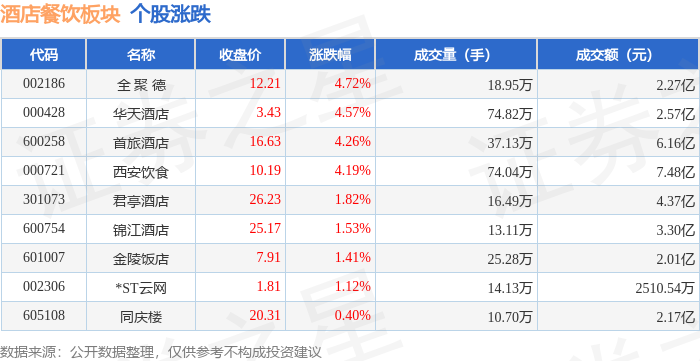
酒店餐饮板块12月17日涨2.7%,全聚德领涨,主力资金净流入8703.26万元
Zheng Xing Xing Ye Ri Bao· 2025-12-17 09:08
Core Viewpoint - The hotel and catering sector experienced a 2.7% increase on December 17, with Quan Juding leading the gains, while the overall market indices also showed positive performance [1] Market Performance - The Shanghai Composite Index closed at 3870.28, up 1.19% - The Shenzhen Component Index closed at 13224.51, up 2.4% [1] Individual Stock Performance - Quan Juding (002186) closed at 12.21, up 4.72% with a trading volume of 189,500 shares and a turnover of 227 million yuan - Huatian Hotel (000428) closed at 3.43, up 4.57% with a trading volume of 748,200 shares and a turnover of 257 million yuan - Shoulv Hotel (600258) closed at 16.63, up 4.26% with a trading volume of 371,300 shares and a turnover of 616 million yuan - Xian Yinshi (000721) closed at 10.19, up 4.19% with a trading volume of 740,400 shares and a turnover of 748 million yuan - Junxiang Hotel (301073) closed at 26.23, up 1.82% with a trading volume of 164,900 shares and a turnover of 43.7 million yuan - Jinjiang Hotel (600754) closed at 25.17, up 1.53% with a trading volume of 131,100 shares and a turnover of 330 million yuan - Jining Hotel (601007) closed at 7.91, up 1.41% with a trading volume of 252,800 shares and a turnover of 201 million yuan - ST Yunwang (002306) closed at 1.81, up 1.12% with a trading volume of 141,300 shares and a turnover of 25.1 million yuan - Tongqinglou (605108) closed at 4.20, up 0.31% with a trading volume of 107,000 shares and a turnover of 217 million yuan [1] Capital Flow Analysis - The hotel and catering sector saw a net inflow of 87.03 million yuan from main funds, while retail funds experienced a net outflow of 25.98 million yuan [1] - Main fund inflows for key stocks included: - Xian Yinshi: 61.25 million yuan - Quan Juding: 22.24 million yuan - Shoulv Hotel: 21.06 million yuan - Huatian Hotel: 19.48 million yuan - Tongqinglou: 6.60 million yuan [2] - Notable outflows included: - Shoulv Hotel: 48.15 million yuan - Quan Juding: 29.26 million yuan - Huatian Hotel: 25.76 million yuan [2]