
华菱钢铁

Search documents
今年来,6家上市湘企已完成增持超8.5亿元
Chang Sha Wan Bao· 2025-12-08 06:57
今年来多家上市湘企重要股东实施了增持。其中,道道全、雪天盐业、ST华扬、华菱钢铁、天桥起 重、大湖股份于近日发布了增持进度公告。 今年8月6日,道道全重要股东表示在半年内将通过深圳证券交易所交易系统集中竞价交易的方式增持公 司股份,拟增持金额不低于5000万元,不超过1亿元。截至12月4日,该股东已累计增持5317400股,增 持金额58226618.11元。公司表示,本次增持计划尚未实施完毕,兴创投资将继续实施增持计划。 今年4月下旬,雪天盐业发布公告称,控股股东湖南盐业集团拟在12个月内,通过上海证券交易所交易 系统允许的方式增持雪天盐业股份,拟增持金额不低于1.5亿元,不超过3亿元。截至9月4日间,公司控 股股东已累计增持公司股票1582.54万股,增持金额约8860.8万元。 长沙晚报掌上长沙12月8日讯(全媒体记者 刘军)5日,湘股道道全发布关于股东增持股份计划进展暨 权益变动触及1%刻度的提示性公告,表示公司控股股东、实际控制人刘建军之一致行动人兴创投资今 年已完成增持58226618.11元。本次增持计划尚未实施完毕,兴创投资将继续实施增持计划。据相关数 据,今年A股市场内已有800余家上市公司 ...
为何钢铁的需求侧具有韧性?
Changjiang Securities· 2025-12-08 04:33
行业研究丨行业周报丨钢铁 [Table_Title] 为何钢铁的需求侧具有韧性? 报告要点 [Table_Summary] 回顾 2025 年钢铁需求侧表现, 1~10 月粗钢、钢材产量同比分别-3.9%、+4.7%。钢材产量由 于涉及冷轧、钢管等二次材重复计算的问题,伴随钢铁产品结构升级和二次材占比的提升,或 对实际产量有所高估。粗钢产量由于系钢企自行上报,缺乏严格监督机制,不涉及流转税数据 的检验,导致实际的产量或有所低估。由此,实际钢铁产量或介于统计局粗钢产量和钢材产量 之间。结合钢材库存整体去化至低位,当前库存水平和年初库存水平差异也不大,表明 2025 年 钢铁总需求相对 2024 年是较为平稳的。为何钢铁的需求侧具有韧性? 丨证券研究报告丨 分析师及联系人 [Table_Author] 王鹤涛 赵超 易轰 吕士诚 SAC:S0490512070002 SAC:S0490519030001 SAC:S0490520080012 SAC:S0490525080005 SFC:BQT626 SFC:BUY139 SFC:BUZ394 请阅读最后评级说明和重要声明 %% %% %% %% research ...
年,月:金属的分化
GOLDEN SUN SECURITIES· 2025-12-07 08:18
Investment Rating - The report maintains a "Buy" rating for several key companies in the steel sector, including Hualing Steel, Nanjing Steel, Baosteel, and New Steel [9]. Core Insights - The steel industry is experiencing a divergence in performance compared to non-ferrous metals, with non-ferrous metals benefiting more from manufacturing sectors like electrical machinery and telecommunications, while steel is more reliant on real estate and automotive industries [2]. - The average daily pig iron production has decreased, with a notable drop in steel output, particularly in rebar production [12][18]. - Total steel inventory has seen a significant reduction, with a week-on-week decline of 2.5% [24]. - Apparent consumption of steel has weakened, with rebar demand declining more than hot-rolled coil demand [40]. - Iron ore prices have strengthened, influenced by supply adjustments and market dynamics [50]. Summary by Sections Supply - Daily pig iron production has decreased by 23,000 tons to 2.323 million tons, with a significant drop in steel output [12][18]. - The capacity utilization rate for blast furnaces across 247 steel mills is at 87.1%, down 0.9 percentage points from the previous week [18]. Inventory - Total steel inventory has decreased by 2.5% week-on-week, with social inventory down 2.9% and steel mill inventory down 1.6% [24][26]. Demand - Apparent consumption of the five major steel products is 8.642 million tons, down 2.7% week-on-week [51]. - Weekly average transaction volume for construction steel is 99,000 tons, reflecting a 5.3% decrease [41]. Raw Materials - The iron ore price index for 62% Fe is at $107.1 per ton, with a week-on-week increase of 1.0% [61]. - Australian iron ore shipments have decreased slightly, while Brazilian shipments have increased [61]. Prices and Profits - The comprehensive steel price index has increased by 0.6% week-on-week, indicating a slight improvement in the industry's profitability [75]. - The current cost of long-process rebar is 3,533 RMB per ton, with a loss of 233 RMB per ton [75][81].


钢价震荡偏强运行,继续看多钢铁板块
Xinda Securities· 2025-12-07 07:42
Investment Rating - The investment rating for the steel industry is "Positive" [2] Core Insights - The steel sector has shown a slight increase of 0.54% this week, underperforming compared to the broader market, which rose by 1.28% [10] - The report indicates that while the steel industry faces supply-demand imbalances, the implementation of "stability growth" policies is expected to support steel demand, particularly in real estate and infrastructure sectors [3] - The report suggests that the overall industry structure is likely to improve, with specific companies being undervalued and presenting structural investment opportunities [3] Supply Summary - As of December 5, the capacity utilization rate for blast furnaces among sample steel companies is 87.1%, a decrease of 0.90 percentage points week-on-week [27] - The average daily pig iron production is 2.323 million tons, down 2.38% week-on-week [27] - The total production of five major steel products is 7.187 million tons, a decrease of 3.78% week-on-week [27] Demand Summary - The consumption of five major steel products is 8.642 million tons, down 2.68% week-on-week [35] - The transaction volume of construction steel among mainstream traders is 99,000 tons, a decrease of 5.31% week-on-week [35] Inventory Summary - The social inventory of five major steel products is 9.785 million tons, down 2.86% week-on-week [43] - The factory inventory of five major steel products is 3.871 million tons, down 1.64% week-on-week [43] Price & Profit Summary - The comprehensive index for ordinary steel is 3,473.6 CNY/ton, an increase of 0.60% week-on-week [49] - The profit for rebar produced in blast furnaces is 34 CNY/ton, an increase of 383.33% week-on-week [55] - The profit for electric arc furnace-produced construction steel is -25 CNY/ton, an increase of 59.02% week-on-week [55] Raw Material Summary - The spot price index for Australian iron ore (62% Fe) is 790 CNY/ton, down 0.75% week-on-week [71] - The price of primary metallurgical coke is 1,880 CNY/ton, down 55 CNY/ton week-on-week [71]
2025 三季度 A 股消费钢铁赛道业绩情况排名发布!用 iFinD Chat 一键获取数据与解析
Xin Lang Cai Jing· 2025-12-05 12:57
Core Viewpoint - The performance ranking of A-share steel companies for Q3 2025 reveals a landscape characterized by "stability among leaders, pressure on some, and increasing differentiation" in the industry, highlighting the impact of supply-demand dynamics and cost management capabilities on profitability [1][6]. Revenue Ranking - Baosteel Group leads the revenue ranking with 232.436 billion yuan, despite a slight year-on-year decline of 4.29%, maintaining its position due to a comprehensive industry chain and high-end product structure [2][7]. - Hebei Steel and Hualing Steel follow in second and third place with revenues of 96.542 billion yuan and 94.598 billion yuan, respectively, with Hualing Steel experiencing a 14.96% year-on-year decline due to temporary supply-demand adjustments in the steel industry [2][7]. - Other companies like CITIC Special Steel and Shougang Group also maintain significant revenue levels, although some have seen slight declines due to product price fluctuations [2][7]. Net Profit Differentiation - Leading companies exhibit strong profit resilience, with Baosteel reporting a net profit of 8.088 billion yuan, a year-on-year increase of 29.31%, supported by high-end product premiums and effective cost control [3][8]. - Hebei Steel's net profit reached 1.011 billion yuan, reflecting a 57.08% year-on-year increase due to regional demand recovery and cost reduction efforts [3][8]. - Conversely, companies like Ansteel and Taiyuan Iron and Steel faced significant losses, with Ansteel reporting a net loss of 1.985 billion yuan (down 260.76% year-on-year) and Taiyuan Iron and Steel a net profit of 0.586 billion yuan (down 206.99% year-on-year), primarily due to declining steel prices and high costs [3][8]. Industry Landscape - The advantages of leading companies like Baosteel and Hebei Steel are reinforced by their high-end capacity layouts and diverse product structures, allowing them to maintain profitability amid industry fluctuations [4][9]. - Some regional steel companies are under pressure due to localized supply-demand issues and a lack of product diversity, leading to declines in both revenue and net profit [4][9]. - The industry is witnessing a concentration of resources towards leading companies with cost advantages and high-end product offerings, further highlighting the differentiation at the bottom of the cycle [4][9].

险资入市再松绑 增量长期资金有望“跑步入场”
Xin Jing Bao· 2025-12-05 12:44
Core Viewpoint - The recent adjustment by the National Financial Regulatory Administration to lower risk factors for certain insurance company investments is aimed at encouraging insurance capital to enter the stock market and support strategic industries in China [1][4]. Group 1: Risk Factor Adjustments - The risk factor for insurance companies holding stocks in the CSI 300 Index and the China Securities Low Volatility 100 Index for over three years has been reduced from 0.3 to 0.27 [2][4]. - For stocks listed on the Sci-Tech Innovation Board held for over two years, the risk factor has been lowered from 0.4 to 0.36 [2][4]. - Lowering the risk factor allows insurance companies to free up capital, enhancing their investment capacity in the stock market [2][3]. Group 2: Encouragement of Long-term Investment - The adjustments encourage insurance companies to hold stocks for longer periods, which supports corporate development and aligns with national strategies [3][4]. - The focus on specific indices and stocks, such as blue-chip and technology stocks, indicates a strategic direction to bolster investments in key economic sectors [4][5]. Group 3: Increased Market Participation - As of the end of Q3 this year, insurance companies have accelerated their stock market participation, with investments in stocks and securities reaching 5.59 trillion yuan, accounting for 14.92% of their total investment [5]. - Insurance capital has been increasing its holdings in major stocks, with significant acquisitions noted in several banks and companies [5]. - The ongoing reduction in risk factors is expected to further enhance insurance capital's engagement in the stock market, driving improvements in investment efficiency and market stability [5].
重磅!险资入市再松绑,增量长期资金有望“跑步入场”
Bei Ke Cai Jing· 2025-12-05 12:33
Core Viewpoint - The National Financial Regulatory Administration has adjusted the risk factors for certain insurance company investments, aiming to encourage insurance capital to enter the stock market and support strategic industries in the country [1][3][11]. Risk Factor Adjustments - The risk factor for stocks held by insurance companies for over three years in the CSI 300 Index and the CSI Low Volatility 100 Index has been reduced from 0.3 to 0.27 [5][11]. - The risk factor for ordinary shares listed on the Sci-Tech Innovation Board held for over two years has been lowered from 0.4 to 0.36 [6][11]. Impact on Capital Allocation - Lowering the risk factors will free up capital for insurance companies, allowing them to invest more in the stock market. For example, a company with a total capital of 1 billion yuan would see a reduction in capital usage from 300 million yuan to 270 million yuan for a 100 million yuan investment in the CSI 300 stocks [7][8]. - The saved capital can be reinvested into stocks or other assets, thereby expanding the investment capacity of insurance capital [8]. Encouragement of Long-term Investment - The adjustments encourage insurance companies to hold stocks for longer periods, which supports the development of enterprises and aligns with national strategies [10][12]. - The focus on specific indices and stocks indicates a targeted approach to encourage investment in blue-chip and technology stocks, which are crucial for economic growth [11][12]. Recent Trends in Insurance Capital - As of the end of Q3 this year, the total investment by life and property insurance companies in stocks and securities investment funds reached 5.59 trillion yuan, accounting for 14.92% of their total investment balance, marking a new high since 2022 [13]. - Insurance capital has been increasing its holdings in major stocks, with significant increases observed in the first three quarters of the year [13][15]. Future Outlook - With the reduction in risk factors, insurance capital is expected to further increase its stock market investments, which may lead to enhanced resource allocation towards equity investment and research capabilities within insurance companies [16].
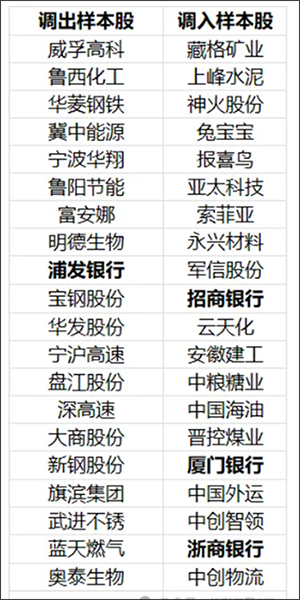
股息收益率仅为3.32%,浦发银行被剔除中证红利指数
Guan Cha Zhe Wang· 2025-12-05 07:47
Core Viewpoint - The annual review of the CSI Dividend Index has resulted in the removal of 20 constituent stocks, including Shanghai Pudong Development Bank and Baosteel, while adding 20 new stocks such as China National Offshore Oil Corporation and China Merchants Bank. The adjustments will take effect after the market closes on December 12 [1][2]. Group 1: Index Adjustments - The CSI Dividend Index has replaced exactly 20 constituent stocks, adhering to the rule that sample changes generally do not exceed 20% [2][3]. - In comparison, the CSI Low Volatility Dividend Index replaced 29 stocks, indicating a higher turnover rate than the CSI Dividend Index [3]. Group 2: Market Capitalization and Dividend Yield - The newly added stocks, including China Merchants Bank, Xiamen Bank, and Zheshang Bank, have a total market capitalization of approximately CNY 1.08 trillion, CNY 189.75 billion, and CNY 837.67 billion, respectively. In contrast, the removed Shanghai Pudong Development Bank has a market capitalization of about CNY 372 billion [3]. - The dividend yields for the newly added banks are notably higher, with China Merchants Bank at 4.63%, Xiamen Bank at 4.04%, and Zheshang Bank at 5.40%, compared to Shanghai Pudong Development Bank's yield of only 3.32% [3][4]. Group 3: Dividend Payment Trends - Shanghai Pudong Development Bank's dividend payout ratios for 2022-2024 are 18.4%, 25.7%, and 27.4%, respectively, which remain below the common industry benchmark of 30%, indicating a conservative dividend policy [4]. - The CSI Dividend Index has implemented three quarterly dividends this year and has a total of 14 dividends since its inception, with a cumulative dividend amount of CNY 3.65 per ten shares. The annual dividend ratios over the past five years have been consistently high, averaging around 4.5% [4]. Group 4: Financial Performance of Shanghai Pudong Development Bank - As of the end of September, Shanghai Pudong Development Bank's total assets reached CNY 9.892 trillion, reflecting a year-on-year growth of 4.55% [5]. - The bank reported a net profit attributable to shareholders of CNY 38.82 billion for the first three quarters, marking a 10.2% increase compared to the previous year [5][6]. - However, the bank's revenue growth has been weak, with a total operating income of CNY 132.28 billion, showing only a 1.9% increase year-on-year, which is significantly lower than the industry average [6].


今年来,7家上市湘企完成回购超8亿元
Chang Sha Wan Bao· 2025-12-04 08:24
Group 1 - The total amount of share buybacks by A-share listed companies has exceeded 130 billion yuan this year, marking the second highest level in history [1][2] - In December, several companies from Hunan Province, including Hualing Steel and Blue思科技, have announced their share buyback progress, with a total buyback amount exceeding 800 million yuan [1] - Century Huatong completed its share buyback with a total amount of approximately 999.9 million yuan, repurchasing 56,120,796 shares at prices ranging from 17.06 yuan to 18.38 yuan per share [1] Group 2 - Over 1,400 companies in the A-share market have implemented buybacks since 2025, with the total buyback amount exceeding 130 billion yuan [2] - Midea Group leads the buyback amounts this year with over 9.6 billion yuan, having announced two buyback plans [2] - The stock buyback index has increased by over 27% this year, reaching a historical high, with more than 100 companies doubling their stock prices [2] Group 3 - As of December 2, Blue思科技 has repurchased 7.31 million shares for a total amount of 212 million yuan [3] - Flag Group has repurchased 27.96 million shares, exceeding its planned buyback amount, with a total buyback amount of 196 million yuan [3] - Hunan Silver has repurchased 19.76 million shares, with a total buyback amount of 106 million yuan [3] Group 4 - As of November 30, Hualing Steel has repurchased 4.35 million shares for a total amount of 210 million yuan [4]




财信证券晨会纪要-20251204
Caixin Securities· 2025-12-03 23:35
Financial Insights - The bond market overview indicates a slight increase in yields, with the 1-year government bond yield rising by 0.35 basis points to 1.41% and the 10-year yield increasing by 0.77 basis points to 1.85% [15] - The People's Bank of China conducted a 7-day reverse repurchase operation amounting to 793 billion yuan, with a fixed interest rate of 1.40% [21] Industry Dynamics - In Q3 2025, the online sales revenue of headphones and earphones in China increased by 9.8% year-on-year, reaching 7.84 billion yuan, despite a 6.4% decline in sales volume [27] - From January to October 2025, China's exports of construction machinery and parts totaled 48.57 billion USD, marking a 12% year-on-year increase, with significant growth in excavator exports to Europe and North America [29] - Global shipments of foldable smartphones reached a record high in Q3 2025, growing by 14% year-on-year, driven by the popularity of high-end models [31] Company Updates - Baijun Medical's ePTFE pericardial membrane product has received regulatory approval, with plans for global market sales following FDA registration [33] - Renfu Pharmaceutical has withdrawn its registration application for a recombinant plasmid liver cell growth factor injection, which was intended for treating severe limb ischemia [35] - Hualing Steel has repurchased a total of 43.48 million shares, representing approximately 0.63% of its total share capital, as part of its share buyback program [37]