
纳芯微

Search documents
模拟芯片复苏,纳芯微A+H着陆
Bei Jing Shang Bao· 2025-12-28 12:52
Core Viewpoint - The semiconductor industry is experiencing a recovery, particularly in the analog chip segment, as major companies signal price increases due to rising demand from sectors like industrial control and automotive, as well as AI data centers [3][4]. Group 1: Price Increases and Demand Recovery - Major semiconductor manufacturers, including Analog Devices and Texas Instruments, have announced price hikes for their products, with increases ranging from 10% to 30% starting in February 2026 [3]. - The price increases are driven not only by cost factors but also by a recovery in downstream demand, particularly in industrial control and automotive sectors, indicating a potential turning point in the industry cycle [3][4]. Group 2: Company Performance and Market Position - Naxin Micro, a company focused on chip design and sales, recently listed on the Hong Kong Stock Exchange, becoming one of the few domestic analog chip companies to achieve dual listing [3][4]. - According to Frost & Sullivan, Naxin Micro ranks fifth among Chinese analog chip manufacturers by revenue in 2024 and is the only top ten domestic player focusing on sensors, signal chain chips, and power management chips [3]. Group 3: Market Growth and Investment - The domestic automotive analog chip market is expected to grow at a compound annual growth rate (CAGR) of 18% from 2025 to 2029, with the market size projected to surpass that of consumer electronics by 2029 [4]. - Naxin Micro's market share in automotive analog chips is anticipated to increase from 1.8% in 2024 to 2.8% in 2026, driven by the rise in new energy vehicle penetration and smart electric vehicle acceleration [4]. Group 4: Fundraising and Strategic Initiatives - Naxin Micro plans to use the funds raised from its IPO to enhance its technical capabilities, expand its product portfolio, and grow its international sales network [5]. - The company has secured cornerstone investment agreements with several major entities, including those affiliated with BYD and Xiaomi, indicating strong market confidence in Naxin Micro's growth prospects [4][5]. Group 5: Financial Performance - Naxin Micro reported a significant revenue increase of 79.49% year-on-year, reaching 1.524 billion yuan in the first half of 2025, although it still recorded a net loss of 78 million yuan [6]. - The company's gross margin improved to 35.97% in Q2, reflecting a trend towards operational recovery, although profitability has not yet been achieved [6].


半导体企业掀上市潮:“后备军”持续扩容,多家公司冲刺“A+H”
Cai Jing Wang· 2025-12-26 08:40
Group 1: IPO Activity in Semiconductor Industry - Yuexin Semiconductor Technology Co., Ltd. has had its IPO application accepted by the Shenzhen Stock Exchange, aiming to raise 7.5 billion yuan, marking it as the second unprofitable IPO accepted by the exchange this year [1] - The semiconductor industry has seen a surge in IPO activity driven by AI computing demand and domestic substitution, with 8 semiconductor companies raising over 23 billion yuan in the A-share market this year [1][2] - The approval of the "1+6" policy for unprofitable tech companies has accelerated IPO review efficiency, with companies like Moer Thread and Muxi Co., Ltd. achieving rapid listing timelines [2][10] Group 2: Market Trends and Company Developments - The number of semiconductor companies seeking IPO guidance has rapidly increased, reflecting optimism in the capital market environment [3][4] - Yuexin Semiconductor focuses on providing 12-inch wafer foundry services and plans to use IPO proceeds for production line projects and technology platform development [3] - Shenghe Jingwei, a leading company in advanced packaging, aims to raise 4.8 billion yuan for multi-chip integration projects [3] Group 3: Hong Kong Market Dynamics - The Hong Kong market has become a key financing hub for high-end chip companies, with firms like Birun Technology and Tian Shu Zhixin accelerating their listing processes [6][7] - Birun Technology plans to raise approximately 4.855 billion HKD, with a significant portion allocated for R&D in intelligent computing solutions [6] - Tian Shu Zhixin has reported substantial growth in GPU product shipments, indicating strong market demand and successful deployment across various industries [7] Group 4: Policy and Industry Support - The dual support from policy and industry demand has fueled interest in the semiconductor sector, with significant growth projected for the global semiconductor market [10][11] - The introduction of favorable listing regulations in both A-share and Hong Kong markets has enhanced the accessibility for hard tech companies to raise capital [10] - Domestic AI computing chip manufacturers are establishing comprehensive technology systems, indicating a maturation of the domestic semiconductor ecosystem [11] Group 5: Future Outlook - The semiconductor industry is expected to continue benefiting from high growth in cloud computing and the push for domestic chip production, presenting core opportunities for growth [12]
【IPO前哨】冲刺半导体“A+H”股,龙迅股份能否撬动千亿国产替代市场?
Sou Hu Cai Jing· 2025-12-26 05:55
Core Viewpoint - The semiconductor industry is experiencing a surge in "A+H" listings, with companies like Longxin Co., Ltd. and others pursuing dual listings to capitalize on market opportunities and enhance capital resources [2][3]. Company Overview - Longxin Co., Ltd. is a leading domestic high-speed mixed-signal chip designer, focusing on efficient and reliable data transmission for smart terminals and AI applications [4][6]. - The company has established a strong market position, ranking first in China and among the top five globally in the video bridge chip market [6]. Financial Performance - Longxin Co., Ltd. has demonstrated impressive financial metrics, with a gross margin exceeding 53% and a net profit margin around 30%, outperforming peers [7]. - The company reported a revenue of 389 million RMB for the first three quarters of 2025, reflecting a year-on-year growth of 16.67%, and a net profit of 125 million RMB, up 32.47% [6][7]. Revenue Breakdown - The company's revenue is primarily derived from smart visual terminals, which accounted for 79.3% of total revenue in the first three quarters of 2025 [8]. - The smart vehicle segment has shown significant growth but is currently facing challenges, while the AI & HPC segment remains small but is expected to grow due to ongoing investments in high-speed transmission protocols [8]. Market Opportunities - The high-speed mixed-signal chip sector presents substantial growth potential, with a current domestic localization rate below 5%, indicating significant room for domestic manufacturers to capture market share [9]. - The market for smart video and interconnect chips is projected to reach a scale of hundreds of billions by 2024, providing ample opportunities for domestic firms [9]. Industry Dynamics - The semiconductor industry is benefiting from supportive domestic policies and technological advancements, which are accelerating development and creating opportunities for local companies [11]. - Longxin Co., Ltd. faces intense competition in technology, particularly in core areas like vehicle SerDes, where it must invest heavily in R&D to keep pace with international leaders [12].

纳芯微跌2.07%,成交额1.27亿元,主力资金净流出1798.05万元
Xin Lang Cai Jing· 2025-12-26 03:00
Core Viewpoint - Naxin Microelectronics has experienced fluctuations in stock performance, with a notable increase in revenue and a significant rise in stockholder numbers, indicating potential growth in the semiconductor sector [1][2][3]. Group 1: Stock Performance - On December 26, Naxin Micro's stock fell by 2.07%, trading at 159.58 yuan per share, with a total market capitalization of 25.788 billion yuan [1]. - Year-to-date, Naxin Micro's stock price has increased by 22.47%, with a 7.14% rise over the last five trading days and a 3.96% increase over the last 20 days, although it has decreased by 18.92% over the past 60 days [1]. - The company has appeared on the trading leaderboard twice this year, with the most recent instance on April 11, where it recorded a net buy of -803.23 million yuan [1]. Group 2: Company Overview - Naxin Microelectronics, established on May 17, 2013, and listed on April 22, 2022, focuses on the research and sales of high-performance, high-reliability analog integrated circuits [2]. - The company's revenue composition includes signal chain products (38.45%), power management products (34.09%), sensor products (27.11%), and others (0.35%) [2]. - As of September 30, the number of shareholders increased by 39.73% to 11,200, while the average circulating shares per person decreased by 28.44% to 12,708 shares [2]. Group 3: Financial Performance - For the period from January to September 2025, Naxin Micro achieved a revenue of 2.366 billion yuan, representing a year-on-year growth of 73.18%, while the net profit attributable to shareholders was -140 million yuan, reflecting a year-on-year increase of 65.54% [2]. - Since its A-share listing, Naxin Micro has distributed a total of 162 million yuan in dividends, with 80.8512 million yuan distributed over the past three years [3]. Group 4: Institutional Holdings - As of September 30, 2025, Hong Kong Central Clearing Limited is the fourth-largest circulating shareholder with 6.0758 million shares, marking a new entry among major shareholders [3]. - XINGQUAN He Run Mixed A (163406) is the seventh-largest circulating shareholder with 2.4277 million shares, having decreased its holdings by 1.1057 million shares compared to the previous period [3].
2025年新增A股上市公司数量登顶全国 资本市场 “苏州军团” 彰显硬核实力
Xin Hua Cai Jing· 2025-12-25 13:49
Group 1 - The core viewpoint of the article highlights the continuous expansion of the "Suzhou Legion" in the capital market, with Suzhou Jiangtian Packaging Technology Co., Ltd. listing on the Beijing Stock Exchange, bringing the total number of listed companies in Suzhou to 282, ranking fifth nationwide [1] - Suzhou has added 18 new domestic and foreign listed companies since 2025, with 10 of them being A-share listings, the highest among major cities in the country [1] - The strong listing momentum is attributed to Suzhou's solid industrial foundation and high-quality development ecosystem, with over 60% of companies in the A-share "Suzhou sector" focusing on emerging industries such as electronics, machinery, power, automotive, and biomedicine [1] Group 2 - In the first three quarters of 2025, Suzhou's GDP reached 19,930.21 billion yuan with a growth rate of 5.5%, leading among prefecture-level cities in the country, and the industrial added value contributed 50.9% to economic growth [2] - During the "14th Five-Year Plan" period, Suzhou is advancing new industrialization and implementing the "Suzhou Intelligent Manufacturing" project, forming a modern industrial system consisting of 10 key industrial clusters and 30 key industrial chains [2] - Suzhou has become a hub for venture capital and private equity investment, establishing a comprehensive capital support system that caters to different stages of enterprise development [2] Group 3 - Yuanhe Holdings, a well-established equity investment institution in Suzhou managing over 100 billion yuan in funds, has directly invested in 119 listed companies and has a long-term investment cycle for 205 companies [3] - The establishment of the Jiangsu Social Security Science and Technology Innovation Fund, with an initial scale of 50 billion yuan, aims to inject patient capital into Suzhou's technological innovation and economic transformation [3]
长三角企业全球化路径:资本锚定全球,产业链扬帆远航|2025中国经济年报
Hua Xia Shi Bao· 2025-12-25 09:54
Core Viewpoint - In 2025, "globalization" has become a high-frequency term in the development strategies of enterprises in the Yangtze River Delta, as companies accelerate their global layout through diversified collaborative paths amid the dual waves of global industrial restructuring and regional economic integration [2] Group 1: Capital and Market Trends - The Yangtze River Delta region has seen a surge in A-share companies planning to list H-shares in Hong Kong, with 47 out of approximately 122 companies (38.5%) coming from this region [2] - Companies like Estun and Huayi Group are preparing for H-share listings to optimize financial structures and expand overseas production capacity [3][4] - Suzhou Naxin Microelectronics successfully listed on the Hong Kong Stock Exchange, raising approximately HKD 2.096 billion, with 25% allocated for expanding overseas sales networks [4] Group 2: Collaborative Ecosystem Development - The Yangtze River Delta has established various outbound bases and service platforms to support collective development among enterprises, highlighting a "cluster outbound" ecosystem [6] - The G60 Science and Technology Corridor has formed an outbound service alliance to integrate services such as market access and compliance, benefiting over 20,000 enterprises [7] Group 3: Transition from Product to Brand Globalization - Enterprises in the Yangtze River Delta are transitioning from "product export" to "brand export" and "value chain export," focusing on building international brand influence [9] - Companies like Zhongyuan Home and Gujia Home are investing in overseas production bases in Vietnam and Indonesia to enhance supply chain resilience and respond to international trade uncertainties [9] Group 4: Case Studies of Globalization - XCMG Group has evolved from merely exporting machinery to establishing local operations and acquiring global resources, showcasing a deepening commitment to localization [10] - The company has introduced customized products that meet European standards and has established training centers and subsidiaries in Europe to strengthen its local operational capabilities [10]



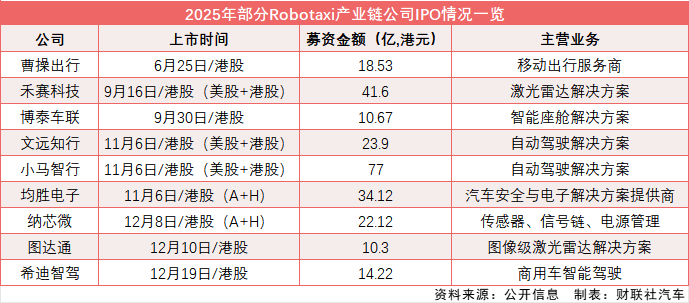
ROBO+赛道热火重燃!九家产业链公司港股敲钟 募资金额超200亿
Xin Lang Cai Jing· 2025-12-25 05:16
Core Insights - The competition in the Robotaxi sector is shifting towards commercial ecosystems and profitability as the technology matures, with companies focusing on rapid fundraising for innovation and market expansion [1] - As of December 25, 2025, at least nine companies in the Robotaxi industry chain have completed IPOs in Hong Kong, raising over 20 billion HKD in total [1] - The trend of companies going public in Hong Kong is driven by the need for funding to enhance R&D and to connect with global capital markets [5][6] IPO Overview - Companies that have completed IPOs include: - Cao Cao Mobility: June 25, 2025, raised 1.853 billion HKD [2] - Hesai Technology: September 16, 2025, raised 4.16 billion HKD [2] - Baidu's Apollo: November 6, 2025, raised 2.39 billion HKD [2] - Pony.ai: November 6, 2025, raised 7.7 billion HKD [2] - Others include Junsheng Electronics, Naxin Micro, and others with varying amounts [2] - Companies currently in the IPO pipeline include DeepWay, Mainline Technology, and others, indicating a robust interest in the sector [4] Industry Dynamics - The Robotaxi sector is experiencing a surge in interest due to supportive policies in China, indicating a potential turning point for market growth [5] - Cost remains a critical factor for the commercial viability of Robotaxi services, with significant financing from IPOs providing short-term relief for cash flow pressures [6] - Predictions suggest that advancements in technology will lead to a tenfold increase in computing power for autonomous driving products, facilitating rapid regional expansion [6] International Expansion - Companies like WeRide and Uber are collaborating to launch Robotaxi services in Dubai, highlighting the international competitive landscape [7] - The global competition in smart driving technology is intensifying, with expectations that the period from 2026 to 2030 will see significant advancements and competition in the Robotaxi market [7]
开源证券:半导体释放涨价信号 晶圆厂、存储、模拟有望进入价格上行期
智通财经网· 2025-12-25 01:47
Group 1: Semiconductor Industry Overview - The semiconductor industry is experiencing a price uptrend driven by a surge in AI demand and supply-side capacity shortages [1][2] - Foundries like SMIC and Hua Hong are maintaining high capacity utilization rates, with SMIC's utilization reaching 95.8% and Hua Hong at 109.5% [2] - Price increases are being implemented, particularly in the 8-inch BCD process, with a 10% hike announced by SMIC and World Advanced [2] Group 2: Memory Market Dynamics - The NAND price index has increased by 173% and the DRAM price index by 169% since late July [3] - There is a significant shortage of NAND, with some manufacturers indicating inventory levels that will only last until Q1 2026 [3] - Companies like Beijing Junzheng and Zhaoyi Innovation are adjusting prices for storage and computing chips, with expectations of significant revenue growth in niche DRAM products by H2 2025 [3] Group 3: Analog Chip Market Trends - Major overseas companies like ADI and Texas Instruments have initiated price increases, with ADI planning an average hike of 15% starting February 2026 [4] - The demand for high-power and high-current analog chips is being driven by the recovery in industrial control and automotive sectors, as well as AI data centers [4] - Domestic analog chip manufacturers are expected to benefit from rising demand and prices as the market continues to recover [4] Group 4: Beneficiary Companies - Beneficiary companies in the foundry sector include SMIC and Hua Hong [4] - In the memory sector, companies such as Jiangbolong, Demingli, and Zhaoyi Innovation are highlighted [4] - For the analog sector, companies like Shengbang Technology, Naxin Micro, and Aiwai Technology are noted as potential beneficiaries [4]

纳芯微:逐浪先锋的创“芯”路
Shang Hai Zheng Quan Bao· 2025-12-24 20:11
Core Viewpoint - The article highlights the growth and strategic direction of Naxin Micro, emphasizing its focus on the energy and automotive markets as key areas for development and its recent achievement of becoming the first Chinese analog chip supplier approved by Bosch [3][10]. Group 1: Company Growth and Market Position - Naxin Micro has captured nearly one-third of the domestic analog chip market in the energy sector and close to 50% market share in automotive three-electric systems [3]. - The company achieved revenue exceeding 8 million yuan and a net profit of over 1 million yuan within its first year of operation [2]. - By 2025, 52% of Naxin Micro's revenue is projected to come from the energy market, while 34% will come from the automotive electronics market, demonstrating the effectiveness of its strategic planning [5][6]. Group 2: Strategic Focus and Market Opportunities - In 2020, Naxin Micro identified energy and automotive markets as relatively untapped opportunities, diverging from the crowded consumer electronics sector [5]. - The company aims to maintain a strategic focus on these two markets while also exploring smart terminal markets such as robotics and smart appliances [6]. Group 3: Mergers and Acquisitions - Naxin Micro acquired the magnetic sensor company Maigen, enhancing its product offerings and application scenarios across automotive, industrial, and consumer electronics sectors [7]. - The acquisition is seen as a synergistic move, with the integration of Maigen expected to significantly bolster Naxin Micro's core capabilities [7]. Group 4: Industry Trends and Future Outlook - The semiconductor industry is undergoing a significant reshaping, with a predicted period of consolidation and increased competition [8]. - Naxin Micro is committed to technological innovation and collaboration with leading clients to enhance its competitive edge in the semiconductor market [8][9]. Group 5: Global Expansion and Capital Market Activities - Naxin Micro successfully completed its "A+H" dual capital platform setup, marking its transition from a China-focused company to a global player [10]. - The company plans to allocate 25% of the funds raised from its Hong Kong IPO to expand its overseas sales network and market promotion [10].
深圳华强(000062) - 2025年12月24日投资者关系活动记录表
2025-12-24 11:36
Group 1: Storage Business Insights - The company is a leading authorized distributor of electronic components in China, with a significant product line that includes storage products. The total shipment of storage products in the first three quarters of this year saw a substantial year-on-year increase [2] - The current round of storage price increases is driven by strong procurement demand from AI infrastructure and a shift in original manufacturers' capacity towards high-end storage. It is widely expected that this price increase will continue until 2026, although the exact duration remains to be observed [2] Group 2: Domestic Analog Chip Business - The company has established long-term partnerships with most major domestic analog chip manufacturers, distributing approximately 50 product lines, including but not limited to brands like Naxin Micro, Saimicro, and Aiwai Electronics. The types of analog chips include signal chain chips, power management chips, and RF front-end chips, widely used in consumer electronics, automotive electronics, new energy, industrial control, and IoT [3] Group 3: Growth in Electronic Component Demand - AI development is the core driver of electronic component demand growth currently and in the future. The acceleration of AI technology iterations and the rapid advancement of new infrastructure such as cloud computing and data centers are leading to sustained demand growth in areas like AI servers and data center power supplies. The company's collaboration scale with clients in these fields has also maintained a growth trend in the first three quarters of this year [3]
