
重庆百货

Search documents
重庆百货(600729) - 重庆百货大楼股份有限公司2025年半年度经营数据公告
2025-08-27 08:51
证券代码:600729 证券简称:重庆百货 公告编号:临 2025-032 根据《上海证券交易所上市公司自律监管指引第 3 号——行业信息披露》第 四号——零售和《关于做好主板上市公司 2025 年半年度报告披露工作的重要提 醒》的要求,重庆百货大楼股份有限公司(以下简称"公司")将 2025 年半年 度主要经营数据披露如下: 1 / 2 单位:数量:个,面积:万平方米 地区 经营 业态 年初数 新增 关闭 本期余额 数量 建筑 面积 数量 变动时间 建筑 面积 数量 变动时间 建筑 面积 数量 建筑 面积 重庆 地区 百货业态注 1 42 99.20 42 99.20 超市业态 143 67.48 2 2025.01.01 2025.05.31 0.46 1 2025.05.12 0.66 144 67.28 电器业态 42 16.53 42 16.53 汽贸业态 33 10.16 1 2025.01.01 0.05 34 10.21 四川 地区 百货业态 8 21.78 8 21.78 超市业态 5 2.29 5 2.29 小计 273 217.44 3 0.51 1 0.66 275 217.29 一、 ...

邀请函|“新消费时代”:国泰海通证券2025消费品年会
国泰海通证券研究· 2025-08-26 13:34
国泰海通证券 | 研究所 葡 12-5 国泰海通证券2025消费品年会 2025年 9月2日-3日 上海 · 金茂君悦大酒店 联席首席分析 联席首席分 织服装 在线上游戏即时 7越田 杜服 家用电器 以用相 *议程内容更新于2025年8月25日15:40 9月2日上午 · 主会场 | 09:00-09:10 开场致辞 | | | --- | --- | | | 陈忠义 - 国泰海通证券副总裁、研究与机构业务委 | | | 员会总裁、政策和产业研究院院长 | | 09:10-09:40 | 长寿时代消费趋势 | | | 张教授-复旦大学人口研究所所长 | | 09:40-10:10 | 国货美妆如何逆袭? | | | 舒总-美妆商业评论主理人 | | 10:10-10:40 | 功能性保健品时代 | | | 杨总-仙乐健康董事 | | 10:40-11:10 | 超市调改解读与展望 | | | 知名超市专家 | | 11:10-12:00 | 圆桌论坛 | | | 新消费时代 | | | 警 猛-研究所所长助理、消费组长、食品饮料/美护 | | | 首席分析师 | | | 新消费持续高景气,强政策推动大机会 | ...


【策略专题】自由现金流资产系列13:现金流指数为何今年偏弱,往后会强吗?
Huachuang Securities· 2025-08-22 09:07
Group 1 - The cash flow index has shown weak performance since 2025, primarily due to the profit fluctuations in the coal and petrochemical industries leading to valuation adjustments [13][16][36] - Value strategies should not only focus on the level of ROE but also on the stability of ROE to enhance returns and avoid volatility caused by declining performance [13][24] - The Huachuang strategy's free cash flow combination has achieved a cumulative return of 31% from April 2024 to August 2025, outperforming benchmarks such as the CSI 300 and the national cash flow index [10][13][31] Group 2 - The cash flow index has underperformed relative to the dividend index mainly due to the absence of bank sector contributions, which has been a significant drag on returns [36][37] - The cash flow index tends to favor large-cap stocks due to its weighting methodology, which contrasts with the dividend index that benefits more from small-cap stocks during favorable market conditions [37][38] - Expectations of a return to inflation could lead to the cash flow index outperforming both the dividend index and the broader market, as historical patterns suggest that cash flow indices have performed well during periods of inflation recovery [38][39]
中国超市百强榜洗牌:盒马领跑前三,胖东来服务佳却居19位
Sou Hu Cai Jing· 2025-08-22 08:27
Core Insights - The sales revenue of China's top 100 supermarket companies reached approximately 900 billion RMB, reflecting a slight growth of 0.3%, while the total number of stores decreased significantly by 9.8% to 25,200 stores, indicating transformation challenges in the supermarket industry due to diversified consumer trends and e-commerce impacts [1] - Only 14 companies achieved both sales and store number growth, showcasing a stark polarization in performance within the industry [1] - Notable companies in the lower half of the ranking include Chongqing Department Store, Costco (China), Tianhong Digital Technology, Pang Donglai, and Beiguo Mall, with Pang Donglai achieving sales of approximately 8.094 billion RMB and 12 stores, recognized for its exceptional customer service [1] Group 1 - The top ten companies include Walmart (China), RT-Mart, Hema, Yonghui Superstores, and Wumart, with Walmart leading at a sales scale of 158.84 billion RMB and 334 stores [4][5] - Hema's innovative business model resulted in a sales revenue of approximately 75 billion RMB and 420 stores, with plans to open nearly 100 new stores in over 50 new cities this year [5] - Lianhua Supermarket achieved sales of approximately 48.64 billion RMB with 3,152 stores, focusing on providing a rich selection of goods and creating a convenient shopping experience [5] Group 2 - Jibai Holdings, Lihua Group, Henan Dazhang, Aeon (China), and Guangzhou Yichulai ranked 11th to 15th, with Jibai Holdings reporting a sales scale of approximately 12.06 billion RMB and 3,179 stores [2] - The performance of the top 100 supermarket companies highlights the competitive landscape, where only a few have successfully adapted to market changes and consumer preferences [1][2]


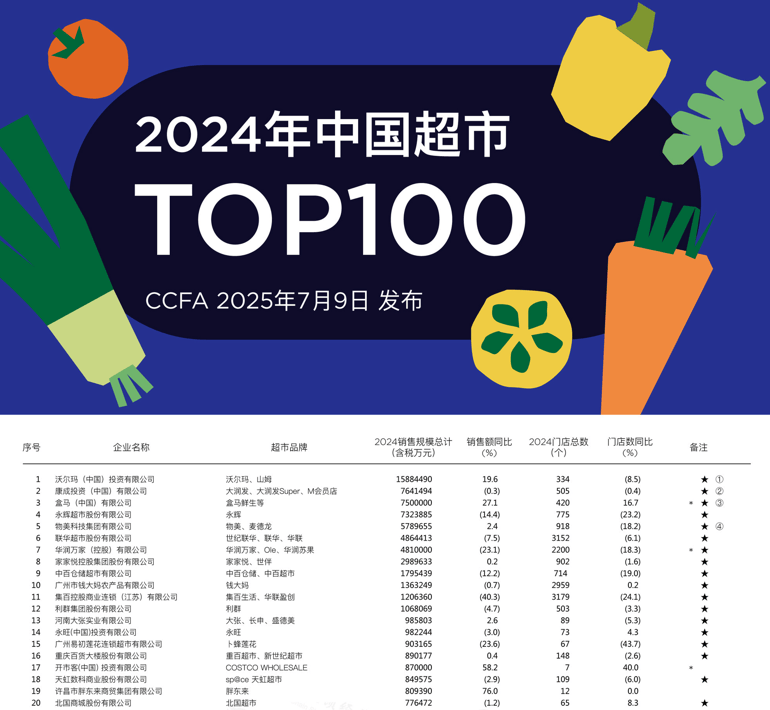
中国超市排行榜大变局:盒马跻身前三,胖东来服务赢口碑却排19
Sou Hu Cai Jing· 2025-08-21 15:26
Industry Overview - The sales scale of China's top 100 supermarket companies reached approximately 900 billion yuan, achieving a year-on-year growth of 0.3%, while the total number of stores declined by 9.8% to 25,200 stores, indicating transformation pressures in the supermarket industry amid diversified consumer markets and e-commerce impacts [1] - Only 14 companies in the top 100 list achieved both sales and store number growth, highlighting a significant performance divergence among companies in the industry [1] Company Performance - In the latter half of the top 100 list, Chongqing Department Store, Costco (China), Tianhong Digital Technology, Pang Donglai, and Beiguo Mall ranked 16th to 20th, with Pang Donglai achieving annual sales of approximately 8.094 billion yuan and operating 12 stores, known for its exceptional customer service [3] - Companies ranked 11th to 15th include Jibai Holdings, Liqun Group, Henan Dazhang Industrial, Aeon (China), and Guangzhou Yichu Lianhua, with Jibai Holdings reporting an annual sales scale of approximately 12.064 billion yuan and operating 3,179 stores, demonstrating strong market coverage [3] - The top ten companies include Lianhua Supermarket, China Resources Vanguard, Jiajiayue, Zhongbai Warehouse, and Qian Dama, with Lianhua Supermarket achieving annual sales of approximately 48.644 billion yuan and operating 3,152 stores, focusing on providing convenient shopping services [3] Sales Data - Walmart (China) leads with a sales scale of 158.8449 billion yuan, a year-on-year increase of 19.6%, operating 334 stores, despite a store number decline of 8.5% [5] - Other top performers include RT-Mart with sales of 76.41494 billion yuan, a slight decline of 0.3%, and Hema with sales of 75 billion yuan, showing a significant growth of 27.1% and an increase in store count by 16.7% [5] - Hema plans to open nearly 100 new stores and enter over 50 new cities within the year, reflecting confidence in the domestic consumption market [5]
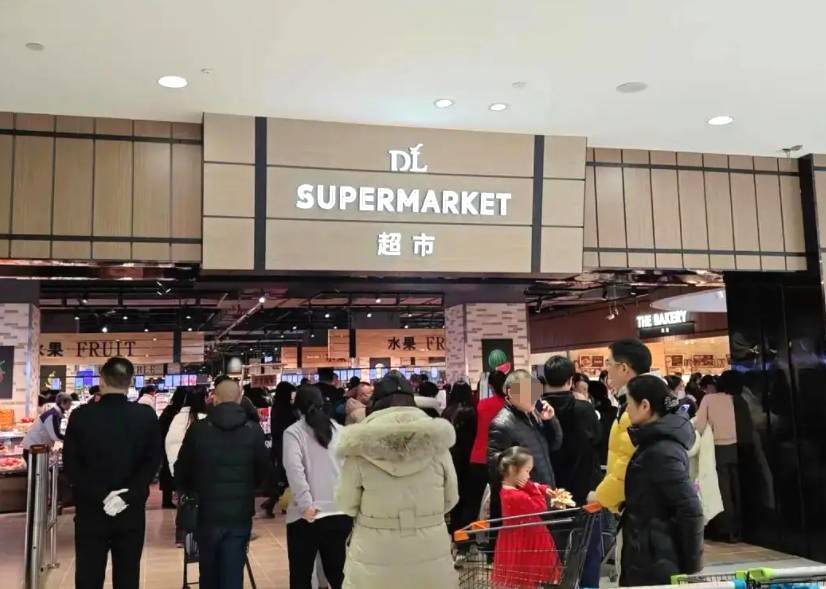
中国超市排名大洗牌!盒马冲进前三,胖东来服务再好也难进前十?
Sou Hu Cai Jing· 2025-08-21 11:30
Core Insights - The sales scale of China's top 100 supermarket companies reached approximately 900 billion yuan, with a year-on-year growth of 0.3%, while the total number of stores decreased by 9.8% to 25,200, indicating transformation challenges in the supermarket industry due to diversified consumer markets and e-commerce impacts [1][3] Group 1: Company Performance - Among the top 100 companies, 42 achieved positive sales growth, but only 25 increased their store numbers, with only 14 companies achieving both sales and store growth [1] - Walmart (China) led the list with a sales scale of 158.84 billion yuan and 334 stores, showcasing its strong supply chain and brand influence [5] - Hema (盒马) emerged as a strong competitor, achieving sales of approximately 75 billion yuan with 420 stores, demonstrating rapid growth and innovative strategies [6] Group 2: Operational Strategies - Some companies optimized resource allocation by closing underperforming stores and focusing on enhancing the service quality of core stores, such as Fat Donglai Supermarket, which is known for its exceptional service [3] - Companies like Jibai Holdings and Lihua Group displayed solid performance through stable operational strategies, with Jibai achieving a sales scale of approximately 12.06 billion yuan and 3,179 stores [3][5] Group 3: Market Trends - The overall decline in store numbers reflects the industry's adaptation to changing consumer preferences and the competitive landscape influenced by e-commerce [1] - The significant performance disparity among companies highlights the importance of precise market positioning, innovative business strategies, and superior service quality in navigating the competitive environment [1][3]
胖东来等商超发力自有品牌谋突围
Zheng Quan Ri Bao· 2025-08-18 16:10
Group 1 - The retail industry consensus is to break through with private labels, as seen in various companies like Budonglai and Hema Fresh [1] - Companies like Bubu Gao reported a net profit of 201 million yuan in the first half of the year, turning losses into profits by implementing a private label strategy [1] - Hongqi Chain achieved a net profit of 281 million yuan, a year-on-year increase of 5.33%, by diversifying its product matrix and expanding its private label offerings [1] Group 2 - Baoyuezhong from Baum Consulting emphasized that developing private labels helps retailers form differentiated competitive advantages and transition from price competition to value competition [2] - Zhongbai Holdings introduced over 300 new private label products, while Chongqing Department Store's private label "Baoyuantong" generated 15 million yuan in sales from four stores [2] - Xinhua Department Store is expanding its private label range to reduce costs and improve sales margins through direct sourcing and joint farming [2] Group 3 - The development of private labels is seen as beneficial for the overall growth of the retail industry, enhancing profit margins and supply chain efficiency [2] - However, challenges such as product homogeneity, quality issues, and lack of innovation have emerged, impacting consumer experience and industry health [2] - Baoyuezhong advised that retailers should avoid blindly following trends and instead focus on positioning and developing a systematic approach to private label creation [3]


7月社会零售品消费数据点评:7月社零同比+3.7%,线上消费渗透率持续提升
Shenwan Hongyuan Securities· 2025-08-17 14:22
Investment Rating - The industry investment rating is "Overweight" indicating a positive outlook for the sector compared to the overall market performance [11]. Core Insights - In July 2025, the total retail sales of consumer goods increased by 3.7% year-on-year, which was below market expectations. The total retail sales reached 3.9 trillion yuan, with a month-on-month decline of 1.1 percentage points [5]. - Online retail sales and penetration rates have significantly increased due to enhanced subsidies from instant retail platforms. The online retail sales for the first seven months of 2025 grew by 9.2% year-on-year, surpassing the overall retail growth rate [5]. - The report highlights a divergence in domestic consumption performance, with sectors like instant retail benefiting significantly, while the restaurant sector continues to face pressure [5]. Summary by Sections Retail Sales Performance - July 2025 saw a 3.7% year-on-year increase in retail sales, lower than the expected 4.9%. Excluding automobiles, retail sales grew by 4.3% [5]. - The retail sales of goods in July reached 3.4 trillion yuan, with a year-on-year growth of 4.0% [5]. Online and Offline Retail Trends - Online retail sales in July amounted to 959.9 billion yuan, with a year-on-year growth of 8.3% and a month-on-month increase of 3.6% [5]. - The online penetration rate reached 24.8%, up from 23.7% in the previous year [5]. Consumer Goods and Services - The report notes a significant increase in the sales of daily consumer goods, with categories like communication and food seeing growth rates of 14.9% and 8.6% respectively [5]. - The restaurant sector's growth remains low, with July's revenue at 450.4 billion yuan, reflecting a year-on-year increase of only 1.1% [5]. Investment Recommendations - The report recommends focusing on e-commerce and instant retail sectors, highlighting companies like Alibaba, JD.com, and Meituan as key players [5]. - It also suggests investing in quality gold and jewelry brands, as well as companies in the travel industry that are expected to benefit from the summer tourism season [5].
2025年7月社零数据点评:社零同比增长3.7%,主要可选消费品增长稳健
Guoxin Securities· 2025-08-17 04:56
Investment Rating - The investment rating for the retail industry is "Outperform the Market" (maintained) [3][17]. Core Viewpoints - In July 2025, the total retail sales of consumer goods reached 38,780 billion, with a year-on-year growth of 3.7%. Excluding automobiles, the growth was 4.3% [4][5]. - The growth trend in retail sales continues, with goods retail growing by 4% and catering income increasing by 1.1% in July [4][5]. - For the first seven months of 2025, the total retail sales amounted to 284,238 billion, reflecting a growth of 4.8% [5]. Summary by Relevant Sections Retail Sales Performance - In July 2025, essential goods maintained steady growth, with categories such as grain and oil, tobacco and alcohol, and daily necessities growing by 8.6%, 2.7%, and 8.2% respectively. In the optional category, cosmetics, gold and jewelry, and clothing grew by 4.5%, 8.2%, and 1.8% respectively [4][8]. - The online retail sales for the first seven months of 2025 increased by 9.2%, with physical goods online retail sales growing by 6.3%, accounting for 24.9% of total retail sales [8]. Future Outlook and Investment Suggestions - The report anticipates that domestic policies focusing on stimulating consumption and countering supply-side issues will create a favorable environment for future consumption recovery [4][11]. - Recommendations for long-term investment opportunities include: 1. Cross-border expansion: With improving external trade conditions, companies like Xiaogoods City, Focus Technology, and Anker Innovation are highlighted [4][11]. 2. Gold and jewelry: Companies such as Chao Hong Ji, Chow Tai Fook, and Cai Bai Co. are expected to benefit from high gold prices and consumer demand [4][11]. 3. Beauty and personal care: Brands like Shiseido, Dengkang Oral Care, and Shanghai Jahwa are positioned to gain market share due to domestic product replacement [4][11]. 4. Traditional retail: Companies like Chongqing Department Store and Miniso are noted for their potential in improving performance and being undervalued [4][13].
商贸零售行业点评报告:7月社零同比+3.7%,金银珠宝和化妆品环比改善
KAIYUAN SECURITIES· 2025-08-15 10:41
Investment Rating - The industry investment rating is "Overweight" [8] Core Viewpoints - The report indicates that social retail sales maintained steady growth, with a year-on-year increase of 3.7% in July, supported by national subsidies [3][4] - Essential categories like grain, oil, and food showed stronger resilience, while discretionary categories such as gold and jewelry, and cosmetics saw improved performance [4] - Online retail channels continued to grow, with a 9.2% year-on-year increase in online retail sales from January to July 2025, while offline retail growth showed signs of marginal slowdown [5] Summary by Sections Social Retail Sales - The total retail sales of consumer goods from January to July 2025 reached 28,423.8 billion yuan, with July sales at 3,878 billion yuan, reflecting a year-on-year growth of 4.8% and 3.7% respectively [3] - Urban and rural retail sales increased by 4.8% and 4.7% year-on-year [3] Price Factors - The overall Consumer Price Index (CPI) remained stable, with food CPI down by 1.6% year-on-year [4] - Retail sales in various categories showed different growth rates, with essential goods like grain and oil up by 8.6% year-on-year, while discretionary items like cosmetics and jewelry saw increases of 4.5% and 8.2% respectively [4] Online vs Offline Channels - Online retail sales reached 86,835 billion yuan from January to July 2025, with physical goods online sales at 70,790 billion yuan, accounting for 24.9% of total retail sales [5] - Offline retail growth rates for supermarkets, convenience stores, and department stores showed a slight decline compared to the previous month [5] Investment Recommendations - The report suggests focusing on high-quality companies in sectors aligned with "emotional consumption," particularly in gold jewelry, offline retail, cosmetics, and medical aesthetics [6] - Specific recommendations include brands like Lao Pu Gold and Chao Hong Ji in gold jewelry, and companies like Mao Ge Ping and Pechoin in cosmetics [6]