
阿特斯

Search documents
光伏龙头ETF、光伏ETF嘉实、光伏ETF、光伏ETF基金涨超2%,头部硅片企业联合大幅上调报价
Ge Long Hui A P P· 2025-12-26 05:28
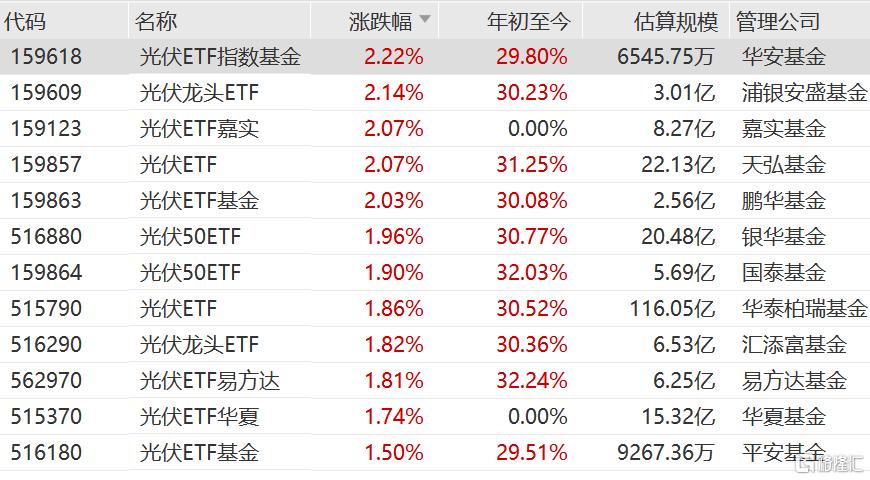
Core Viewpoint - The photovoltaic industry is experiencing significant price increases in silicon wafers and components, driven by strong pricing power and a shift towards higher quality production, with expectations for improved profitability in 2026 [2][3][5] Group 1: Market Performance - Several leading photovoltaic companies, including GCL-Poly, Junda, and Sungrow, saw their stock prices surge, with GCL-Poly and Junda hitting the daily limit, while others like LONGi Green Energy and Trina Solar also experienced notable gains [1] - Various photovoltaic ETFs, such as the Photovoltaic ETF Index Fund and Photovoltaic Leader ETF, reported increases of over 2%, with year-to-date performance showing significant growth, e.g., the Photovoltaic ETF has risen by 31.25% [2] Group 2: Price Trends - Major silicon wafer manufacturers have collectively raised their prices, with 183N wafers priced at 1.4 yuan per piece and 210N wafers at 1.7 yuan per piece, reflecting an average increase of 12% [2] - The average transaction price for N-type G10L single crystal silicon wafers increased by 2.56% week-on-week, while N-type G12R wafers saw a 9.17% rise [3] Group 3: Industry Outlook - The photovoltaic industry has faced a continuous loss trend for eight consecutive quarters, with a projected 33% workforce reduction in 2024, leading to an increase in average interest-bearing debt ratio from 23% to 31% [4] - The industry is undergoing a transition from rapid capacity expansion to a focus on quality and efficiency, necessitating technological upgrades and cost control to manage raw material price fluctuations [4] - The "anti-involution" policy is being implemented to facilitate the orderly exit of outdated capacities and ensure the stable continuation of high-quality production [5]

储能与锂电2026年度策略:能源转型叠加AI驱动,周期反转步入繁荣期
2025-12-26 02:12
Summary of Key Points from the Conference Call Industry Overview - The conference call focuses on the energy storage and lithium battery industry, highlighting the expected growth and transformation driven by energy transition and AI demand [1][2][3]. Core Insights and Arguments - **AI and Energy Storage Demand**: The demand for energy storage in data centers is expected to surge due to the rapid increase in AI computing power and the slow expansion of the power grid in Europe and the US. By 2026, the AI-related energy storage demand in the US is projected to reach 59 GWh, with 46 GWh for front-of-the-meter and 13 GWh for behind-the-meter applications [1][2][11]. - **Shift in Data Center Energy Needs**: Data centers are transitioning from using energy storage primarily as backup power to utilizing it for peak shaving, frequency regulation, and grid support. Current requirements include at least 2 hours of storage, with some aggressive setups using lithium batteries for 6-8 hours of power [4]. - **Global Energy Storage Market Growth**: The global energy storage market is expected to reach 438 GWh by 2025, with China accounting for 250 GWh, reflecting a 67% year-on-year growth. The US market is projected to reach 70 GWh, and Europe 51 GWh [7][8]. - **Impact of US Trade Policies**: The US "Inflation Reduction Act" has introduced new standards that limit foreign ownership in companies participating in subsidy programs, pushing the US market to seek supply chains outside of China, although reliance on Chinese supply chains will remain high in 2026 [6][11]. Additional Important Insights - **European Net Zero Industrial Act**: This act encourages the use of local production capacities and scores non-EU supply chains, benefiting Chinese companies establishing factories in Europe. The cost of solar plus storage has fallen below that of gas turbines, leading to an expected installation growth rate of over 70% in 2026 [3][10]. - **Lithium Battery Industry Recovery**: The lithium battery industry is in a recovery phase, with expected shipment growth of 30-50% in 2026. The industry is projected to enter a prosperous phase, with a 25% overall growth rate, driven by a 15% increase in power demand and a 56% increase in storage demand [3][22]. - **Emerging Markets**: Regions such as Australia, the Middle East, and Latin America are showing strong growth potential in energy storage, with Australia increasing its capacity targets and significant projects underway in the Middle East and Chile [12][13]. - **Supply Chain Dynamics**: The supply chain for lithium battery materials is expected to see significant price increases, particularly in lithium hexafluorophosphate and separators, which are crucial for battery production. The current market conditions suggest a tight balance in supply and demand for these materials [27][29]. Recommendations for Investment - Companies to watch include CATL, EVE Energy, and Xinwangda, which are positioned well in the energy storage and lithium battery markets. The separator sector is also highlighted as a key area for investment due to its high profit margins and limited new capacity until 2028 [24][25]. This summary encapsulates the critical insights and projections discussed during the conference call, providing a comprehensive overview of the energy storage and lithium battery industry's current state and future outlook.



阿特斯股价涨5.03%,富国基金旗下1只基金重仓,持有54.08万股浮盈赚取42.72万元
Xin Lang Cai Jing· 2025-12-26 01:58
Group 1 - The core viewpoint of the news is that Arctech has seen a stock price increase of 5.03%, reaching 16.50 CNY per share, with a trading volume of 598 million CNY and a turnover rate of 2.74%, resulting in a total market capitalization of 60.112 billion CNY [1] Group 2 - Arctech is a major global manufacturer of photovoltaic modules, established on July 7, 2009, and listed on June 9, 2023. The company's main business includes the research, production, and sales of crystalline silicon photovoltaic modules, as well as extending into photovoltaic application solutions [2] - The revenue composition of Arctech's main business includes: 68.22% from photovoltaic module products, 21.04% from energy storage system products, 6.05% from photovoltaic system products, 2.57% from construction contracts, and 2.12% from other income [2] Group 3 - According to data from the top ten holdings of funds, one fund under the Fortune Fund has a significant position in Arctech. The Fortune SSE Sci-Tech Innovation Board New Energy ETF (588960) increased its holdings by 216,100 shares in the third quarter, holding a total of 540,800 shares, which accounts for 5.25% of the fund's net value, making it the fourth-largest holding [3] - The Fortune SSE Sci-Tech Innovation Board New Energy ETF (588960) has a total asset size of 1.38 billion CNY and has achieved a return of 34.69% since its inception on February 6, 2025 [3]

研判2025!中国光伏检测设备行业相关政策、发展现状、企业分析及未来前景展望:光伏产业供过于求,导致行业内企业业绩短期承压[图]
Chan Ye Xin Xi Wang· 2025-12-26 01:17
Core Viewpoint - The photovoltaic testing equipment industry is experiencing rapid growth driven by the expansion of photovoltaic cell and module production capacity, leading to increased demand for testing equipment and higher quality standards in production processes [1][3][6]. Industry Overview - Photovoltaic testing equipment is essential for assessing the performance, quality, safety, and reliability of photovoltaic components and systems, playing a crucial role in the development of the photovoltaic industry [3][4]. - The market size of China's photovoltaic testing equipment industry is projected to reach 2.101 billion yuan in 2024, representing a year-on-year increase of 4.9% [1][7]. Industry Policies - Recent government policies have been implemented to promote the development of the photovoltaic industry, including guidelines for updating and replacing equipment to improve efficiency standards [4][6]. - The 2024-2025 energy conservation and carbon reduction action plan emphasizes the construction of large-scale photovoltaic bases in desert areas, which will further drive the demand for testing equipment [4][6]. Market Dynamics - The cumulative installed capacity of photovoltaic systems in China increased from 204.2 GW in 2019 to 886.66 GW in 2024, with new installations rising from 30.1 GW to 277.17 GW during the same period [6]. - The rapid growth in installed capacity is expected to lead to increased demand for testing equipment to ensure quality control and operational efficiency [6][10]. Competitive Landscape - The photovoltaic testing equipment market is dominated by a few large manufacturers from Europe, the United States, and Japan, while domestic companies in China are rapidly improving their technology and quality [8][9]. - Key players in the Chinese market include Shanghai Optoelectronics Technology Co., Ltd., Shenzhen Huashengchang Technology Co., Ltd., and others, with varying performance and revenue trends [8][9]. Development Trends - The industry is moving towards greater automation and intelligence in testing processes, integrating visual defect detection systems to enhance production efficiency and reduce labor costs [10][11]. - As the focus shifts from quantity to quality, there is an increasing demand for high-performance testing equipment, prompting continuous technological innovation within the industry [11]. - Global expansion is accelerating, with Chinese companies establishing production bases in Southeast Asia and the Middle East to meet international market demands and comply with global testing standards [12].



中金:2026光伏需求有望修复 储能迎海内外景气共振
智通财经网· 2025-12-24 07:41
Core Viewpoint - The photovoltaic industry chain is expected to gradually bottom out and improve by the second half of 2025, aided by anti-involution measures, although financial improvements may slow market clearing, making the continuation of anti-involution essential [1] Group 1: Industry Outlook - The photovoltaic demand is anticipated to recover in the latter half of the 14th Five-Year Plan due to enhanced energy storage capacity and the need for market-oriented adjustments in the domestic electricity market [1] - The global energy transition is driving strong demand for energy storage, with a projected growth rate of nearly 50% for new installations in 2026, fueled by domestic policies and decreasing costs [2] Group 2: Market Dynamics - A decline in domestic installations is expected to lead to profit differentiation among glass glue film companies, with those having overseas clients likely to increase export ratios and profit margins [3] - The high silver prices are promoting the industrialization of silver-copper paste, while auxiliary material companies are actively seeking second growth curves in sectors like semiconductors and storage [3] Group 3: Valuation and Recommendations - Current valuations for major companies in the main industry chain are at historical low levels of 1xP/B to 2.5xP/B, with potential for performance recovery and sector opportunities as demand improves in 2Q26 [4] - Recommended stocks include: 1) Quality large-scale storage and industrial storage companies such as Canadian Solar (688472.SH), Shangneng Electric (300827.SZ), and others [4] 2) High-power module manufacturers like JinkoSolar (688223.SH) and Aiko Solar (600732.SH) [4] 3) Silicon material companies such as GCL-Poly Energy (03800) and Tongwei Co., Ltd. (600438.SH) [4] 4) Optimized players like Xinyi Solar (00968) and Flat Glass Group (601865.SH) [4] 5) Companies with new product launches like Dike Co., Ltd. (300842.SZ) and Juhe Materials (688503.SH) [4]


金元证券每日晨报-20251224
Jinyuan Securities· 2025-12-24 05:30
Core Insights - The report highlights a significant growth in the U.S. GDP for Q3, with an annualized quarter-on-quarter increase of 4.3%, surpassing market expectations of 3.3% [9] - The consumer confidence index in the U.S. has declined for the fifth consecutive month, dropping from 92.9 to 89.1, indicating growing pessimism about the labor market and business environment [10] - The report notes a strong performance in the semiconductor sector, contributing to mixed results in European markets, with the DAX index rising by 0.23% [11] International Market Overview - U.S. stock indices recorded gains, with the Dow Jones increasing by 0.16% to 48,442.41 points, and the S&P 500 rising by 0.46% to 6,909.79 points [11] - The Hang Seng Index in Hong Kong fell by 0.11% to 25,774.14 points, while the Nikkei 225 in Japan saw a slight increase of 0.02% to 50,412.87 points [11] - The Nasdaq China Golden Dragon Index decreased by 0.58%, reflecting a downward trend in Chinese concept stocks [13] Domestic News - The offshore RMB has strengthened, surpassing the 7.02 mark against the USD for the first time since October 2024, driven by a weakening dollar index and year-end settlement demands [12] - President Xi Jinping emphasized the need for state-owned enterprises to focus on core responsibilities and enhance technological capabilities [12] - China's electric vehicle charging infrastructure reached 19.32 million units by the end of November, marking a 52% year-on-year increase [12] Key Company Developments - Novo Nordisk received FDA approval for Wegovy, the first oral medication for weight management, marking a significant advancement in the obesity treatment market [13] - JD.com reported a theft at its warehouse in France, with over 50,000 electronic devices stolen, valued at approximately €37 million [13] - ByteDance plans to increase its capital expenditure to 160 billion RMB in 2026, focusing on AI infrastructure development [13] Research Recommendations - The report discusses the potential of domestic AI ecosystems, particularly through the launch of the MUSA open-source architecture by Moore Threads, which aims to compete with NVIDIA's CUDA [14] - The performance of the computer industry is under scrutiny, with a recent decline in the industry index, but long-term prospects remain positive due to ongoing support for the AI industry [14]
铂、钯、白银、镍、碳酸锂期货将震荡偏强:黄金、白银、铂、钯、铜期货将创下上市以来新高
Guo Tai Jun An Qi Huo· 2025-12-24 05:27
2025 年 12 月 24 日 黄金、白银、铂、钯、铜期货将创下上市以来新高 铂、 钯、白银、镍、碳酸锂期货将震荡偏强 陶金峰 期货投资咨询从业资格号:Z0000372 邮箱:taojinfeng@gtht.com 【正文】 【声明】 本报告的观点和信息仅供风险承受能力合适的投资者参考。本报告难以设置访问权限,若给您造成不 便,敬请谅解。若您并非风险承受能力合适的投资者,请勿阅读、订阅或接收任何相关信息。本报告不构 成具体业务或产品的推介,亦不应被视为相应金融衍生品的投资建议。请您根据自身的风险承受能力自行 作出投资决定并自主承担投资风险,不应凭借本内容进行具体操作。 【期货行情前瞻要点】 通过宏观基本面分析和黄金分割线、水平线、日均线等技术面分析,预期 2025 年 12 月 23 日期货主力合约行 情走势大概率如下: | 期 | 货 | 主力合 | 趋势 | 阻力位 | 支撑位 | 备注 | | --- | --- | --- | --- | --- | --- | --- | | 品种 | | 约 | | | | | | 股指 | | IF2603 | 偏弱震荡 | 4583 和 4605 点 | 4 ...
京东回应巴黎仓库被盗抢
21世纪经济报道· 2025-12-24 03:11
近年来,京东加速推进"全球织网计划",已在全球23个国家和地区建设了超130个各类型海外 仓,并合法合规运营,京东将持续建设好超级供应链,为广大企业和用户提供高质量的物流服 务。 北京时间12月22日,位于法国巴黎地区的京东仓储遭遇盗抢,京东方面今日回应称,当地警方 已介入调查处理,目前仓库已恢复正常运营,公司关注到相关方面披露的"重大损失数据",与 实际情况有较大出入。 此前有消息显示,当地时间22日,法国警方表示,距离巴黎17公里、中国电商公司京东位于塞 纳-圣但尼省的仓库,超过5万台3C数码设备包括手机、电脑和平板电脑等三十个托盘物品被 盗。窃贼在21日晚至22日凌晨作案,破坏了仓库的监控摄像头,而警报系统也没有正常工作。 京东方面否认了传闻中的被盗数额,但没有提供准确的数字。 记者丨 孔海丽 出品丨21财经客户端 21世纪经济报道 编辑丨江佩佩 见习编辑张嘉钰 有色金属概念大涨,中矿资源涨超6%,现货黄金首次升破4520美元,金饰克价涨到1411元 估值200亿,"中国版Space X"冲刺上市 英伟达涨超3%市值增超9400亿元,阿特斯太阳能下挫近12%,美联储降息概率有变 SFC 21君荐读 编辑 ...


国金证券:能源转型叠加AI驱动 储能周期反转步入繁荣期
Zhi Tong Cai Jing· 2025-12-24 02:48
Core Insights - The global energy storage industry is entering a new growth cycle, with an expected addition of 438 GWh of new installations by 2026, representing a year-on-year growth of 62% [1] - The growth drivers have shifted from solely renewable energy consumption to a combination of "AI computing infrastructure + energy transition demand + grid congestion" [1] - The supply-demand relationship in the industry is significantly improving, transitioning from a destocking phase to a replenishment boom, leading to simultaneous increases in both volume and price in certain segments of the supply chain [1] Regional Insights - China is projected to install 250 GWh by 2026, a year-on-year increase of 67%, with policies shifting from "strong allocation" to "profitability" [2] - The United States is expected to add 70 GWh of installations by 2026, a 35% increase year-on-year, driven by AI [2] - Europe is forecasted to install 51 GWh by 2026, a 55% increase year-on-year, with long-term contracts locking in gigawatt-level demand [2] - Emerging markets are anticipated to add 67 GWh by 2026, a 91% increase year-on-year, with significant growth in Australia, the Middle East, and Chile [2] Technological Developments - AI computing is becoming synonymous with electricity, with energy storage evolving from merely backup power to active supply, addressing voltage fluctuations and serving as a strategic infrastructure for AI data centers [3] - The mismatch between rapid renewable energy generation and slow grid development is intensifying, making energy storage a critical solution for congestion [4] - Solid-state batteries are expected to enter small-scale production by 2026, marking a significant step towards commercialization across various applications [7] Supply Chain and Market Dynamics - The lithium battery supply is expected to recover by 2026 after a two-year destocking phase, driven by sustained high demand from AI and energy storage, while supply expansion slows due to reduced capital expenditure [6] - Trade barriers are increasing, with the U.S. and EU implementing stricter regulations, favoring companies with localized production capabilities [5] Investment Recommendations - Focus on midstream materials that are expected to benefit from supply-demand reversals, particularly lithium fluoride, lithium carbonate, separators, and electrolyte additives [8] - Invest in leading companies with localized manufacturing capabilities and strong ESG frameworks, such as CATL and Sungrow, to capitalize on high-profit markets while mitigating tariff risks [8][9] - Target companies that can integrate into the overseas data center supply chain, providing solar-storage solutions and microgrid systems [9]


能源转型叠加AI驱动,周期反转步入繁荣期 | 投研报告
Zhong Guo Neng Yuan Wang· 2025-12-24 02:02
Core Viewpoint - The global energy storage industry is entering a new growth cycle, with an expected addition of 438 GWh of new installations by 2026, representing a 62% year-on-year increase. The growth drivers have shifted from solely renewable energy consumption to a combination of "AI computing infrastructure, energy transition needs, and grid congestion" [1][2]. Group 1: Global Market Insights - The global energy storage market is expected to see significant improvements in supply-demand dynamics, transitioning from a destocking phase to a replenishment boom, with some segments of the supply chain experiencing simultaneous increases in volume and price [2]. - In China, the expected installation for 2026 is 250 GWh, a 67% increase year-on-year, with policies shifting from "strong allocation" to "profitability" [2]. - In the United States, the anticipated installation for 2026 is 70 GWh, a 35% increase year-on-year, driven by AI-related demand [2]. - In Europe, the expected installation for 2026 is 51 GWh, a 55% increase year-on-year, with long-term contracts locking in gigawatt-level demand [2]. - Emerging markets are projected to install 67 GWh in 2026, a 91% increase year-on-year, with significant growth in Australia, the Middle East, and Chile [2]. Group 2: Technological and Structural Changes - Energy storage is evolving from merely providing backup power to actively supplying electricity, addressing voltage fluctuations, and becoming a strategic infrastructure for AI data centers [3]. - The mismatch between rapid renewable energy generation and slow grid development is intensifying, making energy storage the only immediate solution to grid congestion [3]. - The U.S. is tightening regulations on supply chains, which will favor companies with localized production capabilities, enhancing their pricing power [3]. Group 3: Lithium Battery Supply and Demand - The lithium battery supply is expected to recover in 2026 after a two-year destocking phase, driven by sustained high demand from AI and energy storage, while supply growth slows due to reduced capital expenditures [3]. - The industry is shifting from price wars to collaborative pricing strategies, leading to a recovery in prices and a redistribution of profits towards upstream materials with high barriers to entry [3]. Group 4: Emerging Technologies - The trend towards solid-state batteries is becoming clearer, with expectations for small-scale production by 2026 and advancements in various battery technologies [4]. Group 5: Investment Recommendations - Investment focus should be on midstream materials experiencing supply-demand reversals, particularly lithium fluoride, lithium carbonate, separators, and electrolyte additives [5]. - Companies with localized manufacturing capabilities and strong ESG frameworks, such as CATL and Sungrow, are recommended for their ability to capture high-profit markets while mitigating tariff risks [5]. - Firms that can integrate solar storage and microgrid solutions into overseas data center supply chains, such as Sungrow and Aters, are also recommended [5]. - Attention should be given to core materials and equipment for solid-state batteries, including lithium anodes and dry-process technologies [5].