平安人寿

Search documents
黄金“发疯”众生相:消费者挤爆金店,投资端“大口吃肉”,金饰品销售平淡
Bei Jing Shang Bao· 2026-01-29 16:00
Core Viewpoint - The surge in gold prices, driven by geopolitical conflicts, the impact on the dollar-centric system, and uncertainties from the Trump 2.0 policies, has made gold the dominant asset in financial markets, with prices reaching unprecedented levels [1][24]. Group 1: Gold Price Surge - As of January 29, 2026, international gold prices approached $5,600 per ounce, with a daily increase of over 2.23%, marking a year-to-date rise of over 27% [1][3]. - The price of gold in Beijing's flagship stores rose significantly, with investment gold priced at 1,240.90 yuan per gram and gold jewelry at 1,622 yuan per gram [3][5]. - The price at Cai Bai Jewelry increased from 1,550 yuan per gram to 1,650 yuan per gram, a rise of 6.45%, and from 1,342 yuan per gram at the beginning of January, marking a 22.95% increase [5]. Group 2: Consumer Behavior - Consumers are flocking to gold stores, with wait times for gold buybacks exceeding two hours, indicating a strong demand for both investment and jewelry gold [9][10]. - In Shenzhen's Shui Bei market, the demand for gold jewelry remains high, particularly among young couples preparing for weddings [8][9]. - Retailers are experiencing a shift in focus from gold jewelry to investment gold, as consumers are less inclined to purchase high-priced jewelry due to rising gold prices [16]. Group 3: Supply Constraints - Many banks are facing shortages of physical gold, with reports of "sold out" statuses and the need for appointments to purchase gold products [10][11]. - The supply constraints are attributed to a structural shortage in the global silver market and increased demand driven by rising gold prices and geopolitical uncertainties [13]. Group 4: Industry Impact - Mining companies are benefiting from the price surge, with companies like Zijin Mining reporting a projected net profit increase of 59%-62% for 2025, driven by higher production and sales prices [14]. - Conversely, midstream and downstream companies, particularly those in jewelry manufacturing, are struggling as rising raw material costs suppress consumer demand [15][16]. - The shift in consumer preference from jewelry to investment gold is altering the dynamics of the gold industry, with retailers adapting their strategies accordingly [16]. Group 5: Investment Trends - Gold-related stocks and ETFs are experiencing significant gains, with multiple gold stocks hitting daily limits and ETFs seeing transaction volumes exceeding 10 billion yuan [17][18]. - Investors are showing heightened interest in gold investment products, with many actively seeking to capitalize on the rising prices [19]. - Despite the bullish sentiment, there are concerns about potential market corrections, prompting some investors to adopt a cautious approach [27][28].


斥资近10亿港元!险资掘金港股IPO,看好哪些领域?
Guo Ji Jin Rong Bao· 2026-01-29 13:19
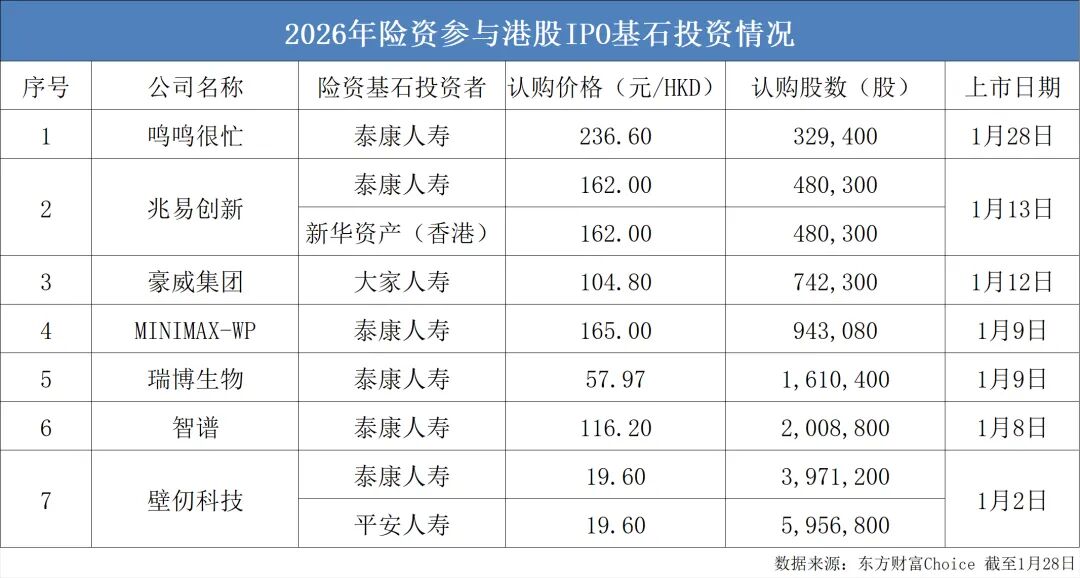
Core Viewpoint - Insurance capital is increasingly participating in Hong Kong IPOs as a response to low interest rates and asset allocation pressures, with significant investments from major insurance firms like Taikang Life and Ping An Life [1][4]. Group 1: Insurance Capital Participation - In 2026, four insurance institutions, including Taikang Life and Ping An Life, have participated in cornerstone investments for seven Hong Kong IPOs, totaling approximately 9.88 billion HKD [1][2]. - Taikang Life has invested a total of 716 million HKD across six IPOs, with individual investments in companies like Mingming Hen Mang and Wallen Technology [3][4]. - Other insurance firms, such as Ping An Life and Xinhua Asset (Hong Kong), have also engaged in cornerstone investments, indicating a broader trend among insurance capital [4]. Group 2: Market Dynamics and Investment Strategy - The shift in insurance capital's participation in Hong Kong IPOs is attributed to a combination of asset allocation pressures and changes in market conditions, with a focus on high-quality, growth-oriented companies [4][5]. - The current environment allows insurance capital to acquire long-term equity assets through IPO participation, which is seen as a more efficient method to gain exposure to the market [5]. - The focus of insurance capital is on sectors like hard technology and new consumption, aligning with national strategic directions and offering potential for long-term returns [6][7]. Group 3: Future Outlook - The trend of insurance capital participating in Hong Kong IPOs is expected to continue in 2026, driven by low interest rates and supportive policies for long-term capital inflow [9]. - Future participation is likely to become more selective, focusing on leading companies and verifiable profit paths, transitioning from broad participation to strategic allocation [9].
平安人寿再度增持中国人寿H股,持股比例升至9.14%
Guo Ji Jin Rong Bao· 2026-01-29 12:48
Group 1 - Ping An Life increased its stake in China Life by acquiring 11.891 million H-shares at an average price of HKD 32.0553 per share, totaling approximately HKD 381 million, raising its holding to 681 million shares, or 9.14% of the total [1] - This is not the first time Ping An Life has increased its stake in China Life, having previously crossed the 5% threshold in August 2025 and continued to accumulate shares thereafter [1] - In addition to China Life, Ping An Life has also increased its holdings in China Pacific Insurance, acquiring 1.7414 million H-shares at an average price of HKD 32.0655, raising its stake from 4.98% to 5.04% [1] Group 2 - The head of non-bank financial industry research at Guosen Securities noted that "insurance stake acquisitions" are based on the logic of expanding dividend assets, indicating three key signals: insurance stocks have medium to long-term valuation recovery potential, enhanced high-dividend strategies, and improved asset-liability linkage efficiency under new standards [2] - Ping An Life's investment strategy extends beyond the insurance sector, having made multiple stake acquisitions in major state-owned banks, including Agricultural Bank and China Merchants Bank, with ownership percentages surpassing 5%, 10%, 15%, and 20% [2] - The co-CEO of China Ping An emphasized the importance of understanding the investment strategy rather than focusing solely on stake acquisitions, highlighting the need for asset-liability matching in their investment approach [2] Group 3 - Ping An Life follows a "three criteria" principle for investments: reliable operations, expected growth, and sustainable dividends, which are core standards for evaluating long-term stock holdings [3] - The demand for insurance stake acquisitions can be categorized into two types: one based on dividend yield focusing on stable cash flow expectations, and the other based on ROE targeting state-owned enterprises with mature profit models [3] - The trend of insurance stake acquisitions is expected to continue into 2026, with ongoing market demand for both types of investment strategies [4]

【财闻联播】飞天茅台,批发价涨至约1600元!泰国新出黄金交易限制措施
券商中国· 2026-01-28 11:29
Macro Dynamics - The first APEC Senior Officials' Meeting in 2026 will be held in Guangzhou from February 1 to 10, marking the first formal event of APEC China Year [2] Energy Sector - By the end of 2025, China's total installed power generation capacity is expected to reach 389 million kilowatts, a year-on-year increase of 16.1%. Solar power capacity will reach 120 million kilowatts, up 35.4%, while wind power capacity will reach 64 million kilowatts, up 22.9% [3] Financial Institutions - China Construction Bank announced the appointment of Tang Shuo as the new vice president, with the approval from the National Financial Regulatory Administration [8] - Ping An Life increased its stake in China Life H-shares to 9.14%, acquiring 11.891 million shares at an average price of HKD 32.0553 per share, totaling approximately HKD 381 million [9] Market Data - On January 28, the A-share market showed mixed results, with the Shanghai Composite Index rising by 0.27% and the Shenzhen Component Index increasing by 0.09%. The total trading volume was approximately CNY 29,654.1 billion, an increase of about CNY 704.29 billion from the previous trading day [10] - As of January 27, the financing balance on the Shanghai Stock Exchange was CNY 1,365.541 billion, a decrease of CNY 12.58 billion from the previous trading day, while the Shenzhen Stock Exchange's financing balance was CNY 1,331.408 billion, down CNY 8.96 billion [11] - The Hong Kong stock market closed with the Hang Seng Index up 2.58% and the Hang Seng Tech Index up 2.53%, with significant gains in gold and real estate stocks [12] Company Dynamics - The wholesale price of Feitian Moutai has risen to approximately CNY 1,600 per bottle, an increase of CNY 35 from the previous day, marking a 7% rise from the recent low of CNY 1,495 [14] - ASML announced a restructuring of its technology and IT departments, potentially resulting in a net reduction of 1,700 jobs, primarily in the Netherlands and some in the United States [15] - Industrial Fulian expects a net profit attributable to shareholders of CNY 35.1 billion to CNY 35.7 billion for 2025, representing a year-on-year increase of 51% to 54% [16] - Hainan Mining is planning to acquire control of Fengrui Fluorine Industry through a combination of share issuance and cash payment, with stock trading suspended starting January 29, 2026 [17]




火力全开!2026开年泰康平安新华等超10亿险资南下,狂扫港股AI、生物医药IPO
Sou Hu Cai Jing· 2026-01-28 03:33
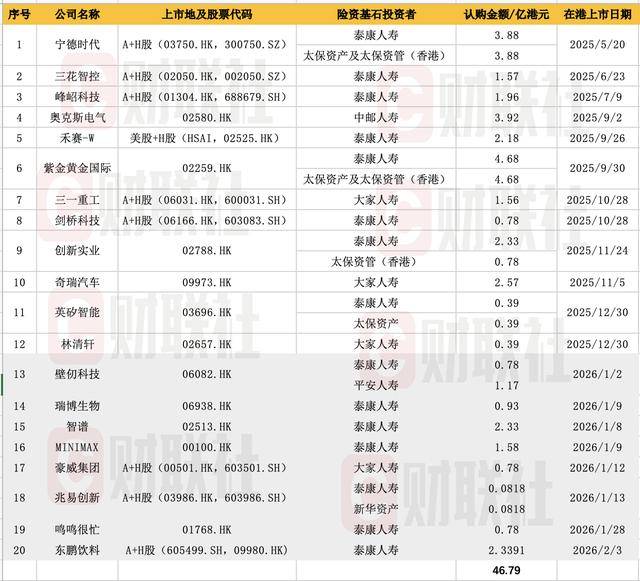
Core Viewpoint - Insurance capital is increasingly participating in cornerstone investments in Hong Kong IPOs, signaling strong market confidence, with significant investments from major insurance companies like Taikang Life and Ping An Life [1][3][4]. Group 1: Investment Trends - In early 2026, four insurance companies participated in eight Hong Kong IPO cornerstone investments, with Taikang Life investing $10 million in the IPO of Mingming Hen Mang [1]. - From 2025 to early 2026, seven insurance institutions participated as cornerstone investors in 20 Hong Kong IPOs, with a total subscription amount of HKD 4.679 billion [1][4]. - The average return for Hong Kong IPOs in 2025 was 38%, with the first-day price drop rate at a five-year low of 23.08% [6][10]. Group 2: Challenges Faced - Insurance companies face challenges in accessing IPO projects due to high entry barriers and the need for strong cross-market research capabilities [2][15]. - The balance between high return potential and net asset value volatility is a significant concern for insurance funds, which are generally risk-averse [2][15]. Group 3: Market Outlook - The IPO fundraising scale in Hong Kong is expected to remain strong in 2026, with insurance capital becoming a long-term force in the market [2][15][16]. - The cornerstone investment mechanism is seen as a key entry point for quality assets in the Hong Kong market, enhancing liquidity and valuation flexibility [2][16]. Group 4: Sector Focus - Insurance capital is focusing on sectors such as AI, biomedicine, and new consumer brands, with a notable interest in companies like MINIMAX and Ruibo Biotechnology [9][10]. - The investment strategy is shifting towards a more diversified valuation framework, moving beyond traditional profit metrics to include growth potential [10][11].
平安人寿增持中国人寿H股,持股比例达到9.14%
Xin Lang Cai Jing· 2026-01-28 02:29
1月27日,联交所最新权益披露资料显示,平安人寿于1月22日在场内以每股均价32.0553港元,增持中 国人寿1189.1万股H股,涉资约3.81亿港元。增持后,最新持股数目为6.81亿股,持股比例由8.98%上升 至9.14%。 ...
招商银行H股年涨32%AH股价倒挂 总资产首超13万亿近八年翻倍增长
Chang Jiang Shang Bao· 2026-01-26 00:55
Core Viewpoint - In 2025, China Merchants Bank reported a slight increase in revenue and net profit, with total assets exceeding 13 trillion yuan for the first time, indicating steady growth despite a decline in return on equity (ROE) [2][8]. Financial Performance - In 2025, the bank achieved operating revenue of 337.53 billion yuan, a year-on-year increase of 0.01% [3][4]. - The net profit attributable to shareholders reached 150.18 billion yuan, reflecting a growth of 1.21% year-on-year [3][4]. - The total profit amounted to 178.99 billion yuan, with a year-on-year increase of 0.19% [3]. Asset Quality - As of the end of 2025, the bank's total assets surpassed 13 trillion yuan, marking a 7.56% increase from the previous year [5][6]. - The non-performing loan (NPL) ratio stood at 0.94%, a decrease of 0.01 percentage points year-on-year, maintaining a level below 1% for five consecutive years [8]. - The provision coverage ratio was 391.79%, down 20.19 percentage points from the previous year, indicating a strong risk mitigation capacity [8]. Return on Equity (ROE) - The ROE for 2025 fell to 13.33%, a decrease of 1.05 percentage points from the previous year, raising concerns among investors [8][9]. - The management acknowledged that the decline in ROE is linked to slower profit growth and net asset growth, emphasizing the importance of maintaining a high ROE for shareholder returns [9]. Market Performance - In 2025, the A-shares and H-shares of China Merchants Bank saw cumulative increases of 13.23% and 32%, respectively [10]. - The bank's A and H share prices were reported at 37.5 yuan and 46.4 HKD, with an AH premium rate of approximately -12%, indicating a rare occurrence of price inversion among A+H listed banks [10]. Dividend Policy - The bank announced its first interim dividend in 2025, totaling 25.55 billion yuan, with a dividend payout ratio of 35.02% [9][10].

百亿级私募再扩容 资金借基入市步伐加快
Shang Hai Zheng Quan Bao· 2026-01-25 14:24
Core Insights - The private equity sector is experiencing significant growth, with an increase in the number of private equity firms reaching the 100 billion yuan threshold, indicating a robust influx of capital into the market [1][2]. Group 1: Expansion of Private Equity Firms - As of January 23, 2026, the number of private equity firms in the 100 billion yuan tier has reached 116, an increase of 3 firms since the end of 2025 [2]. - Seven new or returning firms have joined the 100 billion tier this year, while four firms have exited [2]. - The performance of equity assets has been favorable, with the Shanghai Composite Index stabilizing above the 4100-point mark, contributing to the active fundraising environment for private equity [2]. Group 2: Influx of Long-term Capital - Among the newly added firms, Hengyi Chiying (Shenzhen) Private Equity has rapidly surpassed the 100 billion yuan mark, having started with a management scale of only 0 to 5 billion yuan at the end of 2025 [3]. - Insurance capital is increasingly entering the private equity sector, driven by the ongoing push for long-term investment trials and the need for asset reallocation in a low-interest-rate environment [3]. Group 3: Structural Market Trends - The continuous influx of new capital is expected to support the market's performance throughout the year, with high-net-worth individuals and insurance funds leading the asset reallocation efforts [4]. - The current market conditions are characterized by a gradual and rational approach to asset reallocation, suggesting that the resilience of this market trend may exceed expectations [4]. - The ratio of household deposits to GDP has risen from approximately 0.8 to around 1.2, indicating a significant accumulation of household savings, which may shift towards equity markets as risk-free returns decline [5].
券商App涌现“保险专区”,一线员工已被下派保险销售任务
Nan Fang Du Shi Bao· 2026-01-25 04:49
Core Viewpoint - The recent launch of dedicated insurance sections in the apps of major securities firms marks a significant shift in wealth management strategies, indicating a new phase in the competition among brokerages [2][3][10]. Group 1: Launch of Insurance Sections - Major securities firms such as CITIC Securities, Ping An Securities, and China Merchants Securities have introduced "insurance sections" in their official apps, reflecting a growing focus on insurance products [3][5]. - CITIC Securities' app now features 20 insurance products, including health insurance, life insurance, and annuities, while Ping An Securities offers a wide range of products including health, accident, and pet insurance [3][5]. - The insurance sections are designed to enhance the user experience and provide a comprehensive suite of financial products [2][3]. Group 2: Sales Performance and KPIs - Several brokerage branches in Shenzhen have been assigned specific sales KPIs for insurance products, indicating a push for performance in this new area [9][10]. - Sales targets for individual employees range from 100,000 to 500,000 yuan, but many employees report difficulties in meeting these targets [9][10]. Group 3: Market Context and Expert Insights - The push for insurance product sales by brokerages is seen as a response to the cyclical nature of their traditional revenue streams, with insurance providing a more stable income source [10][12]. - Experts suggest that the integration of insurance products can enhance customer loyalty and lifetime value, positioning brokerages as comprehensive wealth managers rather than just investment advisors [12][14]. - The recent regulatory environment has facilitated this shift, allowing brokerages to expand their offerings and better meet diverse investor needs [11][12]. Group 4: Competitive Landscape - Traditionally, banks have dominated the insurance agency space, but brokerages are leveraging their unique client base, which is more familiar with capital markets, to sell investment-linked insurance products [13][14]. - While brokerages face challenges such as a lack of insurance expertise and service infrastructure, their entry into the insurance market is expected to stimulate innovation and competition within the industry [13][14].


同股不同价 银行A/H股近五月为何分化了
2 1 Shi Ji Jing Ji Bao Dao· 2026-01-15 14:09
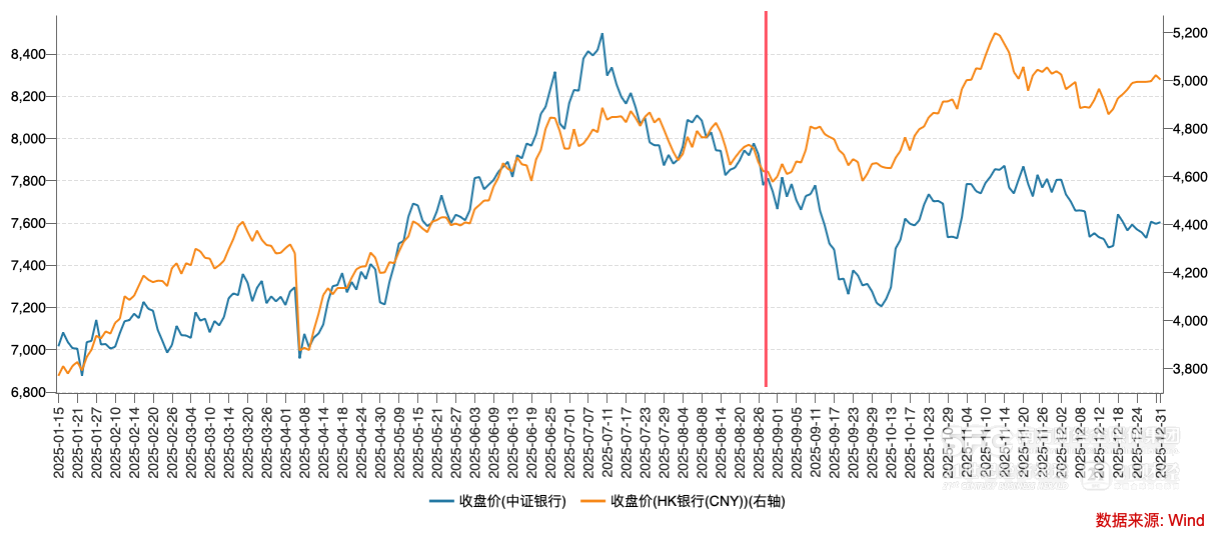
Core Viewpoint - In a low-interest-rate environment, bank stocks are seen as representatives of dividend style investments, offering medium to long-term allocation value due to their high dividend characteristics [1] Group 1: Bank Indices Performance - The main bank indices in A-share and Hong Kong markets include the China Securities Bank Index, the China Securities Hong Kong Bank Index, and the China Securities AH Bank Index [2] - The China Securities Hong Kong Bank Index is expected to significantly outperform the China Securities Bank Index in 2025 [3] - From January 1 to December 31, 2025, the Hong Kong Bank Index recorded a growth of 28.94%, which is substantially higher than the 6.79% increase of the China Securities Bank Index and the 9.60% of the AH Bank Index [4] Group 2: Investment Trends and Fund Flows - In Q3 2025, the Hong Kong banking sector saw significant buying from insurance capital, while the A-share banking sector experienced substantial selling by public funds [10] - The proportion of active equity funds' holdings in A-share banks dropped from 3.91% to 1.49%, with the market value decreasing from 64.1 billion yuan to 30.8 billion yuan [10] - In contrast, insurance capital made 41 significant investments in banks throughout 2025, with 33 of these targeting H-share banks [10] Group 3: Stock Performance and Dividend Yields - The strong performance of the Hong Kong Bank Index is attributed to the notable gains of key stocks such as HSBC Holdings, which rose by 25.53%, and Standard Chartered, which increased by 30.66% [11] - The dividend yield for Hong Kong banks remains above 6%, making them attractive to insurance capital, while A-share banks generally have yields between 3% and 4% [13] - Historical data indicates that buying bank stocks before the Spring Festival has an 80% success rate, with quality joint-stock banks and city commercial banks often yielding excess returns [13] Group 4: Future Outlook - Looking ahead to 2026, insurance capital is expected to remain a significant source of funding, but bank stocks may underperform the broader market in the first quarter due to a growth-oriented market style [15] - The return on tangible equity (ROTE) for Hong Kong banks is projected to slightly decline in 2026, yet the combined return from dividends and buybacks is still expected to exceed 7%, maintaining their investment appeal [15]